
LEAD ANALYST
Utkarsh Khirodkar is a Lead Market Research Analyst at MetaStat Insight, specializing in market intelligence, technology sector assessments, and competitive strategy.

Europe Marketing Analytics Market Size, Share, By Deployment (On-Premise and Cloud), By Application (Social Media Marketing, E-Mail Marketing, Search Engine Marketing, Content Marketing and Others), By Industry Vertical (Retail and E-Commerce, Consumer Goods and FMCG, Banking, Financial Services and Insurance, Media, Entertainment and Publishing, Technology, Software and Telecommunications, Healthcare and Life Sciences, Automotive and Mobility), By Region (United Kingdom, Germany, France, Italy, Spain and Rest of Europe), Industry Analysis, Growth, Trends, and Forecast, 2026-2033
Report ID
MSI-4952
Published
August, 2026
Pages
253 Pages
Format
Historical
Base year
Forecast
Forecast period
Report Details
Choose Your License
Europe Marketing Analytics Market
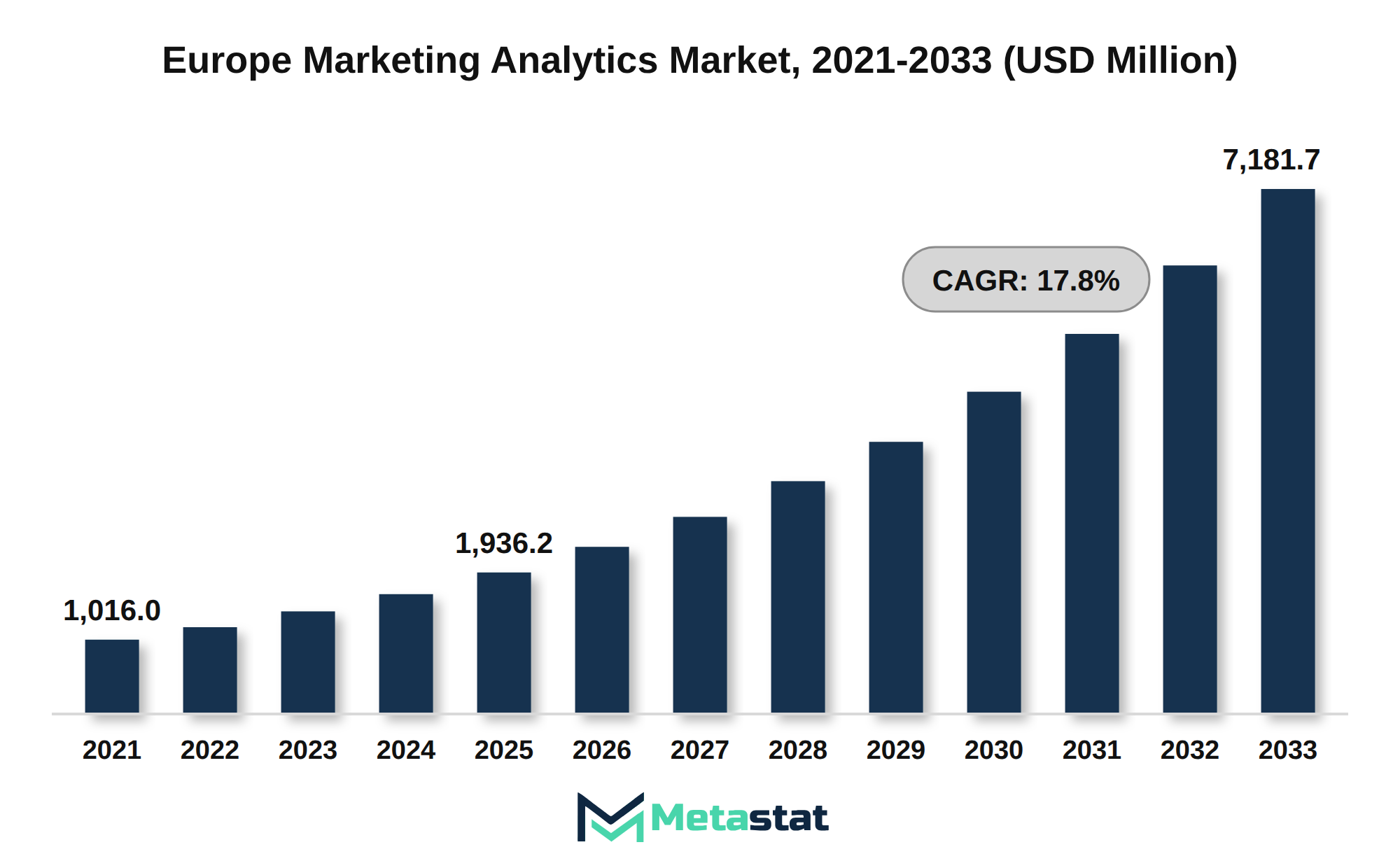
The Europe Marketing Analytics market was valued at USD 1,936.2 million in 2025 and is projected to reach USD 7,181.7 million by 2033, growing at a CAGR of 17.8% over the forecast period.
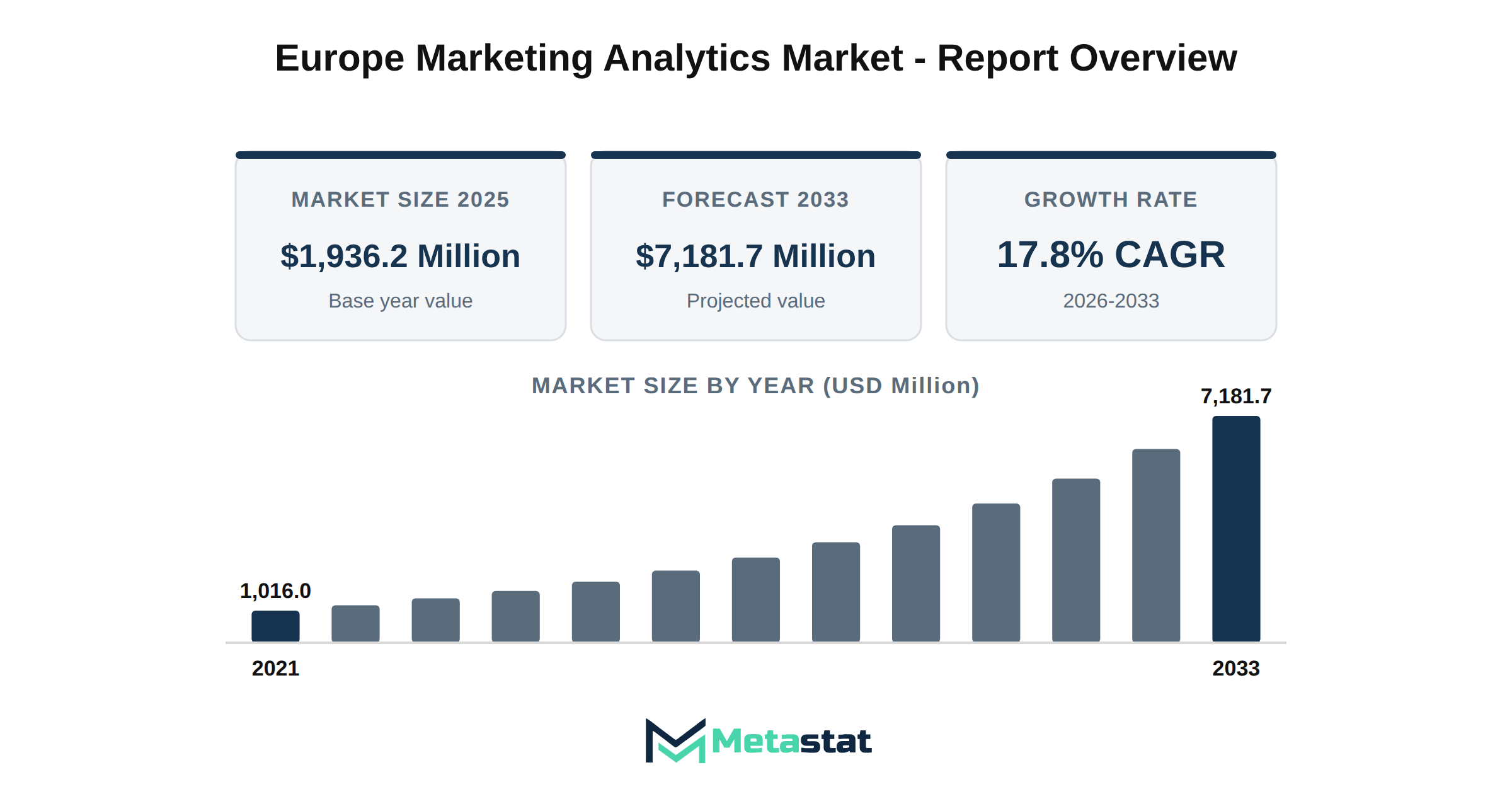
The Europe Marketing Analytics market displayed significant growth from USD 1,016 million in 2021 to USD 1,936.2 million in 2025, reflecting a strong compound annual growth rate (CAGR) of 17.8%. This upward trajectory indicates robust demand for analytics solutions across various sectors, driven by the increasing need for data-driven decision-making and enhanced customer engagement strategies.
Projected growth for the market anticipates reaching USD 7,181.7 million by 2033, characterized by a steady increase in investment in analytical tools and technologies. The shift towards cloud-based solutions significantly influences this expansion, with cloud deployment expected to capture a larger market share owing to its scalability and flexibility.
Industry verticals including retail, consumer goods, and technology play a crucial role in the market's evolution, leveraging analytics for improved customer insights and operational efficiencies. The integration of advanced analytics tools facilitates a better understanding of consumer behavior, ultimately enhancing the customer journey.
Key players including Adobe Inc., Google LLC, and Salesforce, Inc. operate in this competitive landscape, continuously innovating to meet evolving customer demands. These companies invest heavily in R&D, ensuring the development of next-generation analytics solutions that support sustainable transformation and enhance overall market dynamics. This competition drives advancements in analytics capabilities, fostering a more dynamic market environment.
The Europe Marketing Analytics market experiences a shift towards cloud-based solutions, driven by increasing demand for scalability and flexibility in marketing strategies. Organizations prioritize data-driven decision-making, leading to investments in advanced analytics capabilities. This transition supports the growth of cloud deployment, projected to reach USD 5,668.5 million by 2033, reflecting a compound annual growth rate of 19.9%.
In contrast, on-premise solutions maintain a stable growth trajectory, with expectations of reaching USD 1,513.2 million by 2033, exhibiting a compound annual growth rate of 11.7%. This dual deployment strategy enables companies to cater to diverse customer preferences and regulatory requirements across various industries.
Market fragmentation remains a prominent characteristic of the industry, influenced by the diverse requirements of stakeholders across sectors including retail, financial services, and healthcare. This fragmentation presents challenges and opportunities for companies operating in the Europe Marketing Analytics market, necessitating innovative approaches to capture market share and enhance customer engagement.
Inflationary pressures and currency volatility introduce macroeconomic headwinds that impact marketing budgets, compelling organizations to optimize resource allocation and prioritize high-impact initiatives. Strategic investment in analytics tools becomes essential for navigating these challenges while ensuring effective marketing execution.
Future strategic outlooks indicate a strong focus on next-generation innovations within marketing analytics. Organizations increasingly leverage artificial intelligence and machine learning to enhance predictive capabilities and automate marketing processes, driving efficiency and effectiveness in reaching target audiences.
The Europe Marketing Analytics market evolves rapidly, influenced by technological advancements, economic factors, and shifting consumer behaviors. Companies that strategically align their investments with market trends and customer needs are positioned for sustained growth in this dynamic environment.
The Europe Marketing Analytics market experiences significant growth driven by the increasing focus on digital transformation. Organizations across various sectors invest heavily in technologies that enhance data analytics capabilities, leading to improved decision-making processes. This trend toward automation, artificial intelligence integration, and software adoption creates opportunities for marketers to optimize strategies and streamline operations.
Investment in digital solutions is particularly prominent in sectors including retail and e-commerce, banking, and healthcare. These industries recognize the importance of leveraging data-driven insights to enhance customer engagement and satisfaction while improving operational efficiency. Consequently, the demand for advanced marketing analytics tools continues to rise, reflecting the market's potential for sustained growth.
This digital transformation drives innovation and enables organizations to adapt to evolving consumer behaviors and preferences. Embracing these technological advancements enhances competitive edge for businesses within the Europe Marketing Analytics market, allowing for future expansions and increased market share.
The Europe Marketing Analytics market experiences growth driven by increased investment in infrastructure development. Upgrading both physical and digital capabilities enhances the effectiveness of marketing analytics tools. Businesses prioritize modernization to improve operational efficiency, which aligns with the ongoing digital transformation across industries. Access to advanced analytics results from improved infrastructure, enabling organizations to process data rapidly and make informed decisions.
Increased capital investment environments, characterized by robust GDP growth and favorable venture funding conditions, encourage companies to allocate resources toward technology integration. This trend facilitates the digitization of legacy processes and the adoption of advanced software solutions. Enhanced technological capabilities allow firms to analyze consumer behavior with greater accuracy and respond to shifting demographic patterns effectively, thereby capturing more market share in the competitive landscape.
Operational productivity gains emerge from investments in marketing analytics. Businesses streamline processes, optimize labor, and reduce overhead costs. The resultant cost-efficiency initiatives contribute to the overall growth of the market, driven by organizations seeking to maximize return on investment. While firms adopt innovative technologies and analytics solutions, the potential for enhanced revenue streams increases, which further supports the growth of the Europe Marketing Analytics market.
The Europe Marketing Analytics market faces challenges associated with regulatory compliance hurdles that affect operational efficiency and adoption. Various industries navigate complex frameworks, requiring significant resources and expertise to ensure adherence. Compliance with these regulations often leads to increased costs for businesses, restricting their ability to invest in marketing analytics solutions.
Macroeconomic headwinds further complicate the situation, with inflationary pressures driving operational costs higher. Organizations in sectors including retail, financial services, and healthcare experience significant impacts, grappling with rising expenses and diminishing margins. This economic environment hampers investment in advanced analytics tools necessary for data-driven decision-making.
Technological obsolescence presents another restraint. Rapid advancements in technology render existing solutions outdated, necessitating frequent updates and investments. Firms lacking the financial capacity to upgrade their systems face declining competitiveness, which discourages participation in the Europe Marketing Analytics market.
Concerns surrounding data security and privacy add another layer of complexity. Stricter regulations on data protection compel companies to invest in secure analytics solutions, further straining budgets. Buyers in the market prioritize compliance, often at the expense of innovative marketing analytics initiatives.
Overall, these factors contribute to a fragmented market structure, where companies face varied challenges based on their industry verticals and regional contexts. Regulatory demands and economic conditions significantly impact the growth trajectory of the Europe Marketing Analytics market.
The Europe Marketing Analytics market confronts challenges stemming from geopolitical fragmentation, which disrupts established trading relationships and complicates cross-border operations. Trade deficits and tariff friction create significant hurdles for businesses in the region, constraining access to essential tools and technologies. Such conditions compel organizations to navigate complex environments, impacting their ability to deploy marketing analytics solutions effectively.
Technological disruptions contribute to the fragmentation, creating gaps in interoperability between different analytics platforms. This situation results in compatibility issues, preventing effective data integration and limiting the effectiveness of marketing strategies across various channels. Organizations experience increased compliance overhead due to evolving legal liabilities, complicating the marketing analytics landscape. The burden of compliance diverts resources and attention from core marketing functions, ultimately affecting operational efficiency.
Rising input cost structures and workforce skill gaps intensify pressures within the market. Organizations face challenges in retaining talent skilled in advanced analytics and digital marketing, which is crucial for leveraging the full potential of marketing analytics tools. Pricing compression and margin pressures exert further stress, compelling companies to optimize operations and innovate continuously to maintain profitability.
Infrastructure gaps and retrofitting barriers limit the implementation of new technologies, delaying the adoption of marketing analytics solutions. Organizations encounter bottlenecks in deploying analytics capabilities, resulting in missed opportunities for growth and competitive advantage. These factors collectively hamper the overall expansion of the Europe Marketing Analytics market, necessitating strategic adjustments to thrive in this evolving environment.
The Europe Marketing Analytics market experiences substantial opportunities driven by evolving buying behaviors and digital procurement shifts. Businesses increasingly adopt data-driven approaches to enhance decision-making and optimize strategies, fueling demand for advanced marketing analytics solutions. The shift towards digital procurement emphasizes the need for integrated platforms that streamline processes and improve efficiency, positioning marketing analytics because a vital component in modern operations.
Geographical expansion contributes significantly to market growth, with organizations seeking to penetrate new regions and diversify their customer bases. The pursuit of next-generation innovations within marketing analytics drives the development of tailored solutions that cater to specific industry verticals, including retail, healthcare, and technology. This trend enhances revenue potential and increases market competitiveness, especially in countries like Germany and the United Kingdom.
Technological disruptions further strengthen the market, with emerging technologies including artificial intelligence and machine learning transforming traditional analytics practices. These advancements enable businesses to derive insights from vast datasets, ultimately improving customer targeting and engagement efforts. The continuous integration of innovative technologies within the Europe Marketing Analytics market positions organizations to stay ahead of industry trends and customer expectations.
In addition, sustainability imperatives and ESG-driven alignments influence investment decisions in marketing analytics. Consumers increasingly prioritize eco-friendly practices, prompting businesses to adopt sustainable marketing strategies that connect with their target audiences. This alignment with sustainability goals creates additional demand for analytical tools that measure and report on the effectiveness of these initiatives.
The Europe Marketing Analytics market is segmented based on Deployment, Application, Industry Vertical, and Region.
Valued at USD 697.7 million in 2026, the On-Premise segment is projected to reach USD 1,513.2 million by 2033, with a CAGR of 11.7% during the forecast period. This growth results from an increasing focus on data privacy and control, which drives organizations, particularly in sensitive industries including banking and healthcare, to prefer on-premise solutions over cloud alternatives. Compliance with stringent regulations enhances the demand for on-premise analytics tools, allowing companies to maintain tighter control over their data and analytics processes.
Technological maturation in the sector supports this trend, driven by advancements in hardware and software that allow for more efficient on-premise deployments. The growing complexity of marketing campaigns necessitates robust analytics capabilities, which on-premise solutions provide through customizable features tailored to specific organizational needs. Enterprises investing in these solutions benefit from enhanced data integration and analytical capabilities, improving a deeper understanding of consumer behavior and driving more effective marketing strategies.
In the Europe Marketing Analytics market, the on-premise segment experiences robust adoption driven by demand from various industries, including retail and e-commerce. These sectors require precise insights to optimize marketing efforts and enhance customer engagement. The increasing emphasis on personalized marketing strategies further increases the demand for on-premise analytics solutions, because organizations seek to leverage their data to create tailored experiences for consumers.
End-use dynamics indicate a shift toward companies prioritizing long-term investments in on-premise solutions, recognizing the importance of data security and compliance. Pricing volatility associated with cloud-based services presents challenges for organizations, making stable, predictable on-premise solutions more appealing. The steady expansion of the on-premise segment highlights the strategic opportunity windows available for providers, allowing them to enhance their offerings and capture greater market share in the evolving landscape of marketing analytics.
Rapid growth in the Cloud segment of the Europe Marketing Analytics market stems from increasing demand for efficient data management and analytics solutions. Organizations prioritize advanced data insights, which facilitate targeted marketing strategies and improve customer engagement. Migration to cloud-based platforms enables businesses to leverage scalable solutions, reducing the need for extensive on-premise infrastructure.
The Cloud segment is projected to reach USD 5,668.5 million by 2033, at a CAGR of 19.9% during the forecast period. This growth trajectory aligns with the industry's shift towards digital transformation and the necessity for real-time analytics capabilities. Adoption of artificial intelligence and machine learning technologies within cloud solutions enhances operational efficiencies and decision-making processes across various sectors.
Increased investments in data security and compliance measures support the expansion of cloud services. Organizations adapt to evolving regulatory landscapes, ensuring that marketing analytics solutions align with stringent data protection standards. Such compliance mitigates risks and builds consumer trust, ultimately benefiting market stakeholders.
This segment attracts significant capital investment, leading to innovations in product offerings. Vendors enhance their solutions to meet the dynamic needs of end-users, driving competition among market players. The Europe Marketing Analytics market experiences a robust increase in adoption rates, reflecting the critical role of cloud technology in contemporary marketing strategies.
Social media marketing represents a crucial component of the Europe Marketing Analytics market, driven by the increasing importance of digital engagement strategies among businesses. Companies recognize the necessity of utilizing social platforms to connect with consumers, leading to heightened demand for analytics solutions tailored to these channels.
Technological advancements fuel the evolution of social media marketing. Innovations in data collection and analysis enable businesses to refine their marketing strategies, enhancing customer targeting and engagement. This technological maturation supports ongoing adoption in various industries, including retail, consumer goods, and technology sectors, where effective customer interaction is essential.
The expansion of social media platforms continues to open new avenues for marketing analytics, allowing businesses to explore diverse application opportunities. This expansion drives significant shifts in consumption patterns, resulting from organizations increasingly prioritizing data-driven decision-making processes to optimize campaign performance and improve return on investment.
Regulatory compliance standards and data privacy concerns impact social media marketing strategies, necessitating robust analytics solutions that ensure adherence to legal frameworks. Companies strategically integrate compliance measures within their marketing analytics, addressing consumer expectations and building trust. This approach influences overall market dynamics, compelling organizations to invest in sophisticated analytics tools.
Pricing volatility and margin pressures present challenges within the social media marketing segment. Fluctuations in advertising costs and the need for consistent performance tracking place financial strain on businesses, prompting a focus on efficient cost structures. Organizations explore various options to mitigate these pressures, including adopting cloud-based solutions that offer scalability and flexibility in response to changing market conditions.
The social media marketing segment thrives within the Europe Marketing Analytics market, characterized by rapid technological advancements, evolving consumer behaviors, and stringent regulatory requirements. Strategic investments in analytics capabilities drive growth and enable businesses to maximize the full potential of social media because a powerful marketing tool.
Interest in E-Mail Marketing continues to rise within the Europe Marketing Analytics market, driven by the increasing necessity for businesses to engage customers through personalized communication. High open and click-through rates associated with targeted email campaigns enhance customer engagement and retention. Organizations prioritize data-driven strategies, enhancing the effectiveness of email marketing efforts.
Technological advancements support the evolution of E-Mail Marketing tools, enabling automation and integration with other marketing channels. Adoption of artificial intelligence and machine learning in email marketing facilitates enhanced customer segmentation and predictive analytics, improving campaign performance. The focus on mobile optimization captures user attention, since many consumers access emails on mobile devices.
Regulatory compliance, particularly with data privacy laws, significantly impacts E-Mail Marketing strategies. Companies invest in solutions that ensure adherence to regulations while maintaining effective communication with their audiences. These considerations drive innovation in email marketing practices, leading to the development of new tools and methodologies.
Cost structures associated with E-Mail Marketing vary, influenced by factors including platform selection and campaign scale. Pricing volatility in marketing technologies affects budgeting strategies for many organizations. Despite these challenges, the segment exhibits resilience. Businesses recognize the importance of customer relationship management and the role of email campaigns in driving sales and brand loyalty.
Strategic opportunity windows exist for companies that leverage advanced analytics and customer insights to enhance their email marketing initiatives. Focusing on delivering value through personalized content and timely engagement positions organizations favorably within the competitive environment of the Europe Marketing Analytics market.
Increasing reliance on digital marketing strategies drives demand for search engine marketing within the Europe Marketing Analytics market. Businesses recognize the importance of optimizing their online presence to enhance visibility and attract potential customers. The growth of e-commerce significantly influences this trend, with companies striving to improve their search rankings amid rising competition.
Technological advancements drive segment expansion, facilitating the emergence of innovative tools and platforms that streamline search engine marketing processes. These tools enhance keyword analysis, ad targeting, and performance tracking, thereby improving overall efficiency. The integration of artificial intelligence and machine learning technologies allows for more sophisticated analytics, enabling businesses to tailor campaigns effectively and achieve better results.
Changing consumer behaviors contribute to evolving end-use dynamics in search engine marketing. Users increasingly access mobile devices for search queries, prompting marketers to adapt their strategies to mobile optimization. This shift highlights the necessity for businesses to embrace responsive design and prioritize mobile-friendly content to engage users effectively.
Regulatory compliance standards impact marketing tactics, with new privacy regulations influencing how companies collect and manage customer data for targeted advertising. Marketers navigate these regulations while striving to maintain personalized engagement with their audience. Adjustments to pricing structures and cost management strategies become essential owing to businesses responding to these regulatory changes, ensuring sustainable growth in a competitive market.
Strategic opportunity windows arise because businesses identify gaps in the market and develop tailored approaches to meet evolving customer expectations. Companies that prioritize investment in search engine marketing tools and strategies position themselves effectively within the Europe Marketing Analytics market, enhancing their competitive edge.
Content marketing increasingly influences the Europe Marketing Analytics market. This segment leverages data-driven insights to enhance audience engagement and optimize content strategy. Brands prioritize creating personalized and relevant content, contributing to heightened customer loyalty and improved conversion rates.
Continued investment in technological advancements drives the evolution of content marketing tools. Companies seek innovative software solutions to analyze consumer behavior and optimize content delivery across multiple platforms. This trend aligns with the growing demand for data analytics, enabling marketers to refine their strategies and maximize reach.
Shifts in consumer behavior significantly impact content marketing dynamics. Consumers increasingly favor authentic and engaging content, leading brands to adopt storytelling techniques that connect on a personal level. This transformation encourages companies to adopt more agile marketing strategies that adapt to evolving consumer preferences.
Regulatory compliance standards emerge because a crucial factor in content marketing strategies. Adhering to data protection regulations enhances consumer trust, ensuring that brands maintain ethical practices in their marketing efforts. This compliance supports a sustainable approach to content marketing, aligning with consumer expectations for transparency and accountability.
Strategic opportunity windows arise because brands recognize the importance of integrating content marketing into their broader marketing strategies. The emphasis on collaboration among marketing teams enhances the effectiveness of campaigns, driving demand for integrated analytics tools that provide comprehensive insights. Companies equipped with robust analytics capabilities gain a competitive edge in this dynamic environment.
Growing interest in innovative marketing techniques drives the adoption of various analytical applications in the Europe Marketing Analytics market. Businesses increasingly leverage analytics to enhance customer engagement and measurement across diverse platforms. The "Others" segment includes applications that support emerging trends in analytics, often focusing on niche markets or specialized campaigns that do not fit traditional categories including social media, email, or search marketing.
Adoption of new technologies and evolving consumer behavior contribute to the expansion of this segment. Organizations seek to optimize marketing strategies by integrating advanced analytics tools that provide insights into customer preferences and behaviors. This shift leads to a greater focus on personalized marketing approaches, resulting in increasing demand for tailored solutions in the market.
Technological maturation in analytics tools enhances capabilities, enabling businesses to adopt next-generation upgrades. Enhanced data processing and analysis capabilities drive product evolution, ensuring more accurate insights and recommendations. The need for effective measurement and evaluation of marketing efforts becomes essential, particularly in competitive industries where differentiation is critical.
Various industries, including retail, technology, and healthcare, increasingly invest in marketing analytics to refine their strategies and improve customer experiences. Organizations recognize the importance of data-driven decision-making, making investments in analytics solutions crucial for maintaining competitive advantage.
Regulatory compliance standards influence the direction of marketing analytics applications, particularly in sectors including healthcare and finance. Adhering to stringent guidelines while effectively engaging customers through marketing efforts remains a challenge for organizations. While navigating this landscape, companies focus on ensuring compliance without compromising marketing effectiveness.
The "Others" segment within the Europe Marketing Analytics market reflects the evolving complexity of marketing strategies. Organizations across various industries pursue specialized analytics solutions to address unique challenges while leveraging technological advancements to enhance customer engagement and drive business growth.
Growth in the retail and e-commerce sector drives demand for advanced marketing analytics, enabling businesses to understand consumer behavior and optimize marketing strategies. Increasing competition within this sector forces companies to apply data analytics to enhance customer engagement and personalize marketing efforts. The integration of artificial intelligence and machine learning technologies in marketing analytics tools supports real-time decision-making and improves the effectiveness of campaigns.
Investment in next-generation upgrades, including predictive analytics and automated reporting, enhances operational efficiency for retailers. This technological maturation allows firms to adapt quickly to market changes and consumer preferences, maximizing their return on investment. Strategic opportunity windows in the market emerge owing to businesses prioritizing data-driven decision-making to increase market share and improve customer satisfaction.
Shifts in consumer behavior toward online shopping highlight the importance of digital marketing solutions. Retailers are increasingly adopting marketing analytics to track performance across multiple channels, including social media, email, and website interactions. This trend creates a more cohesive understanding of customer journeys and preferences, leading to improved targeting and conversion rates.
Regulatory compliance standards surrounding data privacy and consumer protection influence how marketing analytics solutions are developed and applied. Companies in the retail and e-commerce sector face pressures to ensure compliance while still leveraging consumer data for targeted marketing. Adhering to these standards increases operational costs but ultimately leads to enhanced consumer trust and brand loyalty.
Pricing volatility in data analytics services impacts budgeting decisions for retailers. Companies invest strategically in analytics solutions that provide the best value while remaining compliant with regulations. This careful allocation of resources ensures that firms maintain competitiveness in the evolving landscape of the Europe Marketing Analytics market.
Consumer preferences increasingly lean toward personalized and engaging products, directly influencing marketing strategies within the Consumer Goods and FMCG sector. Enhanced analytical capabilities facilitate the extraction of insights from consumer data, allowing brands to tailor their offerings effectively. Adoption of advanced technologies including artificial intelligence and machine learning enables companies to refine their targeting methods, driving efficiency in campaigns and improving return on investment.
Investment in marketing analytics accelerates segment expansion owing to companies striving to understand evolving consumer behavior and preferences. The integration of data-driven decision-making processes supports agility and responsiveness to market changes. Regulatory compliance standards, particularly regarding data privacy, necessitate robust analytics solutions to maintain consumer trust and adhere to legal requirements.
Pricing volatility presents challenges alongside margin pressures, compelling businesses to optimize their cost structures. Efforts to improve supply chain resilience influence strategic priorities, emphasizing the importance of data in forecasting demand and managing inventory effectively. This focus on analytics contributes to informed decision-making, enhancing operational efficiency across the Consumer Goods and FMCG sector.
Technological maturation builds confidence in adopting next-generation upgrades, enabling firms to use more sophisticated analytics tools. The strategic opportunity windows for growth widen because organizations explore innovative applications of marketing analytics, aligning their goals with changing consumer landscapes. The Europe Marketing Analytics market reflects these dynamics, with the Consumer Goods and FMCG sector set to utilize the full potential of analytics in driving competitive advantage.
In the European region, the Banking, Financial Services and Insurance sector experiences significant demand drivers stemming from the necessity for data-driven decision making, enhanced customer engagement, and regulatory compliance. Adoption of advanced analytics tools supports institutions in personalizing financial products and services, which increases customer satisfaction and retention. Segment expansion drives investments in innovative technologies and analytics platforms, which assist in managing complex financial landscapes and regulatory requirements.
The maturation of technology within the market facilitates the integration of Artificial Intelligence and Machine Learning, optimizing customer insights and operational efficiencies. Next-generation upgrades enable banks and financial institutions to leverage real-time data analytics for fraud detection, risk management, and performance optimization. Product evolution continues to focus on enhancing user experiences and service offerings, driving competitive advantages across the sector.
End-use dynamics reflect a growing emphasis on compliance with evolving regulatory standards, pushing institutions to invest in analytics solutions that ensure transparency and accountability. These factors prompt shifts in consumption patterns, driven by organizations prioritizing tools that offer predictive analytics, customer segmentation, and campaign optimization capabilities. Cost structures remain a consideration, with financial institutions evaluating pricing volatility and margin pressures inherent in adopting such technologies.
Alongside these trends, the sector faces supply chain resilience challenges, particularly in sourcing data and technology while minimizing disruption risks. The emergence of disruptive alternatives necessitates strategic opportunity windows for traditional institutions to enhance their service delivery. By capitalizing on white-space analysis, firms identify unmet needs in the market, driving further innovation and investment within the Europe Marketing Analytics market.
Digital transformation within the media, entertainment and publishing sector drives significant changes in marketing strategies. The transition toward data-driven decision-making enhances the effectiveness of marketing campaigns while improving audience engagement. Advanced analytics tools enable companies to better understand consumer behavior, delivering tailored content aimed at maximizing user experience. The sector's growth relies heavily on technological maturation, allowing organizations to leverage emerging tools and platforms effectively.
Innovative marketing techniques attract increased investment driven by businesses seeking to enhance brand visibility. The competitive landscape evolves, with companies emphasizing agility and responsiveness to customer feedback. Market participants invest in next-generation upgrades that streamline operations and improve marketing efficacy. By employing advanced analytics, organizations identify emerging trends, ensuring relevance in a dynamic environment.
Consumption shifts toward personalized content create new opportunities for businesses, prompting a reevaluation of traditional strategies. Marketers focus on creating immersive experiences, capitalizing on changing preferences. Regulatory compliance standards increasingly influence marketing practices, encouraging organizations to adapt strategies with transparency and accountability in mind. These factors collectively shape the future direction of the Europe Marketing Analytics market.
Significant demand dynamics characterize the Technology, Software and Telecommunications segment within the Europe Marketing Analytics market. This growth stems from heightened investment in digital transformation initiatives, driven by the pursuit of enhanced operational efficiency and customer engagement strategies. Increased reliance on data-driven decision-making processes influences businesses across this segment, compelling them to adopt advanced analytics solutions that enable targeted marketing campaigns and improved customer insights.
Technological maturation influences the evolution of this segment. Innovations in artificial intelligence and machine learning enable organizations to analyze vast amounts of data and extract valuable insights. This capability supports the development of highly personalized marketing strategies, strengthening deeper connections between brands and their customers.
End-use dynamics reflect a growing emphasis on integrating marketing analytics with existing software solutions. This integration improves workflows and enhances the effectiveness of marketing campaigns, leading to improved return on investment. Businesses within the Technology, Software and Telecommunications sector prioritize tools that offer effective data integration and real-time analytics, driving adoption rates.
Regulatory compliance standards exert influence over marketing strategies within this segment. Adherence to data protection regulations compels organizations to implement robust analytics frameworks that ensure data privacy and security. This compliance requirement shapes investment decisions, promoting the development and adoption of solutions that align with regulatory expectations.
Strategic opportunity windows emerge in response to evolving consumer expectations. Organizations within the Technology, Software and Telecommunications segment recognize the necessity for adaptive marketing strategies that respond to shifting market trends. Capital investment in next-generation upgrades supports sustained growth, enabling businesses to remain competitive in a rapidly changing environment.
Healthcare and life sciences represent a vital segment within the Europe Marketing Analytics market, driven by stringent regulatory compliance and the increasing need for data-driven insights. Adoption of marketing analytics is fueled by the necessity for healthcare organizations to enhance patient engagement and improve service delivery through personalized marketing strategies. The segment benefits from technological maturation, with advanced analytics tools enabling real-time data processing and insights that help healthcare providers make informed decisions.
Investment in next-gen upgrades enhances the efficacy of marketing strategies, resulting in improved patient outreach and retention. The evolution of digital marketing within healthcare facilitates a shift towards more targeted content, directly impacting patient acquisition efforts. While the demand for innovative healthcare solutions expands, organizations increasingly prioritize marketing analytics for optimizing campaigns and measuring effectiveness.
Regulatory complexities within healthcare necessitate compliance with various standards, influencing marketing practices and strategies. This segment experiences unique cost structures and pricing volatility, significantly impacting decision-making processes and budget allocations. Consequently, healthcare organizations recognize the strategic opportunities presented by data analytics to improve operational efficiencies and drive long-term growth.
Resilience within the supply chain enables healthcare firms to adapt to changing market dynamics and mitigate risks associated with disruptive alternatives. The focus on raw material sourcing and logistics ensures continuity in marketing operations, further strengthening the market's foundations. Overall, the healthcare and life sciences segment significantly shapes the broader Europe Marketing Analytics market.
Technological advancements significantly influence the Automotive and Mobility segment within the Europe Marketing Analytics market. Increased adoption of connected vehicles and advanced telematics systems enhances data collection and analysis capabilities. This evolution in technology encourages automotive companies to apply data-driven marketing strategies, targeting consumers with personalized offers based on their preferences and behaviors. The shift towards electric vehicles and environmentally friendly transportation options further stimulates demand for innovative marketing solutions that connect with eco-conscious consumers.
Changes in consumer purchasing behaviors impact marketing strategies. Consumers increasingly seek digital experiences, prompting automotive brands to invest in advanced analytics tools that optimize customer engagement across multiple channels. Regulatory compliance standards, particularly those related to data privacy and consumer protection, shape how automotive companies approach data collection and analytics. Adapting to these regulations ensures brands maintain consumer trust while effectively applying marketing analytics to drive sales.
Competition in the automotive sector intensifies, leading companies to explore new opportunities for market differentiation. Strategic investments in next-generation marketing technologies, including artificial intelligence and machine learning, enhance predictive analytics capabilities, allowing brands to anticipate consumer needs and preferences. These advancements support targeted campaigns and improve return on investment for marketing initiatives. This competitive environment drives innovation and adaptation among automotive brands.
While the automotive industry transforms, integrating marketing analytics into business strategies becomes essential. Companies prioritizing data-driven decision-making position themselves favorably within the market, capitalizing on emerging trends and shifting consumer demands. The ongoing evolution of marketing analytics tools presents a strategic opportunity window for automotive brands, enabling them to optimize marketing efforts and strengthen brand loyalty in a competitive environment.
Integration of marketing analytics within the energy and utilities, public sector, and education sectors enhances operational efficiency and consumer engagement. These industries increasingly adopt data-driven marketing strategies to better understand their audiences and optimize messaging. Investment in advanced analytics tools facilitates targeted campaigns, allowing organizations to tailor communication based on specific demographics and user preferences.
Regulatory compliance standards influence the adoption of marketing analytics, particularly in the public sector. Awareness of data protection and privacy regulations drives organizations to implement robust analytics solutions that ensure compliance while enhancing marketing effectiveness. Educational institutions leverage analytics to improve enrollment processes and tailor curriculums to meet the needs of prospective students, further driving the relevance of marketing analytics within this sector.
Technological maturation drives innovation within these industries, leading to the development of next-generation marketing tools that streamline data collection and analysis. Enhanced capabilities in artificial intelligence and machine learning provide organizations with deeper insights into consumer behavior, enabling more effective marketing strategies. These advancements contribute to the overall growth of the Europe Marketing Analytics market.
Significant investment opportunities arise owing to organizations within the energy, utilities, public sector, and education sectors recognizing the value of marketing analytics. Companies that prioritize analytics-driven approaches position themselves advantageously in a competitive market, aligning their services with evolving consumer expectations. This strategic focus ultimately supports long-term growth and sustainability.
Digital marketing strategies increasingly rely on advanced analytics to enhance campaign effectiveness and consumer engagement in the United Kingdom. This evolution stems from businesses seeking to optimize their marketing efforts and efficiently allocate resources. The adoption of sophisticated tools and platforms accelerates, driven by businesses aiming to analyze consumer behavior, track campaign performance, and derive insights.
Technological maturation plays a critical role in shaping the market. With advancements in artificial intelligence and machine learning, marketers leverage predictive analytics to forecast trends and tailor messaging accordingly. This shift towards data-driven decision-making enables brands to offer personalized experiences, thereby improving customer retention and loyalty.
Consumer expectations for tailored content and effective interactions fuel demand for innovative marketing solutions. The rapid growth of social media and e-commerce platforms further increases the need for effective analytics tools. Engaging consumers across multiple touchpoints requires a comprehensive understanding of their preferences and behaviors, highlighting the importance of a robust analytics framework.
Regulatory compliance standards and data privacy concerns impact marketing strategies and investment decisions. Businesses navigate complex regulations while maintaining transparency with consumers concerning data usage. Consequently, integrating compliance considerations into marketing analytics enhances brand reputation and builds consumer trust.
In terms of cost structures, investments in marketing analytics represent a strategic move to optimize overall marketing expenditures. By identifying high-performing channels and campaigns, businesses gain insights that facilitate more informed budget allocations. The focus on maximizing marketing return on investment drives ongoing enhancements in analytics capabilities.
Strategic opportunity windows emerge owing to organizations exploring new technologies and platforms that reshape customer engagement. The pursuit of next-generation upgrades, including cloud-based solutions, supports scalability and flexibility, allowing businesses to respond swiftly to market changes. This dynamic creates a competitive edge in the evolving Europe Marketing Analytics market.
Demand for marketing analytics in Germany reflects a significant trend toward data-driven decision-making among businesses. Organizations in various sectors, including retail and e-commerce, increasingly adopt analytics to optimize their marketing strategies and improve customer engagement. This shift results from the need for insights derived from extensive consumer data, which enhances targeting and personalization efforts.
Technological maturation plays a critical role in expanding the market. Advancements in cloud computing and analytics tools facilitate integration and real-time data processing, allowing companies to derive insights quickly. Adoption of next-generation upgrades, including artificial intelligence and machine learning, enhances predictive analytics capabilities, making marketing strategies more effective and responsive to market changes.
End-use dynamics further define the landscape in Germany, where sectors including healthcare and life sciences leverage marketing analytics to cater to specific customer needs and regulatory requirements. Shifts in consumer behavior indicate a growing expectation for tailored marketing approaches, prompting businesses to invest in sophisticated analytics solutions that deliver personalized experiences.
Regulatory compliance standards impose additional pressures on organizations to ensure data privacy and security. The evolving landscape of data protection legislation influences strategic decisions within the marketing analytics space, compelling firms to adopt compliant solutions while maintaining effective marketing practices. This compliance drives investment in technologies that support data governance and analytics.
Overall, the Germany segment continues to experience significant growth within the Europe Marketing Analytics market, driven by technological advancements, evolving consumer expectations, and the necessity of regulatory compliance. Investments in analytics solutions signal a commitment to leveraging data for competitive advantage, positioning businesses for success in this dynamic environment.
Increasing investment in digital marketing strategies impacts the France segment of the Europe Marketing Analytics market. Companies in France prioritize data-driven decision-making to enhance customer engagement and improve marketing return on investment. The rise of social media usage among consumers significantly influences marketing tactics, prompting businesses to adopt advanced analytics tools for social media marketing.
Growing competition among businesses within the retail and e-commerce sector drives the adoption of innovative marketing analytics solutions. Companies leverage these tools to analyze consumer behavior and optimize marketing efforts effectively. The need for accurate insights into customer preferences and market trends influences firms to invest in comprehensive marketing analytics platforms.
Technological maturity within the analytics landscape enhances the value of marketing analytics solutions in France. Emerging technologies, including artificial intelligence and machine learning, improve the capabilities of marketing analytics tools, allowing businesses to achieve greater precision in targeting and personalization. The push for next-generation upgrades fuels demand for these advanced solutions, aligning with evolving consumer expectations.
Compliance with regulatory standards significantly shapes the marketing analytics framework in France. Adherence to data protection regulations affects how companies manage consumer data and design their marketing strategies. This regulatory landscape imposes additional costs, which firms navigate while striving to innovate and optimize their marketing initiatives.
Investment in marketing analytics focuses on enhancing supply chain resilience. Companies recognize the importance of integrating analytics solutions into their marketing strategies to improve operational efficiency and responsiveness to market changes. The evolving landscape presents strategic opportunities for firms looking to differentiate themselves through advanced analytics capabilities.
Investment in digital marketing strategies significantly influences adoption of marketing analytics in Italy. Companies increasingly pursue advanced analytics to optimize campaign performance and enhance customer engagement. The growing emphasis on data-driven decision-making reflects a broader trend in the Europe Marketing Analytics market, where organizations strive for measurable results and improved return on investment.
Technological maturation fuels the expansion of the market, with innovations enabling businesses to leverage data more effectively. Enhanced tools and platforms facilitate sophisticated analytics capabilities, which appeal to diverse industries including retail, consumer goods, and financial services. These sectors actively seek solutions that provide clear insights, driving a competitive edge in a dynamic marketplace.
End-use dynamics play a crucial role in shaping market trends. Increased consumer demand for personalized experiences drives organizations to adopt analytics solutions that support targeted marketing efforts. Firms recognize that tailoring communications based on consumer behavior enhances engagement and loyalty, contributing to overall market growth.
Regulatory compliance standards impact the market landscape in Italy. Organizations prioritize data privacy and protection, necessitating analytics solutions that adhere to these regulations. Ensuring compliance not only mitigates risks but strengthens trust among consumers, creating a favorable environment for marketing analytics adoption.
Strategic opportunity windows exist owing to businesses exploring innovative applications of marketing analytics. Companies leverage analytics to refine customer segmentation, optimize pricing strategies, and enhance performance measurement. This evolution indicates a shift toward more sophisticated approaches that align with consumer expectations, driving growth within the Europe Marketing Analytics market.
Spain's advertising landscape experiences a surge in demand for innovative marketing analytics solutions. Brands increasingly prioritize data-driven strategies to enhance customer engagement and optimize campaigns. Adoption of advanced analytics tools emerges because a vital strategy for businesses seeking to navigate the complexities of consumer behavior in a competitive marketplace.
Growing reliance on social media and digital platforms significantly influences marketing dynamics. Companies across various sectors leverage analytics to gauge effectiveness and refine targeting efforts. Retailers, in particular, invest in analytics to understand purchasing patterns and improve customer experiences.
Regulatory compliance presents both challenges and opportunities within the Spanish market. Adherence to privacy standards and data protection regulations necessitates efficient data management strategies. Companies that successfully navigate these compliance requirements enhance their market positioning and build consumer trust.
The evolving landscape of marketing analytics contributes to downstream applications across diverse industries. Insights derived from analytics facilitate informed decision-making, enabling organizations to allocate resources more effectively. This strategic approach enhances profitability and operational efficiency, reinforcing the growth trajectory of the Europe Marketing Analytics market.
Investment in next-generation technologies drives ongoing product evolution. Companies that prioritize technological maturation in their analytics offerings are better positioned to meet the demands of a dynamic market. Strategic opportunity windows arise because businesses explore disruptive alternatives and refine their analytics capabilities, fostering sustained growth.
Increasing focus on data-driven decision-making influences the marketing analytics landscape within the Rest of Europe. Companies across various sectors recognize the value of leveraging data analytics to enhance customer targeting and engagement strategies. The demand for advanced marketing solutions is driving growing adoption of marketing analytics tools, facilitating more effective campaigns and improved return on investment.
Technological maturation, exemplified by the rise of machine learning and artificial intelligence, drives innovation in the market. These next-generation upgrades enhance capabilities, allowing businesses to analyze vast amounts of data rapidly. Organizations in the Rest of Europe are increasingly adopting cloud-based solutions, which provide scalability and flexibility in marketing operations.
Shifts in consumption patterns, particularly the growth of online shopping, highlight the necessity for brands to understand customer behavior through analytics. In response, companies are investing in comprehensive marketing strategies that integrate analytics to optimize customer experiences across digital platforms. This trend reflects broader changes within the Europe Marketing Analytics market, where businesses seek to remain competitive in a dynamic environment.
Regulatory compliance standards significantly impact marketing strategies within the region. Adhering to privacy regulations requires businesses to implement robust data governance frameworks. This necessity creates opportunities for analytics providers to develop solutions that ensure compliance while maximizing marketing effectiveness.
Pricing volatility and margin pressures continue to influence the operational landscape in the Rest of Europe. Organizations face challenges in balancing investment in advanced marketing solutions with cost control. Strategic opportunity windows emerge for analytics vendors that offer cost-effective solutions, addressing the demand for high-quality insights without compromising profitability.
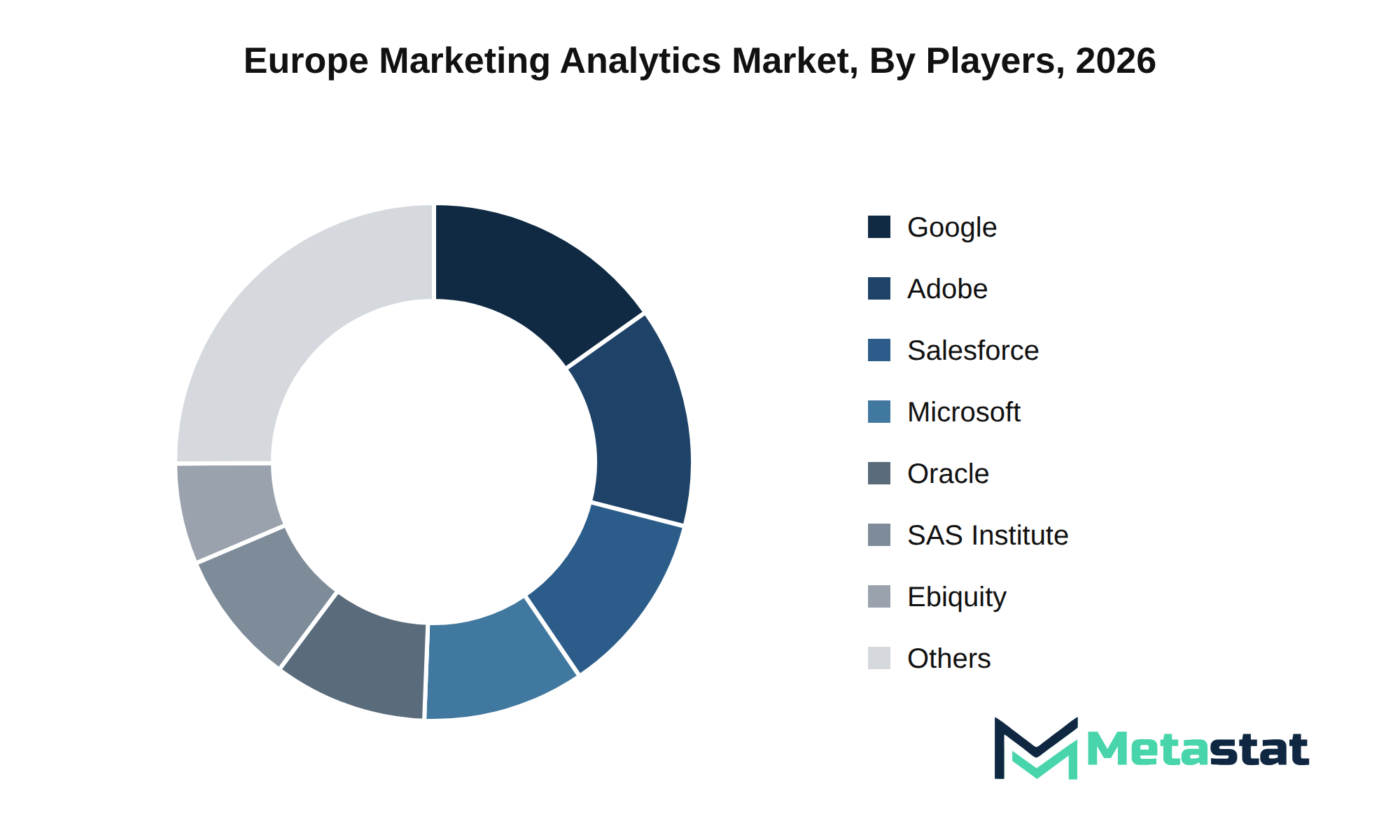
The Europe Marketing Analytics market features a diverse range of players engaged in various strategic maneuvers. Companies including Adobe Inc., Google LLC, and Salesforce, Inc. implement aggressive go-to-market strategies characterized by innovative product differentiation and pricing architectures. These companies leverage technological advancements to establish significant barriers to entry, effectively deterring new entrants in this competitive space.
Strategic alliances and partnerships play a vital role in the competitive dynamics of the market. Firms like Microsoft Corporation and SAS Institute Inc. engage in collaborative efforts to expand service offerings and enhance customer retention strategies. This approach strengthens brand equity and integrates value chains for improved supply chain dominance.
The market experiences ongoing strategic consolidation with leaders like Oracle Corporation and Ebiquity Plc focusing on mergers and acquisitions to enhance market position. Such movements consolidate resources, improve R&D pipelines, and develop proprietary technology moats that reinforce competitive advantages.
Future competitive outlooks suggest continued emphasis on intellectual property portfolios, which will become crucial in sustaining technological defensibility. While firms navigate these complexities, customer switching costs will influence market dynamics, compelling players to innovate and retain loyal clientele in the Europe Marketing Analytics market. This environment fosters a continuous drive for improvement and adaptation among industry participants.
Market size is forecast to rise from USD 1,936.2 million in 2025 to over USD 7,181.7 million by 2033. This growth reflects a compound annual growth rate (CAGR) of 17.8%, driven by several key factors.
Macroeconomic conditions influence downstream demand changes, leading to evolving consumer behaviors that impact the Europe Marketing Analytics market. Economic cycles result in fluctuations in demand, with periods of growth prompting increased investment in analytics capabilities, strengthening long-term demand.
The maturation of core industries encourages organizations to adopt advanced marketing analytics tools to maintain competitiveness. Changes in structural consumption patterns, driven by the integration of next-generation technologies, enhance demand for analytics solutions, expanding the addressable base.
R&D commercialization timelines play a significant role in shaping product life cycles within the market. Innovations in analytics solutions require timely regulatory evolution and compliance to meet increasing standards, impacting how companies allocate resources and invest in new technologies, increasing compliance costs for participants.
Geopolitical realignments contribute to shifting trade corridors, which alter regional supply chains and affect market dynamics. Strategic capital allocation directives focus on infrastructure commitments and CapEx investment vectors, reinforcing growth of analytics capabilities across industries, enhancing competitive positioning.
Emerging white-space opportunities present unmet enterprise needs and high-growth pockets, encouraging strategic imperatives among executives. Companies that prioritize defensibility roadmaps and future growth initiatives position themselves favorably in the evolving Europe Marketing Analytics market, increasing investment across the value chain.
The report strategically identifies and profiles the key market players and analyses their core competencies in each sub-segment of the Marketing Analytics market.
Report Attributes | Details |
Study Period | 2021-2033 |
Base Year | 2025 |
Estimated Year | 2026 |
Forecast Period | 2026-2033 |
Historical Period | 2021-2025 |
Growth Rate | CAGR 17.8% from 2026 to 2033 |
Revenue Unit | USD million |
Segmentation | By Deployment, Application, Industry Vertical, Region, and Region |
Find answers to common questions about this report
The Marketing Analytics market size in Europe was valued at USD 1,936.2 million in 2025.
The Marketing Analytics market is projected to grow at a CAGR of 17.8% during the forecast period from 2026 to 2033.
The Cloud segment leads the Europe Marketing Analytics market, projected to reach USD 5,668.5 million by 2033, compared to the On-Premise segment, which is expected to reach USD 1,513.2 million in the same year.
The Europe Marketing Analytics market experiences significant growth driven by the increasing focus on digital transformation and substantial investments in infrastructure development. Organizations across various sectors leverage advanced analytics tools to enhance decision-making, improve operational efficiency, and optimize customer engagement, reflecting a strong demand for data-driven insights.
Regulatory compliance hurdles and rising operational costs restrict investment in marketing analytics solutions. technological obsolescence and concerns surrounding data security add complexity, leading to fragmented market structures and limiting competitiveness. These factors collectively hinder growth in the Europe Marketing Analytics market.
Investment in digital transformation and infrastructure development drives product adoption in the Europe Marketing Analytics market. Organizations prioritize technologies that enhance data analytics capabilities, enabling improved decision-making and operational efficiency across sectors including retail and healthcare. This focus on automation and advanced analytics tools creates a favorable environment for growth.
The Marketing Analytics market is estimated to reach a valuation of USD 7,181.7 million by 2033.
Key players in the Europe Marketing Analytics market include Adobe Inc., Google LLC, Salesforce, Inc., Microsoft Corporation, SAS Institute Inc., and Oracle Corporation. These companies significantly influence the market through their innovative solutions and extensive customer bases.
The Cloud segment is projected to grow at a compound annual growth rate of 19.9% through 2033.
Retail and e-commerce demonstrate significant investment in marketing analytics, driven by the need for enhanced customer engagement and operational efficiency.
The analysts below cover Information & Technology research at Metastat Insights.
LEAD ANALYST
Utkarsh Khirodkar is a Lead Market Research Analyst at MetaStat Insight, specializing in market intelligence, technology sector assessments, and competitive strategy.

PRINCIPAL CONSULTANT - ENTERPRISE AI & EMERGING TECHNOLOGIES
Banking & Finance · Electronics and Semiconductor · Energy and Power · Healthcare IT · Information & Technology · Professional Services
Vijay Gunti is a Principal Consultant at MetaStat Insight, bringing over two decades of experience across enterprise digital transformation, technology strategy, and intelligent systems.

LEAD CONSULTANT - COMMUNICATION, TELECOM, AND IT
Electronics and Semiconductor · Information & Technology · Machinery & Equipment · Professional Services
Ravindra Sathe Consultants for Communication, Telecom, and IT at MetaStat Insight. He leads the firm's industry research initiatives across telecommunications infrastructure, digital connectivity, enterprise networking, and emerging information technology domains.
Evaluating calorific value requirements and air permit compliance across municipal waste facilities requires localized data. Metastat Insight structured their analysis around operational throughput capacity and feedstock composition variations in Latin America and Eastern Europe. Their competitive mapping of sorting equipment vendors helped clarify technology differences between optical separators and heavy media systems. The study provided an objective baseline during our capital expenditure reviews.
Decarbonizing industrial thermal processes hinges on refrigerant regulations and compressor efficiency limits. Metastat Insights delivered a thorough market analysis that evaluated natural refrigerants like CO2 and hydrocarbons against synthetic low-GWP alternatives. The breakdown of utility incentives and grid capacity constraints across key European manufacturing hubs offered valuable perspective. The follow-up conversation with their sector analysts addressed our specific questions on mechanical vapor recompression systems efficiently.
Assessing 200mm wafer transition schedules and substrate supply bottlenecks requires precise technical intelligence. MetaStat Insight supplied an actionable breakdown comparing planar and trench MOSFET architectures across automotive and industrial drive markets. The regional capacity estimates for Asia-Pacific foundries helped clarify lead-time uncertainties during our strategic planning session. When we needed additional clarification on high-purity raw material sourcing, their analyst team responded with helpful context within twenty-four hours.
Explore related market intelligence reports worth reading alongside this one.