
LEAD ANALYST
Utkarsh Khirodkar is a Lead Market Research Analyst at MetaStat Insight, specializing in market intelligence, technology sector assessments, and competitive strategy.

Global Digital Transformation Market Size, Share, By Solution (Analytics, Cloud Computing, Mobility, Social Media, and Others), By Service (Professional Services, Implementation, and Integration), By Deployment Mode (On-premise and Cloud), By End-Use Industry (BFSI, Healthcare, Retail, E-commerce, Manufacturing, IT, Telecommunications, Government, Public Sector, Energy, Utilities, and Others), Industry Analysis, Growth, Trends, and Forecast, 2026-2033
Report ID
MSI-4653
Published
April, 2026
Pages
312 Pages
Format
Report Details
Choose Your License
Digital Transformation Market
Global Digital Transformation market size is valued at USD 1,417.5 billion in 2025 and projected to grow at a CAGR of 28.5% during the forecast period, reaching USD 10,532.7 billion by 2033.
North America holds a 33.0% share of the Global Digital Transformation Market in 2025, with the United States leading regional revenue generation.
Analytics segment accounts for a 24.8% market share in 2025.
Key trends driving growth: Cloud, AI, and Automation Adoption Across Core Business Functions, Need for Omnichannel Customer Experience and Real-Time Personalization.
Opportunities include Industry-Specific AI-Led Transformation and Platform Modernization.
Key insight: Enterprise modernization strategies across industries continue to accelerate adoption within the Global Digital Transformation market.
The Global Digital Transformation Market represents a structural shift in how enterprises design, operate, and deliver products and services through advanced digital technologies. Businesses across industries are increasingly adopting digital platforms to improve operational efficiency, streamline workflows, and strengthen customer engagement. Integration of technologies such as artificial intelligence, advanced analytics, automation, cloud computing, and connected platforms continues to redefine enterprise operating models. Organizations are pursuing digital transformation strategies to remain competitive in dynamic global markets where speed, innovation, and data-driven decision-making shape business performance.
Digital transformation initiatives also address the need for real-time visibility across enterprise operations. Enterprises are implementing digital solutions that connect data across multiple functions, enabling decision-makers to evaluate performance, optimize resources, and respond quickly to market changes. Integrated digital ecosystems improve operational agility and support faster responses to evolving customer expectations.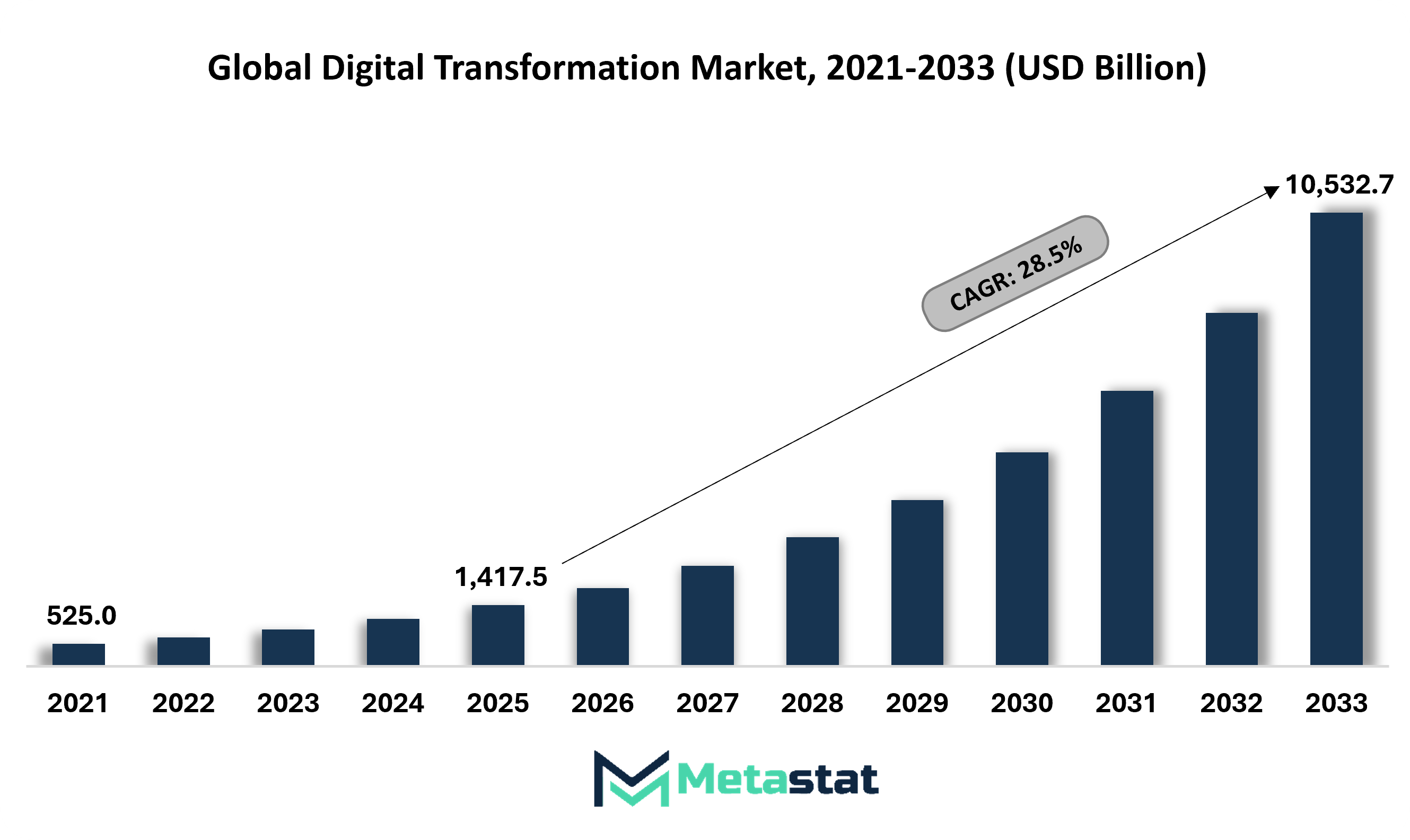
Cloud, AI, and Automation Adoption Across Core Business Functions.
Organizations across industries are adopting cloud infrastructure, artificial intelligence tools, and automation technologies to streamline operations. The Global Digital Transformation Market continues to expand as enterprises deploy intelligent systems that improve decision-making accuracy, raise productivity, and reduce dependence on manual processes. Businesses are increasingly relying on data-driven insights generated through digital tools to strengthen competitive positioning and improve enterprise performance.
Need for Omnichannel Customer Experience and Real-Time Personalization
Customers increasingly interact with brands across digital platforms such as mobile applications, social media channels, websites, and connected devices. Companies are investing heavily in digital transformation initiatives to deliver seamless and personalized customer experiences across these touchpoints. The Global Digital Transformation Market benefits from the growing need to integrate customer data platforms, marketing automation tools, and analytics solutions that support personalized engagement strategies.
Legacy IT Complexity and Integration Challenges
Many enterprises operate complex legacy IT systems that create major challenges during digital transformation programs. Integrating modern digital platforms with existing infrastructure requires substantial technical expertise and significant capital investment. These integration complexities often lead to operational delays and longer implementation timelines.
Cybersecurity, Data Privacy, and Organizational Change Barriers
Digital transformation initiatives significantly expand the digital footprint of organizations, increasing exposure to cybersecurity risks and data privacy concerns. Companies must implement robust security frameworks and compliance systems to protect sensitive information across digital environments. Organizational resistance to change, shortages of skilled digital talent, and governance challenges also slow transformation programs across some enterprises.
Industry-Specific AI-Led Transformation and Platform Modernization
Industry-specific digital transformation solutions create significant opportunities across sectors such as finance, healthcare, manufacturing, and retail. Technology vendors are increasingly developing specialized platforms tailored to sector-specific operational requirements. The Global Digital Transformation Market continues to expand as enterprises invest in AI-powered systems that modernize business functions, strengthen analytics capabilities, and improve operational agility.
The Global Digital Transformation Market is segmented by Solution, Service, Deployment Mode, End-Use Industry, and Region.
Analytics segment is valued at USD 450.6 billion in 2026 and is projected to reach USD 2,696.4 billion by 2033, at a CAGR of 29.1% during the forecast period.
Analytics platforms represent a foundational component of digital transformation initiatives. Organizations deploy advanced data analytics tools to generate actionable insights from large volumes of structured and unstructured information. Within the Global Digital Transformation Market, analytics solutions support predictive modeling, operational optimization, and data-driven decision-making across enterprise functions.
Cloud Computing segment is valued at USD 515.4 billion in 2026 and is projected to reach USD 3,292.5 billion by 2033, at a CAGR of 30.3% during the forecast period.
Cloud computing technologies enable enterprises to deploy scalable digital infrastructure without heavy upfront capital investment. The Global Digital Transformation Market continues to witness strong adoption of cloud platforms owing to their ability to store, process, and access enterprise data across distributed digital environments. Cloud-based architectures also support flexible collaboration and remote workforce productivity.
Mobility segment is valued at USD 319.9 billion in 2026 and is projected to reach USD 1,741.1 billion by 2033, at a CAGR of 27.4% during the forecast period.
Mobility solutions enable businesses to deliver digital services through mobile devices, allowing employees and customers to access enterprise systems from any location. Mobility technologies improve workforce productivity, operational flexibility, and digital customer engagement within the Global Digital Transformation market.
Social Media segment is valued at USD 210.2 billion in 2026 and is projected to reach USD 1,039.6 billion by 2033, at a CAGR of 25.7% during the forecast period.
Social media platforms play an important role in digital transformation strategies focused on customer interaction and brand engagement. Organizations integrate social media analytics tools, marketing automation systems, and customer engagement platforms to monitor digital conversations and strengthen brand communication strategies.
Others segment is valued at USD 323.9 billion in 2026 and is projected to reach USD 1,763.2 billion by 2033, at a CAGR of 27.4% during the forecast period.
Additional digital transformation solutions include artificial intelligence platforms, robotic process automation tools, Internet of Things integration frameworks, and digital experience platforms. These technologies contribute significantly to enterprise modernization across the Global Digital Transformation Market.
Professional Services segment is projected to reach USD 4,712.3 billion by 2033, at a CAGR of 27.7% during the forecast period.
Professional services support organizations in planning, strategy design, and implementation of digital transformation initiatives. Consulting firms and technology vendors help enterprises identify digital opportunities, design transformation roadmaps, and execute complex modernization programs.
Implementation & Integration segment is projected to reach USD 5,820.4 billion by 2033, at a CAGR of 29.2% during the forecast period.
Implementation and integration services involve deploying digital platforms and connecting them with existing enterprise infrastructure. The Global Digital Transformation Market relies heavily on these services, as enterprises require technical expertise to integrate new digital solutions into complex IT environments.
On-premises segment is projected to reach USD 3,414.7 billion by 2033.
On-premises deployment remains relevant for organizations requiring full control over digital infrastructure and sensitive data. Industries such as government, financial services, and healthcare continue to adopt on-premises digital transformation platforms to maintain strict regulatory compliance.
Cloud segment is projected to reach USD 7,118 billion by 2033.
Cloud deployment models dominate the Digital Transformation Market owing to their scalability, flexibility, and cost efficiency. Cloud-based digital platforms enable enterprises to rapidly deploy new technologies and scale operations in line with changing market requirements.
BFSI segment is projected to grow at a CAGR of 27.6% during the forecast period.
BFSI companies continue to invest heavily in technology programs designed to modernize operations, strengthen security architecture, and improve digital customer engagement. Banking and financial services institutions are adopting intelligent automation, advanced analytics, and secure digital platforms to support faster transactions, stronger compliance management, and data-driven financial services within the Digital Transformation market.
Healthcare segment is projected to grow at a CAGR of 29.8% during the forecast period.
Healthcare institutions are increasingly integrating digital platforms to improve clinical service delivery, decision support, and operational coordination. Hospitals, diagnostic networks, and research centers are adopting connected health systems, predictive analytics, digital health infrastructure, and remote monitoring technologies. Digital integration across healthcare ecosystems supports improved patient management, efficient data exchange, and stronger medical innovation.
Retail and E-commerce segment is projected to grow at a CAGR of 29.4% during the forecast period.
Retail organizations are pursuing digital modernization to improve customer experience, optimize supply chains, and enable data-driven merchandising strategies. Online markets, physical retail chains, and logistics networks are integrating artificial intelligence, predictive demand planning, smart inventory systems, and immersive shopping technologies. Digital commerce environments support personalized buying journeys and highly responsive retail ecosystems.
Manufacturing segment is projected to grow at a CAGR of 28% during the forecast period.
Manufacturing enterprises are advancing digital integration across production lines, supply chains, and quality monitoring systems. Smart factories powered by industrial analytics, connected machinery, robotics, and digital twins improve operational visibility and production precision. Advanced manufacturing environments strengthen predictive maintenance capabilities, reduce downtime, and support highly efficient industrial output across global networks.
IT and Telecommunications segment is projected to grow at a CAGR of 29% during the forecast period.
Information technology companies and telecommunications providers are driving infrastructure modernization through cloud platforms, advanced network architecture, and intelligent data management systems. Expansion of high-speed connectivity, edge computing frameworks, and next-generation communication networks is supporting digital ecosystems across industries and enabling large-scale enterprise automation and advanced digital service delivery.
Government and Public Sector segment is projected to grow at a CAGR of 29.2% during the forecast period.
Public institutions are adopting digital platforms to improve administrative transparency, citizen engagement, and service efficiency. Smart governance platforms, digital identity systems, secure data infrastructure, and integrated public service portals strengthen administrative coordination. Government digital programs also enhance urban management, digital documentation processes, and efficient policy implementation across national economies.
Energy and Utilities segment is projected to grow at a CAGR of 27.7% during the forecast period.
Energy companies are integrating advanced digital infrastructure to manage complex power networks, optimize resource distribution, and improve operational monitoring. Smart grids, predictive energy analytics, automated infrastructure management, and digital asset tracking improve energy security. Utilities are also adopting intelligent energy platforms that support renewable energy integration and sustainable resource management.
Others segment is projected to grow at a CAGR of 26.4% during the forecast period.
Additional sectors such as education, transportation, agriculture, and logistics continue to pursue digital modernization programs that improve productivity and operational intelligence. Educational institutions are integrating digital learning ecosystems, transportation networks are adopting smart mobility systems, and agriculture is advancing through precision technologies. Cross-sector digital expansion is strengthening innovation capacity and long-term economic competitiveness worldwide.
Based on geography, the Global Digital Transformation market is divided into North America, Europe, Asia-Pacific, South America, Middle East, and Africa.
In North America strong presence of leading technology companies and digital innovation hubs supports broad enterprise adoption across the Digital Transformation Market.
In North America high investment in artificial intelligence, cloud infrastructure, and enterprise software platforms accelerates digital modernization across industries.
Europe continues to hold a significant position in the market, supported by mature enterprise technology environments, strong regulatory focus on data governance, and rising investment in cloud migration, artificial intelligence, cybersecurity, and industrial automation.
Asia Pacific is expanding digital ecosystems in sectors such as fintech, e-commerce, and telecommunications create significant growth opportunities for digital transformation service providers.
In South America, Middle East, and Africa growing digital infrastructure investment, rising internet penetration, and government-led digital economy initiatives across these regions support long-term growth potential in the Digital Transformation Market.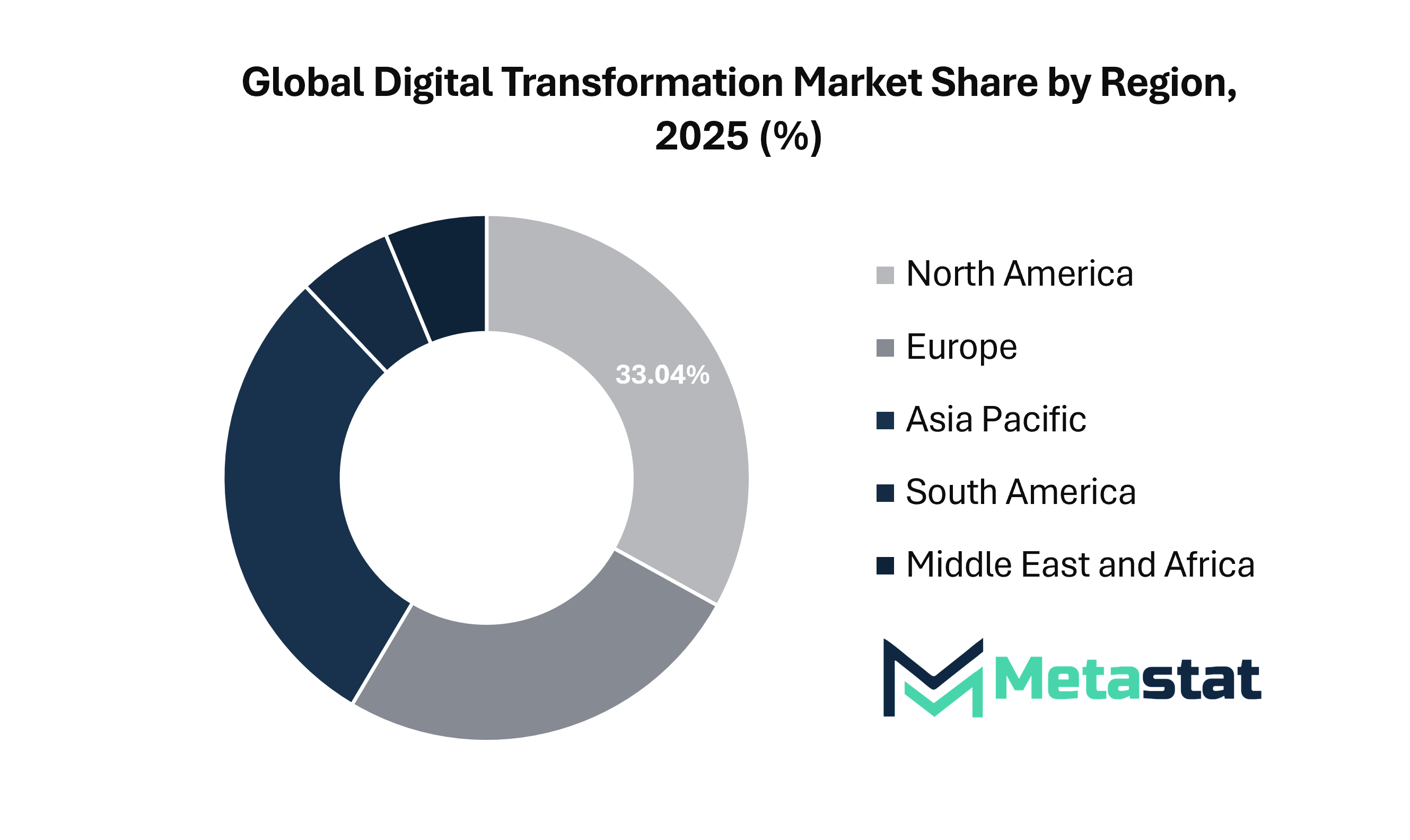
The Global Digital Transformation Market continues to gain strong strategic attention as enterprises invest in modern technologies to improve operations and customer engagement. Businesses across industries are transforming their systems, processes, and service models through digital tools such as cloud platforms, data analytics, automation, and artificial intelligence. Digital transformation is helping organizations manage information more effectively, improve productivity, and build more flexible operating environments.
Companies are investing in digital strategies that support long-term growth and business resilience. Industries such as banking, healthcare, retail, manufacturing, and education are expanding spending on digital systems to improve service delivery and maintain competitiveness. Remote work, online services, and digital customer engagement continue to reshape enterprise operating models, while stronger focus on cybersecurity and data protection remains central to platform modernization.
Key participants in the Global Digital Transformation Market include Accenture plc, IBM Corporation, Capgemini SE, Deloitte Touche Tohmatsu Limited, Cognizant Technology Solutions Corporation, Tata Consultancy Services Limited, Infosys Limited, Wipro Limited, HCL Technologies Limited, Digital Tranzform Pvt. Ltd., Tech Mahindra Limited, NTT DATA Group Corporation, DXC Technology Company, CGI Inc., EPAM Systems, Inc., Globant S.A., Publicis Sapient, and Endava plc. These companies are expanding their technology capabilities, strengthening digital platforms, and supporting enterprises in cloud migration, automation, data management, and digital customer engagement across global markets.
Competition in the market will remain strong as companies introduce new tools, partnerships, and platform capabilities to strengthen digital offerings. Enterprises will continue to rely on technology partners to simplify complex transformation programs and improve implementation efficiency. With rising demand for faster, smarter, and more connected business models, digital transformation will remain a strategic priority for organizations focused on long-term performance and growth.
Market size is forecast to rise from USD 1,417.5 billion in 2025 to over USD 10,532.7 billion by 2033.
The Global Digital Transformation Market is positioned for sustained expansion, supported by rapid technology adoption across enterprises worldwide. Organizations increasingly recognize digital capabilities as essential to long-term business strategy, operating efficiency, and competitive positioning. Continued advances in artificial intelligence, machine learning, cloud computing, and automation will keep shaping enterprise transformation priorities across industries.
This research report categorizes the Digital Transformation market based on key segments and regions, forecasts revenue growth, and analyses trends in each submarket. The report analyses the key growth drivers, opportunities, and challenges influencing the Digital Transformation market. Recent market developments and competitive strategies such as expansion, product launch, partnership, merger, and acquisition have been included to draw the competitive landscape in the market.
The report strategically identifies and profiles the key market players and analyses their core competencies in each sub-segment of the Digital Transformation market.
|
Report Attributes |
Details |
|
Study Period |
2021-2033 |
|
Base Year |
2025 |
|
Estimated Year |
2026 |
|
Forecast Period |
2026-2033 |
|
Historical Period |
2021-2025 |
|
Growth Rate |
CAGR 28.5% from 2026 to 2033 |
|
Revenue Unit |
USD billion |
|
Segmentation |
By Solution, Service, Deployment Mode, End-Use Industry, and Region |
|
By Region |
North America (By Solution, Service, Deployment Mode, End-Use Industry, and Country)
|
|
Europe (By Solution, Service, Deployment Mode, End-Use Industry, and Country)
|
|
|
Asia Pacific (By Solution, Service, Deployment Mode, End-Use Industry, and Country)
|
|
|
South America (By Solution, Service, Deployment Mode, End-Use Industry, and Country)
|
|
|
Middle East and Africa (By Solution, Service, Deployment Mode, End-Use Industry, and Country)
|
Find answers to common questions about this report
Global Digital Transformation market is estimated to reach USD 10,532.7 billion by 2033.
Top players operating in the Digital Transformation industry include Accenture plc, IBM Corporation, Capgemini SE, Deloitte Touche Tohmatsu Limited, and Cognizant Technology Solutions Corporation.
Legacy IT Complexity and Integration Challenges will hamper the market growth within the forecast period.
North America region dominates the market.
Cloud, AI, and Automation Adoption Across Core Business Functions and need for Omnichannel Customer Experience and Real-Time Personalization are key driving factors, boosting the market.
The Global Digital Transformation market is expected to grow at a CAGR of 28.5% over the forecast period (2026-2033).
The Metastat Insights analysis shows that the North America Digital Transformation market size is estimated to be USD 3,033.4 billion by 2033.
The Metastat Insights study shows that the Global Digital Transformation market size was USD 1,417.5 billion in 2025.
The analysts below cover Information & Technology research at Metastat Insights.
LEAD ANALYST
Utkarsh Khirodkar is a Lead Market Research Analyst at MetaStat Insight, specializing in market intelligence, technology sector assessments, and competitive strategy.

PRINCIPAL CONSULTANT - ENTERPRISE AI & EMERGING TECHNOLOGIES
Banking & Finance · Electronics and Semiconductor · Energy and Power · Healthcare IT · Information & Technology · Professional Services
Vijay Gunti is a Principal Consultant at MetaStat Insight, bringing over two decades of experience across enterprise digital transformation, technology strategy, and intelligent systems.

LEAD CONSULTANT - COMMUNICATION, TELECOM, AND IT
Electronics and Semiconductor · Information & Technology · Machinery & Equipment · Professional Services
Ravindra Sathe Consultants for Communication, Telecom, and IT at MetaStat Insight. He leads the firm's industry research initiatives across telecommunications infrastructure, digital connectivity, enterprise networking, and emerging information technology domains.
Floating offshore wind feasibility relies heavily on specialized installation vessel availability and port crane limits, which most broad renewable energy forecasts ignore. The report delivered a thorough analysis of dry dock capacity, mooring chain supply constraints, and raw material pricing trends for deepwater anchor installations. It served as a solid independent sanity check for our offshore project capital expenditure assumptions.
Assessing commercial microgrid software adoption requires looking past top-level installation numbers and examining utility interconnection queues. The research provided verifiable data on average permitting timelines, tariff structures, and battery storage integration costs across regional utility territories. That grounded perspective was valuable for our team when building five-year demand projections for industrial microgrid controllers.
Ambulatory surgical centers have very different purchasing cycles for robotic-assisted surgery platforms than major hospital networks. The MetaStat Insight study focused squarely on capital expenditure depreciation, procedural reimbursement pathways, and surgeon training overhead. That operational clarity made it much simpler to validate multi-year procedure growth forecasts against actual ambulatory center adoption patterns.
Explore related market intelligence reports worth reading alongside this one.