
The Latin America Carbon Credit market is set for significant growth as corporate sustainability efforts rise. This article explores the factors driving this trend and the dynamics shaping the market's future.
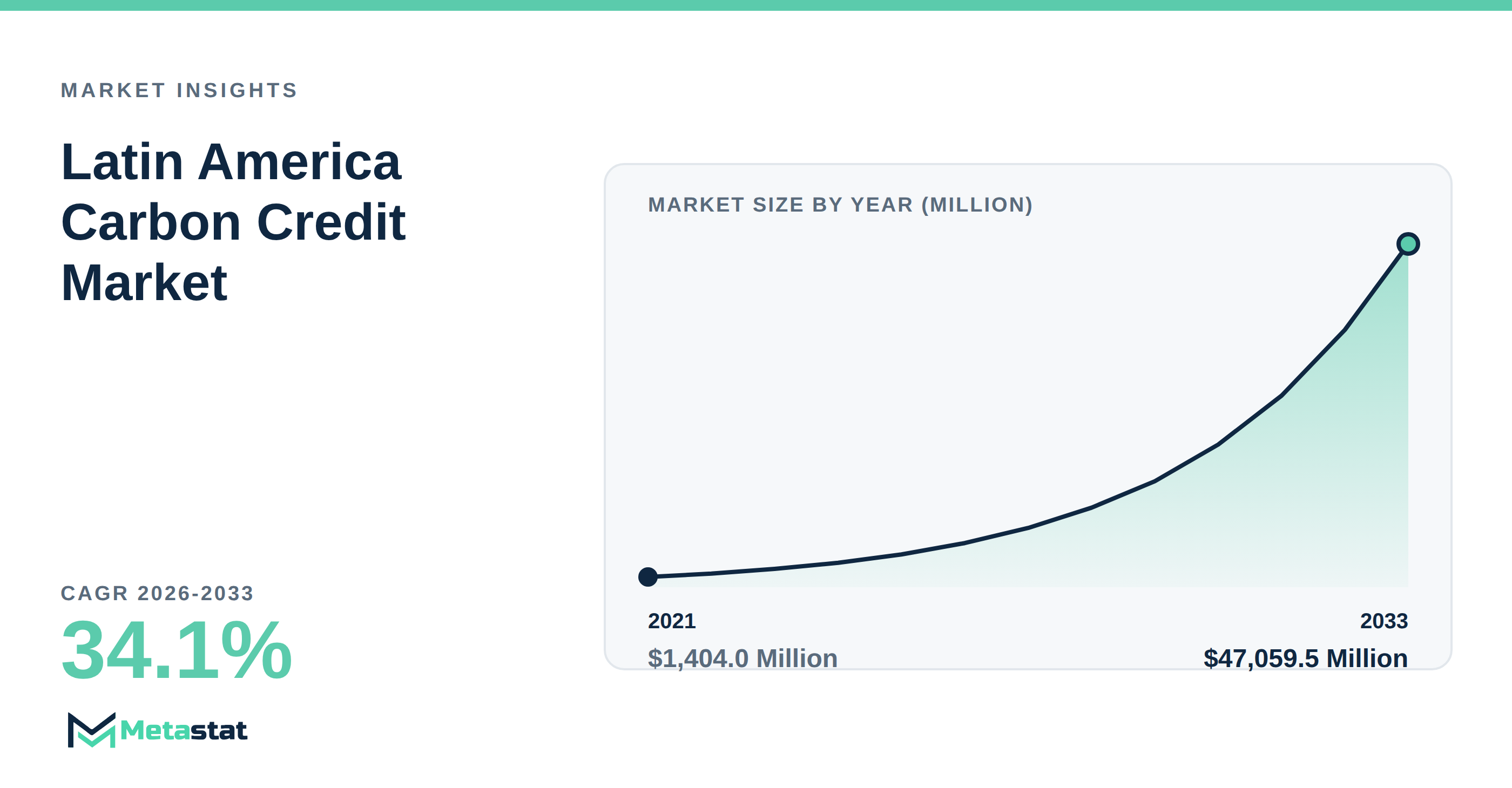
The Latin America Carbon Credit market is on a path of substantial growth, with expectations indicating an increase from USD 4,498.9 million in 2025 to USD 47,059.5 million by 2033. This growth represents a remarkable compound annual growth rate (CAGR) of 34.1%, suggesting notable developments across various sectors that demand carbon credit solutions.
What factors are driving the rapid growth?
Several dynamics fuel the expansion within the Latin America Carbon Credit market, particularly due to escalating regulatory pressures and corporate sustainability commitments. Governments across the region are establishing stringent emission limits, compelling industries to adopt carbon credit solutions. This trend opens avenues for both voluntary and compliance carbon markets.
For instance, the voluntary carbon market constitutes 61.6% of the overall market, reflecting a strong interest among companies aiming to offset their emissions voluntarily. Conversely, the compliance carbon market, which accounts for 38.4%, emphasizes the regulatory framework that drives mandated emissions reductions, seen prominently in countries like Brazil and Colombia. This regulatory landscape shapes how companies engage in carbon credit initiatives.
How is technological advancement influencing the market?
Technological integration significantly enhances the efficiency of carbon credit generation and trading processes. The adoption of innovations, including blockchain technology, improves transparency and traceability in transactions, increasing trust among market participants. Advancements in data management streamline the certification and trading processes, simplifying the acquisition of reliable carbon credits for companies.
Brazil's introduction of the Sistema Brasileiro de Comercio de Emissões (SBCE) exemplifies how technology enhances carbon credit trading. This system supports investments in renewable energy and forestry projects that are essential for generating carbon credits. Consequently, Brazil’s carbon market is expected to experience considerable growth, projected to hit USD 19,849.7 million by 2033.
What role do regulatory changes play?
Regulatory frameworks significantly shape the Latin America Carbon Credit market, because demonstrated by Colombia's recent implementation of a carbon tax that encourages companies to pursue compliance solutions. Such regulatory pushes incentivize businesses to invest in carbon credit initiatives, aligning their operations with compliance requirements while pursuing environmental goals simultaneously.
Mexican efforts to develop a comprehensive carbon market aim to establish an emissions trading system that enhances transparency and industry participation. Such initiatives are expected to strengthen the market because participation from various sectors increases amid evolving regulatory frameworks.
What challenges could hinder market participation?
Despite the positive outlook for the Latin America Carbon Credit market, several compliance hurdles pose challenges to growth. Complex regulatory requirements overwhelm smaller enterprises, leading to delays and increased costs associated with initiating projects. In addition, macroeconomic factors, including inflation and rising operational expenses, exacerbate these challenges.
Infrastructure gaps complicate market participation, because insufficient technological deployment and a shortage of skilled labor hinder access to vital resources needed for effective carbon credit projects. Addressing these challenges is crucial for increasing market engagement and ensuring stakeholders capitalize on emerging opportunities.
What emerging trends should stakeholders monitor?
The market stands poised for considerable growth, propelled by increasing corporate commitments to sustainability and changing consumer preferences for environmentally responsible practices. Companies across sectors are actively seeking to enhance their sustainability profiles, which drives demand for carbon credits. Investments directed toward renewable energy projects and sustainable agricultural practices will likely boost the market's capacity for generating carbon credits.
The rise of forestry and land use projects under frameworks including REDD+ presents lucrative opportunities for generating carbon credits while supporting conservation efforts. These trends align with global sustainability objectives and position the Latin America Carbon Credit market because a crucial participant in global climate change mitigation strategies.
For a deeper dive into the evolving landscape of the Latin America Carbon Credit Market, understanding these dynamics will be vital for stakeholders looking to navigate this rapidly changing environment and fully leverage available opportunities.
Tags
About the Authors

LEAD ANALYST
Utkarsh Khirodkar is a Lead Market Research Analyst at MetaStat Insight, specializing in market intelligence, technology sector assessments, and competitive strategy.

PRINCIPAL CONSULTANT - ENTERPRISE AI & EMERGING TECHNOLOGIES
Banking & Finance · Electronics and Semiconductor · Energy and Power · Healthcare IT · Information & Technology · Professional Services
Vijay Gunti is a Principal Consultant at MetaStat Insight, bringing over two decades of experience across enterprise digital transformation, technology strategy, and intelligent systems.