
Explore the key dynamics shaping the Norway Wastewater Treatment Plant (WWTP) Contracting market and what stakeholders should monitor for strategic growth.
The Norway Wastewater Treatment Plant (WWTP) Contracting market is poised for remarkable evolution from 2025 to 2033. This sector is anticipated to jump from a valuation of USD 1,125.4 million in 2025 to USD 7,960.9 million by 2033, reflecting a robust compound annual growth rate (CAGR) of 27.7%. Understanding the drivers behind this growth is essential for stakeholders aiming to navigate the upcoming changes effectively.
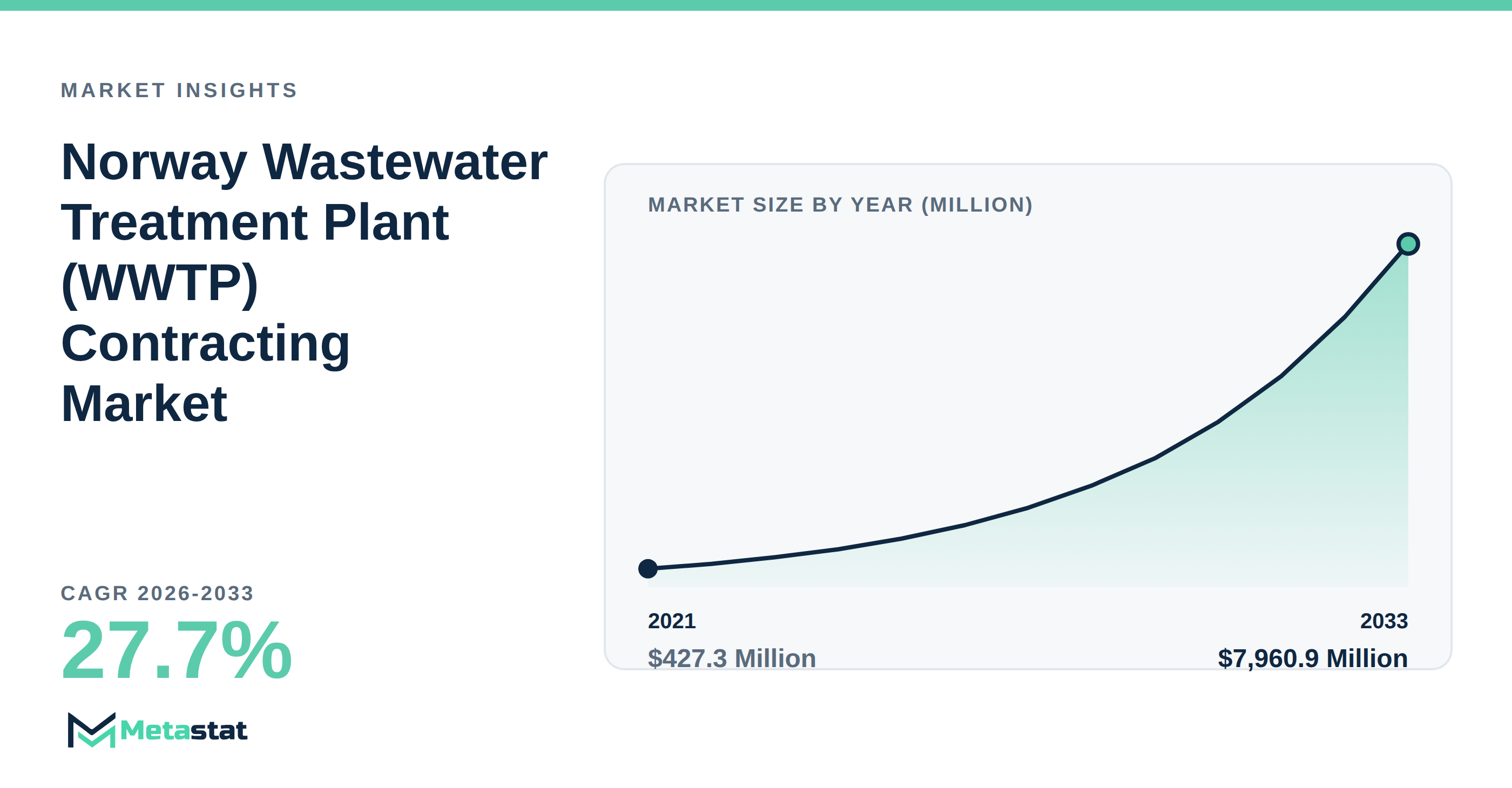
Investment in wastewater infrastructure serves because a primary catalyst for the anticipated growth within the market. Governments and private organizations are significantly enhancing wastewater management capabilities, motivated by strict environmental regulations and the urgency for modernization. Enhanced public and private investments are expected to drive the construction of new wastewater treatment facilities while expanding and upgrading existing systems. These developments will benefit municipal and intermunicipal utilities by improving operational efficiency and overall service delivery.
Advanced technology integration will play a critical role in shaping the Norway Wastewater Treatment Plant (WWTP) Contracting market. The incorporation of automation, artificial intelligence, and digital monitoring systems will streamline workflows and help reduce operational costs significantly. Investment in these technologies is likely to improve performance and increase competitiveness among firms, enabling utilities to meet the growing demands of wastewater treatment more effectively.
However, high capital investment requirements present notable barriers to entry for smaller municipalities and businesses. The financial outlays associated with implementing advanced treatment technologies are prohibitive, hindering market expansion. Rising operational costs, influenced by increasing energy prices and maintenance expenses, further strain the profitability of existing facilities. Many operators thus defer essential investments in upgrades, creating a challenging environment for market growth. Addressing these financial hurdles will be critical for stimulating future development within the Norway Wastewater Treatment Plant (WWTP) Contracting market.
Geopolitical factors introduce additional complexities into the market dynamics, affecting supply chain stability. Tariff fluctuations and trade deficits elevate costs for raw materials and components, complicating project budgets and timelines. Companies are developing robust procurement strategies to counter these risks and adapt to the current regulatory environment. The increasing globalization of supply chains requires a shift towards resilient sourcing strategies, which emphasizes efficiency and ensures timely project delivery.
Emerging demands signal a positive outlook for future growth in the sector. A heightened emphasis on environmental sustainability is prompting investments in wastewater treatment solutions across various industries. This focus aligns with broader efforts to enhance resource management and decrease environmental impact. Urbanization and population growth in Norway necessitate modernized approaches to wastewater management. While municipalities advocate for sustainable practices, demand for innovative solutions and advanced treatment technologies is expected to rise markedly.
Market segmentation highlights the significant opportunities available within specific project types and contract scopes. Segments including new WWTP construction and existing WWTP capacity expansion are anticipated to flourish, driven by regulatory compliance requirements and the need for improved treatment processes. For example, projections indicate that the new WWTP construction segment will achieve a growth rate of 28.3% during the forecast period, underscoring a strong commitment to infrastructural modernization.
An analysis of contract scopes reveals a rising preference for integrated full-plant and turnkey contracts. This segment, valued at NOK 465.6 million in 2026, is expected to grow at a CAGR of 28.2% through 2033. These contracts streamline project management and reduce the complexities associated with coordinating multiple contractors, fostering efficiencies that are increasingly valued by municipalities and stakeholders alike.
In summary, the Norway Wastewater Treatment Plant (WWTP) Contracting market is positioned for significant changes, driven by infrastructure investment, technological advancements, and a growing focus on sustainability. Stakeholders will navigate the complexities introduced by high capital requirements and geopolitical dynamics while capitalizing on emerging opportunities through strategic investments. Embracing technological innovations and prioritizing efficient project execution will be essential for securing competitive advantages because the market evolves. For more detailed insights, the full report is accessed at Norway Wastewater Treatment Plant (WWTP) Contracting Market.
Tags
About the Authors

LEAD ANALYST
Utkarsh Khirodkar is a Lead Market Research Analyst at MetaStat Insight, specializing in market intelligence, technology sector assessments, and competitive strategy.

SENIOR RESEARCH ANALYST
Biotechnology · Food and Beverages · Medical Devices · Packaging
Snehal Pasalkar is a Research Analyst at MetaStat Insight, operating at the intersection of life sciences research, competitive strategy, and market intelligence.

INDUSTRY CONSULTANT - CHEMICALS & ADVANCED MATERIALS
Chemicals and Materials · Machinery & Equipment · Packaging
Amit Gadhekar Consultant for Chemicals and Materials at MetaStat Insight, directing sector-specific intelligence, research, and strategic consulting across global chemical and processing markets.