
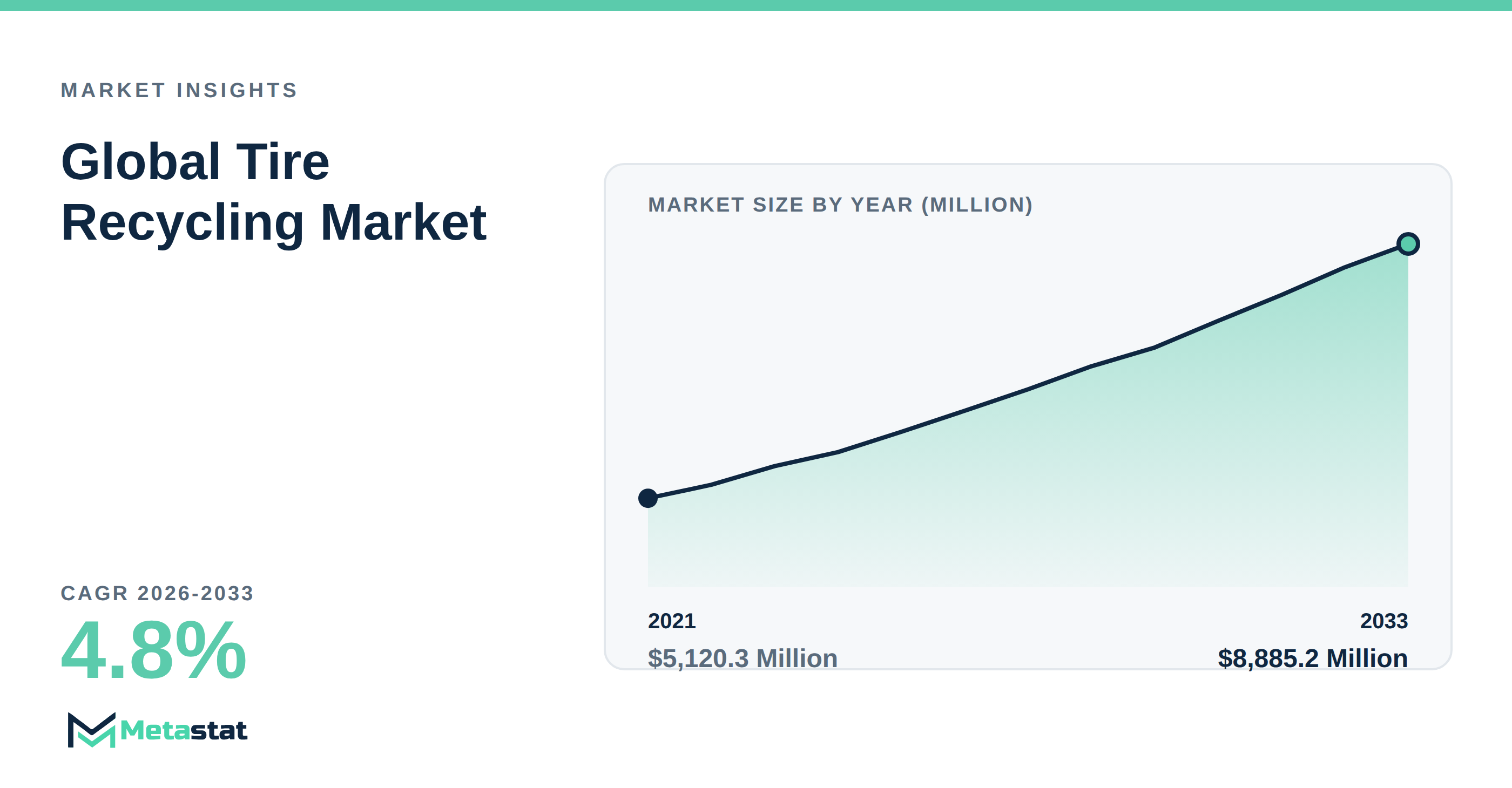
Explore the key drivers, challenges, and trends shaping the Tire Recycling market, forecasted to reach USD 8,885.2 million by 2033.
The Tire Recycling market is experiencing a fundamental shift driven by evolving consumer preferences and increasing regulatory demands. Companies are adapting their approaches to end-of-life tires, pushing forward the growth of recycling initiatives.
What drives growth in the Tire Recycling market?
Expansion in the Tire Recycling market arises from the heightened production of end-of-life tires alongside the growing emphasis on sustainable recycling methods. The global market was estimated at USD 6,104.3 million in 2025 and is expected to increase to USD 8,885.2 million by 2033, representing a compound annual growth rate (CAGR) of 4.8%. This upward trajectory highlights a significant movement towards practices that prioritize recycling and resource recovery.
The increasing prioritization of circular economy principles within diverse industries has amplified the focus on recycling initiatives. Companies are responding to shifts in consumer expectations and evolving regulatory landscapes, which are transforming how they manage waste. For instance, the demand for recovered carbon black is notably rising, because it finds application in the production of new tires and various industrial uses, thereby promoting further market growth.
How do technological advancements affect the market?
Technological innovations play a vital role in enhancing the effectiveness of tire recycling operations. Processes including tire pyrolysis and thermochemical recycling are instrumental in converting tires into valuable outputs, including oils, gases, and high-quality rubber products. These advancements not only enhance recovery rates but facilitate the creation of high-performance recycled materials.
While mechanical tire recycling techniques are continually evolving, there are marked improvements in both efficiency and product quality. Companies that invest in state-of-the-art recycling technologies, including advanced methods like cryogenic grinding and devulcanization, position themselves favorably in the market by improving the quality of their outputs. This trend aligns with the increasing consumer demand for top-tier sustainable products, reinforcing the overall momentum within the Tire Recycling sector.
What challenges are faced by the industry?
Despite the optimistic outlook for the Tire Recycling market, various regulatory challenges impose significant operational hurdles on recycling facilities. Adhering to strict environmental standards entails considerable investments in both technology and infrastructure, which elevates operational costs. The substantial financial requirements for advanced recycling technologies deter potential new entrants, thus limiting market competition and stifling innovation.
Unpredictable pricing for recovered materials complicate the economic feasibility of recycling operations, affecting investment decisions within the industry. Access to high-quality feedstock, namely end-of-life tires, is crucial for maintaining the competitiveness of recycling processes. Compounded by supply chain disruptions and inflation, these factors create an intricate operational landscape that poses challenges to market expansion.
What role does regulation play in shaping the market?
Regulatory frameworks significantly impact the Tire Recycling market. Compliance with established regulations prompts investment in advanced recycling technologies and encourages the establishment of facilities that efficiently process end-of-life tires. Initiatives centered on extended producer responsibility serve to enhance compliance within tire recycling, incentivizing manufacturers to pursue more sustainable practices.
This regulatory environment promotes collaboration among stakeholders, streamlining the management of end-of-life tires. The growing focus on sustainability and carbon reduction in tire recycling aligns with global efforts to minimize carbon footprints. Such regulations encourage innovation and open avenues for growth for companies dedicated to sustainable tire recycling approaches.
What are the emerging trends in the market?
Innovations in recycling technology continue to enhance product recovery in the Tire Recycling market. New advancements in recycling processes offer significant opportunities, improving operational efficiency and the overall quality of recovered materials. While firms adopt novel recycling methodologies, the demand for sustainable materials rises across various sectors, notably within construction and automotive industries.
Investment in infrastructure is crucial for securing resilience within supply chains linked to tire recycling. Strategic partnerships and mergers within the industry promote collaboration, expanding market capabilities in line with the increasing emphasis on sustainability. While the market matures, incorporating recycled materials into tire manufacturing processes reflects the industry's dedication to circular economy principles.
The Tire Recycling market is set for growth, propelled by technological advancements, supportive regulatory frameworks, and shifting consumer behavior. Companies focusing on sustainability and innovation are likely to navigate the complexities of the market adeptly, capitalizing on emerging opportunities.
For further insights, explore the Global Tire Recycling Market.
Tags
About the Authors

LEAD ANALYST
Utkarsh Khirodkar is a Lead Market Research Analyst at MetaStat Insight, specializing in market intelligence, technology sector assessments, and competitive strategy.

ENERGY & INFRASTRUCTURE INDUSTRY CONSULTANT
Automotive and Transportation · Electronics and Semiconductor · Energy and Power · Machinery & Equipment
Saurabh Vasant Ganvir consults for Energy & Infrastructure Industry at MetaStat Insight, specializing in renewable energy, solar EPC, and electric vehicle (EV) infrastructure markets.