
Primary research in market research reports is the buyer’s best test of a number. Learn how AI drafting, circular data and undisclosed synthetic respondents weaken evidence, and which five questions help procurement teams trace a figure to its source.
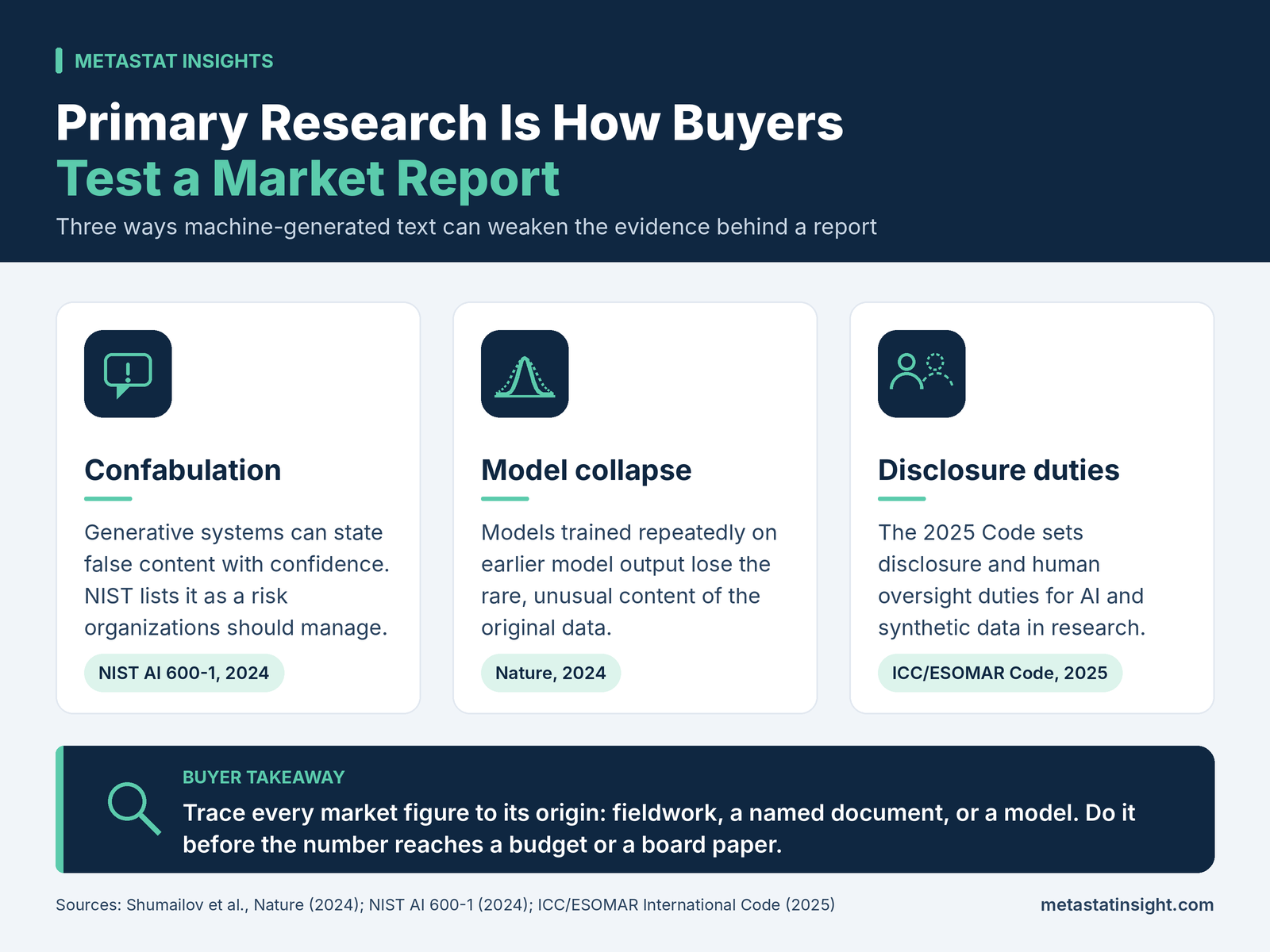
In July 2024, researchers writing in a peer-reviewed Nature study reported that language models trained repeatedly on text produced by earlier models lose the rare, unusual content of the original data and drift toward narrower, blander output. They called the effect model collapse. The study concerns model training, not market reports, but it lands on a problem every buyer of market intelligence now shares: primary research in market research reports is becoming harder to see, while machine-written text is becoming cheaper to produce.
The commercial stake is practical. A market size figure feeds a capacity plan, a supplier negotiation or an investment case. If that figure rests on nothing firmer than a fluent paragraph, the error travels with it, and nobody downstream can tell.
 What primary research in market research reports actually provides
Primary research means evidence collected first-hand for the question at hand: structured interviews with manufacturers, distributors and end users, surveys with a defined sample, observed prices and contract terms. Secondary research compiles what already exists, such as company filings, customs and trade statistics, regulator publications and academic studies. A sound report uses both, and the two do different jobs.
Secondary sources give breadth and a record others can check. Primary work gives a way to test that record. When two published figures for a segment disagree, a round of interviews with procurement managers or a pricing check across distributors can show which one matches how the market actually trades. It can also capture what has not yet been published: capacity expansions under discussion, switching intentions, discounts that never appear in a filing.
The weakness of secondary-only work is circularity. If every input is a prior publication, the report can only rearrange what is already public, and any error in the earlier material is inherited.
Where AI drafting weakens a research report
The US National Institute of Standards and Technology uses the term confabulation in its Generative AI Profile, NIST AI 600-1, meaning the tendency of generative systems to produce confidently stated content that is false. The same document treats information integrity, data provenance and the homogenization of outputs as risk areas that organizations should manage.
For a research report, three failure modes follow. A model can produce a plausible number with no source behind it. It can smooth conflicting inputs into one tidy narrative, hiding the disagreement a buyer would want to see. And because many authors use similar tools, reports on adjacent topics can drift toward the same phrasing and framing, which looks like consensus but is closer to repetition.
None of this makes the tools unusable. Transcribing interviews, coding open-ended survey answers, translating source documents and flagging inconsistencies in a draft are reasonable uses when a named person reviews the output. The risk sits at the step where a model supplies the evidence rather than helps handle it.
How does circular data get into a report?
The mechanism is simple, and it is an inference from the research above, not a measured rate. A model generates a market figure with no origin. The figure is published in a blog post, a summary or a report. Another model, or a time-pressed analyst, later picks it up and treats it as a data point. A third document cites the second. By the end, three publications appear to agree, and all three trace back to one unsupported sentence.
The Nature study shows a related dynamic at training scale: when models learn from model output, simplifications compound and the tails of the original distribution disappear. In market data the tails are often where the value sits, such as a niche segment growing quickly, a regional price anomaly or a supplier leaving a category.
No public dataset reliably measures how often this happens in commercial research. Buyers should treat it as a risk to test, and the test is cheap: ask where the figure began.
Synthetic respondents and the disclosure line
Synthetic data has legitimate uses. Researchers use it to test questionnaires, model scenarios and extend small samples, provided the method is stated. The line is crossed when machine-generated responses are presented as if people gave them.
The 2025 edition of the ICC/ESOMAR International Code, the main ethics code for market, opinion and social research, addresses artificial intelligence and synthetic data and places disclosure and human oversight obligations on researchers. For a buyer, that offers a workable standard to cite in a request for proposal: what was generated, what was collected, and who is accountable for the difference.
Five questions to put to any report before it informs a decision
- Which figures come from first-hand interviews or surveys, and what were the sample size, respondent roles, regions and fieldwork year?
- Which figures come from filings, trade statistics or regulator data, and can each be traced to a named document?
- Was a generative model used to draft, summarize or produce any estimate, and who reviewed it?
- Are forecasts built bottom-up from stated inputs and assumptions, or do they start from a top-level growth rate?
- Where sources agree, are they independent, or do they trace back to a single origin?
A publisher that can answer these in writing gives the buyer something to audit. One that cannot is asking for a number to be taken on trust. Either response is informative, and the questions cost an email.
What the market for AI tooling signals
The pace of generative AI adoption explains why these questions are arriving now. Metastat’s Global Generative AI Market report estimates the market at USD 19.7 billion in 2025 and USD 258.9 billion by 2033, and lists synthetic data generation among its application segments, so the tooling behind synthetic datasets is a market in its own right. The Global Insights-as-a-Service Market report estimates USD 6.8 billion in 2025 for packaged, on-demand insight, a category where provenance matters because the buyer rarely meets the analyst. The Global LLM Firewall Market report puts USD 268.4 million in 2025 on tools that screen AI systems, and includes hallucination and groundedness control among the risks it covers.
These are market estimates and forecasts, not observed outcomes. Taken together, they suggest organizations are already paying to constrain machine error inside their own systems. Applying the same discipline to purchased research looks like a natural extension.
Primary research does not guarantee a correct number, and secondary data does not guarantee a wrong one. What differs is whether a claim can be traced and challenged. Readers who want to see how application-level estimates are structured can explore the Global Generative AI Market report, then put the five questions above to it and to any other report on their desk.
Tags
About the Authors

LEAD ANALYST
Utkarsh Khirodkar is a Lead Market Research Analyst at MetaStat Insight, specializing in market intelligence, technology sector assessments, and competitive strategy.

PRINCIPAL CONSULTANT - ENTERPRISE AI & EMERGING TECHNOLOGIES
Banking & Finance · Electronics and Semiconductor · Energy and Power · Healthcare IT · Information & Technology · Professional Services
Vijay Gunti is a Principal Consultant at MetaStat Insight, bringing over two decades of experience across enterprise digital transformation, technology strategy, and intelligent systems.

LEAD CONSULTANT - COMMUNICATION, TELECOM, AND IT
Electronics and Semiconductor · Information & Technology · Machinery & Equipment · Professional Services
Ravindra Sathe Consultants for Communication, Telecom, and IT at MetaStat Insight. He leads the firm's industry research initiatives across telecommunications infrastructure, digital connectivity, enterprise networking, and emerging information technology domains.