
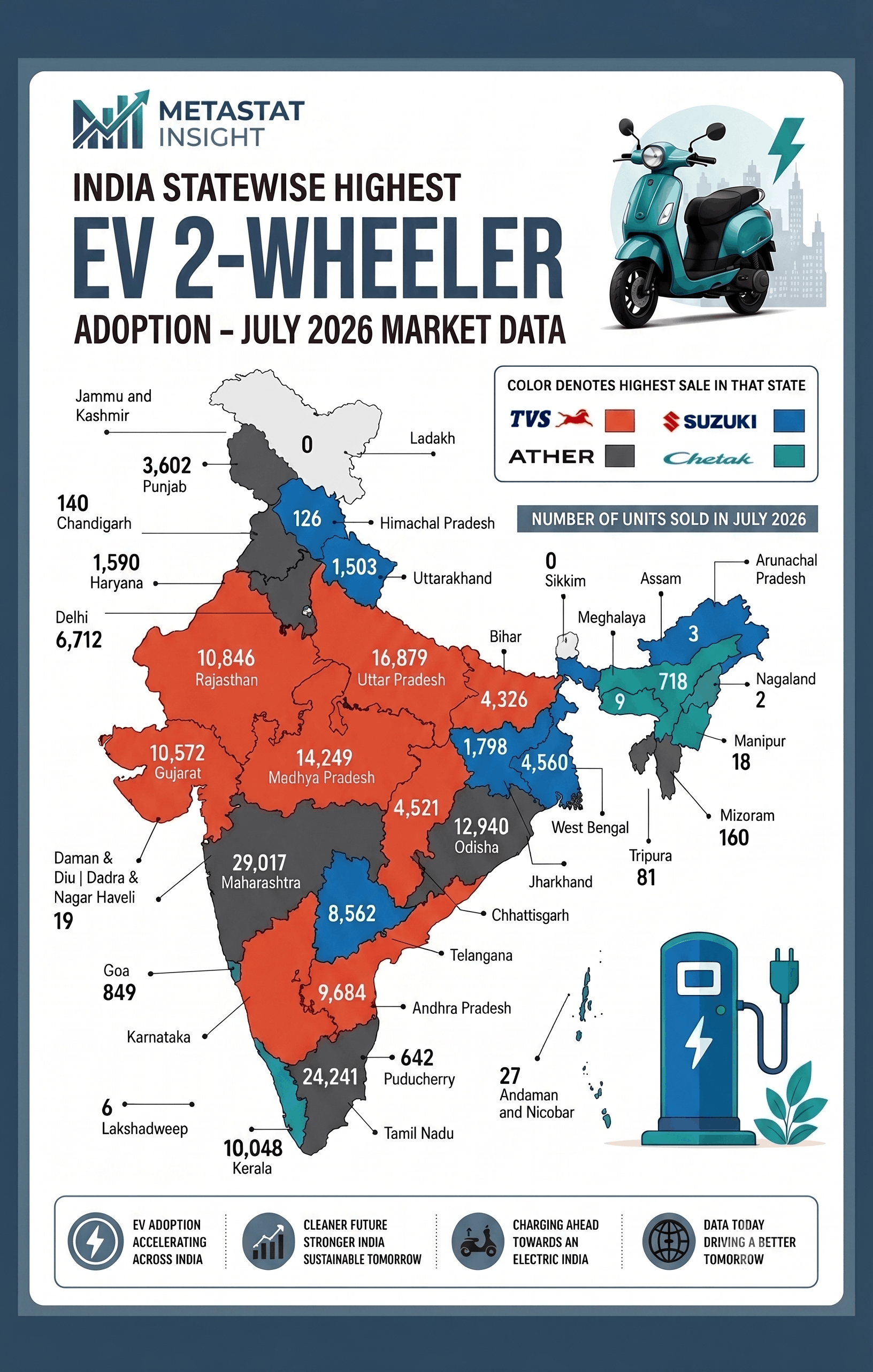
India’s electric vehicle transformation is largely propelled by the two-wheeler (E2W) segment, which accounts for the vast majority of consumer EV registrations nationwide. Regional sales data highlights distinct geographical adoption patterns driven by local incentive frameworks, urban commuting demands, and charging network availability.
Top State Markets by Registration Volume
Consumer demand is concentrated heavily across western, southern, and central states:
-
Maharashtra (29,017 units): The nationwide leader in overall volume, driven by high commuter density in tier-1 and tier-2 hubs.
-
Tamil Nadu (24,241 units): A major southern hub with strong adoption rates supported by robust local manufacturing and charging infrastructure.
-
Uttar Pradesh (16,879 units): Northern India's largest volume driver, with strong uptake across commercial and personal transit routes.
-
Madhya Pradesh (14,249 units) & Odisha (12,940 units): Central and eastern high-growth corridors exhibiting rapid transition beyond early-adopter phases.
-
Rajasthan (10,846 units) & Gujarat (10,572 units): Established automotive belts showing strong consumer appetite for commuter-grade electric scooters.
-
Kerala (10,048 units): High per-capita EV density driven by high fuel sensitivity and short-distance daily commuting routes.
-
Other Prominent Markets: Andhra Pradesh (9,684 units), Telangana (8,562 units), and Delhi (6,712 units) continue to register stable, high-volume fleet and retail demand.
 Brand Dominance Across Indian States
Rather than a single brand controlling the national market, state-level dominance is divided among established legacy players and pure-play EV manufacturers:
-
Bajaj Chetak: Controls top sales in Western and industrial states, leading registrations in Maharashtra, Gujarat, Assam, and Puducherry through wide dealership distribution.
-
TVS Motor: Dominates the northern and central belts, securing the highest market share in Uttar Pradesh, Madhya Pradesh, Rajasthan, Andhra Pradesh, Bihar, and Chhattisgarh.
-
Ather Energy: Holds the top position in tech-forward and southern markets, leading sales in Tamil Nadu, Odisha, Kerala, Punjab, and Mizoram.
-
Suzuki: Outperforms competitors in northern and hilly regions, capturing leading volume in Uttarakhand, Himachal Pradesh, and Arunachal Pradesh.
Growth Drivers Behind Regional Expansion
-
Total Cost of Ownership (TCO) Advantages: Operating costs for electric scooters remain significantly lower than internal combustion engine (ICE) vehicles, accelerating adoption among both delivery fleets and daily office commuters.
-
Dealership and Service Proximity: Legacy manufacturers are converting traditional showroom foot traffic into EV sales across tier-2, tier-3, and rural markets.
-
Fast-Charging Network Expansion: Public and proprietary charging grids along major suburban arterial corridors are eliminating range concerns for daily riders.
The dispersion of sales beyond major metropolitan areas demonstrates that electric two-wheelers have entered mainstream retail viability across India. As domestic component localization deepens and charging density expands, regional adoption across non-metro belts will continue to drive the next wave of volume expansion.
Tags
About the Authors

LEAD ANALYST
Utkarsh Khirodkar is a Lead Market Research Analyst at MetaStat Insight, specializing in market intelligence, technology sector assessments, and competitive strategy.

PRINCIPAL CONSULTANT - ENTERPRISE AI & EMERGING TECHNOLOGIES
Banking & Finance · Electronics and Semiconductor · Energy and Power · Healthcare IT · Information & Technology · Professional Services
Vijay Gunti is a Principal Consultant at MetaStat Insight, bringing over two decades of experience across enterprise digital transformation, technology strategy, and intelligent systems.

PRINCIPAL CONSULTANT - QUALITY SYSTEMS & COMPLIANCE
Electronics and Semiconductor · Machinery & Equipment · Professional Services
Omkar Phadtare is an Industry Consultant at MetaStat Insight, specializing in quality systems, regulatory compliance, and standards benchmarking to drive data-driven market intelligence and strategic industry research.

ENERGY & INFRASTRUCTURE INDUSTRY CONSULTANT
Automotive and Transportation · Electronics and Semiconductor · Energy and Power · Machinery & Equipment
Saurabh Vasant Ganvir consults for Energy & Infrastructure Industry at MetaStat Insight, specializing in renewable energy, solar EPC, and electric vehicle (EV) infrastructure markets.

LEAD CONSULTANT - COMMUNICATION, TELECOM, AND IT
Electronics and Semiconductor · Information & Technology · Machinery & Equipment · Professional Services
Ravindra Sathe Consultants for Communication, Telecom, and IT at MetaStat Insight. He leads the firm's industry research initiatives across telecommunications infrastructure, digital connectivity, enterprise networking, and emerging information technology domains.