
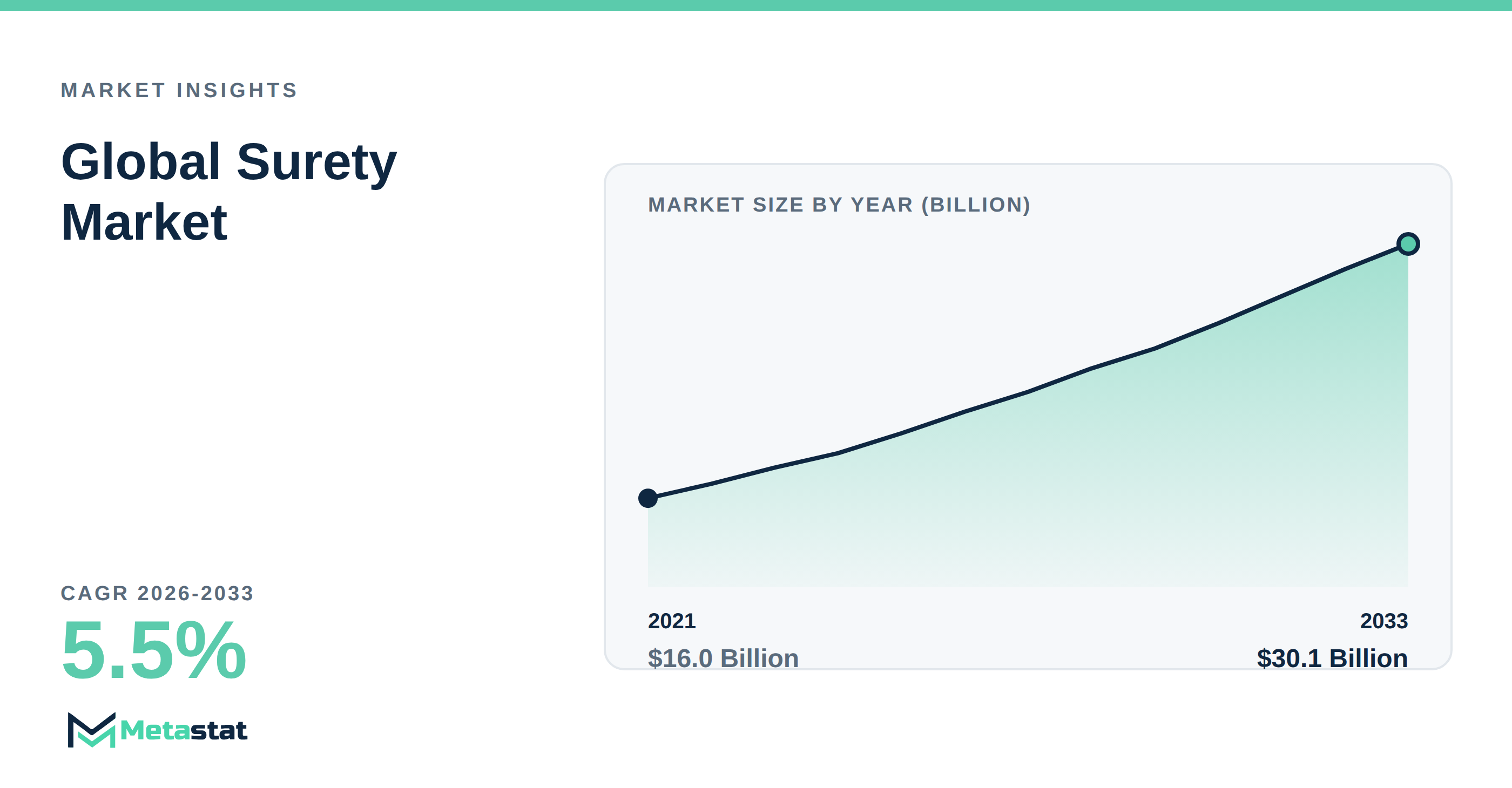
The Surety market is set to expand from USD 19.6 billion in 2025 to USD 30.1 billion by 2033. Understanding key growth factors and emerging challenges is essential for stakeholders.
Significant shifts in the Surety market are on the horizon, attributed to projections indicating growth from USD 19.6 billion in 2025 to USD 30.1 billion by 2033. Understanding the key factors influencing this expansion and what challenges arise is crucial for stakeholders aiming to capitalize on emerging opportunities.
What trends drive growth in the Surety market?
Growth in the Surety market is predominantly fueled by increasing demand from sectors including construction and engineering. These industries employ surety bonds to enhance project reliability and mitigate risks associated with contract fulfillment. In particular, the North American region is poised for notable growth, anticipated to reach USD 12.7 billion by 2033. A robust regulatory environment in North America encourages compliance and risk management practices, enhancing confidence among investors and businesses.
How do regulatory challenges impact the market?
Regulatory compliance remains a significant concern for the Surety market. While adherence to regulations is essential for operational integrity, navigating the complex legal frameworks complicates business strategies and increases administrative burdens. Companies incur substantial costs to ensure compliance, which hinders their competitiveness. Economic downturns and inflationary pressures further strain financial resources and deter investment in new construction projects, impacting the demand for surety bonds.
Which segments show the most potential for growth?
The segmentation of the Surety market reveals promising areas for growth. Contract Surety Bonds are projected to increase from USD 12.4 billion in 2026 to USD 17.8 billion by 2033, driven primarily by robust construction activity that requires performance guarantees. Commercial Surety Bonds exhibit substantial potential, expected to achieve USD 7.6 billion by 2033, influenced by expanding regulatory frameworks across various sectors. The growth of Judicial Surety Bonds and Fidelity Bonds indicates a broadening landscape of financial assurance beyond traditional sectors, suggesting diverse opportunities for growth.
What technological advancements should be monitored?
Technological integration in the Surety market is reshaping how services are delivered. The rise of digital platforms facilitates faster access to surety products and enhances customer experiences. The market anticipates a significant boost in the value of digital platforms, projected to reach USD 4.7 billion by 2033. Companies adopting technology to streamline their processes gain a competitive advantage, crucial because customer expectations evolve. Stakeholders should monitor emerging technologies that enhance operational efficiencies and improve compliance management.
What are the environmental considerations influencing the market?
Sustainability is becoming a focal point for many companies in the Surety market. Increased awareness of environmental issues compels organizations to adopt sustainable practices. Incorporating green initiatives not only enhances brand reputation but aligns operations with global sustainability objectives. The push toward sustainable transformation drives innovation in bonding solutions, catering to emerging industries and enhancing overall market growth.
Awareness of these trends and challenges will be crucial for stakeholders in the Surety market. For more comprehensive insights, the Global Surety Market report provides detailed analysis and projections.
Tags
About the Authors

LEAD ANALYST
Utkarsh Khirodkar is a Lead Market Research Analyst at MetaStat Insight, specializing in market intelligence, technology sector assessments, and competitive strategy.

PRINCIPAL CONSULTANT - ENTERPRISE AI & EMERGING TECHNOLOGIES
Banking & Finance · Electronics and Semiconductor · Energy and Power · Healthcare IT · Information & Technology · Professional Services
Vijay Gunti is a Principal Consultant at MetaStat Insight, bringing over two decades of experience across enterprise digital transformation, technology strategy, and intelligent systems.