
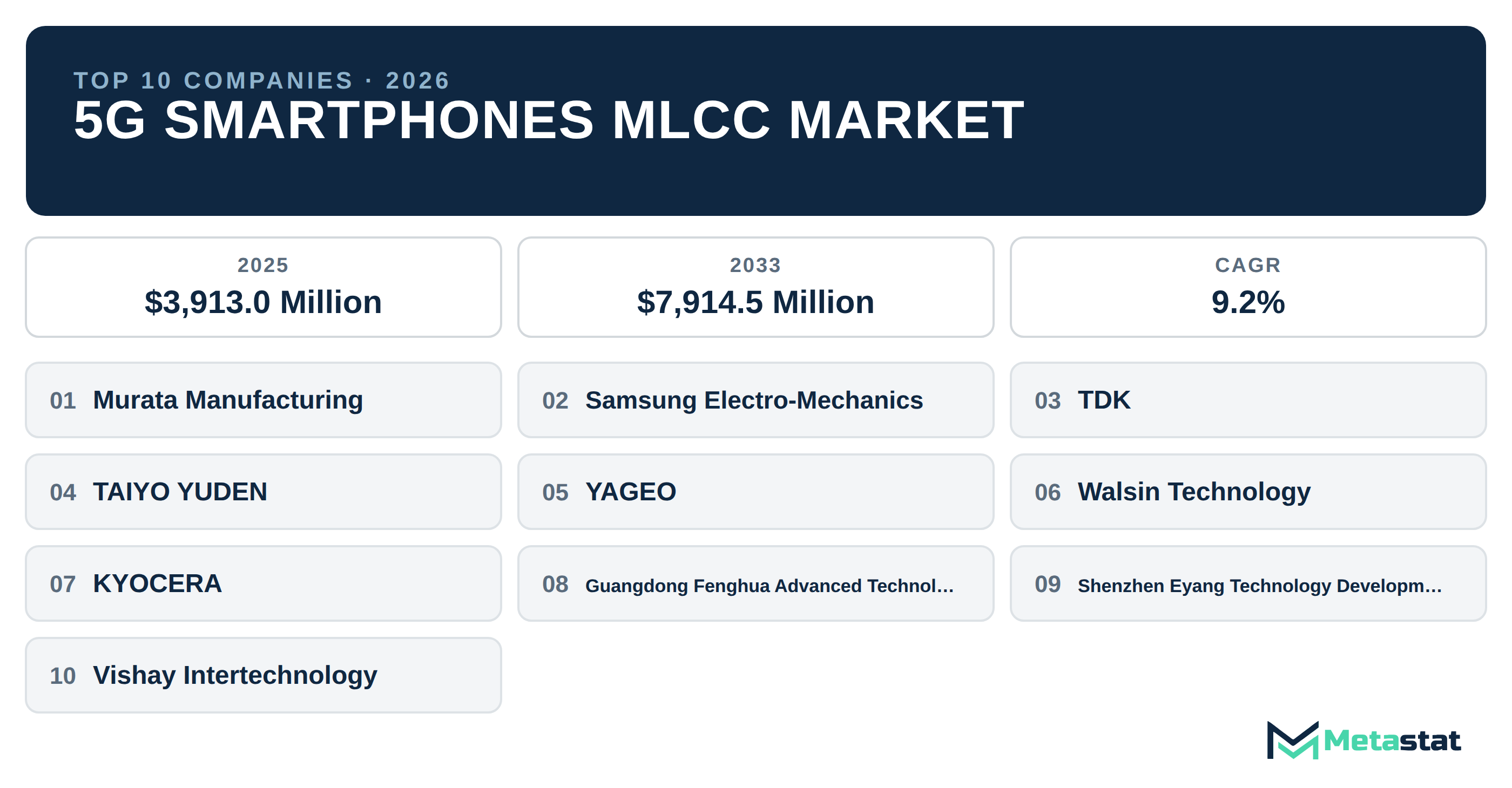
Explore the top 10 companies in the Global 5G Smartphones MLCC Market, projected to grow from USD 3,913 Million in 2025 to USD 7,914.5 Million by 2033.
The Global 5G Smartphones MLCC Market is valued at USD 3,913 Million in 2025 and is projected to reach USD 7,914.5 Million by 2033, growing at a CAGR of 9.2%. This market encompasses various types of Multi-Layer Ceramic Capacitors (MLCCs) specifically designed for 5G smartphones, including general-purpose, high-Q, and low-ESL MLCCs. Key drivers include the growing demand for higher performance in mobile communications, fuelled by the expansion of 5G technology and increasing smartphone penetration.
Innovations in MLCC technology contribute significantly to enhancing the efficiency and functionality of smartphones. Manufacturers focus on improving capacitance and size to meet the requirements of advanced applications, thereby supporting the overall growth of the 5G Smartphones MLCC market.
Global 5G Smartphones MLCC Market Size, Data, & Statistics
The market size for the Global 5G Smartphones MLCC Market in 2021 reached USD 2,783 Million. This value saw an increase to USD 3,014 Million in 2022, followed by a further rise to USD 3,303.2 Million in 2023. The forecast for 2024 indicates this market will grow to USD 3,571.2 Million.
In 2025, the market is expected to reach USD 3,913 Million, with projections suggesting it will expand to USD 4,284.5 Million in 2026. The market will continue its upward trajectory, with an estimated value of USD 4,686.1 Million in 2027 and USD 5,128.3 Million in 2028.
The market will achieve a value of USD 5,556.5 Million in 2029, USD 6,099.6 Million in 2030, and USD 6,669.9 Million in 2031. By 2032, it is expected to reach USD 7,297.8 Million, culminating in a projected size of USD 7,914.5 Million by 2033. This growth reflects a compound annual growth rate (CAGR) of 9.2% from 2025 to 2033.
Regional shares highlight significant market presence, with Asia Pacific leading at 68.6%. North America accounts for 11.5%, Europe for 9.6%, South America for 4.3%, and the Middle East and Africa for 6%.
Top 10 Trends in the Global 5G Smartphones MLCC Market
Inline metrology moves onto the production line
The incorporation of inline metrology is transforming production processes, allowing for real-time quality control. This change enhances manufacturing efficiency and product reliability, enabling manufacturers to promptly address quality issues, thereby reducing waste and improving overall yield.
Miniaturization drives MLCC development
Miniaturization in smartphones has led to a demand for smaller MLCCs that offer higher capacitance. Manufacturers are focusing on developing ultra-small and low-profile MLCCs that fit into compact designs while maintaining performance, catering to the evolving needs of smartphone producers.
Increased focus on high-Q MLCCs
The shift towards 5G technology emphasizes the need for high-Q MLCCs due to their superior performance in high-frequency applications. This demand influences production strategies, prompting manufacturers to invest in advanced materials and techniques to enhance quality and performance.
Expansion of multi-terminal MLCCs
Multi-terminal MLCCs are gaining traction as they provide higher capacitance in smaller packages. This trend supports the development of devices with advanced functionalities and encourages manufacturers to innovate in capacitor design to improve performance and efficiency.
Integration of AI in manufacturing
Artificial intelligence is being integrated into MLCC manufacturing processes to optimize production schedules and enhance quality control. This technological advancement helps reduce operational costs while ensuring the consistency of product quality, appealing to manufacturers focusing on competitive advantage.
Rising demand for low-ESL MLCCs
Low Equivalent Series Inductance (ESL) MLCCs are increasingly important in high-speed applications, including 5G smartphones. Their ability to minimize signal loss at high frequencies drives manufacturers to prioritize the development and production of these components, aligning with market demands.
Focus on sustainability in materials
Sustainability drives manufacturers to explore eco-friendly materials in MLCC production. This shift addresses environmental concerns and aligns with consumer preferences for sustainable products, affecting the choice of materials and production processes in the industry.
Collaboration across supply chains
Collaborations among manufacturers, suppliers, and technology firms are becoming common to enhance MLCC performance and address supply chain challenges. Such partnerships facilitate knowledge sharing and resource optimization, contributing to the overall resilience and adaptability of the market.
Advancements in dielectric materials
Research and development in dielectric materials continually improve the performance of MLCCs. The emergence of new materials enhances capacitance and stability, supporting the evolution of technologies within the 5G smartphones market.
Increased investment in R&D
Increased investment in research and development is vital for staying competitive in the dynamic 5G landscape. Companies are channeling resources into developing innovative MLCC solutions, ensuring they meet the demands of high-performance devices and adapt to changing market conditions.
Top 10 Companies in the Global 5G Smartphones MLCC Market
1. Murata Manufacturing Co., Ltd.
Founded: 1944
Murata Manufacturing Co., Ltd. specializes in the development and production of innovative electronic components, including MLCCs. The company offers a wide range of capacitors that support advanced telecommunications technology. Focused on research and development, Murata aims to deliver high-quality products that meet the demands of the evolving smartphone industry.
With its extensive experience in manufacturing, Murata leverages advanced techniques to produce reliable and efficient MLCCs. Their commitment to quality and innovation helps ensure that their products perform well in high-frequency applications, making them a preferred choice among smartphone manufacturers.
2. Samsung Electro-Mechanics Co., Ltd.
Founded: 1973
Samsung Electro-Mechanics Co., Ltd. is a key player in the electronics sector, providing a diverse array of components, including MLCCs for 5G smartphones. The company focuses on producing high-performance capacitors that cater to the increasing demands of advanced mobile communication technologies. Through continuous innovation, Samsung aims to enhance the efficacy of their products, ensuring compatibility with next-generation smartphones.
Emphasizing quality and technological advancement, Samsung Electro-Mechanics invests heavily in research and development. This dedication allows the company to stay relevant in the MLCC market, offering solutions that meet the complex requirements of 5G applications.
3. TDK Corporation
Founded: 1935
TDK Corporation offers a broad range of electronic components, including MLCCs designed for 5G smartphones. The company prioritizes innovation and high-quality production to support the growing requirements of the telecommunications industry. TDK's focus on advanced technology positions it to address the needs of manufacturers striving for enhanced performance in mobile devices.
With a commitment to sustainability, TDK integrates eco-friendly practices into its production processes. This approach not only meets regulatory standards but also appeals to environmentally-conscious consumers, enhancing TDK's reputation in the competitive MLCC market.
4. TAIYO YUDEN CO., LTD.
Founded: 1950
TAIYO YUDEN CO., LTD. specializes in the manufacture of electronic components, including MLCCs for 5G applications. The company is recognized for its dedication to quality and innovation, providing capacitors that enhance the performance of smartphones. TAIYO YUDEN invests in advanced manufacturing technologies to ensure its products meet the high standards expected by the market.
The company maintains a strong focus on research and development, promoting innovation in capacitor design and functionality. This commitment enables TAIYO YUDEN to respond effectively to the demands of the rapidly evolving 5G landscape.
5. YAGEO Corporation
Founded: 1977
YAGEO Corporation is a prominent manufacturer of passive components, including MLCCs designed for the 5G smartphone market. The company emphasizes quality and innovation, continually enhancing its product offerings to meet the rigorous demands of modern electronic devices. YAGEO's diverse product range supports various applications, positioning it as a reliable partner in the telecommunications sector.
With a commitment to sustainability, YAGEO adopts eco-friendly practices in its manufacturing processes. This focus aligns with global trends towards environmentally responsible production, appealing to conscious consumers and enhancing YAGEO's competitive edge.
6. Walsin Technology Corporation
Founded: 1992
Walsin Technology Corporation specializes in producing passive components, specifically MLCCs for 5G smartphones. The company emphasizes innovation and quality, ensuring its products meet the evolving needs of the telecommunications industry. Walsin's commitment to excellence drives its efforts to enhance product performance and reliability.
By investing in research and development, Walsin Technology Corporation aims to stay ahead of industry trends. Their proactive approach allows them to adapt to the changing demands of the smartphone market while providing high-quality MLCCs for various applications.
7. KYOCERA Corporation
Founded: 1959
KYOCERA Corporation manufactures a wide range of electronic components, including MLCCs suitable for 5G smartphones. The company is known for its rigorous quality standards and innovative approaches in producing capacitors that meet the demands of advanced telecommunications. KYOCERA's extensive experience in the industry enables it to provide reliable solutions to its customers.
With a focus on sustainability, KYOCERA integrates eco-friendly practices into its manufacturing processes. This commitment not only addresses environmental concerns but also enhances the company’s reputation among consumers who prioritize sustainable products.
8. Guangdong Fenghua Advanced Technology Holding Co., Ltd.
Founded: 1997
Guangdong Fenghua Advanced Technology Holding Co., Ltd. specializes in the production of electronic components, including MLCCs for 5G smartphones. The company's dedication to quality and technological advancement positions it as a competitive player in the market. Guangdong Fenghua focuses on developing products that meet the needs of telecommunications companies while ensuring high performance and reliability.
The company invests in research and development to enhance its manufacturing capabilities. By prioritizing innovation, Guangdong Fenghua aims to deliver advanced solutions that contribute positively to the rapidly evolving 5G landscape.
9. Shenzhen Eyang Technology Development Co., Ltd.
Founded: 2010
Shenzhen Eyang Technology Development Co., Ltd. offers a range of electronic components, including MLCCs designed for 5G smartphones. The company emphasizes quality and innovation, ensuring its products cater to the demands of modern telecommunications technologies. Shenzhen Eyang's approach to product development focuses on enhancing performance and adaptability in the competitive market.
By investing in advanced manufacturing techniques, Shenzhen Eyang aims to produce reliable MLCCs that meet the needs of various applications. Their commitment to quality positions them as a valuable partner for smartphone manufacturers.
10. Vishay Intertechnology, Inc.
Founded: 1962
Vishay Intertechnology, Inc. is a leading manufacturer of electronic components, including MLCCs for 5G smartphones. The company focuses on delivering high-quality products that support the evolving needs of the telecommunications sector. Vishay's commitment to innovation and quality ensures its components perform reliably in various applications.
With a strong emphasis on research and development, Vishay Intertechnology is well-positioned to meet the challenges of the dynamic 5G market. Their ongoing efforts contribute to advancements in capacitor technology, making them a notable player in the industry.
Conclusion
The Global 5G Smartphones MLCC Market is poised for significant growth, with a forecast reaching USD 7,914.5 Million by 2033. This growth reflects the increasing demand for advanced mobile communication technologies that rely heavily on MLCCs for functionality and performance. The investments made by the top 10 companies in this market underscore their commitment to innovation and quality.
For stakeholders and manufacturers, understanding the landscape of 5G Smartphones MLCC companies is essential for navigating the evolving market. The focus on research and development, coupled with sustainable practices, will likely shape future advancements in this sector, offering opportunities for collaboration and growth.
Tags
About the Authors

LEAD ANALYST
Utkarsh Khirodkar is a Lead Market Research Analyst at MetaStat Insight, specializing in market intelligence, technology sector assessments, and competitive strategy.

PRINCIPAL CONSULTANT - ENTERPRISE AI & EMERGING TECHNOLOGIES
Banking & Finance · Electronics and Semiconductor · Energy and Power · Healthcare IT · Information & Technology · Professional Services
Vijay Gunti is a Principal Consultant at MetaStat Insight, bringing over two decades of experience across enterprise digital transformation, technology strategy, and intelligent systems.

PRINCIPAL CONSULTANT - QUALITY SYSTEMS & COMPLIANCE
Electronics and Semiconductor · Machinery & Equipment · Professional Services
Omkar Phadtare is an Industry Consultant at MetaStat Insight, specializing in quality systems, regulatory compliance, and standards benchmarking to drive data-driven market intelligence and strategic industry research.
ENERGY & INFRASTRUCTURE INDUSTRY CONSULTANT
Automotive and Transportation · Electronics and Semiconductor · Energy and Power · Machinery & Equipment
Saurabh Vasant Ganvir consults for Energy & Infrastructure Industry at MetaStat Insight, specializing in renewable energy, solar EPC, and electric vehicle (EV) infrastructure markets.

LEAD CONSULTANT - COMMUNICATION, TELECOM, AND IT
Electronics and Semiconductor · Information & Technology · Machinery & Equipment · Professional Services
Ravindra Sathe Consultants for Communication, Telecom, and IT at MetaStat Insight. He leads the firm's industry research initiatives across telecommunications infrastructure, digital connectivity, enterprise networking, and emerging information technology domains.