
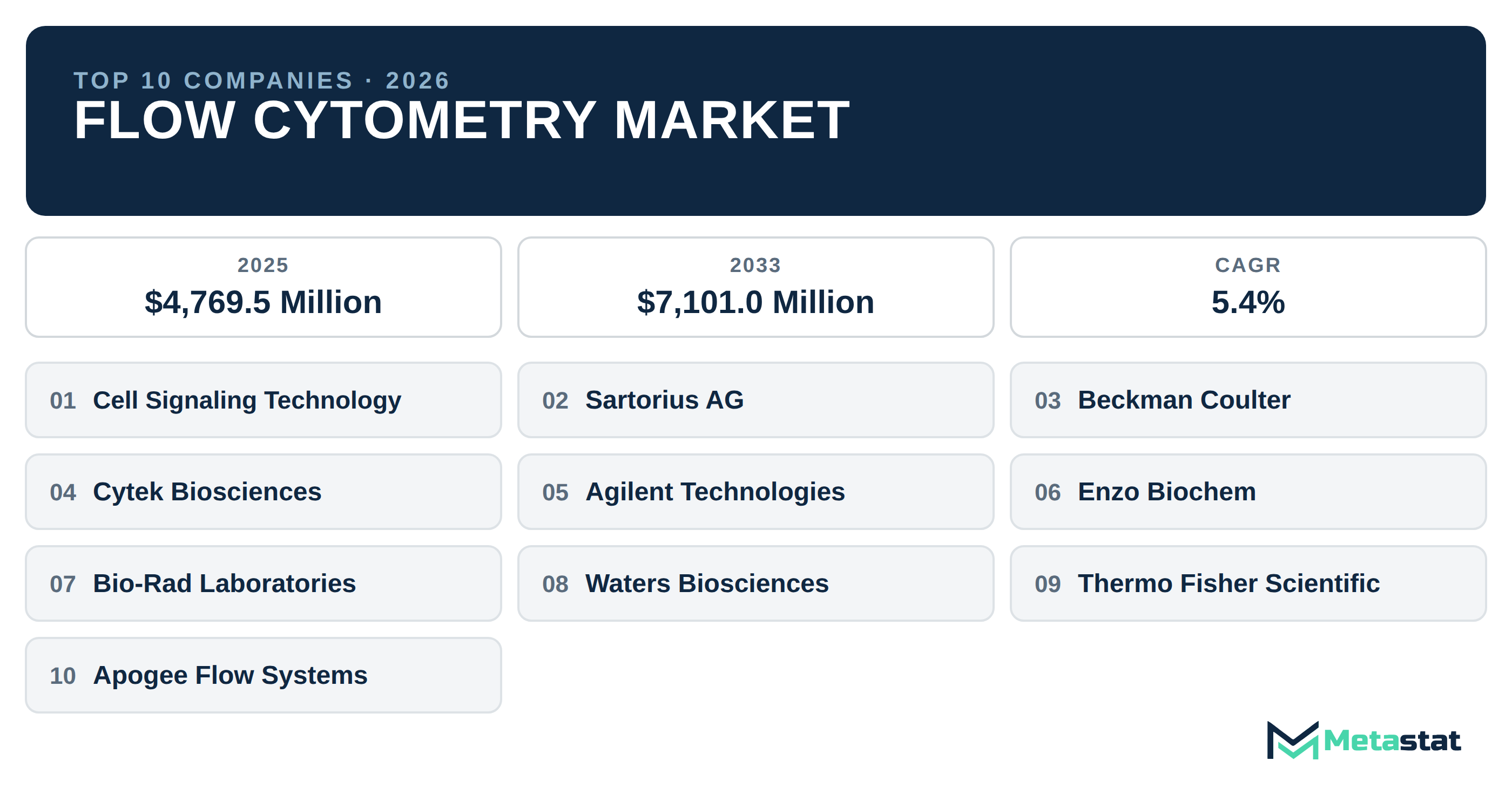
Explore the top 10 companies in the Flow Cytometry industry, highlighting their contributions and innovations in this dynamic sector.
The Flow Cytometry industry plays an essential role in various research and clinical applications, enabling scientists and healthcare professionals to analyze and sort cells with precision. Buyers range from academic and research institutes to pharmaceutical and biotechnology companies, as well as hospitals and clinical testing laboratories. Rapid advancements in technology and a growing emphasis on personalized medicine influence the direction of this sector. For detailed insights, refer to our Flow Cytometry market size and forecast report.
Top 10 Flow Cytometry Trends
Inline metrology moves onto the production line
Recent developments in integrated inline metrology allow for real-time monitoring during production processes. This innovation improves quality assurance and product consistency, particularly in biopharmaceutical manufacturing, where precise cell analysis is crucial.
Growth in personalized medicine
The demand for personalized medicine drives the need for advanced flow cytometry technologies. Tailored therapies rely on accurate cellular profiling, prompting manufacturers to innovate and provide sophisticated analytical tools that support this evolution.
Increased automation in laboratories
Automation in flow cytometry laboratories enhances efficiency and throughput. Lab personnel focus on complex analyses while automated systems handle routine tasks, thereby boosting productivity and reducing human error in cell sorting and analysis.
Emergence of microfluidics
Microfluidic technologies are transforming flow cytometry by enabling miniaturization and integration of processes. These advancements lead to faster analyses and lower sample volumes, making flow cytometry more accessible for various applications.
Integration of artificial intelligence
Artificial intelligence improves data interpretation in flow cytometry. Algorithms analyze complex datasets, leading to quicker insights and better decision-making in research and clinical diagnostics, thus streamlining workflows.
Demand for multi-parameter analysis
Multi-parameter flow cytometry allows for comprehensive cell characterization, providing deeper insights into cellular functions and interactions. This capability responds to the growing complexity of biological questions and therapeutic developments.
Focus on user-friendly platforms
Manufacturers are prioritizing user-friendly interfaces in flow cytometry instruments. Simplified operation and intuitive designs facilitate broader usage among researchers, enhancing the technology's adoption across various sectors.
Advancements in reagents and consumables
Innovations in reagents and consumables support the evolving needs of flow cytometry applications. Improved reagents enhance detection capabilities, while optimized consumables contribute to accurate and reproducible results.
Regulatory developments in diagnostics
As flow cytometry plays a key role in clinical diagnostics, regulatory frameworks surrounding its use are becoming more stringent. Companies must navigate these regulations to ensure compliance while continuing to innovate.
Collaboration between academia and industry
Partnerships between academic institutions and biotechnology companies stimulate innovation in flow cytometry. Collaborative research initiatives drive the development of advanced technologies, addressing unmet needs in diagnostics and therapeutics.
Flow Cytometry Companies Profiled
1. Cell Signaling Technology, Inc.
Founded: 2000
Cell Signaling Technology, Inc. focuses on providing high-quality antibodies and reagents essential for cell signaling research. The company is known for developing innovative tools that enable researchers to study complex cellular processes. Committed to scientific rigor, Cell Signaling Technology aims to advance cell biology and molecular biology through its products, supporting academic and clinical research globally.
2. Sartorius AG
Founded: 1870
Sartorius AG specializes in providing laboratory and bioprocess solutions, including flow cytometry technologies. The company emphasizes accuracy and efficiency in its offerings, serving a diverse range of customers in the pharmaceutical and biotechnology sectors. Sartorius' innovative solutions are designed to meet the rigorous demands of life science research and production, reinforcing its reputation in the industry.
3. Beckman Coulter, Inc.
Founded: 1935
Beckman Coulter, Inc. has established itself as a key player in laboratory instruments and reagents, with a strong portfolio in flow cytometry. The company provides advanced analytical solutions that streamline laboratory workflows and enhance research capabilities. Its commitment to innovation is evident in its continuous development of technologies that support clinical diagnostics and life sciences research.
4. Cytek Biosciences
Founded: 2014
Cytek Biosciences is recognized for its innovations in flow cytometry, particularly in the area of multi-color analysis. The company focuses on expanding the capabilities of flow cytometry systems to improve cellular analysis across various applications. Its user-friendly instruments and software solutions are designed to enhance the research experience for scientists in diverse fields.
5. Agilent Technologies, Inc.
Founded: 1999
Agilent Technologies, Inc. offers a broad range of solutions for life sciences, including flow cytometry products that cater to researchers in genomics and proteomics. Known for its commitment to quality and performance, Agilent strives to deliver innovative technologies that facilitate scientific discovery. The company’s expertise in analytical instruments positions it well within the flow cytometry space.
6. Enzo Biochem Inc.
Founded: 1976
Enzo Biochem Inc. specializes in biotechnology and life sciences, providing a range of products and services that support flow cytometry applications. The company is dedicated to developing high-quality reagents and assay systems that aid researchers in their studies. Enzo's focus on innovation and customer satisfaction drives its efforts in the biotechnology arena.
7. Bio-Rad Laboratories, Inc.
Founded: 1952
Bio-Rad Laboratories, Inc. is a prominent provider of life science research and clinical diagnostics tools, including flow cytometry solutions. With a commitment to quality and innovation, Bio-Rad develops an extensive range of reagents, instruments, and software that enhance research capabilities. The company supports various scientific disciplines, facilitating advancements in healthcare and research.
8. Waters Biosciences (BD Biosciences)
Founded: 1970
Waters Biosciences, a part of BD Biosciences, focuses on providing advanced flow cytometry solutions for researchers in life sciences and clinical diagnostics. The company emphasizes the development of innovative technologies that enhance cellular analysis and profiling. Its commitment to excellence and customer service positions Waters Biosciences as a trusted partner in the scientific community.
9. Thermo Fisher Scientific Inc.
Founded: 2006 (merger of Thermo Electron and Fisher Scientific)
Thermo Fisher Scientific Inc. is a leading provider of scientific instrumentation, reagents, and consumables, with a strong presence in flow cytometry. The company develops comprehensive solutions that cater to various research and clinical applications, supporting scientists in their quest for discovery. Its broad portfolio facilitates advancements in life sciences and enhances laboratory productivity.
10. Apogee Flow Systems Ltd.
Founded: 2002
Apogee Flow Systems Ltd. specializes in developing advanced flow cytometry instruments and software solutions. The company focuses on providing high-performance systems that enable precise cell analysis and sorting. With a commitment to innovation and customer support, Apogee aims to advance the capabilities of flow cytometry in various research fields.
Conclusion
The Flow Cytometry industry is poised for continued innovation, driven by advancements in technology and increasing demand for personalized medicine. Companies listed here represent a diverse range of expertise and solutions, reflecting the sector's dynamic nature. Collaboration between academia and industry will likely further stimulate developments in flow cytometry.
As researchers and healthcare professionals explore the potential of flow cytometry, understanding the capabilities of these companies is essential. For comprehensive insights into the industry, consider exploring our Global Flow Cytometry Market report.
Tags
About the Authors

LEAD ANALYST
Utkarsh Khirodkar is a Lead Market Research Analyst at MetaStat Insight, specializing in market intelligence, technology sector assessments, and competitive strategy.

LEAD PRINCIPAL ANALYST, PHARMA AND HEALTHCARE
Food and Beverages · Healthcare · Healthcare IT · Medical Devices
Ajay Devgire is the Lead Healthcare Analyst at MetaStat Insight, leading strategic research and market intelligence initiatives across the global healthcare domain.

SENIOR RESEARCH ANALYST
Biotechnology · Food and Beverages · Medical Devices · Packaging
Snehal Pasalkar is a Research Analyst at MetaStat Insight, operating at the intersection of life sciences research, competitive strategy, and market intelligence.