
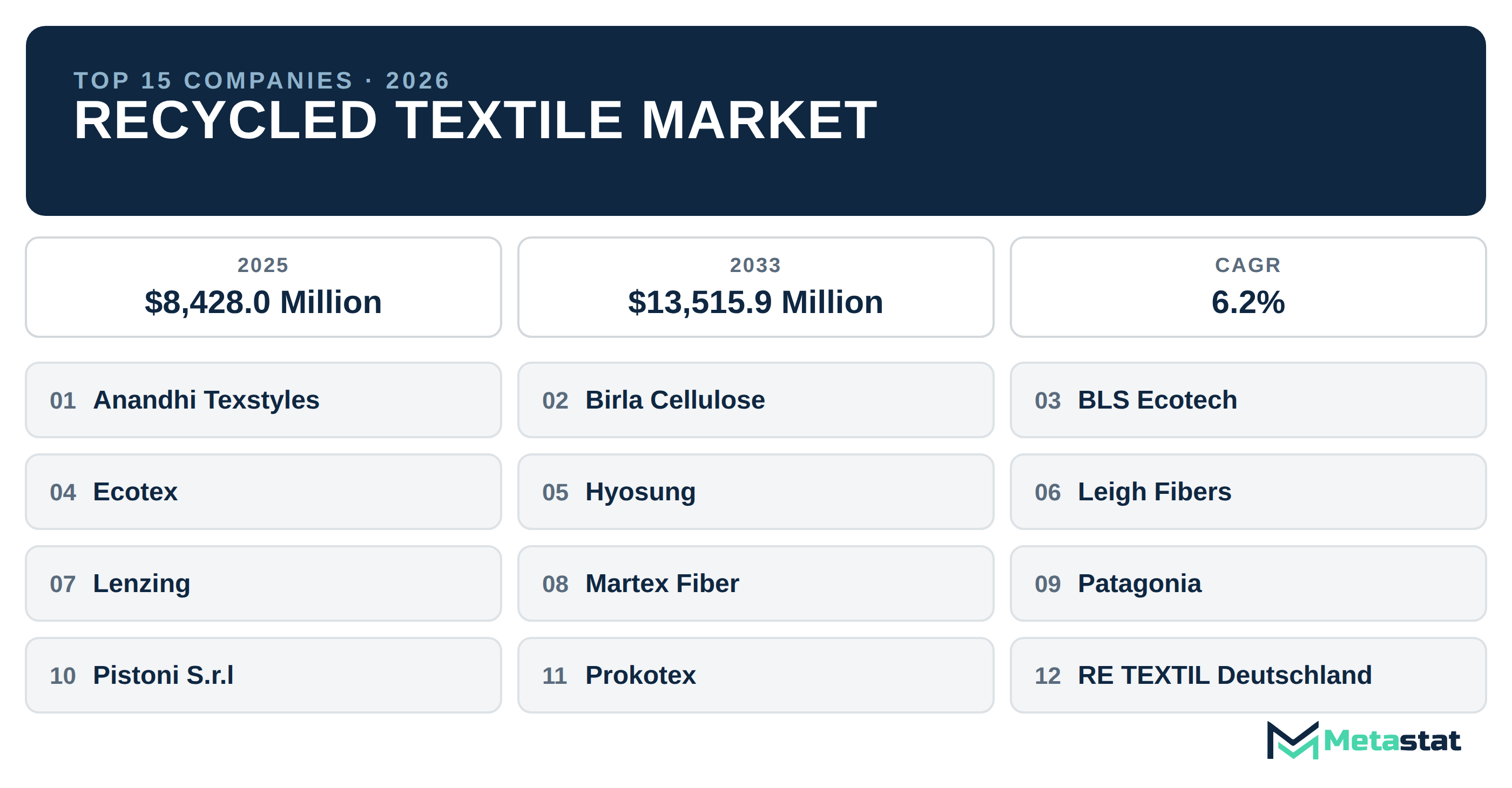
Explore the Global Recycled Textile Market, valued at USD 8,428 Million in 2025 and projected to reach USD 13,515.9 Million by 2033, highlighting 15 key companies.
The Global Recycled Textile Market is valued at USD 8,428 Million in 2025 and is projected to reach USD 13,515.9 Million by 2033, growing at a CAGR of 6.2%. This market encompasses textiles that are recycled from various sources, including post-consumer and pre-consumer textile waste. The demand for sustainable practices and eco-friendly products drives growth in this sector, as industries shift towards reducing waste and enhancing sustainability.
Recycled textiles find applications in multiple areas such as apparel, home furnishings, and industrial uses. The increasing awareness of environmental issues is fueling interest in recycled materials, encouraging companies to innovate in recycling technologies and processes.
Global Recycled Textile Market Size, Data, & Statistics
In 2021, the Global Recycled Textile Market was valued at USD 6,798.6 Million. This figure increased to USD 6,957.5 Million in 2022 and further rose to USD 7,507.6 Million in 2023. The market continued its upward trajectory, reaching USD 7,977.8 Million in 2024.
The market is expected to grow significantly, reaching USD 8,428 Million by 2025. By 2026, the value will rise to USD 8,881.7 Million, followed by USD 9,348.8 Million in 2027. This growth pattern continues with projections of USD 9,876.2 Million by 2028.
The market is forecasted to reach USD 10,471.1 Million in 2029 and USD 11,109.8 Million by 2030. The upward trend continues with an anticipated value of USD 11,776.4 Million in 2031, USD 12,673.2 Million in 2032, and ultimately USD 13,515.9 Million in 2033.
The CAGR for this market from 2025 to 2033 is estimated at 6.2%. Regional shares indicate North America comprising 24%, Europe at 27.5%, Asia Pacific leading with 41.7%, South America at 3.6%, and the Middle East and Africa holding 3.2%.
Top 10 Trends in the Global Recycled Textile Market
Inline metrology moves onto the production line
Integrating inline metrology into production processes enhances quality control. This shift reduces waste and ensures that products meet specifications. It allows manufacturers to respond quickly to defects, maintaining a high standard in recycled textiles.
Technological innovations in recycling
Advancements in recycling technologies improve efficiency and output. Companies invest in research to enhance chemical recycling methods, allowing for higher quality fibre recovery. These innovations support the rising demand for sustainable textiles.
Increased consumer demand for sustainable products
Consumers are prioritizing sustainability in their purchases. This trend drives brands to adopt recycled materials in their offerings. Companies that highlight their sustainability commitment attract more environmentally-conscious customers.
Expansion of collection networks
Enhanced collection networks for textile waste facilitate recycling efforts. These networks make it easier for consumers to recycle unwanted textiles. Improved accessibility supports higher recycling rates and reduces landfill contributions.
Collaboration across the supply chain
Partnerships among stakeholders in the textile supply chain boost innovation and recycling capacity. Collaborative efforts allow companies to share best practices and technologies, accelerating the transition to a circular economy.
Regulatory pressures on waste management
Regulations regarding textile waste management are becoming stricter. Companies are required to adopt sustainable practices, pushing them to integrate recycled materials into their product lines. Compliance with these regulations shapes market dynamics.
Focus on circular economy principles
Shifting towards a circular economy minimizes waste and maximizes resource use. This principle encourages companies to design products for reuse and recycling, reinforcing the demand for recycled textiles.
Emerging markets invest in recycling infrastructure
Developing countries are investing in recycling infrastructure to support sustainable practices. These investments increase the capacity for processed recycled textiles, expanding market reach and opportunities in those regions.
Education and awareness initiatives
Educational campaigns about the benefits of recycled textiles are gaining traction. Raising awareness among consumers leads to higher acceptance of recycled materials, further driving market growth.
Integration of digital technologies
Digital technologies streamline recycling processes and enhance traceability. Implementing these tools allows companies to monitor quality and sustainability metrics, ensuring compliance with industry standards.
Top 15 Companies in the Global Recycled Textile Market
1. Anandhi Texstyles Private Limited
Headquarters: Coimbatore, India · Founded: 1999. Anandhi Texstyles Private Limited is involved in the production of a range of textile products, focusing on sustainable practices. Their operations include recycling textile waste to create new fabric materials, catering to both domestic and international markets.
The company emphasizes eco-friendly processes in its manufacturing, contributing to the circular textile economy. Anandhi Texstyles aims to innovate in textile recycling, enhancing the quality and availability of recycled materials.
2. Birla Cellulose
Headquarters: Mumbai, India · Founded: 1998. Birla Cellulose specializes in producing sustainable fibers and fabrics made from recycled materials. The company is part of the Aditya Birla Group, renowned for its commitment to sustainability and innovative textile solutions.
By utilizing eco-friendly processes, Birla Cellulose supports the development of high-quality recycled textiles. Their focus on R&D enhances the performance of recycled fabrics, making them suitable for various applications.
3. BLS Ecotech
Founded: 2010. BLS Ecotech engages in recycling textile waste to create valuable resources. The company operates a range of recycling facilities that process various types of textile waste, contributing to sustainability efforts in the industry.
BLS Ecotech focuses on developing innovative recycling solutions that minimize environmental impact, positioning itself as a key player in the recycled textile market.
4. Ecotex Group
Founded: 2015. Ecotex Group is dedicated to recycling textiles and transforming waste into high-quality products. Their operations prioritize eco-friendly practices, aiming to reduce the textile industry's carbon footprint.
The company invests in advanced recycling technologies, ensuring that its processes yield sustainable materials for various textile applications. Ecotex Group champions the circular economy through its innovative approaches.
5. Hyosung Group
Headquarters: Seoul, South Korea · Founded: 1966. Hyosung Group is a global leader in textile manufacturing, emphasizing sustainable products. The company integrates recycled materials into its product lines, catering to the growing demand for eco-friendly textiles.
Hyosung's commitment to innovation is evident in its investment in research to develop new recycling methods. The group's diverse portfolio includes technical textiles and sustainable solutions that address market needs.
6. Leigh Fibers, Inc.
Headquarters: Spartanburg, South Carolina, USA · Founded: 1927. Leigh Fibers, Inc. specializes in recycling textile waste, focusing on sustainability and resource recovery. The company processes various textile materials to create sustainable fiber solutions.
Leigh Fibers emphasizes quality in its recycled products, serving a wide range of industries. Their commitment to environmental responsibility positions them as a reliable partner in the recycled textile market.
7. Lenzing Group
Headquarters: Lenzing, Austria · Founded: 1931. Lenzing Group is renowned for its sustainable fiber production, including recycled textiles. The company focuses on innovation and eco-friendly practices in its manufacturing processes.
Lenzing's products include several well-known brands that utilize recycled materials, enhancing the performance and sustainability of textiles. Their commitment to sustainability aligns with growing market demands.
8. Martex Fiber
Founded: 1990. Martex Fiber specializes in recycling textiles into high-quality fiber products. The company operates state-of-the-art recycling facilities to process textile waste efficiently.
Martex Fiber emphasizes innovation in its recycling methods, contributing to the availability of sustainable materials in the textile market. Their eco-friendly approach aligns with the industry's shift towards sustainability.
9. Patagonia, Inc.
Headquarters: Ventura, California, USA · Founded: 1973. Patagonia, Inc. is a leading outdoor clothing brand that prioritizes sustainable practices. The company utilizes recycled materials in its products, focusing on reducing environmental impact.
Patagonia's commitment to environmental responsibility influences its supply chain, encouraging the use of recycled textiles. Their initiatives support the circular economy and promote sustainability in the apparel industry.
10. Pistoni S.r.l.
Founded: 1996. Pistoni S.r.l. engages in the recycling of textiles, focusing on creating sustainable solutions for the industry. The company specializes in processing textile waste to produce new materials.
Pistoni's operations are characterized by a commitment to reducing waste and promoting eco-friendly practices. Their innovative recycling processes contribute to the circular textile economy.
11. Prokotex
Founded: 2012. Prokotex focuses on recycling textiles and transforming waste into new products. The company's approach emphasizes sustainability and resource efficiency.
Prokotex develops innovative recycling solutions that minimize environmental impact, supporting the growth of the recycled textile market. Their expertise in processing various textile materials positions them competitively in the industry.
12. RE TEXTIL Deutschland GmbH
Founded: 2005. RE TEXTIL Deutschland GmbH specializes in textile recycling, turning waste into valuable resources. The company operates facilities that focus on eco-friendly practices.
With a commitment to sustainability, RE TEXTIL Deutschland GmbH aligns its operations with market trends that prioritize recycled materials. Their initiatives support the circular economy in the textile sector.
13. Renewcell AB
Headquarters: Stockholm, Sweden · Founded: 2012. Renewcell AB is at the forefront of textile recycling, developing innovative processes to convert textile waste into high-quality materials. The company focuses on sustainability and resource efficiency.
Renewcell's pioneering efforts enhance the availability of recycled textiles, supporting market growth. Their commitment to eco-friendly practices aligns with increasing consumer demand for sustainable products.
14. Santanderina Group
Founded: 1958. Santanderina Group engages in the recycling of textiles, focusing on creating sustainable materials for the industry. The company aims to reduce waste and promote eco-friendly practices.
With a commitment to quality and sustainability, Santanderina Group contributes to the circular economy. Their innovations in recycling processes position them as a significant player in the recycled textile market.
15. Textile Recycling International
Founded: 2003. Textile Recycling International specializes in recycling and transforming textile waste into valuable resources. The company prioritizes eco-friendly practices in its operations.
By focusing on sustainability, Textile Recycling International supports the development of high-quality recycled textiles. Their efforts contribute to reducing the environmental impact of the textile industry.
Conclusion
The Global Recycled Textile Market is poised for substantial growth, driven by increasing consumer demand for sustainable products and innovations in recycling technologies. The diverse range of companies listed highlights the industry's commitment to sustainability, with each organization contributing uniquely to the market.
For stakeholders in the recycled textile sector, understanding these key players offers valuable insights into the market dynamics and opportunities for collaboration. Engaging with these Recycled Textile companies can lead to strategic partnerships that foster innovation and sustainability in the industry.
Tags
About the Authors

LEAD ANALYST
Utkarsh Khirodkar is a Lead Market Research Analyst at MetaStat Insight, specializing in market intelligence, technology sector assessments, and competitive strategy.

INDUSTRY CONSULTANT - CHEMICALS & ADVANCED MATERIALS
Chemicals and Materials · Machinery & Equipment · Packaging
Amit Gadhekar Consultant for Chemicals and Materials at MetaStat Insight, directing sector-specific intelligence, research, and strategic consulting across global chemical and processing markets.