
Explore the top 25 Decentralized Artificial Intelligence (DeAI) companies shaping the market from 2025 to 2033 with significant growth potential.
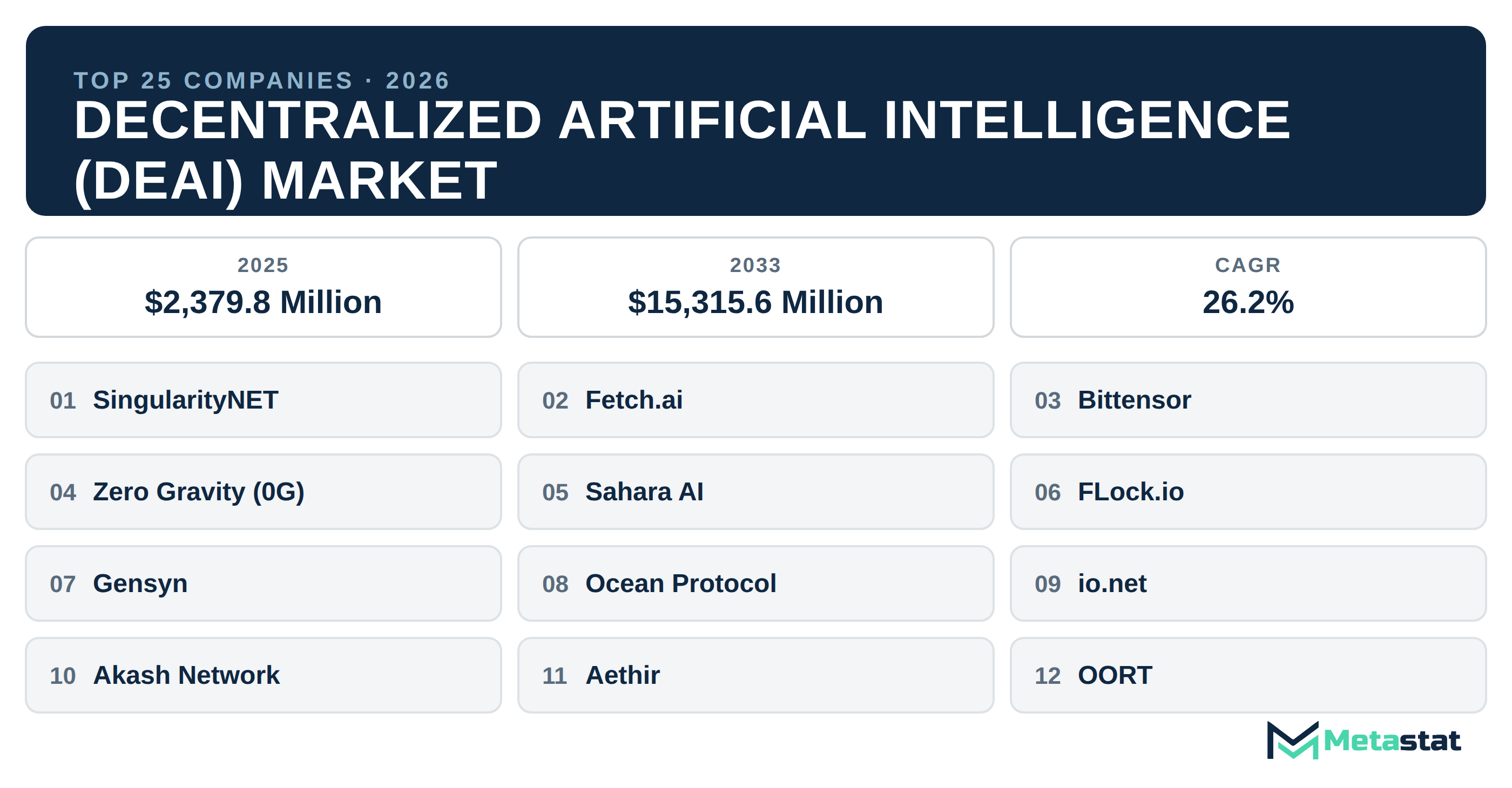
The Global Decentralized Artificial Intelligence (DeAI) Market is valued at USD 2,379.8 Million in 2025 and is projected to reach USD 15,315.6 Million by 2033, growing at a CAGR of 26.2%. This market encompasses a range of technologies that leverage decentralized networks to enhance the development and deployment of artificial intelligence applications. An increasing demand for more efficient data handling and AI functionalities across industries is propelling the growth of this sector.
Organizations are seeking to integrate AI capabilities to streamline operations, improve decision-making, and enhance customer engagement. The rise of decentralized models is becoming increasingly significant, allowing for greater transparency, security, and collaboration in the AI ecosystem.
Global Decentralized Artificial Intelligence (DeAI) Market Size, Data, & Statistics
The market was valued at USD 1,502.8 Million in 2023. This growth trajectory indicates an increasing investment and interest in decentralized AI technologies. The continuing evolution of AI applications across various sectors drives this upward momentum.
In 2025, the market size is expected to reach USD 2,379.8 Million. This figure highlights the growing recognition of the advantages that decentralized AI can offer over traditional centralized systems, such as improved data security and reduced costs.
The forecast for 2033 projects the market will expand to USD 15,315.6 Million. This substantial increase demonstrates the anticipated adoption of decentralized AI solutions across a broader range of industries and use cases.
With a CAGR of 26.2% from 2025 to 2033, the market is poised for significant growth, reflecting the accelerating integration of AI into everyday business practices.
The geographical distribution of the market shows North America accounting for 36.7%, Europe for 25.2%, and Asia Pacific for 28.7%. South America represents 5.2%, while the Middle East and Africa hold 4.2%. This distribution illustrates the diverse global interest in decentralized AI technologies.
Top 10 Trends in the Global Decentralized Artificial Intelligence (DeAI) Market
Enhanced data privacy through decentralization
Decentralized Artificial Intelligence (DeAI) enhances data privacy by allowing users to retain control over their data. This shift reduces reliance on central entities, mitigating risks associated with data breaches and misuse.
Increased collaboration among AI agents
The emergence of cooperative AI agents is reshaping how intelligence is developed and utilized. Collaborative protocols between agents enhance efficiency, enabling the sharing of resources and knowledge across platforms.
Growth of AI data marketplaces
AI data marketplaces are gaining traction, allowing organizations to buy and sell data securely. Decentralized frameworks facilitate trustless transactions, improving access to quality datasets for AI model training.
Focus on decentralization in AI model training
Decentralization is becoming a core strategy in AI model training, enabling distributed computational resources to be harnessed more effectively. This approach enhances scalability and reduces operational costs.
Evolution of tokenized incentives for participation
Tokenized incentives encourage participation in decentralized AI networks, rewarding users for contributing data and resources. This model fosters engagement and a collaborative ecosystem.
Rise of open-source AI solutions
Open-source solutions are increasingly prevalent in DeAI, promoting transparency and collaboration. Developers are more willing to contribute to projects, leading to faster innovation cycles.
Integration of blockchain for security
Blockchain technology is being integrated into DeAI solutions to enhance security and transparency. This integration ensures traceability and accountability in AI decision-making processes.
Adoption of federated learning techniques
Federated learning, which allows machine learning models to be trained across multiple decentralized devices, is gaining popularity. This approach retains data privacy while enhancing model accuracy through diverse datasets.
Expansion of decentralized cloud computing platforms
Decentralized cloud computing platforms are becoming integral to the DeAI ecosystem. These platforms provide scalable resources for AI applications, reducing reliance on traditional cloud providers.
Increased demand for AI explainability
There is a growing emphasis on AI explainability within decentralized models. Stakeholders are demanding transparency in AI decision-making, leading to the development of methods that clarify how models derive their conclusions.
Top 25 Companies in the Global Decentralized Artificial Intelligence (DeAI) Market
1. SingularityNET
Headquarters: Amsterdam, Netherlands · Founded: 2017. SingularityNET operates a decentralized platform for AI services, allowing anyone to create, share, and monetize AI technologies. The platform facilitates a marketplace where developers can connect their algorithms and users can access a range of AI capabilities, from machine learning to data processing.
This innovative ecosystem is structured to promote collaboration among developers and researchers, helping them leverage AI technologies more effectively. SingularityNET aims to democratize AI by providing tools and resources that are accessible to all.
2. Fetch.ai
Headquarters: Cambridge, United Kingdom · Founded: 2017. Fetch.ai provides a decentralized platform that enables autonomous agents to perform tasks. These agents can interact, negotiate, and execute services without human intervention, optimizing various processes across industries.
The technology behind Fetch.ai focuses on enabling collaborative networks, where these autonomous agents can share data and insights. This approach enhances efficiency and decision-making in sectors such as supply chain and smart cities.
3. Bittensor
Headquarters: San Francisco, United States · Founded: 2020. Bittensor is creating a decentralized network for machine learning that incentivizes participants to contribute computing power and data. This platform allows developers to create and train AI models collaboratively.
Bittensor's architecture is designed to reward users based on their contributions to the network. By promoting a collaborative environment, the platform enhances the capabilities of AI systems and encourages innovation.
4. Zero Gravity (0G)
Headquarters: Singapore · Founded: 2020. Zero Gravity focuses on building a decentralized ecosystem for AI applications, enabling developers to deploy AI services on a distributed network. The platform emphasizes scalability and accessibility for various use cases.
By leveraging decentralized technologies, Zero Gravity aims to create a more efficient and cost-effective environment for AI deployment. Their solutions enable smooth interaction between AI applications and users.
5. Sahara AI
Headquarters: Dubai, United Arab Emirates · Founded: 2021. Sahara AI develops decentralized AI solutions tailored for businesses, enabling them to implement AI technologies effectively. The platform focuses on providing tools for AI model development and deployment in various industries.
Sahara AI aims to simplify the integration of AI into existing systems, enhancing operational efficiency. Their solutions are designed to improve decision-making processes and provide practical insights for organizations.
6. FLock.io
Headquarters: London, United Kingdom · Founded: 2020. FLock.io offers a decentralized platform for AI collaboration and resource sharing. The platform facilitates the development of AI models by connecting developers and users in a collaborative environment.
FLock.io emphasizes the importance of community-driven innovation, allowing users to benefit from shared resources and knowledge. This approach enhances experimentation and accelerates the development of AI technologies.
7. Gensyn
Headquarters: Berlin, Germany · Founded: 2021. Gensyn is focused on creating a decentralized infrastructure for machine learning, enabling efficient model training and deployment. The platform allows developers to leverage distributed computing resources effectively.
By utilizing decentralized technologies, Gensyn aims to enhance the scalability and performance of AI applications. Their approach promotes collaboration among developers while ensuring data privacy and security.
8. Ocean Protocol
Headquarters: Singapore · Founded: 2017. Ocean Protocol provides a decentralized data exchange protocol that enables secure sharing and monetization of data. The platform allows data providers to maintain control over their data while enabling AI developers to access valuable datasets.
Ocean Protocol emphasizes the importance of data privacy and security, fostering collaboration between data providers and consumers. Their solutions are designed to create a more open data economy, benefiting both AI development and data owners.
9. io.net
Founded: 2020. io.net specializes in decentralized AI services, empowering developers to create innovative applications using AI technologies. The platform offers tools and frameworks for AI model development and integration.
By focusing on user-friendly solutions, io.net aims to lower barriers for entry into the AI space. Their commitment to decentralization promotes the responsible use of AI technologies across industries.
10. Akash Network
Headquarters: San Francisco, United States · Founded: 2017. Akash Network is a decentralized cloud computing platform that provides affordable and scalable resources for AI applications. The platform connects users with available computing power from a global network.
This approach enhances flexibility and cost-efficiency for AI developers, allowing them to deploy applications quickly. Akash Network's focus on decentralization ensures that users retain control over their computing resources.
11. Aethir
Founded: 2021. Aethir develops a decentralized platform for AI processing, emphasizing efficiency and accessibility. Their solutions cater to developers seeking to leverage AI technologies in their applications.
Aethir aims to simplify the deployment of AI models, enabling seamless integration into various systems. Their commitment to decentralization encourages innovation and cooperation among developers.
12. OORT
Founded: 2021. OORT focuses on building decentralized AI solutions that enhance data privacy and security. The platform enables users to retain control over their data while accessing AI capabilities.
By emphasizing user empowerment, OORT promotes responsible AI usage and collaboration across industries. Their solutions are designed to facilitate the secure exchange of data and AI services.
13. Nillion
Founded: 2021. Nillion offers decentralized solutions for AI applications, focusing on efficient data handling and processing. The platform provides developers with tools to create scalable AI models.
Nillion's approach emphasizes collaboration and innovation, fostering an environment where developers can experiment and improve AI technologies. Their solutions aim to enhance the performance of AI systems while ensuring data privacy.
14. Prime Intellect
Founded: 2021. Prime Intellect is focused on creating decentralized AI tools that enhance decision-making processes. Their platform provides resources for developers to build and deploy AI solutions effectively.
By promoting a collaborative environment, Prime Intellect encourages innovation and the sharing of knowledge among developers. Their focus on decentralization enhances the accessibility of AI technologies across various sectors.
15. Gradient
Founded: 2021. Gradient specializes in decentralized AI infrastructure, providing tools for model development and deployment. Their platform supports developers in creating and sharing AI applications.
Gradient aims to lower the barriers to entry for AI development, fostering collaboration and innovation among users. Their approach emphasizes the importance of data privacy and security in AI applications.
16. Olas
Founded: 2021. Olas offers a decentralized platform for AI collaboration, enabling developers to share resources and insights. The platform aims to foster a cooperative environment for AI innovation.
By leveraging decentralized technologies, Olas promotes transparency and collaboration in AI development. Their solutions enhance the capabilities of AI applications while ensuring data security.
17. Theta EdgeCloud
Founded: 2021. Theta EdgeCloud focuses on decentralized content delivery and computing for AI applications. Their platform allows users to share and monetize computing resources efficiently.
By emphasizing decentralization, Theta EdgeCloud enhances the accessibility and affordability of AI services. Their solutions promote a more collaborative ecosystem for AI development.
18. Nosana
Founded: 2021. Nosana is dedicated to building a decentralized infrastructure for AI applications, focusing on resource sharing and collaboration. Their platform allows developers to access distributed computing resources.
By promoting a cooperative environment, Nosana enhances the efficiency and scalability of AI solutions. Their commitment to decentralization ensures that users have control over their resources.
19. Render Network
Founded: 2020. Render Network offers decentralized rendering solutions for AI applications, allowing users to utilize computing power efficiently. Their platform enables developers to create high-quality AI models.
By leveraging distributed resources, Render Network promotes collaboration among developers, enhancing the capabilities of AI systems. Their focus on decentralization ensures that users retain control over their computing resources.
20. Phala Network
Founded: 2021. Phala Network focuses on building decentralized privacy-preserving solutions for AI applications. Their platform enables users to process data securely while utilizing AI capabilities.
By emphasizing data privacy, Phala Network fosters trust in AI technologies. Their solutions are designed to ensure that sensitive information remains protected while enabling access to AI functionalities.
21. Vana
Founded: 2021. Vana develops decentralized AI solutions that prioritize user privacy and control. The platform offers tools for developers to create and deploy AI applications securely.
Vana focuses on enabling users to retain ownership of their data while accessing AI technologies. Their commitment to decentralization promotes responsible and ethical AI usage.
22. Hyperbolic
Founded: 2021. Hyperbolic specializes in decentralized AI solutions that enhance collaboration among developers. The platform allows users to share resources and insights for improved AI model development.
By fostering a cooperative environment, Hyperbolic encourages innovation and knowledge sharing. Their solutions aim to facilitate the creation of advanced AI applications while ensuring data security.
23. CUDOS
Founded: 2021. CUDOS offers a decentralized computing platform for AI applications, emphasizing scalability and accessibility. The platform connects users with distributed computing resources to facilitate AI model development.
By leveraging decentralized technologies, CUDOS enhances the efficiency and performance of AI solutions. Their focus on community engagement promotes collaboration among developers.
24. Lumerin
Founded: 2021. Lumerin develops decentralized AI tools that prioritize user control and data security. The platform provides resources for developers to create and deploy AI technologies effectively.
By emphasizing decentralization, Lumerin promotes responsible use of AI applications. Their solutions are designed to enhance collaboration and innovation in the AI ecosystem.
25. Rivalz Network
Founded: 2021. Rivalz Network is focused on building a decentralized platform for AI services, enabling developers to share resources and insights. The platform fosters a collaborative environment for AI innovation.
By leveraging decentralized technologies, Rivalz Network enhances the capabilities of AI applications. Their commitment to user empowerment promotes responsible and ethical AI usage.
Conclusion
The Global Decentralized Artificial Intelligence (DeAI) Market is on a trajectory of substantial growth, with numerous innovative companies influencing this field. As the market matures, these companies are developing diverse solutions that enhance collaboration, privacy, and resource efficiency in AI applications.
Investors and businesses should consider the potential of Decentralized Artificial Intelligence (DeAI) companies as they explore opportunities for innovation and development in the AI landscape. The advancements in this sector promise to reshape various industries, offering significant benefits for early adopters.
Tags
About the Authors

LEAD ANALYST
Utkarsh Khirodkar is a Lead Market Research Analyst at MetaStat Insight, specializing in market intelligence, technology sector assessments, and competitive strategy.

PRINCIPAL CONSULTANT - ENTERPRISE AI & EMERGING TECHNOLOGIES
Banking & Finance · Electronics and Semiconductor · Energy and Power · Healthcare IT · Information & Technology · Professional Services
Vijay Gunti is a Principal Consultant at MetaStat Insight, bringing over two decades of experience across enterprise digital transformation, technology strategy, and intelligent systems.

LEAD CONSULTANT - COMMUNICATION, TELECOM, AND IT
Electronics and Semiconductor · Information & Technology · Machinery & Equipment · Professional Services
Ravindra Sathe Consultants for Communication, Telecom, and IT at MetaStat Insight. He leads the firm's industry research initiatives across telecommunications infrastructure, digital connectivity, enterprise networking, and emerging information technology domains.