
LEAD ANALYST
Utkarsh Khirodkar is a Lead Market Research Analyst at MetaStat Insight, specializing in market intelligence, technology sector assessments, and competitive strategy.

Global Decentralized Artificial Intelligence (DeAI) Market Size, Share, By Offering (Software and Platforms, Compute Infrastructure, Services), By Deployment Model (Public Permissionless Networks, Consortium/Permissioned Networks, Private Enterprise Networks, Hybrid Decentralized Networks), By Application (AI Data Collection and Labeling, AI Data Storage and Exchange, Model Training and Fine-Tuning, Model Validation and Verification, AI Inference and Model Serving, AI Agent Execution and Orchestration, AI Model and Data Monetization), By End-Use Industry (IT and Telecommunications, BFSI, Healthcare and Life Sciences, Media, Entertainment and Gaming, Retail and E-commerce, Automotive and Mobility, Manufacturing, Government and Public Sector, Energy and Utilities), Industry Analysis, Growth, Trends, and Forecast, 2026-2033
Report ID
MSI-5341
Published
September, 2026
Updated
Pages
284 Pages
Format
Historical
Base year
Forecast
Forecast period
Report Details
Market Valuation: Valued at $2,379.8 Million in 2025, projected to reach $15,315.6 Million by 2033 at a 26.2% CAGR.
Dominant Segment: The Software & Platforms segment leads the market, driven by the increasing need for efficient and scalable solutions across industries like IT and telecommunications.
Geographic Lead: The Asia-Pacific region is expected to grow the fastest due to rising investments in digital transformation and decentralized technologies, particularly in sectors such as healthcare and finance.
What's Inside: The report provides a comprehensive analysis of market dynamics, competitive landscape, and detailed segmentation across offerings, deployment models, applications, and end-use industries.
Emerging Trends: Innovations in blockchain technology and machine learning are creating new opportunities for decentralized AI, attracting investments and driving modernization across various sectors.
Choose Your License
Global Decentralized Artificial Intelligence (DeAI) Market
Decentralized artificial intelligence (DeAI) distributes machine learning computation, data governance, and model execution across independent network nodes rather than concentrating them within single cloud server farms. This market structural shift pairs distributed compute clusters with cryptographic verification, allowing multiple contributors to train, evaluate, and deploy models collectively.
From a commercial perspective, DeAI transforms how enterprises procure compute resources, monetize proprietary datasets, and ensure algorithmic integrity. Organizations face mounting operational expenses and data concentration risks within closed ecosystem architectures. DeAI provides a transparent, multi-party framework that aligns economic incentives between data providers, hardware hosts, and software engineers.
DeAI combines cryptographic ledgers, peer-to-peer networking, and edge-native model operations into an integrated compute fabric. Central to this architecture is the decoupling of model ownership from physical hosting infrastructure. Network participants contribute specialized resources such as GPU hours, raw data streams, or algorithmic architectures, receiving automated cryptographic validation and programmatic rewards.
Enterprise demand for sovereign artificial intelligence infrastructure serves as the primary growth catalyst. Rising inference costs, localized data residency mandates, and recurring outages in consolidated hyperscaler environments encourage IT executives to diversify operational footprints. DeAI provides operational resilience by eliminating single points of failure while lowering barriers for businesses seeking access to high-performance computing.
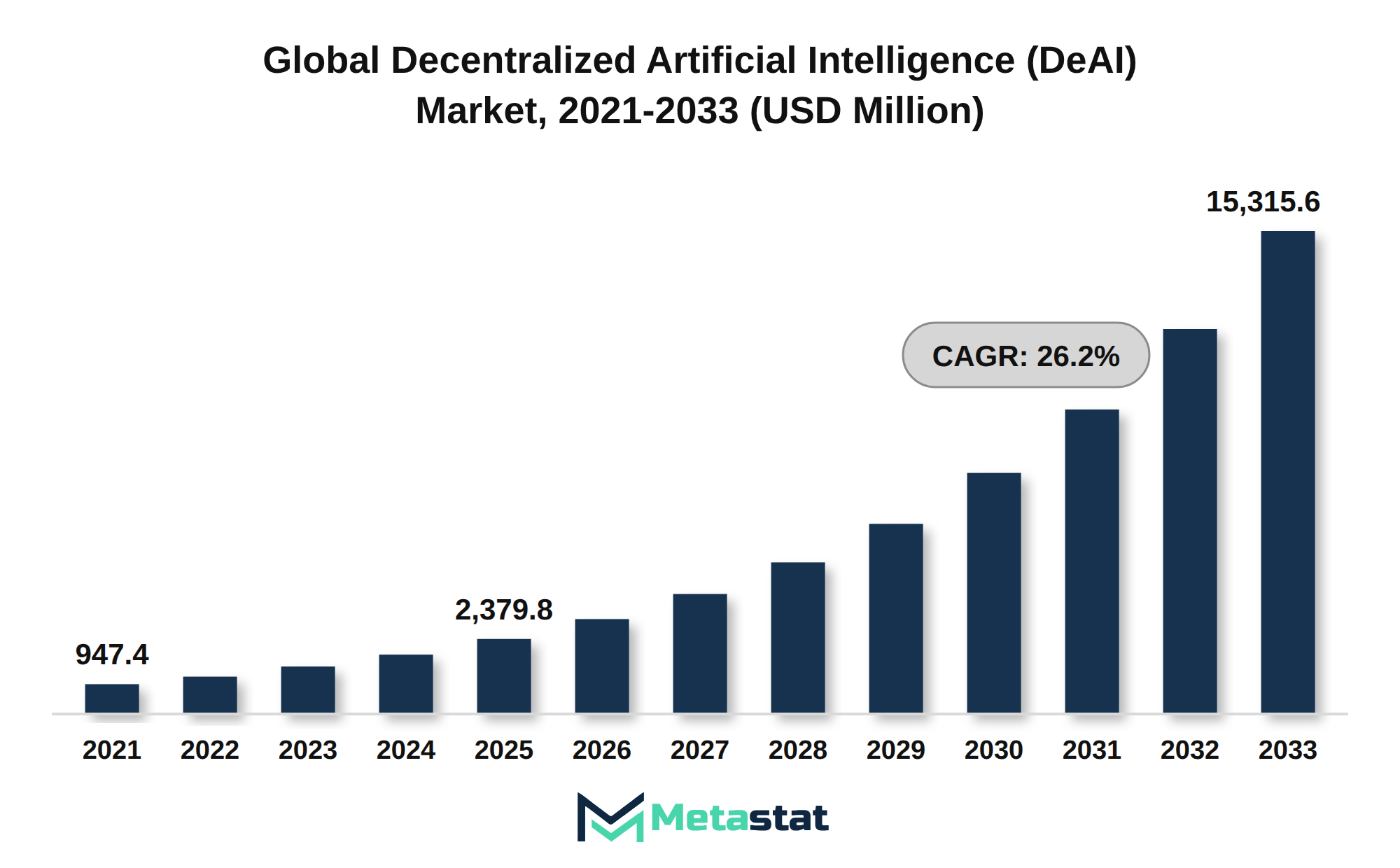
The global Decentralized Artificial Intelligence (DeAI) market was valued at USD 2,379.8 million in 2025 and is projected to reach USD 15,315.6 million by 2033, growing at a CAGR of 26.2% over the forecast period.
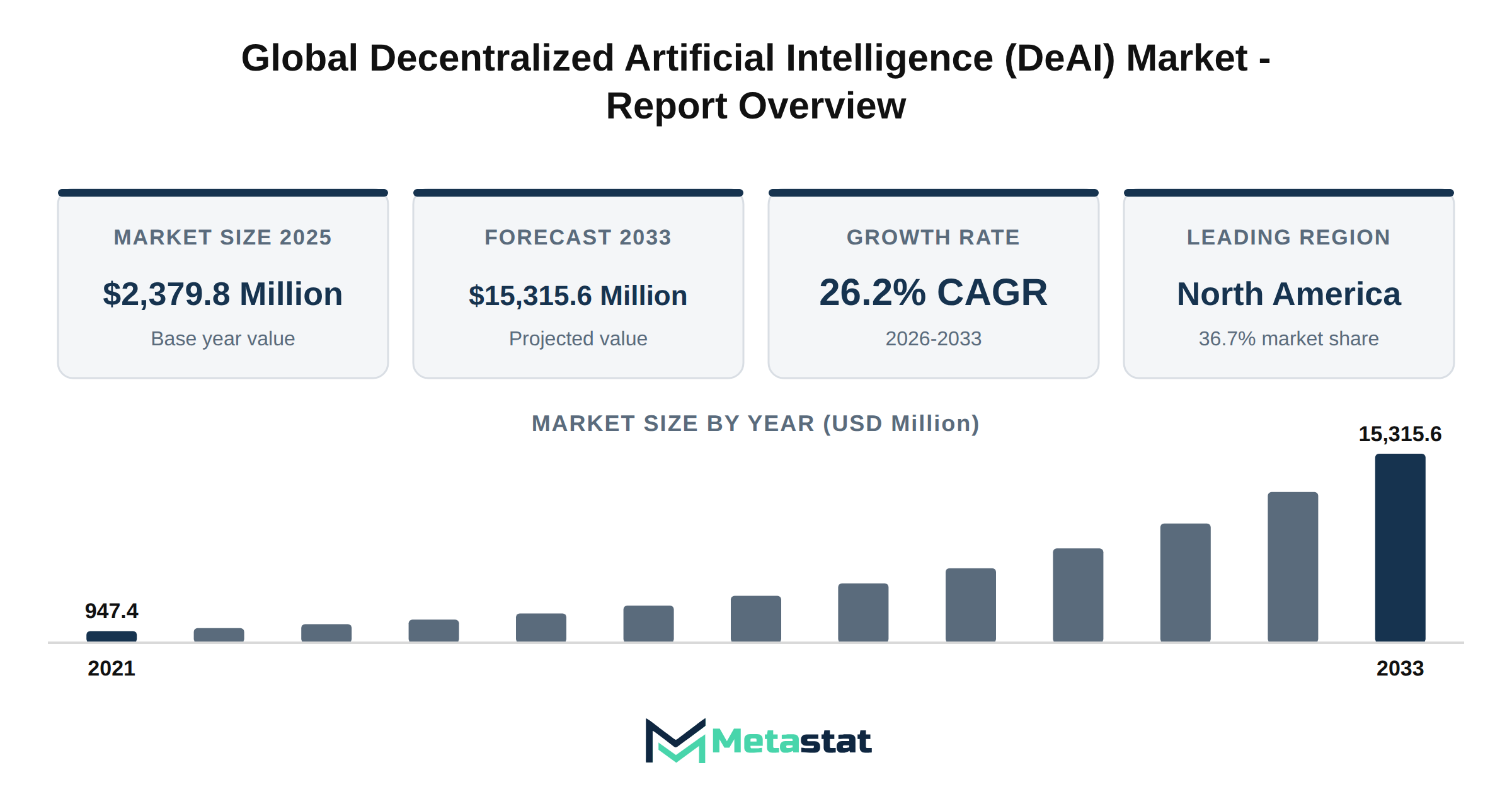
The Decentralized Artificial Intelligence (DeAI) market experienced significant growth, with a base value of USD 2,379.8 million in 2025. By 2033, the market is projected to reach USD 15,315.6 million, reflecting a compound annual growth rate (CAGR) of 26.2%. This growth trajectory highlights the increasing adoption of decentralized AI solutions across various sectors.
Demand for decentralized AI compute infrastructure drives market expansion. Organizations recognize the potential of decentralized systems to enhance computational efficiency while reducing reliance on centralized data centers. This shift towards decentralized infrastructures aligns with the increasing focus on data privacy and security, particularly in industries like healthcare and finance.
Decentralized GPU networks play a crucial role in reshaping AI training and inference. These networks facilitate distributed computing resources, enabling organizations to leverage collective processing power for more complex AI models. The enhanced capabilities provided by such networks contribute to significant improvements in model training times and inference accuracy.
The growth of blockchain-based AI platforms and model marketplaces creates a new ecosystem for AI development. These platforms enable developers to create, share, and monetize AI models securely, promoting collaboration and innovation. Such developments attract investments and partnerships, further fueling the Decentralized Artificial Intelligence (DeAI) market.
Adoption of decentralized AI agent networks and autonomous agents is increasing across various sectors. These networks employ decentralized protocols to enable autonomous decision-making, streamlining processes across industries. Organizations employing these technologies benefit from enhanced operational efficiency and reduced costs.
The expansion of federated learning and privacy-preserving AI aligns with growing concerns regarding data privacy. This approach allows organizations to train AI models on decentralized data sources without compromising sensitive information. The ability to leverage distributed datasets while ensuring privacy enhances the attractiveness of decentralized solutions.
Trends in decentralized AI data sharing and monetization are emerging due to organizations seeking innovative ways to leverage data assets. By employing decentralized networks, organizations securely share data while maintaining ownership and control. This trend is expected to create new revenue streams and enhance data utilization.
AI model ownership and tokenized incentive models represent a shift in how AI assets are valued. Tokenization allows for fractional ownership and incentivizes contributions from developers and users, creating a collaborative ecosystem. Such models enhance engagement and investment in AI technologies, driving further growth in the market.
Verifiable AI and trusted decentralized inference address concerns regarding AI transparency and accountability. By implementing decentralized protocols, organizations enhance the trustworthiness of AI systems. This focus on verifiability supports broader adoption of decentralized AI solutions across various industries.
Integration of edge computing and decentralized physical infrastructure networks (DePIN) complements the growth of decentralized AI. Edge computing facilitates real-time data processing closer to the data source, reducing latency and improving response times. This integration enhances the capabilities of decentralized AI applications.
Open-source AI models significantly contribute to the development of decentralized intelligence networks. These models encourage collaboration among developers, allowing for continuous improvement and innovation. The open-source nature fosters broader community engagement, enhancing the overall robustness of decentralized solutions.
Investment and funding trends in decentralized AI infrastructure reflect increasing confidence in the market's future. Venture capital and institutional investments target innovative startups and established players alike, driving advancements and technological breakthroughs. This influx of capital supports the growth and scalability of decentralized AI initiatives.
Token economics and revenue models in decentralized AI ecosystems create new opportunities for monetization. By establishing clear economic incentives, participants in the ecosystem align their interests with the overall growth of the market. This alignment creates a sustainable environment for innovation and development.
The expansion of decentralized AI compute infrastructure significantly influences the market. Companies increasingly invest in robust compute capabilities to support complex algorithms and large datasets. This trend attracts organizations across various sectors, including IT, healthcare, and finance, driving operational efficiencies and reducing dependency on traditional centralized systems.
Decentralized GPU networks reshape AI training and inference, offering scalable and cost-effective solutions. By distributing workloads across multiple nodes, these networks enhance processing power and reduce latency. Industries focusing on AI-driven solutions benefit from improved performance and flexibility, resulting in accelerated development cycles.
The growth of blockchain-based AI platforms and model marketplaces further drives the decentralized artificial intelligence (DeAI) market. These platforms facilitate secure data transactions and encourage collaboration among developers, researchers, and enterprises. The rise of decentralized marketplaces increases accessibility to diverse AI models, stimulating innovation and adoption across various use cases.
Decentralized AI agent networks are gaining traction, with autonomous agents becoming integral to various applications. These networks provide improved automation capabilities, enabling businesses to optimize processes and enhance decision-making. Adoption across sectors including logistics and customer service drives market growth while highlighting the need for efficient agent management systems.
Federated learning and privacy-preserving AI technologies expand the capabilities of decentralized systems. By allowing data to remain on local devices while enabling model training, organizations enhance data security and comply with privacy regulations. This approach aligns with industries that prioritize sensitive data handling, further supporting market penetration.
Trends in decentralized AI data sharing and monetization emerge due to critical factors for market expansion. Companies leverage decentralized platforms to share data securely and monetize AI models, creating new revenue streams. This shift emphasizes the importance of data ownership and the potential for innovative business models within the market.
AI model ownership and tokenized incentive models are increasingly relevant. By using tokens for access and rewards, platforms encourage participation and collaboration among developers and users. Such models align interests and enhance the sustainability of decentralized ecosystems, further driving market growth.
Verifiable AI solutions contribute to trusted decentralized inference, addressing concerns around model reliability and transparency. This focus on accountability builds confidence in AI systems, particularly in regulated industries including finance and healthcare, thus expanding market opportunities.
Integration of edge computing and decentralized physical infrastructure networks (DePIN) enhances decentralized AI capabilities. By processing data closer to the source, organizations reduce latency and improve responsiveness. This integration supports real-time applications, reinforcing the market's competitive positioning.
Open-source AI models play a significant role in driving decentralized intelligence networks. By promoting collaboration and knowledge sharing, these models encourage developers and organizations to build innovative solutions. The trend toward open-source frameworks encourages broader participation, enhancing the overall ecosystem.
Investment and funding trends in decentralized AI infrastructure contribute to market dynamics. Increased venture capital interest and public funding support the development of innovative solutions and technologies. This influx of capital accelerates growth and positions the market for future advancements.
Token economics and revenue models shape decentralized AI ecosystems. By establishing clear mechanisms for value exchange, platforms enhance user engagement and drive sustained interest. This focus on financial sustainability is critical for long-term success in the market.
Enterprise adoption of permissioned and hybrid decentralized AI solutions gains momentum. Organizations seek the benefits of decentralization while maintaining control over sensitive data. This trend reflects a broader acceptance of decentralized paradigms across various industries, further driving the market's growth trajectory.
Data privacy and security challenges persist within decentralized AI networks. Organizations navigate regulatory landscapes while ensuring user trust and compliance. Addressing these challenges will be crucial for sustaining growth and encouraging a secure environment for innovation.
Regulatory developments significantly impact decentralized AI platforms. Policymakers across regions introduce frameworks that balance innovation with consumer protection. Adapting to these regulations will influence market dynamics and determine the viability of various platforms.
Interoperability across decentralized AI networks and protocols enhances collaboration and integration. Ensuring compatibility between different systems fosters a cohesive ecosystem, enabling effective data exchange and collaboration. This emphasis on interoperability supports market expansion by facilitating diverse applications.
The competitive landscape of decentralized AI platforms and infrastructure providers is dynamic. Companies continually innovate to differentiate their offerings and capture market share. Strategic partnerships and collaborations are vital for enhancing capabilities and expanding reach in the evolving market.
North America presents significant adoption and investment opportunities in decentralized AI. With a strong technology base and supportive regulatory environment, the region attracts investments from various sectors. This trend positions North America because a key player in shaping the future of the decentralized artificial intelligence (DeAI) market.
Asia Pacific's infrastructure growth opportunities are noteworthy, driven by increasing digitalization and demand for AI solutions. Countries in this region focus on building robust decentralized systems to enhance capabilities across industries. While investments flow into this area, the market is set for substantial expansion.
Europe's regulatory landscape influences enterprise adoption trends in decentralized AI. Companies in this region adapt to stringent regulations while exploring innovative solutions. This balance between compliance and innovation shapes the market's trajectory and fosters growth opportunities.
Decentralized AI applications span across various sectors, including BFSI, healthcare, telecommunications, and manufacturing. Each industry leverages decentralized solutions to enhance efficiency, improve decision-making, and drive innovation. This diverse applicability underlines the market's potential for sustained growth.
Scalability, latency, and compute cost challenges impact the decentralized AI landscape. Organizations navigate these obstacles to ensure effective implementation and performance. Addressing these challenges will be pivotal for the market's long-term success and adoption.
Future growth opportunities in decentralized artificial intelligence networks emerge from ongoing technological advancements and evolving industry needs. Organizations that embrace innovation and adapt to changing market dynamics are well-positioned to thrive in the expanding landscape.
Traditional AI infrastructure relies on centralized hyper-scale cloud facilities operated by single technology conglomerates. In this classic paradigm, data collection, model training, fine-tuning, and user inference take place inside closed data centers. This structure grants controlling providers unilateral authority over access pricing, operational uptime, and data consumption terms.
In contrast, DeAI infrastructure separates compute capacity and data management across permissionless or consortium networks. Workloads split into discrete computational packets, which distributed edge servers or specialized mining nodes process independently. This structural divergence redefines capital expenditure profiles, algorithmic transparency, and data ownership models for enterprise adopters.
Centralized platforms require clients to upload proprietary enterprise information into external repositories, which exposes sensitive corporate intelligence to counterparty vulnerabilities. DeAI platforms rely on privacy-preserving frameworks that train algorithms directly where information originates. Businesses retain administrative control over their data assets while participating in collaborative model development.
Hyperscale cloud outages halt client operations across large geographical regions simultaneously. Decentralized compute networks distribute parallel workloads across thousands of sovereign hardware configurations. If an individual node goes offline, the network dynamically shifts execution parameters to alternative available nodes without interrupting broader enterprise processes.
Commercial deployment of DeAI architectures is expanding beyond theoretical proofs-of-concept into high-value vertical industries. Enterprises handle large volumes of regulated or commercially sensitive data, making public cloud processing unfeasible. DeAI bridges this divide by delivering advanced machine intelligence capabilities without compromising data sovereignty.
Clinical institutions deploy decentralized machine learning frameworks to train diagnostic algorithms across disparate hospital systems without sharing raw patient records. Medical facilities maintain strict patient confidentiality while contributing parameters to joint oncology or radiology models. This approach speeds up diagnostic accuracy without transferring confidential patient files across institutional borders.
Financial firms apply autonomous multi-agent networks to detect market inefficiencies, identify cross-border liquidity imbalances, and conduct predictive risk underwriting. By running independent analytical agents across distributed networks, institutions reduce settlement latency, eliminate centralized clearing counterparty risks, and improve fraud detection accuracy across retail payment gateways.
Global supply chains involve heterogeneous logistics providers, shipping networks, and regulatory authorities that often lack mutual operational trust. DeAI systems coordinate inventory auditing, cold-chain monitoring, and dynamic cargo routing using localized IoT nodes. Smart contracts execute payment releases automatically when distributed sensory nodes verify verified milestones.
The competitive structure of the decentralized AI ecosystem encompasses protocol designers, distributed compute providers, and agent-based coordination networks. Market adoption relies on integrated ecosystems that align hardware allocation, model discovery, and programmatic transactions within unified developer frameworks.
Fetch.ai focuses on deploying open, autonomous agent frameworks capable of completing multi-step operational tasks without human intervention. These intelligent software agents automate supply chain procurement, optimize localized energy distribution grids, and manage decentralized finance operations. By standardizing agent communications, the platform fosters peer-to-peer resource exchange without centralized intermediaries.
SingularityNET operates a decentralized marketplace that allows developers to publish, monetize, and discover modular artificial intelligence tools at scale. The platform enables distinct algorithms to communicate, exchange operational parameters, and complete multi-stage predictive tasks cooperatively. This marketplace structure lets small development teams commercialize specialized algorithms without building proprietary billing or hosting infrastructures.
Ocean Protocol provides data sharing and monetization infrastructure built on cryptographic access tokens. The protocol introduces compute-to-data mechanisms, allowing external algorithms to process sensitive information securely behind an enterprise firewall. Data owners preserve complete custody over underlying records while unlocking recurring commercial returns from automated analytical pipelines.
The DeAI technical architecture combines hardware execution environments, distributed consensus systems, and cryptographic privacy primitives. Each structural layer handles a distinct operational task, from physical processing to trustless validation.
Blockchains act as foundational verification and settlement rails across decentralized compute architectures. Smart contract networks manage node reputation scores, orchestrate multi-party staking requirements, and automate micro-incentive disbursements based on verified computational tasks. Ethereum remains an important deployment layer for financial settlement and governance token mechanisms, while Polkadot supports cross-chain interoperability and application-specific parachains designed for high-throughput model coordination.
Federated learning allows machine learning models to train on distributed edge devices without centralizing training sets. Local devices download an initial baseline model, compute localized gradient adjustments based on proprietary local data, and return encrypted mathematical weightings to an aggregation node. Incorporating differential privacy injects calibrated statistical noise into these parameter updates, preventing adversarial attackers from reverse-engineering the underlying raw data records.
Edge computing hardware handles the physical processing burden by running low-latency inference near the original data collection point. For distributed model weights and metadata storage, developers integrate IPFS (InterPlanetary File System), establishing tamper-resistant, content-addressed repositories that function independently of commercial cloud storage hosts.
To secure sensitive data during computation, advanced implementations apply zero-knowledge proofs and homomorphic encryption. Zero-knowledge proofs verify that a specific compute operation was executed accurately without exposing input parameters or proprietary codebases. Homomorphic encryption lets nodes run algebraic operations on encrypted ciphertexts directly, ensuring datasets remain unreadable to host machines throughout the training lifecycle.
Institutional investment across the DeAI sector shifted noticeably across 2024 and 2025, moving from speculative protocol tokens toward functional infrastructure projects. Venture capital allocations focused heavily on developer tooling, decentralized compute aggregation, and cryptographic privacy acceleration.
Hardware aggregation platforms secured substantial capital commitments as investors targeted the global GPU capacity bottleneck. Projects building decentralized physical infrastructure networks (DePIN) successfully pooled underutilized enterprise, gaming, and crypto-mining hardware. This funding trend reflects an enterprise appetite for alternative compute sources capable of running foundational model fine-tuning and inference at competitive pricing.
Institutional funding rounds increasingly targeted the intersection of Web3 and automated AI agents. Allocators directed capital toward autonomous agent platforms capable of controlling decentralized wallets, executing complex arbitrage strategies, and interacting with on-chain protocols. This convergence established institutional validation for artificial intelligence agents operating as sovereign economic participants across decentralized networks.
Regional adoption dynamics reflect distinct regulatory priorities, infrastructure investments, and enterprise software maturity curves across geographical boundaries.
The North American market emphasizes commercial efficiency, compute cost optimization, and developer ecosystem expansion. Tech startups and research labs adopt hybrid architectures, blending proprietary model deployment with decentralized compute networks to reduce infrastructure overhead. Strong venture funding and extensive high-performance GPU deployments provide an established foundation for rapid open-source experimentation.
The Asia-Pacific region demonstrates adoption patterns centered on edge hardware integration, localized IoT installations, and national digital infrastructure programs. Strong domestic manufacturing hubs in East Asia simplify the integration of decentralized client software directly into mobile chipsets and edge gateways. Concurrently, regional initiatives prioritize smart city infrastructure, industrial automation, and decentralized logistics coordination across maritime and supply networks.
Evaluating decentralized artificial intelligence markets requires a hybrid research approach that pairs conventional enterprise software metrics with on-chain analytical tools. Traditional market assessments fail to capture network health indicators across permissionless ecosystems.
Our market research process evaluates on-chain protocol transactions, smart contract interactions, and network gas consumption trends to track authentic platform utility. Analysts evaluate daily active addresses, unique node operator counts, and verified compute proof submissions. This empirical method screens out superficial market activity and isolates sustained commercial usage across networks.
Empirical on-chain analysis is supported by primary interviews with enterprise technology officers, protocol architects, and infrastructure providers. Analysts also examine open-source code repositories, evaluating weekly developer commits, pull request frequencies, and library fork counts. This qualitative insight reveals upcoming architectural transitions long before they emerge in commercial deployments.
Decentralized AI represents an inevitable evolution in computing architectures, mirroring earlier enterprise transitions from on-premise mainframes to distributed cloud networks. Escalating operational expenditures linked to centralized proprietary models create a clear market incentive for open, modular computing fabrics.
Over the next development phase, commercial relevance will hinge on seamless developer experiences. Enterprises will avoid protocols that require difficult token management workflows or expose them to volatile network fee structures. Winning platforms will deliver clean API interfaces that abstract away underlying blockchain layers, presenting decentralized clusters simply as scalable, cost-effective computing resources.
Despite strong market momentum, several technical and structural bottlenecks moderate broader enterprise adoption across the decentralized artificial intelligence landscape.
Training foundational models across distributed, geographically dispersed nodes introduces severe communication bottlenecks. High-bandwidth model training requires ultra-fast inter-GPU connections, which decentralized physical infrastructure networks struggle to reproduce over consumer-grade internet connections. As a result, DeAI networks remain best suited for inference, fine-tuning, and federated learning tasks rather than baseline training of massive dense models.
Reconciling distributed ledgers with data sovereignty regulations presents substantial operational hurdles. Achieving GDPR compliance is difficult on immutable distributed networks that inherently restrict the deletion of historical information. Organizations must design architectures where personal data remains at the local edge, ensuring that only anonymized mathematical weightings interact with permanent network ledgers.
Ecosystem fragmentation limits collaboration among distinct specialized networks. Autonomous agents running on one protocol frequently struggle to discover, communicate, or transact with external agent registries. Achieving functional swarm intelligence, where fleets of specialized software agents complete cross-industry workflows collectively, demands universal communication standards and robust cross-chain message-passing architectures.
Furthermore, decentralized autonomous organizations (DAOs) face structural difficulties in governing complex AI development roadmaps. Coordinating technical upgrades, allocating capital to hardware operators, and addressing protocol vulnerabilities through decentralized voting mechanisms often results in sluggish decision-making compared to traditional corporate structures.
Growth in the Decentralized Artificial Intelligence (DeAI) market correlates with macro-economic factors including increasing capital investment and digital transformation initiatives. Rising GDP in various regions, coupled with enhanced venture funding, creates a favorable environment for technology investments. This capital influx supports the development of innovative DeAI solutions that emphasize automation, software adoption, and the digitization of legacy processes.
Operational productivity remains a focal point for businesses aiming to enhance efficiency and reduce overhead costs. Organizations prioritize cost-efficiency initiatives, including labor optimization and streamlined processes, driving demand for decentralized AI solutions. These strategies improve profitability and align with shifting consumer behaviors and evolving buying preferences.
The Decentralized Artificial Intelligence (DeAI) market benefits from substantial investments in infrastructure development and modernization. Upgrading both physical and digital capabilities enhances network performance and accessibility, facilitating the adoption of decentralized AI technologies. The emphasis on sustainability and resource stewardship encourages firms to seek solutions that minimize carbon footprints while maximizing operational efficiencies.
Globalization continues to impact market dynamics, with the search for resilient supply chains and localized production strategies becoming critical. DeAI solutions enable organizations to navigate these challenges effectively, improving risk mitigation and enhancing market access. The combined effect of these macro-economic factors establishes a robust foundation for sustained growth in the market.
The expansion of infrastructure plays a critical role in advancing the Decentralized Artificial Intelligence (DeAI) market. Upgrading physical and digital capacities enhances the ability to deploy decentralized AI solutions across various sectors. Increased investments in network capabilities create an environment where decentralized AI flourishes, promoting wider adoption among businesses seeking operational efficiency. Modernized facilities enable organizations to leverage advanced technologies, facilitating integration of decentralized AI into existing workflows.
The emphasis on asset modernization strengthens demand for decentralized AI applications, particularly in industries focused on transforming legacy processes. Enhanced infrastructure supports the rise of public permissionless networks, consortium networks, and private enterprise networks, addressing diverse market needs. While infrastructure improvements unfold, stakeholders in the DeAI market experience heightened opportunities for innovation-led product and service diversification, ultimately contributing to growth within the sector.
The Decentralized Artificial Intelligence (DeAI) market faces significant challenges from regulatory and compliance hurdles that limit growth potential. Tightening regulations surrounding data privacy and security compel organizations to invest in costly compliance measures, diverting resources away from innovation and deployment efforts. These compliance requirements heighten operational costs, creating barriers for smaller enterprises attempting to enter the market. Established players maintain a competitive edge, complicating the landscape for new entrants.
Macroeconomic headwinds, including inflationary pressures, contribute to a cautious investment environment. Escalating operating costs, driven by rising workforce overhead and the need for skilled talent, restrict capital flow into the decentralized AI sector. These factors stall growth, leading to slower adoption rates across various industries requiring robust AI solutions for operational efficiencies.
Supply chain disruptions and geopolitical instability complicate market conditions. Resource scarcity, particularly in key technologies, impacts the availability of essential components needed for AI infrastructure development. Organizations confront these challenges, and the potential for innovation diminishes, leading to market fragmentation. This fragmentation results in inconsistent adoption rates across regions, leaving the Decentralized Artificial Intelligence (DeAI) market vulnerable to cultural barriers and varying regional compliance regulations that hinder expansion efforts.
The culmination of these factors contributes to an environment characterized by deployment bottlenecks and talent gaps. Meeting the demand for advanced AI solutions becomes increasingly challenging when organizations grapple with securing skilled labor and navigating complex legal frameworks. Consequently, these obstacles impede the rapid advancement and widespread acceptance of decentralized AI technologies, shaping the market growth trajectory.
The Decentralized Artificial Intelligence (DeAI) market faces challenges stemming from geopolitical fragmentation, which influences global trade dynamics and technology transfers. This fragmentation complicates collaboration between nations, leading to increased tariffs and trade deficits that affect the flow of critical components and software necessary for DeAI development. Manufacturers and service providers encounter heightened costs and extended timelines, impacting market viability and growth potential.
Technological disruptions arising from political instability contribute to uncertainty in investment. Stakeholders experience hesitation in committing resources to projects, slowing the pace of innovation within the market. The lack of unified regulatory standards across different regions further complicates compliance, increasing operational overhead for businesses seeking to operate internationally.
Another significant challenge involves pressure on resources due to rising input costs and fluctuating availability of essential materials. Supply chain instability exacerbates this issue, leading to unpredictable pricing and potential delays in product delivery. Enterprises in the market adapt quickly to these conditions to maintain competitive positioning.
The need for skilled talent in decentralized AI technologies represents an ongoing hurdle. Workforce skill gaps limit the ability of organizations to effectively implement and support DeAI initiatives. Coupled with challenges in talent retention, these factors hinder the development of robust teams capable of driving innovation in the market. Overall, geopolitical fragmentation significantly impacts the strategic landscape of the Decentralized Artificial Intelligence (DeAI) market, necessitating agile responses from key players.
The Decentralized Artificial Intelligence (DeAI) market experiences significant opportunities through emerging technological disruptions. Innovations in blockchain technology and machine learning algorithms drive greater efficiency and security in data management and processing. These advancements attract various industries seeking to modernize operations and enhance decision-making capabilities.
Digital transformation initiatives across sectors highlight the demand for decentralized solutions. Industries including IT and telecommunications, healthcare, and finance increasingly prioritize integration of decentralized technologies to streamline processes and reduce reliance on centralized infrastructures. This shift encourages investment in decentralized platforms, expanding the overall market potential.
Geographical expansion contributes to market growth, particularly in regions like Asia Pacific and Europe, where increasing awareness of data privacy and security fuels demand for decentralized applications. Local companies enhance their offerings in response to these regional trends, driving collaboration and partnerships that strengthen the market ecosystem.
Industry players actively seek niche applications of decentralized AI technology, focusing on areas including AI data collection and labeling, model training, and verification. This diversification allows for tailored solutions that meet specific customer needs, further stimulating investment in the market.
Strategic consolidation among industry players supports growth opportunities by uniting complementary technologies and capabilities. Mergers and acquisitions facilitate access to broader customer bases and enhanced product offerings, reinforcing the competitive landscape in the DeAI market. Such initiatives encourage innovation and development of next-generation solutions that align with evolving market demands.
Overall, the combination of technological disruptions, regional expansion, and strategic industry consolidation positions the Decentralized Artificial Intelligence (DeAI) market for significant growth and increased adoption in the coming years.
The Global Decentralized Artificial Intelligence (DeAI) market is segmented based on Offering, Deployment Model, Application, and End-Use Industry.
Valued at USD 1,413.3 million in 2026, the Software & Platforms segment is projected to reach USD 6,781.8 million by 2033, at a CAGR of 25.1% during the forecast period. Primary demand drivers include the increasing need for efficient and scalable solutions across various industries, particularly in IT and telecommunications. Growing data generation across sectors fuels demand for advanced software that manages, analyzes, and optimizes this data, validating the need for decentralized architectures that enhance data handling capabilities.
Adoption of decentralized frameworks accelerates due to their ability to reduce costs and enhance security through distributed ledger technologies. Industries including healthcare, finance, and media recognize significant benefits, leading to a surge in demand for innovative applications. Segment expansion catalysts include technological maturation, with ongoing advancements enabling more sophisticated software solutions that integrate seamlessly with existing systems.
The evolution of products within this segment emphasizes next-gen upgrades that enhance performance and drive user experience. Companies prioritize model training and fine-tuning capabilities to meet specific business requirements, ensuring software aligns with operational objectives. Downstream applications increasingly reflect a trend toward automation and real-time analytics, positioning the segment favorably within the broader Decentralized Artificial Intelligence (DeAI) market.
End-use dynamics indicate that rising consumer expectations for personalized services and efficient interactions push companies to invest in advanced software solutions. Regulatory compliance standards further influence adoption, driven by businesses seeking to align with data protection and privacy regulations, enhancing the overall security posture of deployed applications. Pricing volatility and margin pressures remain considerations, shaping strategic investment decisions within the sector.
Strategic opportunity windows emerge for companies that prioritize innovation and adaptability, enabling them to capture market share in this evolving landscape. Capital investment outlooks remain positive, owing to organizations recognizing the long-term benefits of investing in decentralized software platforms that position them for continued success within the DeAI ecosystem.
Rapid growth in compute infrastructure influences the Decentralized Artificial Intelligence (DeAI) market significantly. An increasing demand for efficient and scalable computational resources drives this expansion. Investments in advanced hardware and cloud technologies support the integration of decentralized AI solutions across various industries, enhancing performance and functionality. While organizations adopt these technologies, the need for robust computing capabilities becomes evident, leading to increased market penetration.
The segment is expected to reach USD 5,967 million by 2033, at a CAGR of 28% during the forecast period. This growth reflects strong demand for high-performance computing and innovative solutions that cater to specific application requirements. Adoption of compute infrastructure in sectors including IT, telecommunications, and healthcare encourages development of advanced AI models, enhancing decision-making processes and operational efficiencies.
Technological maturation shapes the segment. Ongoing advancements in processing power, storage solutions, and networking capabilities facilitate the evolution of decentralized AI offerings. This progress allows organizations to utilize sophisticated algorithms and data analytics, driving growth in the market.
Emerging use cases across industries contribute to the segment's expansion. Applications including AI data collection, model training, and validation increasingly demand effective compute infrastructure to deliver real-time insights and analytics. Regulatory compliance standards further incentivize investment in reliable computing solutions, ensuring data security and privacy across various applications.
Strategic opportunity windows arise from shifts in consumption patterns and end-use dynamics. Organizations prioritize infrastructure that supports scalability and flexibility, enabling them to meet evolving market demands efficiently. This focus on innovative compute solutions enhances competitiveness and positions market players to capitalize on emerging opportunities.
Market dynamics in the Services segment of the Decentralized Artificial Intelligence (DeAI) market reflect a robust trajectory driven by the growing demand for advanced AI capabilities across various sectors. This demand arises from the increasing need for improved data management, analytics, and operational efficiency, particularly in IT and telecommunications, healthcare, and financial services. The segment is expected to reach USD 2,566.9 million by 2033, highlighting its important position within the broader market.
Technological maturation influences the expansion of the Services segment, with advancements in machine learning algorithms and data processing techniques enhancing service offerings. These innovations enable businesses to leverage AI more effectively, resulting in optimized workflows and better decision-making processes. Adoption of AI-driven solutions has intensified, especially in industries that prioritize data collection, analysis, and customer engagement.
End-use dynamics indicate a pronounced shift towards AI services that facilitate data collection, storage, and processing. Companies increasingly rely on AI to streamline operations and enhance service delivery. This trend is evident in sectors including BFSI and healthcare, where AI applications support real-time data analysis and improve patient outcomes.
Pricing volatility and margin pressures in the Services segment stem from fluctuating costs of technology and the need for continuous investment in next-gen upgrades. Organizations face challenges in managing costs while maintaining competitive pricing for AI services. Strategic opportunity windows emerge due to companies seeking to balance cost management with the demand for advanced AI solutions.
The growing interest in regulatory compliance standards impacts the Services segment, because organizations navigate the complexities of data privacy and security regulations. Compliance with these standards requires investment in secure AI frameworks and services, influencing market growth and shaping service offerings tailored to meet these requirements.
Public Permissionless Networks segment is valued at USD 1,226.2 million in 2026 and is projected to reach USD 5,653 million by 2033, at a CAGR of 24.4% during the forecast period. This segment benefits from increasing demand for decentralized applications and the desire for enhanced data privacy, attracting various industries that prioritize user autonomy and data sovereignty. Growth in this segment is driven by technological maturation, which facilitates the development of more robust and scalable decentralized architectures.
Adoption of Public Permissionless Networks is closely linked to the expansion of blockchain technologies and the evolving regulatory landscape that encourages decentralized solutions. Industries including IT and telecommunications, along with finance and healthcare, increasingly explore the advantages of decentralized models, leading to increased investments and research activities in the market. Enhanced interoperability and improved user experiences serve because key factors that support segment expansion.
Downstream applications involving Public Permissionless Networks demonstrate versatility, finding uses in areas including secure data sharing, decentralized finance, and digital identity management. Innovations surrounding these applications generate considerable interest among stakeholders eager to leverage decentralized solutions for operational efficiency and enhanced security. The market is expected to see a shift towards integrating decentralized AI capabilities, strengthening the value proposition of Public Permissionless Networks.
Certain challenges persist, including cost structures associated with network maintenance and the need for specialized expertise in blockchain technologies. Pricing volatility related to underlying cryptocurrencies and regulatory compliance standards create hurdles for several organizations. Nonetheless, continued investment in research and development, coupled with the emergence of disruptive alternatives, supports the overall growth trajectory of the segment within the Decentralized Artificial Intelligence (DeAI) market.
Growing adoption of Consortium/Permissioned Networks contributes significantly to the expansion of the Decentralized Artificial Intelligence (DeAI) market. This segment offers enhanced security and control, particularly appealing to organizations requiring a balance between decentralization and governance. Industries including finance, healthcare, and supply chain management actively pursue these networks to manage sensitive data while ensuring compliance with regulatory frameworks. The ability to provide secure transactions, data integrity, and streamlined operations drives demand.
Consortium/Permissioned Networks segment is estimated to reach USD 2,998.8 million by 2033, at a CAGR of 25.5% during the forecast period. Market participants invest in innovative technologies to improve the efficiency and scalability of these networks, responding to growing data complexity and demand for real-time analytics. Advancements in blockchain and cryptographic technologies further enhance the robustness of these networks, positioning them because attractive solutions for enterprises.
Regulatory compliance standards heavily influence the adoption of Consortium/Permissioned Networks, particularly in sectors that handle sensitive information. The increasing necessity for transparency and accountability drives organizations to explore these decentralized models. While enterprises seek to leverage artificial intelligence capabilities while adhering to data privacy regulations, the relevance of Consortium/Permissioned Networks continues to rise, shaping future market developments.
Demand for Private Enterprise Networks arises from the increasing necessity for secure and efficient data management solutions. Organizations prioritize confidentiality and data ownership, driving adoption of decentralized technologies. Evolving regulatory standards prompt companies to seek compliant infrastructure to mitigate risks associated with data breaches and unauthorized access.
Forecasted market growth highlights that the Private Enterprise Networks segment is projected to reach USD 2,905.4 million by 2033. This growth results from organizations aiming to enhance operational efficiency through decentralized AI applications. Industries including IT and telecommunications, healthcare, and financial services exhibit pronounced demand for such solutions, reflecting their need for robust, secure data handling.
Technological maturation facilitates the development of advanced decentralized platforms, enabling organizations to access AI capabilities without compromising data integrity. Continuous innovations in AI algorithms improve performance and broaden application areas, further driving segment expansion. The increasing focus on AI-driven decision-making processes emphasizes the segment's importance in the broader Decentralized Artificial Intelligence (DeAI) market.
End-use dynamics indicate a shift toward adopting decentralized models for critical applications, emphasizing the need for adaptability in business operations. Companies explore diverse use cases, including AI data storage and model training, which enhance the efficacy of decentralized networks. This trend encourages investments in infrastructure upgrades, aligning with the overall growth trajectory of the market.
Cost structures in the Private Enterprise Networks segment continue to evolve with competitive pricing strategies emerging among providers. Pricing volatility associated with technological advancements influences investment decisions. Organizations actively seek strategic opportunities that align with their operational objectives, creating a resilient supply chain capable of supporting decentralized AI initiatives.
Growth in Hybrid Decentralized Networks aligns with the increasing demand for flexible and scalable solutions in the Decentralized Artificial Intelligence (DeAI) market. The segment is projected to grow at a CAGR of 28.4% during the forecast period, driven by advancements in blockchain technology and an escalating requirement for secure data sharing across various platforms. Enterprises in sectors including IT and telecommunications adopt hybrid models to balance decentralization with control, enhancing operational efficiency and reducing latency.
Technological maturation influences this segment's expansion, with innovations in network protocols and interoperability enhancing system capabilities. Companies focus on next-generation upgrades that incorporate artificial intelligence for real-time decision-making and predictive analytics. These technological advancements improve performance across multiple applications, including AI data processing and model training.
Investment in hybrid decentralized networks reflects the growing recognition of the importance of data privacy and security. Regulatory compliance standards increasingly necessitate robust frameworks that facilitate secure, decentralized data sharing while adhering to local and international regulations. This demand creates strategic opportunity windows, attracting capital investments in infrastructure development and technology enhancements.
Cost structures within Hybrid Decentralized Networks are evolving, driven by competitive pricing and operational efficiencies that become critical. Organizations leverage economies of scale in infrastructure deployments, resulting in significant margin improvements. The segment's resilience to market fluctuations further strengthens its position within the broader landscape of the Decentralized Artificial Intelligence (DeAI) market, with companies continuously seeking to optimize their offerings.
Valued at USD 416.9 million in 2026, the AI Data Collection & Labeling segment is projected to reach USD 1,798.1 million by 2033, at a CAGR of 23.2% during the forecast period. Demand for effective data collection and labeling underpins the segment's growth, driven by increasing reliance on high-quality data for artificial intelligence model training and deployment. Industries including IT, telecommunications, and healthcare drive this demand through the necessity for accurate data to enhance decision-making and operational efficiency.
Technological maturation in AI techniques and tools supports the segment's expansion. Advancements in machine learning and automation streamline data collection processes, reducing time and costs associated with manual labeling. Investment in decentralized solutions enhances operational efficiencies and allows for scalability across various applications, including model training and validation.
Regulatory compliance standards regarding data privacy and security impact the operational framework of the segment. Adherence to these standards ensures customer trust and mitigates risks associated with data breaches. Consequently, firms focusing on compliance and security measures position themselves favorably within the competitive landscape.
Strategic opportunities arise from the growing emphasis on AI in various sectors, prompting businesses to enhance their data analytics capabilities. Continued investment in the AI Data Collection & Labeling segment strengthens its role within the broader Decentralized Artificial Intelligence (DeAI) market, facilitating growth and driving technological evolution.
Growth in the AI Data Storage & Exchange segment reflects increasing demand for efficient data management solutions in decentralized environments. The escalating volume of data generated across industries necessitates advanced storage solutions that leverage decentralized technologies. Various industries, including IT & Telecommunications and Healthcare, drive demand for these solutions, seeking enhanced data integrity, security, and accessibility. The segment is estimated to reach USD 1,666.3 million by 2033, at a CAGR of 23.5% during the forecast period. Adoption of decentralized architectures enables organizations to reduce costs associated with traditional data storage methods while enhancing data availability and resilience.
Technological maturation in decentralized storage solutions facilitates significant advancements in data retrieval and processing capabilities. Innovations in blockchain technology and distributed ledger systems enhance the reliability and security of data storage and exchange processes. Regulatory compliance standards surrounding data privacy and security increasingly require organizations to adopt robust storage solutions. Compliance with these standards builds trust among users and encourages the adoption of decentralized technologies, further driving growth.
The segment's evolution aligns with broader trends in data-driven decision-making and analytics. Industries are prioritizing investments in decentralized data storage systems to leverage insights from vast data sets. This focus on data-driven strategies enhances operational efficiency and competitive advantage across various sectors. Strategic opportunity windows emerge due to organizations recognizing the potential for improved data access and monetization through decentralized storage options.
Significant growth within the Model Training & Fine-Tuning segment of the Decentralized Artificial Intelligence (DeAI) market aligns with increasing demand for advanced machine learning capabilities. This demand arises from various industries seeking to enhance model performance, particularly in applications requiring high levels of accuracy and efficiency.
Technological maturation of AI algorithms and tools drives investment in model training and fine-tuning processes. Continuous advancements in computational capabilities enable organizations to process larger datasets, thereby improving the reliability and effectiveness of AI models. This trend is evident in sectors including IT & Telecommunications and Healthcare & Life Sciences, where the need for precise data analysis remains critical.
Investment in this segment is projected to significantly increase, with the Model Training & Fine-Tuning segment expected to reach USD 3,087.6 million by 2033. The growing focus on personalized AI solutions heightens the urgency for refined training methodologies that adapt to diverse data inputs and dynamic environments.
Changes in regulatory compliance standards and certifications further influence the market. Organizations strive to meet evolving requirements, prompting a shift towards more efficient training processes that align with best practices and industry benchmarks. This focus on compliance enhances the overall quality of AI-driven solutions, building trust among end-users and stakeholders.
Market dynamics reflect a shift towards strategic opportunity windows where organizations recognize the value of investing in sophisticated model training capabilities. The integration of advanced technologies, including transfer learning and automated machine learning, supports the evolution of training practices, enabling the development of models that perform well across various applications.
Growing focus on accuracy and reliability in AI systems drives demand for Model Validation & Verification in the Decentralized Artificial Intelligence (DeAI) market. Organizations seek to ensure that models perform effectively and ethically, building confidence among users and regulators. This segment benefits from advancements in AI technologies and methodologies, creating a robust environment for validation and verification processes.
Valued at USD 3,087.6 million by 2033, the Model Validation & Verification segment is projected to grow at a CAGR of 24.1% during the forecast period. Businesses prioritize compliance with regulatory standards, driving investments in validation practices. These practices become crucial for industries including healthcare, finance, and autonomous systems, where failures in AI systems lead to significant repercussions.
Technological maturation in AI algorithms enhances the effectiveness of validation techniques, making them integral for organizations looking to adopt advanced capabilities. This progression enables firms to adopt next-generation validation tools that streamline workflows and improve outcomes. While the market evolves, expansion catalysts include increasing collaboration between technology providers and end-users, creating tailored validation solutions that address specific industry needs.
Shifts in consumption patterns highlight the importance of end-user dynamics, with a growing emphasis on transparency and accountability. Companies excelling in model validation and verification practices position themselves favorably in the competitive landscape. Strategic investments in these capabilities lead to improved performance metrics and heightened user trust in decentralized AI applications.
Increasing reliance on AI technologies drives demand for AI Inference & Model Serving, with organizations prioritizing enhanced decision-making capabilities. Industries including IT & Telecommunications, BFSI, and Healthcare & Life Sciences show significant interest in these solutions to process vast amounts of data efficiently. This segment's growth reflects a broader trend toward automation and real-time analytics, which supports strategic operations and improves service delivery.
Technological advancements contribute to the maturation of this segment, with developments in machine learning algorithms and cloud infrastructure facilitating more effective model serving processes. Organizations benefit from next-gen upgrades that enhance model accuracy and performance, ensuring they stay competitive in a data-driven landscape. Such innovations support the ongoing evolution of products, aligning with the increasing complexity of models and the need for robust deployment methods.
Downstream applications across various industries highlight the critical importance of AI Inference & Model Serving in enhancing operational efficiencies. This segment facilitates model validation and verification, which are essential to maintain trust and compliance with regulatory standards. Growing emphasis on data security and privacy further influences this area of the Decentralized Artificial Intelligence (DeAI) market, driven by companies seeking solutions that meet compliance requirements while driving innovation.
Consumption shifts toward decentralized solutions present strategic opportunity windows for organizations looking to leverage AI capabilities. The market transforms with new entrants and established players focusing on enhancing service offerings, creating a competitive environment that encourages continuous improvement. Investment in this segment reflects a strong commitment to adopting advanced technologies to optimize performance, ultimately impacting overall market growth.
Growth in AI Agent Execution & Orchestration aligns with advancements in decentralized systems, enhancing operational efficiency and enabling real-time decision-making across various industries. Increased adoption of AI-driven solutions fuels demand for automation, streamlining complex processes and reducing human errors.
Developments in next-generation upgrades and technological maturation support the segment's expansion. Organizations investing in robust AI frameworks integrate agent execution capabilities, allowing for improved orchestration and management of decentralized tasks. This trend provides a competitive edge in sectors including IT, telecommunications, and healthcare.
End-use dynamics drive consumption shifts toward AI Agent Execution & Orchestration, particularly in environments that require agility and flexibility. Businesses prioritize automation to respond efficiently to market demands and consumer expectations. Regulatory compliance standards and certifications influence the adoption of decentralized AI solutions, ensuring accountability and transparency.
Strategic opportunity windows identify gaps in the market, prompting investments in AI Agent Execution & Orchestration technologies. Organizations pursuing innovation recognize the value of decentralized systems in providing scalable solutions that adapt to evolving business needs. This focus on evolution strengthens the overall market of the Decentralized Artificial Intelligence (DeAI) sector, positioning it for substantial growth.
Growing interest in monetization strategies for AI models drives innovation within the Decentralized Artificial Intelligence (DeAI) market. This segment captures attention due to its potential for generating value from AI-generated data and models. Companies increasingly explore ways to commercialize AI outputs, creating new revenue streams and business models. This trend reflects a strategic shift towards data-driven decision-making across various industries.
The evolving landscape of data privacy and ownership fuels demand for AI model and data monetization. Organizations prioritize solutions that enhance data control while ensuring compliance with regulatory frameworks. This focus on compliance aligns with heightened scrutiny regarding data usage and monetization practices, compelling companies to adopt decentralized approaches.
Technological maturation in AI capabilities strengthens the foundation for monetization efforts. Improvements in machine learning algorithms and data processing techniques enhance the effectiveness of monetized AI solutions. Firms leverage these advancements to refine their offerings, creating competitive advantages in a changing market environment.
Strategic opportunity windows arise for players in the AI model and data monetization segment, particularly in sectors like healthcare, finance, and retail. Businesses within these industries recognize the value of extracting insights from AI models to improve operational efficiency and customer engagement. Such developments drive the segment's growth while highlighting the importance of collaboration among stakeholders.
Amid rising competition, pricing volatility emerges because a critical factor affecting profitability in the AI model and data monetization sector. Fluctuations in demand and technological advancements influence pricing structures, necessitating agile strategies from market participants. Companies striving for sustainability navigate margin pressures while investing in next-gen upgrades to maintain relevance in the market.
Valued at USD 636.3 million in 2026, the IT & Telecommunications segment is projected to reach USD 2,980.4 million by 2033, at a CAGR of 24.7% during the forecast period. Significant demand for Decentralized Artificial Intelligence (DeAI) arises from the increasing need for enhanced data security and improved network efficiency. Organizations in this sector rely on advanced technologies to manage vast amounts of data and ensure effective communication between devices.
Several factors contribute to the expansion of this segment. Integration of artificial intelligence capabilities into telecommunications infrastructure enables companies to optimize operational performance while reducing costs. Consequently, investments in next-gen upgrades and product evolution support the demand for innovative solutions tailored to meet the unique needs of IT and telecommunications applications.
The increasing volume of data generated through various digital channels drives the requirement for effective AI data collection and labeling. The market observes a shift towards decentralized models, enhancing collaboration among stakeholders and improving service offerings. Regulatory compliance regarding data privacy and protection influences strategic investment decisions within the segment.
Technological maturation supports the transition towards decentralized networks, facilitating improved scalability and resource allocation. The DeAI market benefits from heightened interest in AI-driven analytics, enhancing decision-making processes and customer experiences. This growing adoption of decentralized models positions IT and telecommunications companies because leaders in technological advancement.
Steady growth in the BFSI segment reflects advancements in risk management and regulatory compliance technologies. Financial institutions increasingly leverage Decentralized Artificial Intelligence (DeAI) for improved data security and transparency in transactions. This shift enhances operational efficiency and reduces fraud, encouraging investment in innovative data solutions. Digital transformation within the sector drives demand for automated services, streamlining customer interactions and improving service delivery.
Increased focus on compliance with evolving regulatory standards further supports the segment's growth. Institutions invest in DeAI to ensure adherence to regulations, enhancing their reputation and customer trust. Consequently, this segment is projected to reach USD 2,367.8 million by 2033, at a CAGR of 25.4% during the forecast period. The market presents substantial opportunities for scalable solutions, enabling financial entities to maintain a competitive edge while navigating complex compliance landscapes.
Investment in artificial intelligence (AI) technologies within the healthcare and life sciences industry drives market growth. Organizations increasingly adopt decentralized frameworks for data sharing and collaboration, enhancing research and development productivity. This shift toward decentralized artificial intelligence (DeAI) enables improved patient outcomes and operational efficiency.
Healthcare systems seek innovative solutions to manage large datasets, streamline workflows, and enhance patient care. Rising demand exists for advanced AI applications including predictive analytics, personalized medicine, and telehealth services. Integration of DeAI in healthcare promotes transparency and security, addressing privacy concerns associated with patient data.
The Healthcare & Life Sciences segment is expected to reach USD 2,070.7 million by 2033. Adoption of decentralized models allows for more agile responses to emerging health challenges, improving the industry’s adaptability. Increased funding from both public and private sectors accelerates technological advancements and encourages innovation.
Regulatory compliance and industry standards shape the development of DeAI solutions, ensuring they meet necessary safety and ethical guidelines. Organizations focusing on compliance position themselves competitively within the market, enhancing their credibility with consumers and stakeholders.
Overall, the healthcare and life sciences sector's embrace of decentralized artificial intelligence (DeAI) signifies a significant phase, facilitating enhanced data management, operational efficiencies, and superior patient experiences within the market.
Growth in the Media, Entertainment & Gaming segment reflects increasing investment in immersive technologies and interactive content. This sector benefits from rising demand for personalized experiences and enhanced user engagement, driving innovation in content delivery and consumption. Increased focus on data analytics and user preferences supports the development of tailored entertainment experiences, which increases market penetration. The segment is projected to grow at a CAGR of 27.5% during the forecast period.
Technological advancements in decentralized platforms enable creators to distribute content more efficiently while retaining ownership rights. Innovations in AI-powered tools facilitate better data collection, enabling content providers to understand audience behavior more effectively. The influence of blockchain technology on content monetization enhances transparency and trust among users, creating an environment where creators thrive.
While regulatory frameworks evolve, compliance with data protection and copyright laws becomes critical for participants in the market. Adapting to these regulations presents challenges and opportunities, compelling companies to invest in robust compliance solutions. With a growing emphasis on ethical AI practices, organizations within this segment strive to enhance operational frameworks, positioning themselves favorably for future growth.
Retail and e-commerce sectors increasingly adopt Decentralized Artificial Intelligence (DeAI) technologies to enhance customer experiences and operational efficiency. The shift towards personalized shopping experiences drives demand for AI data collection and labeling, enabling businesses to tailor offerings based on individual preferences. Retailers leverage AI for inventory management, optimizing supply chains and reducing costs.
Technological maturation drives innovation in next-gen upgrades, allowing businesses to integrate DeAI solutions seamlessly into existing infrastructures. Product evolution continues to address unique challenges faced by retail players, ensuring that AI solutions remain relevant and effective. Downstream applications include targeted marketing strategies and improved customer service, enhancing brand loyalty and engagement.
Regulatory compliance standards shape investment decisions in the retail industry, driven by businesses seeking to meet evolving legal frameworks. Cost structures present challenges, particularly in aligning traditional operational processes with new AI-driven initiatives. Pricing volatility in AI services impacts margins, necessitating strategic pricing models to maintain profitability.
Supply chain resilience remains crucial for e-commerce players. Retailers face logistics vulnerabilities that disrupt operations, highlighting the need for robust fallback systems. Substitution risks arise from traditional AI solutions, prompting retailers to explore disruptive alternatives, including decentralized models that offer greater transparency and security.
Technological obsolescence pressures retailers to remain innovative. Strategic opportunity windows exist for businesses that invest in AI technologies, positioning themselves to capture market share in a changing environment. The Decentralized Artificial Intelligence (DeAI) market offers significant potential for growth, driven by ongoing advancements and increasing demand for sophisticated AI applications in the retail and e-commerce sectors.
Advancements in the Automotive & Mobility sector significantly influence the Decentralized Artificial Intelligence (DeAI) market. The integration of AI technologies enhances vehicle automation, improves traffic management systems, and optimizes supply chain logistics. Increased consumer demand for connected and autonomous vehicles drives investment in AI applications, leading to the development of innovative features including advanced driver-assistance systems (ADAS) and predictive maintenance solutions.
A growing emphasis on sustainability within the automotive industry fuels the adoption of AI-driven solutions that promote energy efficiency and reduce carbon emissions. This shift toward environmentally friendly technologies attracts capital investments and encourages research into next-generation applications, including electric and self-driving vehicles. Regulatory compliance and safety standards create opportunities for the implementation of AI solutions that enhance vehicle performance and reliability.
Technological maturation within the sector supports the deployment of advanced AI algorithms and machine learning techniques. Automotive manufacturers increasingly seek to leverage data analytics for refining product offerings and enhancing customer experiences. The convergence of AI with Internet of Things (IoT) technologies promotes connectivity across vehicle ecosystems, enabling real-time data exchange and improved fleet management.
The evolving landscape of consumer preferences toward smart mobility solutions encourages further exploration of AI applications in ride-sharing, carpooling, and micro-mobility services. Strategic partnerships between automotive manufacturers and technology companies facilitate the development and deployment of AI-enabled platforms, accelerating time-to-market for innovative automotive solutions.
Overall, the Automotive & Mobility segment stands poised for growth, driven by the increasing integration of AI technologies and the shifting dynamics of consumer demand within the Decentralized Artificial Intelligence (DeAI) market.
Technological advancements within the manufacturing sector drive adoption of Decentralized Artificial Intelligence (DeAI) solutions. Increased efficiency and enhanced productivity emerge due to primary demand drivers, allowing manufacturers to optimize operations and reduce costs. Investment in automation and data analytics supports segment expansion, enabling manufacturers to leverage AI capabilities for real-time decision-making and predictive maintenance.
Next-generation upgrades in AI technologies contribute to improved product evolution, enhancing manufacturing processes through machine learning and data-driven insights. Downstream applications, including supply chain optimization and quality control, highlight the end-use dynamics within this segment, ultimately leading to greater operational resilience.
Regulatory compliance standards and certifications play a critical role in shaping adoption strategies, because manufacturers work to meet stringent requirements. Rising cost structures, alongside pricing volatility, create margin pressures that necessitate efficient resource utilization, driving further interest in DeAI solutions. Strategic opportunity windows arise from this environment, because manufacturers assess risks associated with legacy systems and seek disruptive alternatives.
Investment in the manufacturing sub-segment of the Decentralized Artificial Intelligence (DeAI) market reflects a commitment to innovation and competitiveness. Supply chain resilience remains vital, with raw material sourcing strategies adapting to emerging challenges and ensuring continuity. The segment's focus on enhancing operational efficiency positions it well within the broader market.
Government and public sector entities increasingly adopt Decentralized Artificial Intelligence (DeAI) to enhance operational efficiency and improve decision-making processes. This adoption is influenced by a growing need for transparency and accountability in public services, driving demand for AI technologies that enable better data management and analysis. Regulatory compliance standards encourage the implementation of AI-driven solutions, ensuring adherence to policies while optimizing resource allocation.
Investment in next-generation technologies facilitates the integration of AI into public sector operations, with a focus on upgrading legacy systems to enhance performance and support real-time data processing. Strategic opportunity windows emerge due to government agencies seeking innovative solutions to address complex challenges, including public health, safety, and urban planning. The evolution of AI applications contributes to more effective public services, improving citizen engagement and satisfaction.
Cost structures in the public sector shift because agencies assess the financial implications of integrating DeAI solutions. Pricing volatility arises from fluctuating demand for advanced technology services and the need for ongoing maintenance and support. Supply chain resilience becomes crucial because public sector organizations establish partnerships with technology providers to ensure consistent access to innovative AI solutions, mitigating risks associated with supply chain disruptions.
Overall, the Decentralized Artificial Intelligence (DeAI) market for government and public sector applications demonstrates significant potential for growth, driven by technological maturation and increasing demand for effective, data-driven decision-making frameworks.
Growing interest in sustainability and renewable energy drives the integration of Decentralized Artificial Intelligence (DeAI) technologies within the Energy & Utilities sector. Organizations increasingly adopt AI-driven solutions to optimize energy management, enhance predictive maintenance, and improve operational efficiencies, resulting in reduced costs and improved service delivery.
Investment in smart grid technologies supports the implementation of AI systems capable of analyzing vast amounts of data for real-time decision-making. These systems enable utilities to forecast demand, manage supply fluctuations, and reduce operational costs effectively, contributing to a more resilient energy infrastructure and enhancing overall operational performance.
Technological maturation within AI applications has led to expanded capabilities in energy consumption analysis. Enhanced data analytics support utility companies in identifying consumption patterns and implementing targeted strategies to lower energy usage, driving demand for DeAI solutions in this segment and fostering a more efficient energy ecosystem.
Policy compliance and regulatory standards increasingly emphasize the adoption of digital technologies, including AI, to meet sustainability goals. Utilities leveraging these technologies benefit from improved regulatory compliance while simultaneously enhancing their service offerings, which strengthens their competitive position in the market.
The Energy & Utilities segment of the Decentralized Artificial Intelligence (DeAI) market is poised for significant transformation, influenced by a shift toward cleaner energy sources and the ongoing evolution of AI technologies. Strategic investments in this segment reflect an opportunity for market players to capitalize on emerging trends and consumer demands for sustainable energy solutions, reinforcing long-term growth prospects.
Investment in decentralized technologies reshapes educational approaches, enabling personalized learning experiences that cater to individual student needs. In agriculture, decentralized solutions enhance supply chain transparency, improve resource management, and promote sustainable practices. The integration of decentralized artificial intelligence (DeAI) within professional services facilitates data-driven decision-making and optimizes operational efficiencies. Such advancements align with broader trends emphasizing adaptability and innovation across sectors.
The market for decentralized artificial intelligence (DeAI) benefits from rising demand for efficient data management and automation across various industries. Education, agriculture, and professional services exhibit an increasing need for tailored solutions that enhance productivity and improve outcomes. Regulatory compliance and evolving consumer expectations create a landscape conducive to innovation, driving the adoption of decentralized technologies. Organizations leveraging these capabilities experience notable improvements in performance and competitiveness.
Based on geography, the Global Decentralized Artificial Intelligence (DeAI) market is divided into North America, Europe, Asia-Pacific, South America, Middle East, and Africa.
North America has a significant presence in the Decentralized Artificial Intelligence (DeAI) market, projected to expand at a CAGR of 26.2% within the forecast period, reaching a market size of USD 5,348.2 million by the end of 2033. This growth stems from strong demand for advanced AI solutions across various industries, including IT and telecommunications, financial services, and healthcare.
The regional market benefits from robust technological infrastructure, with high investments in research and development enabling innovation. The focus on AI data collection, storage, and processing drives adoption rates in North America, where companies increasingly recognize the value of decentralized systems for enhanced efficiency. The Americas dominate the global market, contributing 36.7% in 2025.
Emerging market front-runners in the region include major players including SingularityNET and Fetch.ai, which leverage localized expertise to capture market share. The competitive landscape features a mix of established firms and new entrants, creating an environment of rapid advancement and collaboration.
Supply chain regionalization and nearshoring initiatives promote localized manufacturing densities, improving access to resources and enhancing resilience in operations. Foreign direct investment flows support innovation, positioning North America favorably for sustained growth in the Decentralized Artificial Intelligence (DeAI) market.
The Decentralized Artificial Intelligence (DeAI) market in Europe demonstrates a robust presence, characterized by a projected share of 25.2% in the global market by 2025. Countries including Germany, France, the UK, Italy, Spain, and Russia exhibit strong demand for decentralized solutions, driven by an increasing focus on technological innovation and data security. Growing investments in AI technologies within these nations drive advancements in sectors like IT and telecommunications, finance, and healthcare.
Market dynamics in Europe reflect a mature landscape with established players and emerging startups contributing to competitive intensity. Local compliance mandates and varying regulatory frameworks across countries shape adoption strategies, while cross-border trade corridors facilitate market entry for foreign entities. Domestic market participants leverage localized procurement dynamics and cultural nuances to tailor their solutions, improving user engagement.
Infrastructure modernization across Europe supports the deployment of Decentralized Artificial Intelligence (DeAI) solutions. Regions with high-value replacement cycles and incremental growth vectors encourage organizations to adopt advanced technologies to remain competitive. Nearshoring initiatives and localized manufacturing densities further support the market, ensuring that supply chains remain resilient and responsive.
Overall, the combination of strategic entry barriers, foreign direct investment flows, and geographic expansion windows positions Europe because a significant player within the Decentralized Artificial Intelligence market, with numerous opportunities for growth and innovation.
Asia-Pacific accounts for 28.7% of global market value in the Decentralized Artificial Intelligence (DeAI) market in 2025. Rapid technological advancements across this region fuel substantial demand, particularly in countries including China, Japan, and India, where investment in AI infrastructure and data management systems remains robust.
The region benefits from an expanding digital economy, with countries focusing on modernization initiatives to enhance their technological capabilities. The push towards digital transformation in sectors including IT and telecommunications, healthcare, and finance drives the adoption of decentralized solutions, creating a fertile ground for innovation and investment.
Strong government support and strategic foreign direct investment (FDI) flows further support the market. Regulatory frameworks in key countries promote initiatives that encourage the growth of decentralized technologies, while localized procurement dynamics ensure that suppliers meet the specialized needs of businesses within the region.
Emerging players in the Asia-Pacific region exhibit a strong competitive landscape, with companies focusing on unique offerings tailored to local requirements. The presence of both domestic market participants and new entrants accelerates technology adoption, enhancing the overall growth potential of the market. This dynamic environment fosters collaboration and competition, driving continuous improvement in decentralized AI solutions.
The Decentralized Artificial Intelligence (DeAI) market in South America exhibits unique characteristics influenced by regional dynamics. The market's share of the global landscape indicates a moderate but significant presence. Brazil and Argentina emerge because key players, reflecting increased investments in technology and digital infrastructure.
Adoption rates within the region show promising trends driven by rising interest in AI capabilities across various sectors, particularly in retail and telecommunications. Localized manufacturing densities contribute to the market's expansion, because businesses seek to enhance operational efficiencies and reduce reliance on imports. Infrastructure modernization initiatives further improve the region's readiness for advanced technologies.
Supply chain regionalization and nearshoring initiatives gain traction, with companies aiming to capitalize on closer proximity to markets and reduce logistical delays. The blend of cultural nuances and regional B2B buying behaviors shapes procurement dynamics, creating an environment conducive to the growth of decentralized technologies.
Domestic market leaders actively drive innovation, demonstrating a growing commitment to integrating AI solutions within their operations. Foreign Direct Investment (FDI) flows into the tech sector exemplify confidence in the region's potential, while strategic entry barriers gradually diminish, allowing for new market players to emerge.
Overall, the South American market for Decentralized Artificial Intelligence (DeAI) reflects a landscape ripe for expansion, characterized by evolving demand and increasing technological integration. Continued focus on regional competitive landscapes and localized compliance mandates will play a significant role in shaping future market dynamics.
The Decentralized Artificial Intelligence (DeAI) market in the Middle East and Africa faces unique conditions impacting growth and adoption. The region's share of the global market indicates a developing interest in decentralized technologies. Countries including Saudi Arabia and the UAE demonstrate increasing investment in AI infrastructure, driven by government initiatives focused on technological advancement and digital transformation. South Africa presents further opportunities with its expanding IT sector, which seeks innovative solutions to enhance efficiency and drive competitive advantages.
Infrastructure modernization is significant in the region, with ongoing efforts to enhance digital capabilities. This includes investments in energy grid resiliency and local infrastructure, which support the deployment of decentralized technologies. Cultural nuances and regional B2B buying behaviors significantly influence procurement dynamics, because businesses prioritize solutions that align with local needs and preferences. The market presents potential for incremental growth vectors, especially in underpenetrated territories, where increasing demand for AI-driven solutions drives adoption rates.
Emerging market front-runners in the region, including Saudi Arabia and the UAE, are creating an environment conducive to the development of decentralized AI applications. These developments position the Middle East and Africa because a competitive landscape for vendors seeking to establish a foothold in the Decentralized Artificial Intelligence (DeAI) market. Local compliance mandates and regional regulatory frameworks further shape the market dynamics, necessitating that companies adapt their offerings to meet specific requirements.
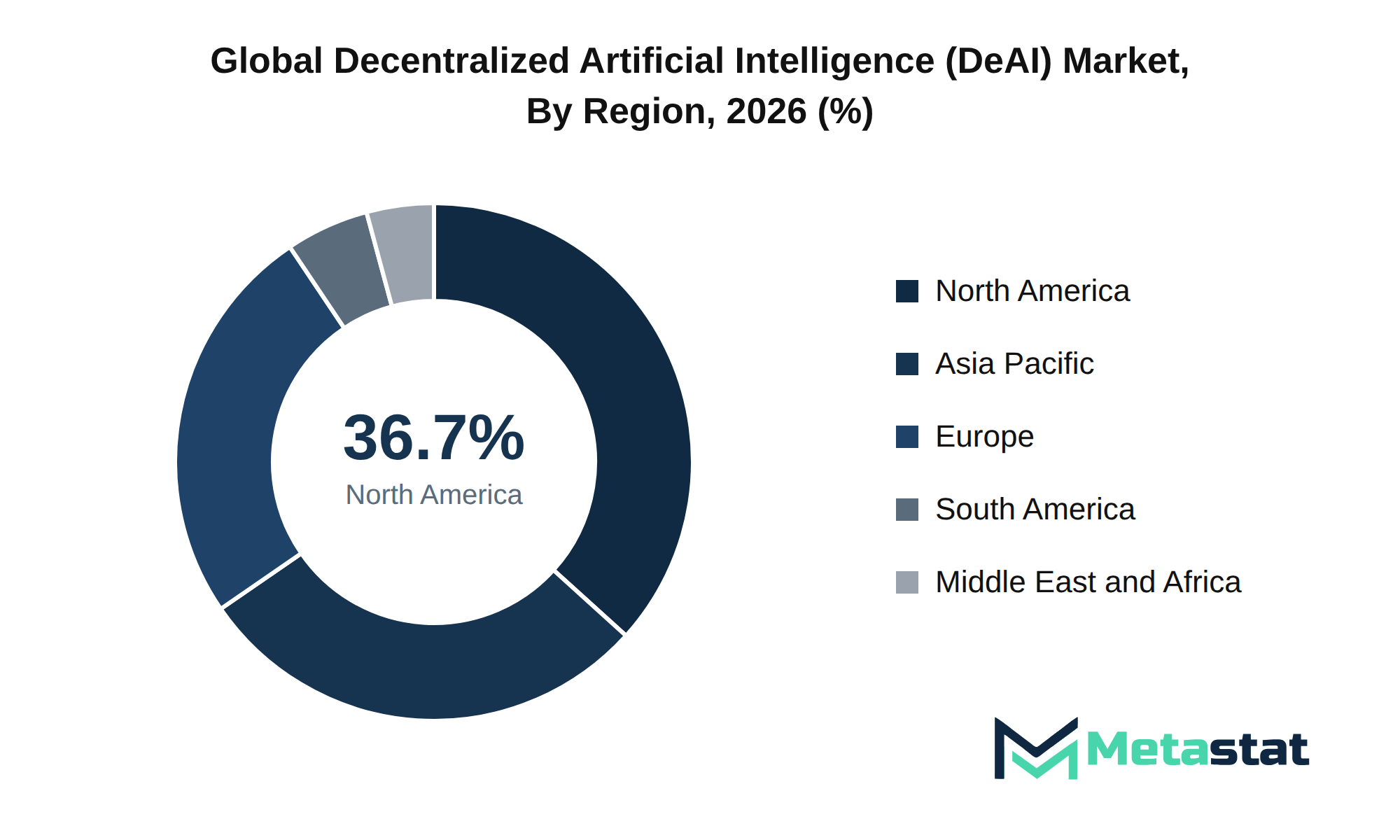
The Decentralized Artificial Intelligence (DeAI) market experiences intense competition driven by innovation and strategic positioning among key players. Companies leverage proprietary technologies and focus on product differentiation to establish unique offerings. The integration of artificial intelligence into various sectors fuels demand for advanced solutions, leading firms including SingularityNET, Fetch.ai, and Bittensor to enhance their research and development pipelines. Such advancements influence pricing architectures, aligning them with the value created for customers.
Strategic alliances and cross-industry partnerships play a significant role in market dynamics. Companies like Zero Gravity (0G) and Sahara AI engage in collaborations that enhance their ecosystem capabilities, facilitating broader access to emerging markets. This trend creates an environment conducive to innovation, allowing players to strengthen their competitive edge. The ongoing threat of new entrants prompts established firms to focus on customer retention strategies and brand equity, ensuring sustained loyalty among users.
The evolving landscape incorporates various barriers to entry that protect established players while presenting challenges for startups. Companies including Gensyn and Ocean Protocol maintain significant intellectual property portfolios, contributing to their technological defensibility. While the Decentralized Artificial Intelligence (DeAI) market matures, the competitive outlook emphasizes the importance of adaptive growth vectors, strategic consolidation, and value chain integration.
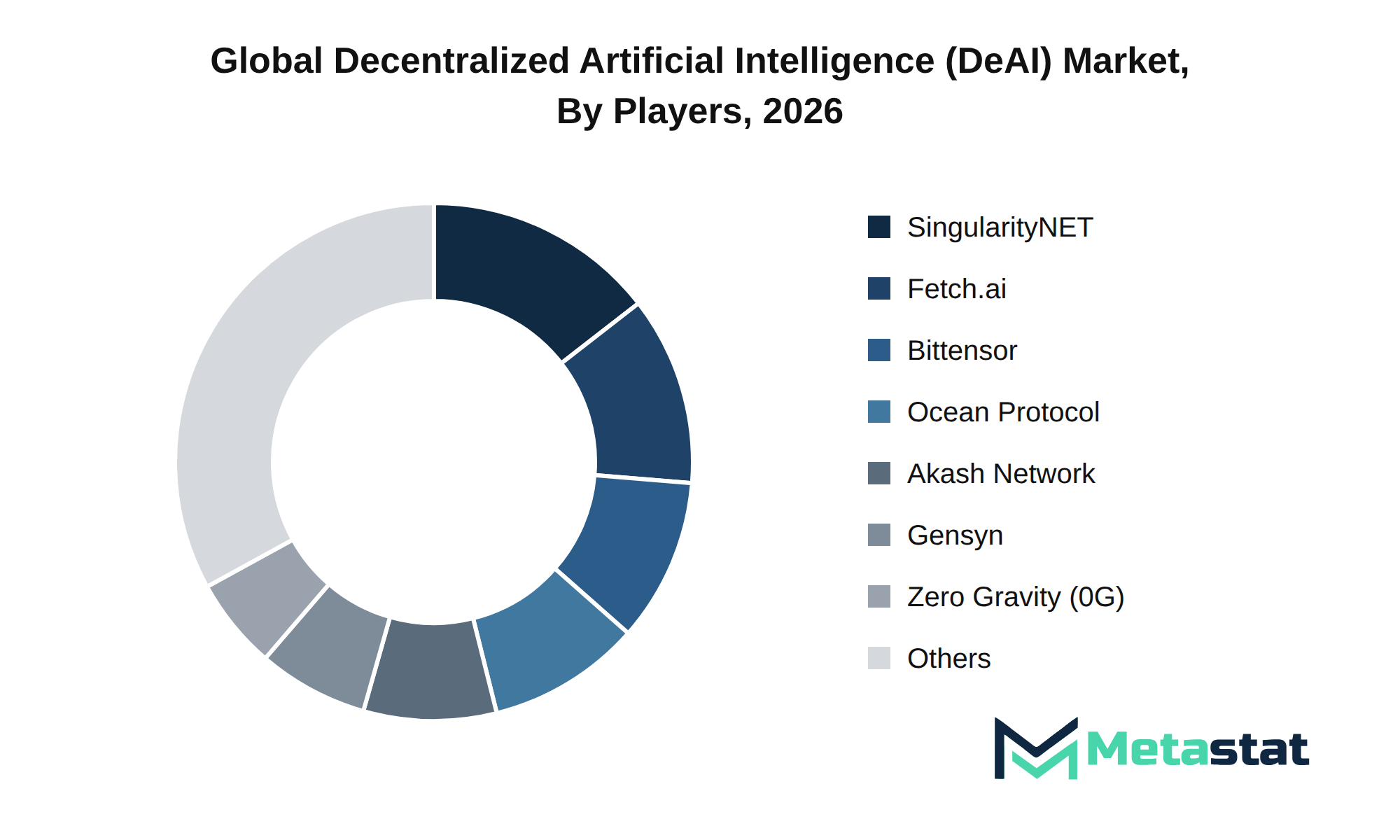
Market size is forecast to rise from USD 2,379.8 million in 2025 to over USD 15,315.6 million by 2033. The base case presents the Decentralized Artificial Intelligence (DeAI) market growing at a 26.2% CAGR during this period. Under a bullish scenario, accelerated adoption driven by advancements in AI capabilities and industry demand could lead to even higher growth rates, driving rapid R&D commercialization and integration of next-generation technologies. Conversely, a bearish outlook considers potential risks including regulatory hurdles, geopolitical tensions, and supply chain disruptions, which could hinder growth momentum and affect investment decisions.
Downstream demand transformations will significantly impact the market, particularly within sectors including IT, telecommunications, and healthcare. The maturation of core industries will drive the integration of DeAI solutions, aligning with strategic capital allocation directives aimed at operational efficiency and innovation. Evolving compliance requirements and policy enforcement timelines will necessitate proactive adjustments from market participants to ensure adherence and mitigate risks.
Market participants will identify emerging white-space opportunities, addressing unmet enterprise needs and targeting high-growth pockets. Strategic imperatives will focus on defensibility roadmaps that enhance competitive positioning in a rapidly changing environment. The combination of these factors will shape the future growth trajectory of the Decentralized Artificial Intelligence (DeAI) market, influencing investment strategies and operational frameworks.
The report strategically identifies and profiles the key market players and analyses their core competencies in each sub-segment of the Decentralized Artificial Intelligence (DeAI) market.
|
Report Attributes |
Details |
|
Study Period |
2021-2033 |
|
Base Year |
2025 |
|
Estimated Year |
2026 |
|
Forecast Period |
2026-2033 |
|
Historical Period |
2021-2025 |
|
Growth Rate |
CAGR 26.2% from 2026 to 2033 |
|
Revenue Unit |
USD million |
|
Segmentation |
By Offering, Deployment Model, Application, End-Use Industry, and Region |
|
By Region |
North America (By Offering, Deployment Model, Application, End-Use Industry, and Country)
|
|
Europe (By Offering, Deployment Model, Application, End-Use Industry, and Country)
|
|
|
Asia Pacific (By Offering, Deployment Model, Application, End-Use Industry, and Country)
|
|
|
South America (By Offering, Deployment Model, Application, End-Use Industry, and Country)
|
|
|
Middle East and Africa (By Offering, Deployment Model, Application, End-Use Industry, and Country)
|
Find answers to common questions about this report
The Decentralized Artificial Intelligence (DeAI) market size was valued at USD 2,379.8 million in 2025, according to the Metastat Insights study.
The Decentralized Artificial Intelligence (DeAI) market is projected to grow at a CAGR of 26.2% during the forecast period from 2026 to 2033.
The North America Decentralized Artificial Intelligence (DeAI) market size is estimated to reach USD 5,348.2 million by 2033.
The leading segment in the Decentralized Artificial Intelligence (DeAI) market is Software & Platforms, with a projected value of USD 6,781.8 million by 2033. This segment surpasses others based on its significant growth trajectory.
Key drivers for the Decentralized Artificial Intelligence (DeAI) market include increasing capital investment, digital transformation initiatives, and a focus on operational productivity. Organizations prioritize cost-efficiency and sustainability, leading to greater demand for decentralized AI solutions that enhance efficiency and reduce overhead costs.
North America holds the dominant share of the Decentralized Artificial Intelligence (DeAI) market, with a projected value of USD 5,348.2 million by 2033, representing 36.7 percent of the total market.
The Decentralized Artificial Intelligence (DeAI) market faces significant challenges from regulatory and compliance hurdles, which increase operational costs and divert resources away from innovation. Macroeconomic headwinds, including inflation and escalating workforce expenses, further restrict capital flow. Geopolitical fragmentation complicates collaboration and compliance, leading to delays in deployment and market growth.
Increasing capital investment, digital transformation initiatives, and a focus on operational productivity favor product adoption in the Decentralized Artificial Intelligence (DeAI) market. Enhanced infrastructure and modernization efforts further facilitate the deployment of decentralized AI solutions, aligning with businesses' priorities for cost-efficiency and innovation.
The Decentralized Artificial Intelligence (DeAI) market is estimated to reach a valuation of USD 15,315.6 million by 2033.
Key players in the Decentralized Artificial Intelligence (DeAI) market include SingularityNET, Fetch.ai, Bittensor, Ocean Protocol, Akash Network, and Theta EdgeCloud.
Emerging governance structures include the European Union AI Act, regional data residency mandates, and global privacy standards such as GDPR. These frameworks require verifiable algorithmic accountability, transparency, and data protection. This pushes DeAI protocols to adopt zero-knowledge validation systems and decentralized autonomous organizations for transparent compliance monitoring.
Unlike centralized AI systems that store information on corporate servers, DeAI processes data locally using federated learning. Sensitive personal or enterprise records remain on original devices. Cryptographic protocols such as zero-knowledge proofs, homomorphic encryption, and differential privacy ensure computations occur securely without revealing raw datasets to outside parties.
Metastat Market analysts expect decentralized architectures to capture an expanding share of localized inference, edge processing, and multi-party fine-tuning tasks, while centralized hyperscalers maintain a strong presence in training massive foundational models.
Decentralized artificial intelligence distributes machine learning processes across independent nodes rather than single corporate clouds. Nodes contribute computing power, storage, or training data to execute tasks. Cryptographic consensus algorithms verify computational outputs, while automated token mechanisms reward participants, ensuring secure model coordination without centralized intermediaries.
Ethereum is widely used for financial settlement, governance structures, and developer tooling. Polkadot provides cross-chain interoperability and specialized application-specific parachains suitable for coordinating distributed workflows. High-throughput layer-1 blockchains and layer-2 rollup frameworks are also commonly adopted to process high-frequency microtransactions and node verification proofs.
Federated learning and edge AI serve as core execution layers within decentralized networks. Edge devices process data locally at the collection point, minimizing network latency. Federated learning trains algorithms across these distributed devices by aggregating mathematical model updates while keeping sensitive raw data secured on host hardware.
Healthcare providers use DeAI to train diagnostic algorithms across institutions without exposing patient records. Financial firms deploy autonomous agents for fraud detection, predictive underwriting, and liquidity routing. Supply chain networks leverage distributed edge nodes and smart contracts to verify tracking events, audit inventory, and automate milestone payments.
Prominent organizations include Fetch.ai, which develops autonomous multi-agent networks, SingularityNET, which operates a decentralized service marketplace, and Ocean Protocol, which builds data monetization and compute-to-data frameworks. Alongside these specialized protocol developers, decentralized physical infrastructure networks provide scalable GPU compute capacity for distributed model execution.
The analysts below cover Information & Technology research at Metastat Insights.
LEAD ANALYST
Utkarsh Khirodkar is a Lead Market Research Analyst at MetaStat Insight, specializing in market intelligence, technology sector assessments, and competitive strategy.

PRINCIPAL CONSULTANT - ENTERPRISE AI & EMERGING TECHNOLOGIES
Banking & Finance · Electronics and Semiconductor · Energy and Power · Healthcare IT · Information & Technology · Professional Services
Vijay Gunti is a Principal Consultant at MetaStat Insight, bringing over two decades of experience across enterprise digital transformation, technology strategy, and intelligent systems.

LEAD CONSULTANT - COMMUNICATION, TELECOM, AND IT
Electronics and Semiconductor · Information & Technology · Machinery & Equipment · Professional Services
Ravindra Sathe Consultants for Communication, Telecom, and IT at MetaStat Insight. He leads the firm's industry research initiatives across telecommunications infrastructure, digital connectivity, enterprise networking, and emerging information technology domains.
Last Updated: October, 2026
Transitioning ultra-class mining haul trucks to alternative power requires concrete data on remote hydrogen refueling infrastructure economics. The report evaluated megawatt-scale electrolyzer installation expenses, onsite storage safety mandates, and heavy-duty fuel cell stack degradation under continuous duty cycles. That technical rigor helped our engineers benchmark realistic total operating cost horizons for off-highway fleet decarbonization.
Enterprise zero-trust network rollouts are often slowed down by multi-cloud transit latency and proprietary hardware retirement schedules. This study provided realistic total cost of ownership models comparing cloud-delivered security edge solutions against traditional hardware refreshes. The analysis of contract renewal lengths and software maintenance fees gave us clear visibility into enterprise replacement cycles over the next three to five years.
Scaling antibody-drug conjugate manufacturing hinges on contract manufacturing availability for high-potency active ingredients. The MetaStat Insight analysis looked closely at global cleanroom slot constraints, bioconjugation batch failure rates, and supply chain redundancies between the US, Europe, and India. The supplier capability matrix proved genuinely useful for our team when mapping secondary source options across our clinical pipeline.
Explore related market intelligence reports worth reading alongside this one.