
LEAD ANALYST
Utkarsh Khirodkar is a Lead Market Research Analyst at MetaStat Insight, specializing in market intelligence, technology sector assessments, and competitive strategy.

Mexico Telecom Cloud Market Size, Share, By Deployment Model (Public Cloud, Private Cloud and Hybrid Cloud), By Cloud Service Model (Infrastructure-as-a-Service, Platform-as-a-Service and Software-as-a-Service), By Telecom Application (Core Network and Network Functions, OSS/BSS and Telecom Applications, Network Management and Orchestration, Unified Communications and Collaboration, Data Analytics and Artificial Intelligence, Edge Computing and Others), By End User (Mobile Network Operators, Fixed Network Operators, Converged Telecom Operators, Mobile Virtual Network Operators, Cable & Broadband Service Providers and Private Network Operators), Industry Analysis, Growth, Trends, and Forecast, 2026-2033
Report ID
MSI-5290
Published
September, 2026
Pages
293 Pages
Format
Historical
Base year
Forecast
Forecast period
Report Details
Market Valuation: Valued at $355.3 Million in 2025, projected to reach $2,405.1 Million by 2033 at a 27.0% CAGR.
Dominant Segment: The hybrid cloud segment leads the Mexico Telecom Cloud market, driven by the increasing demand for flexible and scalable solutions that combine public and private cloud resources.
Geographic Lead: Mexico is experiencing rapid growth in telecom cloud services, fueled by investments in digital transformation and the adoption of advanced technologies across various sectors.
What's Inside: This report provides a comprehensive analysis of the Mexico Telecom Cloud market, including competitive coverage, detailed segment breakdowns, and forecasts through 2033.
Future Growth Opportunities: Future growth in the Mexico Telecom Cloud market hinges on technological advancements and the increasing adoption of cloud solutions among telecom operators and enterprises.
Choose Your License
Mexico Telecom Cloud Market
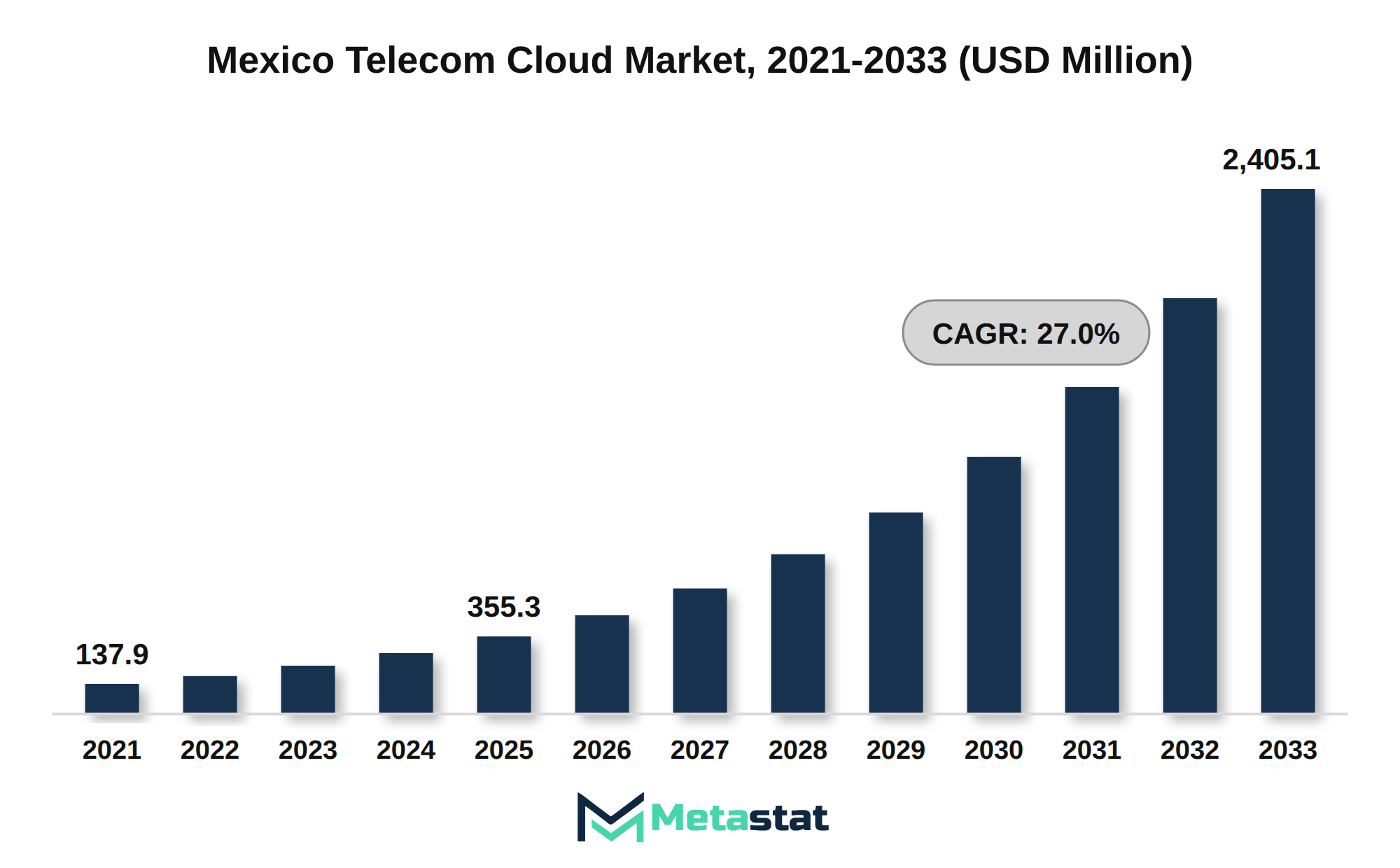
The Mexico Telecom Cloud market was valued at USD 355.3 million in 2025 and is projected to reach USD 2,405.1 million by 2033, growing at a CAGR of 27.0% over the forecast period.
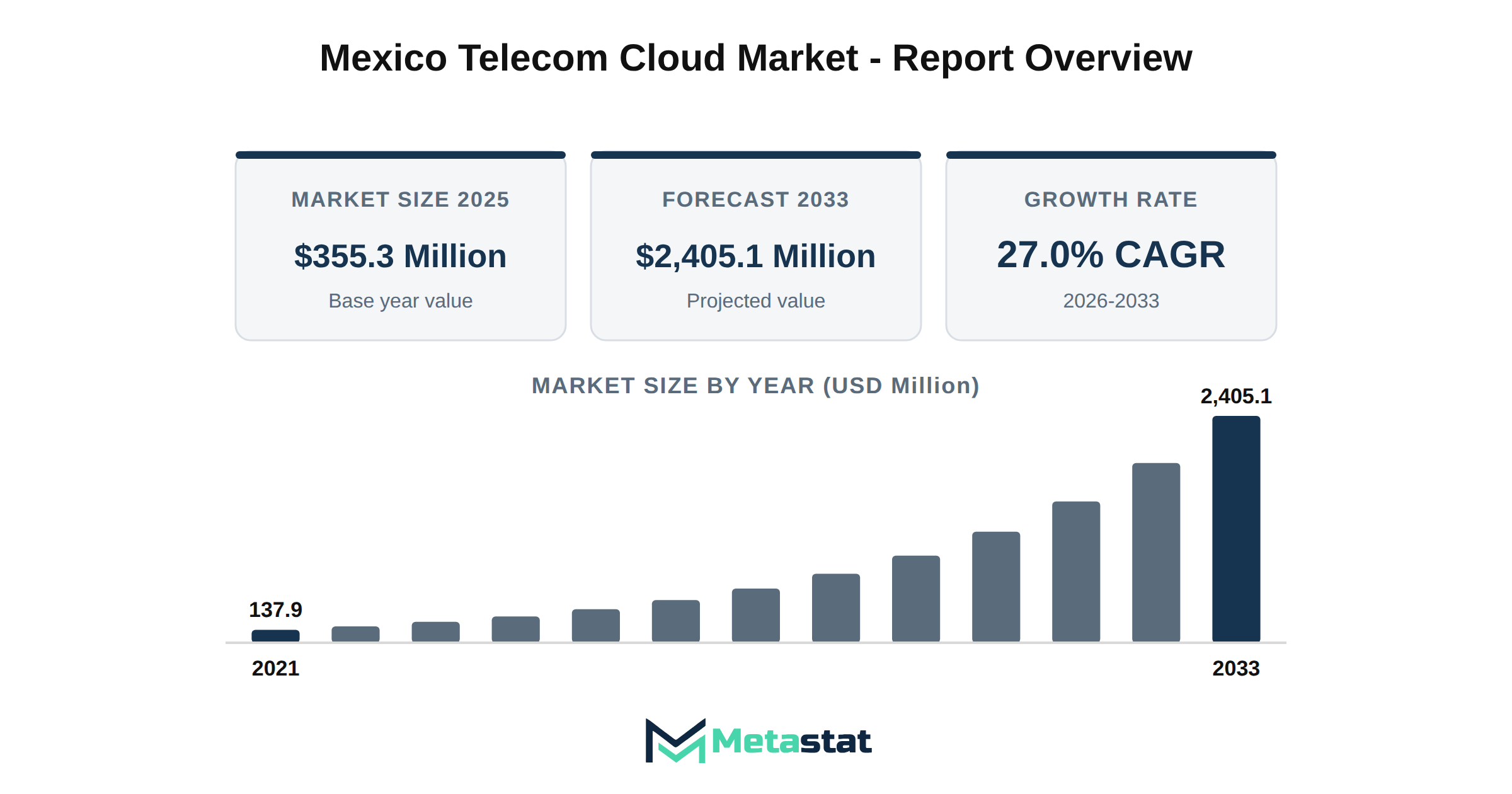
The Mexico Telecom Cloud market reached USD 355.3 million in 2025, with expectations for substantial growth leading to USD 2,405.1 million by 2033. This growth translates to a compound annual growth rate (CAGR) of 27% from 2026 to 2033. Historical data shows the market beginning at USD 137.9 million in 2021 and progressing to USD 355.3 million by 2025, indicating a robust upward trajectory.
Network operators in Mexico increasingly adopt cloud solutions to enhance operational efficiency and service delivery. The shift towards hybrid cloud models reflects the necessity for flexible and scalable infrastructure that meets the diverse needs of telecom services. The adoption of cloud-native core network technology gains momentum, driving modernization efforts across various telecom networks.
Investment in telecom edge computing and Multi-access Edge Computing (MEC) deployments shows significant promise, enhancing low-latency applications and enabling advanced services. Network automation driven by artificial intelligence becomes integral to optimizing operations, allowing providers to enhance efficiency and performance. The migration of Operations Support Systems (OSS) and Business Support Systems (BSS) to cloud environments represents another critical trend shaping the industry.
Public cloud adoption by telecom service providers in Mexico supports increased agility and cost-efficiency, while private cloud solutions are in high demand for mission-critical workloads. Virtualization of 5G networks drives substantial investment in telecom cloud solutions, with operators seeking to leverage cloud-native network functions to transform their infrastructure.
Trends in Open RAN and virtualized RAN deployments highlight the industry's shift towards more flexible and cost-effective network architectures. The demand for cloud orchestration and lifecycle automation reflects the industry's need for improved operational control and resource allocation. Edge AI applications enhance telecom services further, supporting low-latency use cases and data-driven decision-making.
Data analytics and AI workloads experience significant growth within the telecom sector, enabling operators to derive insights from vast amounts of data. Unified communications solutions increasingly gain adoption across telecom providers in Mexico, driving collaboration and enhancing customer engagement. Partnerships with hyperscalers reshape the Mexico Telecom Cloud market, facilitating access to advanced technologies and resources.
Investment in telecom cloud infrastructure continues to expand, particularly in data centers that support the growing demand for cloud services. The adoption of network function virtualization (NFV) among operators enhances service delivery and operational efficiency. Security and data sovereignty requirements remain key considerations, influencing the deployment of telecom cloud solutions in Mexico.
The adoption of cloud technologies among network operators in Mexico reflects a growing commitment to digital transformation. Several operators prioritize the shift towards hybrid cloud architectures, allowing for flexibility and scalability. This trend is evident in the increasing investment in cloud-native core network modernization, which enhances operational efficiency and agility across service offerings.
Hybrid cloud solutions gain traction among Mexican telecom networks due to their ability to combine the advantages of public and private clouds. This model supports diverse workloads and enhances service delivery, meeting the demands of varying customer needs. The hybrid approach contributes to a more resilient network infrastructure while optimizing resource allocation.
Cloud-native core network modernization represents a critical shift for telecom operators in Mexico. This transformation enables operators to deploy services more quickly and efficiently, resulting in enhanced customer experiences. The market experiences increased investment in technologies that support this modernization, driving operational improvements and reducing time-to-market for new services.
Telecom edge computing and Multi-Access Edge Computing (MEC) deployments gain momentum in Mexico, driven by the need for low-latency applications and enhanced service delivery. This approach enables telecom operators to process data closer to end-users, resulting in faster response times and improved application performance. The expansion of edge computing capabilities supports diverse use cases, including IoT applications and real-time analytics.
AI-driven network automation emerges because a key trend within the Mexico Telecom Cloud market. Operators leverage artificial intelligence to enhance operational efficiency, reduce manual intervention, and improve service reliability. This adoption of AI tools leads to better network management and optimization, ultimately delivering superior customer experiences.
Migration of Operational Support Systems (OSS) and Business Support Systems (BSS) to the cloud gains traction among Mexican operators. This transition enables greater efficiency and flexibility in managing telecom services, allowing operators to adapt quickly to market changes. The move to cloud-based OSS and BSS leads to improved data management and customer service capabilities.
The public cloud adoption trend among telecom service providers in Mexico highlights the increasing reliance on scalable infrastructure solutions. Providers seek to leverage public cloud resources to enhance their service offerings and reduce operational costs. This shift enables greater agility and supports the rapid deployment of new services.
Demand for private telco cloud solutions rises among operators focusing on mission-critical network workloads. This trend stems from the need for enhanced security and compliance in handling sensitive data. Private clouds offer tailored solutions that meet the unique requirements of telecom operators while ensuring data sovereignty and operational control.
Investment in telecom cloud infrastructure accelerates due to 5G network virtualization. Operators recognize the importance of virtualized network functions to support enhanced mobile broadband, ultra-reliable low-latency communications, and massive machine-type communications. This investment facilitates the transition to more dynamic and flexible network architectures.
Cloud-native network functions transform the telecom infrastructure landscape in Mexico. By adopting cloud-native principles, operators enhance their ability to innovate and deploy new services rapidly. This transformation supports a more agile operational environment, reducing barriers to entry for new services and applications.
Open Radio Access Network (Open RAN) and virtualized RAN deployments contribute to the evolution of the telecom landscape. These technologies enable operators to optimize network performance and reduce costs associated with traditional infrastructure. The trend signifies a shift towards more flexible and interoperable networks.
Demand for cloud orchestration and lifecycle automation solutions continues to rise among telecom operators. These tools streamline the management of complex cloud environments, improving operational efficiency and enabling effective service delivery. Effective orchestration enhances resource allocation and supports rapid deployment of services.
Edge AI applications gain traction in Mexico, particularly for low-latency scenarios. Operators leverage edge computing to support real-time applications that require quick data processing. This trend enhances service quality and opens new opportunities for innovative applications across various sectors.
Growth in telecom data analytics and AI workloads signifies a shift towards data-driven decision-making. Operators utilize analytics to gain insights into customer behavior and network performance, enabling proactive service improvements. This trend enhances competitive positioning within the market.
Unified communications cloud adoption among telecom providers in Mexico reflects the need for integrated communication solutions. Providers seek to enhance collaboration tools and streamline communication channels for businesses. This trend supports improved productivity and customer engagement.
Partnerships with hyperscalers reshape the Mexico Telecom Cloud ecosystem, driving innovation and service diversification. These collaborations enable telecom operators to leverage advanced cloud capabilities, enhancing their service offerings and competitiveness. The trend represents a strategic approach to addressing evolving customer needs and market demands.
Investment in telecom cloud infrastructure within Mexican data centers rises, reflecting the growing demand for robust cloud services. Operators focus on enhancing their data center capabilities to support expanding cloud workloads. This investment contributes to improved service reliability and performance.
Network function virtualization (NFV) adoption becomes increasingly prevalent among telecom operators in Mexico. This approach allows operators to deploy network functions through virtualized services, enhancing flexibility and reducing operational costs. The trend supports the transition to more agile network architectures.
Security and data sovereignty requirements significantly influence telecom cloud deployment strategies in Mexico. Operators prioritize compliance with local regulations and industry standards to safeguard sensitive data. This focus on security enhances customer trust and supports long-term growth within the market.
Multi-cloud strategies emerge among Mexican telecom operators, allowing for optimized resource allocation and service delivery. By leveraging multiple cloud environments, operators enhance their operational resilience and flexibility. This trend supports the diverse needs of customers while ensuring robust service continuity.
Cloud-based disaster recovery solutions gain importance within the telecom sector in Mexico. Operators recognize the critical ensure service continuity in the face of potential disruptions. Implementing cloud-based disaster recovery enhances resilience and minimizes downtime for essential services.
Cost optimization and infrastructure efficiency become central objectives for telecom operators utilizing cloud solutions. By leveraging cloud technologies, operators enhance operational efficiencies and reduce expenses associated with traditional infrastructure. This strategic focus supports sustainable growth within the market.
Competitive dynamics among telecom cloud platform providers shape the landscape in Mexico. Providers continuously innovate to differentiate their offerings and capture market share. This environment encourages a culture of collaboration and competition, driving advancements in cloud technology.
Opportunities for private 5G and enterprise network cloud solutions expand in Mexico. Enterprises seek tailored solutions to meet specific connectivity and operational requirements. This trend supports the growth of specialized services that cater to business needs, driving further investments in telecom cloud infrastructure.
Innovation across core, edge, and OSS platforms within the Mexico Telecom Cloud market reflects a commitment to enhancing service delivery. Operators invest in modern technologies to improve network performance and operational capabilities. This focus on innovation positions operators for future success in an evolving market.
Future growth opportunities within the Mexico Telecom Cloud market hinge on the continued evolution of technologies and customer demands. Operators that embrace innovative solutions and adapt to changing market conditions will likely secure competitive advantages. This proactive approach positions the market for sustained growth and development.
Economic conditions in Mexico fuel expansion within the Mexico Telecom Cloud market. A growing GDP, coupled with enhanced public and private sector investments, stimulates demand for cloud-based services. Increasing venture funding for technology startups accelerates innovation and integration, allowing businesses to improve operational efficiency.
Digital transformation initiatives among enterprises push organizations to adopt cloud solutions, improving agility and scalability. Companies focus on automating processes and applying artificial intelligence, facilitating a shift from traditional systems toward cloud-based infrastructures. This transformation directly contributes to growth across various sectors in the market.
Shifting demographic patterns and evolving consumer behaviors play significant roles. Urbanization trends in Mexico lead to higher demand for robust telecom services, urging providers to invest in cloud technologies. Preferences for reliable connectivity and on-demand services create new opportunities for telecom operators, enhancing overall market dynamics.
Infrastructure development and asset modernization represent critical components of the growth narrative. Upgrading physical and digital capacities improves network capabilities, enabling telecom operators to meet increasing consumer demands. This modernization aligns with the broader objective of achieving cost efficiency, which remains essential for sustaining competitive advantages in the Mexico Telecom Cloud market.
Overall, these macroeconomic factors shape a favorable environment for investment and adoption within the market, driving future growth trajectories.
Investment in digital transformation significantly influences growth in the Mexico Telecom Cloud market. Businesses increasingly prioritize technological integration to enhance operational efficiency and competitiveness. This trend is driven by the need for automation, artificial intelligence, and the digitization of legacy processes, which lead to improved productivity and cost reductions.
Mobile network operators and fixed network operators actively pursue cloud solutions to modernize their infrastructure, enabling effective service delivery and enhanced customer experience. The deployment of innovative technologies increases market demand because organizations recognize the importance of adapting to evolving consumer behaviors and preferences.
Capital investment environments in Mexico, characterized by venture funding and public-private spending, support the expansion of cloud services. This influx of capital allows enterprises to invest in advanced cloud solutions, contributing to the market's projected growth. The focus on enhancing digital capabilities aligns with the broader trends of economic development and modernization, further strengthening the foundation for sustained growth in the Mexico Telecom Cloud market.
The Mexico Telecom Cloud market faces significant constraints due to the complexity of regulatory compliance and legal mandates. These frameworks require telecom operators to navigate a range of guidelines affecting operational processes and service delivery. Compliance challenges disproportionately impact smaller operators, which lack the resources to effectively manage regulatory burdens. This situation creates a competitive imbalance, limiting market entry for new players.
Macroeconomic headwinds further complicate the landscape. Fluctuations in economic stability and inflationary pressures increase operational costs, constraining investments in essential infrastructure. Operators struggle to allocate resources for technological upgrades, leading to potential obsolescence and stagnation in service innovations. Supply chain disruptions stemming from geopolitical instability introduce unpredictability in equipment procurement, delaying deployment timelines and impacting service reliability.
High capital investment requirements present another hurdle for the market. Telecom operators face escalating operational costs, making it difficult to maintain profitability while investing in cloud infrastructure. The need for skilled labor and talent poses a challenge, driven by a shortage of qualified personnel that limits the sector's potential to fully leverage advanced cloud technologies. Data security vulnerabilities and privacy concerns further exacerbate these issues, discouraging investment and customer adoption. Such factors collectively constrain growth and hinder the overall development of the Mexico Telecom Cloud market.
Geopolitical fragmentation introduces significant complexity within the Mexico Telecom Cloud market. Ongoing trade deficits and tariff friction among nations create uncertainties, influencing supply chain stability and increasing operational costs for telecom providers. This environment leads to heightened pricing compression, impacting margins and profitability across the sector.
Technological disruptions present challenges in research and development integrations. The necessity for interoperability among various cloud services complicates vendor relationships, resulting in project delays and increased compliance overhead. This situation affects investments in new technologies, hindering innovation within the market.
Market participants face rising input cost structures due to geopolitical tensions and supply chain instabilities, straining budgets and limiting expansion capabilities. Workforce skill gaps become evident, because the rapid evolution of cloud technologies demands specialized expertise that is increasingly challenging to retain.
Environmental lifecycle footprints and sustainability demands pressure companies within the market, compelling them to adopt more eco-friendly practices while managing costs. This balance requires investment in new technologies and delays the implementation of necessary upgrades, further complicating market dynamics.
The Mexico Telecom Cloud market's growth trajectory hinges on navigating these geopolitical complexities, requiring proactive strategies to mitigate risks and enhance operational efficiencies. Addressing these challenges effectively will be crucial for maintaining competitive positioning and achieving long-term success in the evolving landscape.
The Mexico Telecom Cloud market benefits from significant technological disruptions that enhance service delivery and operational efficiency. The increasing demand for cloud-based solutions leads various network operators to modernize their infrastructure, supporting faster service deployment and improved customer experiences. The transition towards next-generation innovations, including Artificial Intelligence and Internet of Things integrations, encourages operators to adopt cloud technologies, further stimulating market growth.
Digital transformation initiatives across industries drive heightened investments in cloud solutions. Businesses prioritize agility and scalability in their operations, leading to a notable increase in demand for Infrastructure-as-a-Service and Platform-as-a-Service models. This trend aligns with the growing recognition of the value of data analytics and automation in optimizing processes and enhancing decision-making capabilities.
Sustainability imperatives influence the market, reflecting companies' focus on eco-friendly practices and green transformations. Adoption of cloud solutions allows organizations to reduce energy consumption and minimize their carbon footprint, aligning with broader environmental, social, and governance (ESG) objectives. This shift supports product integration and niche application growth within the Mexico Telecom Cloud market.
Strategic consolidation through cross-industry mergers and acquisitions creates further opportunities for growth. Collaborations among technology providers and telecom operators enhance the development of comprehensive cloud offerings, catering to diverse customer needs. Supply chain localization strategies, incorporating import substitution frameworks, strengthen market resilience and support domestic innovation.
Shifts in buying behaviors towards digital procurement create stronger relationships between cloud service providers and end users. Increased reliance on online platforms for sourcing cloud solutions enhances accessibility and transparency in the market. Operators focus on asset life-cycle extensions and maintenance upgrades, further contributing to the overall growth of the market.
The Mexico Telecom Cloud market is segmented based on Deployment Model, Cloud Service Model, Telecom Application, and End User.
Growth in the Public Cloud segment of the Mexico Telecom Cloud market is driven by increasing demand for scalable and flexible solutions among service providers. This segment is valued at USD 118.9 million in 2026 and is projected to reach USD 596.7 million by 2033, reflecting a CAGR of 25.9% during the forecast period. Enterprises seek to leverage public cloud services to enhance operational efficiency, reduce capital expenditures, and improve service delivery.
The migration to public cloud environments enables telecom operators to innovate and deploy services rapidly. Rising investments in digital infrastructure and emerging technologies support the expansion of this segment. Key participants in the market focus on offering tailored solutions that align with the evolving needs of customers, ensuring robust operational capabilities while addressing data security and compliance requirements.
Technological advancements, including developments in data analytics and artificial intelligence, further drive the growth of the Public Cloud segment. The integration of these technologies into telecom applications enhances service personalization and operational optimization. With intensifying demand for digital transformation, the region is expected to experience a surge in public cloud adoption, significantly impacting the overall market landscape.
Private Cloud deployment in the Mexico Telecom Cloud market is expected to experience significant growth, with an estimated value of USD 852.8 million by 2033, at a CAGR of 24.5% during the forecast period. This segment benefits from increasing demand for secure and customizable solutions among enterprises seeking to enhance their operational efficiencies while ensuring data protection and compliance with regulatory standards.
Technological advancements and the maturation of cloud infrastructure play crucial roles in driving the adoption of Private Cloud solutions. Organizations prioritize scalability and flexibility, allowing them to swiftly adapt to changing market dynamics and consumer demands. Increased focus on data sovereignty and privacy regulations further drives the shift towards Private Cloud deployments, resulting from enterprises seeking greater control over their data environments.
Competitive pressures within the market encourage providers to innovate, offering tailored solutions that meet specific industry requirements. This trend promotes collaboration between technology providers and enterprises, leading to enhanced service offerings that address unique business challenges. The ongoing evolution of cloud technologies supports the integration of next-generation upgrades, strengthening the Private Cloud segment's position in the broader market.
End-user dynamics play a vital role in shaping the growth trajectory of the Private Cloud segment. Mobile Network Operators and Fixed Network Operators increasingly adopt Private Cloud solutions to optimize their network management and improve service reliability. This adoption reflects a broader industry shift towards digital transformation, with firms prioritizing investment in cloud-based infrastructure to enhance operational efficiency and maintain a competitive edge.
The Private Cloud segment exhibits strong growth potential within the Mexico Telecom Cloud market, driven by a combination of technological advancements, regulatory compliance, and evolving end-user needs. The strategic focus on customization and secure data management positions this segment for continued expansion through 2033.
In the Mexico Telecom Cloud market, the Hybrid Cloud segment is expected to reach USD 955.5 million by 2033. This growth primarily stems from increasing demand for flexible, scalable, and cost-effective cloud solutions among operators. Organizations recognize the importance of combining public and private cloud resources to enhance their operational capabilities while ensuring data security and compliance with regulatory standards.
The ongoing technological maturation of cloud infrastructure drives the adoption of hybrid cloud solutions. Enterprises prioritize integration of existing on-premises systems with cloud services to leverage their current investments while transitioning towards more advanced capabilities. Various end users, including mobile and fixed network operators, seek improved service delivery and customer engagement strategies through this trend.
Next-gen upgrades facilitate the evolution of hybrid cloud offerings, allowing businesses to optimize their applications and workloads across diverse environments. The integration of advanced analytics, artificial intelligence, and machine learning within hybrid cloud frameworks significantly enhances operational efficiencies. Such innovations contribute to shifting consumption patterns by enabling organizations to gain data-driven insights for informed decision-making.
Increasing competition in the market drives continuous improvements in service offerings and pricing structures. Providers striving to differentiate themselves focus on delivering tailored hybrid cloud solutions that align with specific customer needs. This competitive landscape encourages investment in advanced technology, further propelling market growth.
Regulatory compliance and evolving policy frameworks create a necessity for organizations to adopt hybrid cloud models that meet stringent data privacy and protection requirements. Compliance challenges often compel companies to invest in secure architectures that leverage both public and private cloud environments. Adapting to these changes encourages businesses to explore hybrid solutions that balance agility with security, supporting their long-term growth objectives.
Strong growth characterizes the Infrastructure-as-a-Service segment within the Mexico Telecom Cloud market. Valued at USD 172.7 million in 2026, this segment is projected to reach USD 822 million by 2033, at a CAGR of 25% during the forecast period. Increasing demand for scalable and flexible cloud solutions drives enterprises towards Infrastructure-as-a-Service offerings, enabling enhanced operational efficiency and reduced capital expenditures.
Technological advancements in cloud computing, including improved virtualization and automation, enhance the appeal of Infrastructure-as-a-Service. Companies across various sectors adopt these solutions to maintain competitiveness in an evolving digital landscape. Mobile network operators, in particular, seek Infrastructure-as-a-Service to streamline operations, lower infrastructure costs, and improve service delivery.
Investment in next-generation upgrades and product evolution supports the growth trajectory of this segment. Enterprises increasingly favor software-defined solutions that facilitate integration and management of resources. Regulatory compliance standards, along with rising concerns regarding data security, drive organizations towards Infrastructure-as-a-Service, because cloud providers offer robust security features that align with compliance requirements.
The Infrastructure-as-a-Service segment plays a critical role in the overall expansion of the Mexico Telecom Cloud market, aligning with broader trends of digital transformation and cloud adoption. Enhanced flexibility, cost savings, and technological maturation position this segment for significant growth over the coming years.
In the Mexico Telecom Cloud market, the Platform-as-a-Service segment is projected to reach USD 688.8 million by 2033, at a CAGR of 27.7% during the forecast period. Demand drivers for this segment include the increasing need for scalable infrastructure and the growing emphasis on innovation within various industries. Organizations seek to leverage cloud-based solutions to enhance operational efficiency and reduce the time-to-market for new applications.
Technological maturation significantly influences the segment's expansion, with advancements in cloud technology enabling more robust and flexible service offerings. Next-generation upgrades and the evolution of software capabilities contribute to effective integration into existing IT environments. Enterprises increasingly adopt Platform-as-a-Service solutions to support digital transformation efforts and facilitate data analytics, machine learning, and artificial intelligence applications.
End-user dynamics indicate a shift in consumption patterns, with a notable rise in adoption among mobile network operators and fixed network operators. Organizations prioritize the need for cost-effective solutions that provide flexibility and customization to meet specific business requirements. Regulatory compliance standards drive demand for secure and reliable cloud services, compelling providers to invest in enhanced security measures and data protection protocols.
Pricing volatility remains a factor impacting the market, driven by intensifying competition among service providers. Margin pressures from operational costs necessitate strategic pricing models that align with customer expectations while maintaining profitability. The focus on supply chain resilience and raw material sourcing ensures that providers meet the increasing demand for services without disrupting offerings.
Overall, the strategic opportunity windows within the Platform-as-a-Service segment present significant capital investment potential. With growing awareness and acceptance of cloud solutions, the Mexico Telecom Cloud market continues to evolve, driven by innovation and a commitment to delivering value to customers.
Adoption of Software-as-a-Service solutions within the Mexico Telecom Cloud market is driven by increasing demand for scalable and flexible applications. Organizations prioritize cost-effectiveness and efficiency, leading to heightened investment in cloud-based software. The expected reach of USD 894.2 million by 2033 reflects strong traction among various industries, particularly telecommunications, which require robust solutions for operational management and customer engagement.
Technological maturation significantly influences the segment, with advancements in cloud infrastructure facilitating smoother integration of Software-as-a-Service offerings. Rapid evolution in product features, including enhanced data analytics and artificial intelligence capabilities, addresses the diverse needs of enterprises. Adoption of these technologies supports improved decision-making and streamlined processes across organizational functions.
Downstream applications, particularly among mobile network operators, demonstrate a strong preference for Software-as-a-Service due to its ability to improve service delivery and customer experiences. Increased competition among cloud service providers compels them to innovate and optimize offerings to capture market share. Regulatory compliance standards further increase the demand for secure and compliant Software-as-a-Service solutions, reinforcing the segment's growth potential.
Cost structures associated with Software-as-a-Service typically offer advantages over traditional software models, contributing to rising adoption rates. Pricing volatility remains manageable, with providers employing flexible subscriptions that cater to varying customer needs. Strategic opportunity windows arise from companies increasingly recognizing the value of investing in cloud solutions, strengthening the segment's position within the Mexico Telecom Cloud market.
In 2026, the Core Network and Network Functions segment is valued at USD 104 million and is projected to reach USD 477.2 million by 2033, with a CAGR of 24.3% during the forecast period. Increasing demand for advanced network capabilities drives growth within this segment, especially among mobile network operators seeking to enhance service delivery and operational efficiency. The shift towards digital transformation across various sectors necessitates the integration of sophisticated network functions that support efficient data processing, management, and connectivity.
Technological maturation significantly influences segment development, with next-gen upgrades in network virtualization and automation facilitating enhanced functionalities. Cloud-native approaches to network architecture enable scalability and flexibility, allowing telecom operators to respond promptly to evolving customer needs. The shift towards 5G technology further accelerates demand for core network solutions, driven by providers focusing on delivering high-performance applications and services.
Regulatory compliance standards and industry certifications reinforce the importance of reliable network functions, promoting investment in robust infrastructure to meet stringent performance metrics. Cost structures within this segment reflect the ongoing competition among providers to deliver innovative solutions while managing pricing volatility. Despite associated margin pressures, strategic opportunity windows emerge through partnerships and collaborations, driving growth within the market.
Investment in research and development supports product evolution, allowing companies to introduce disruptive alternatives that address the unique challenges faced by telecom operators. The dynamic consumption shifts towards cloud-based solutions increase reliance on telecom applications to enhance operational capabilities. Overall, the growing emphasis on advanced core network and network functions positions this segment favorably within the Mexico Telecom Cloud market.
Significant investment in OSS/BSS and Telecom Applications fuels transformation across the Mexico Telecom Cloud market. This segment facilitates improved service delivery and operational efficiency for telecom providers. The increasing demand for integrated solutions drives the need for enhanced operational capabilities, propelling adoption among Mobile Network Operators and Fixed Network Operators. Migration towards digital platforms accelerates the transition from traditional systems to cloud-based applications.
OSS/BSS solutions support integration between various telecom services, enhancing customer experience and operational workflows. This integration allows telecom operators to optimize resource management and streamline service provisioning. With advancements in technology and rising consumer expectations, investment in OSS/BSS and Telecom Applications remains critical for telecom providers aiming to maintain competitiveness in the evolving landscape.
The OSS/BSS and Telecom Applications segment is projected to reach USD 382.9 million by 2033, at a CAGR of 25% during the forecast period. This growth reflects the urgency among telecom operators to adopt more efficient and scalable solutions in response to market demands. While adoption continues to rise, telecom providers will increasingly focus on enhancing their OSS/BSS capabilities to drive operational excellence and support innovative service offerings.
Demand for Network Management and Orchestration services is driven by the increasing complexity of telecom networks. The transition towards 5G technology and the proliferation of Internet of Things devices necessitate advanced management capabilities for effective operations. Network operators focus on optimizing performance and ensuring reliability, further boosting the adoption of such solutions. This segment stands to benefit from significant investments in infrastructure upgrades, allowing telecom operators to enhance service quality and operational efficiency.
Technological maturation plays a critical role in the growth of the Network Management and Orchestration segment. Operators leverage next-generation upgrades to improve service delivery and customer experience. The introduction of artificial intelligence and machine learning in network management enhances predictive capabilities and operational agility, positioning the market for sustained growth. Regulatory compliance standards regarding network performance and security impose additional pressures, encouraging operators to invest in advanced management systems.
The Network Management and Orchestration segment is expected to reach USD 378.3 million by 2033. Increased demand from mobile network operators and fixed network operators contributes to this growth, driven by these entities' efforts to improve network efficiency and reduce downtime. End-user dynamics indicate a shift towards integrated solutions that encompass monitoring, management, and orchestration for comprehensive network visibility and control.
Strong interest in Unified Communications and Collaboration solutions drives growth within the Mexico Telecom Cloud market. Organizations recognize the importance of effective communication and collaboration tools to enhance productivity, streamline workflows, and improve customer engagement. Demand for integrated solutions that support remote work and virtual collaboration continues to rise, particularly following shifts in work environments post-pandemic.
The Unified Communications and Collaboration segment is projected to grow at a CAGR of 25.5% during the forecast period. This expansion results from technological advancements that facilitate real-time communication and the increasing adoption of cloud-based platforms. Competition among service providers focuses on delivering comprehensive solutions that integrate voice, video, and messaging functionalities.
Investments in next-generation technologies, including artificial intelligence and machine learning, further enhance the capabilities of Unified Communications and Collaboration tools, enabling advanced analytics and personalized user experiences. The shift towards subscription-based pricing models supports flexibility for end-users while improving vendor-customer relationships.
Increased focus on regulatory compliance and data security standards influences the development of Unified Communications and Collaboration offerings. Providers ensure that their solutions align with industry regulations, thereby enhancing trust and user confidence. The relationship between evolving customer expectations and regulatory frameworks shapes product evolution within this segment, impacting overall market dynamics.
Adoption of Data Analytics and Artificial Intelligence solutions within the Mexico Telecom Cloud market reflects an increasing need for efficient data management and decision-making processes. Organizations across various sectors recognize the importance of deriving insights from vast amounts of data. This segment supports enhanced operational efficiencies and customer engagement strategies, which are crucial for maintaining competitive advantage.
Segment expansion results from technological maturation and the continuous evolution of analytics tools. Next-generation upgrades, including advanced algorithms and machine learning capabilities, drive demand for more sophisticated analytics solutions. Telecom operators integrate these capabilities into their offerings, enabling a broader array of applications, including network optimization and customer experience enhancement.
Consumption shifts towards cloud-based analytics solutions indicate a preference for scalable, flexible options that align with dynamic business requirements. Regulatory compliance standards and policy headwinds compel organizations to adopt robust analytics frameworks, ensuring adherence to data protection regulations while maximizing the value derived from data assets.
Strategic opportunity windows have emerged, highlighting the potential for innovative applications within the telecom sector. Investments in Data Analytics and Artificial Intelligence drive significant advancements in service delivery and operational excellence. Continued focus on these technologies positions the market for sustained growth, aligning with broader trends in digital transformation across industries.
Increasing reliance on low-latency services fuels demand for Edge Computing within the Mexico Telecom Cloud market. This technology facilitates real-time processing of data, enhancing the performance of applications that require immediate responsiveness. The rise of Internet of Things (IoT) devices and applications further drives this demand, resulting from organizations seeking to process data closer to the source, minimizing latency and bandwidth usage.
Growing interest in smart cities and autonomous systems contributes to expanding adoption of Edge Computing solutions. Industries including manufacturing, transportation, and healthcare recognize the need for immediate data processing capabilities to optimize operations and ensure safety. This trend highlights a shift in consumption patterns, with enterprises prioritizing solutions that deliver operational efficiency and improved customer experiences.
Technological maturation in Edge Computing drives opportunities for investment and innovation. Established telecom players and emerging startups explore partnerships to develop next-generation applications that leverage edge capabilities. This collaborative approach enhances product evolution and accelerates time-to-market for advanced solutions, positioning the market for substantial growth.
Regulatory compliance standards influence the trajectory of Edge Computing adoption, particularly concerning data privacy and security. Organizations navigate these regulations while implementing innovative technologies, creating a complex environment for market participants. Addressing compliance requirements through robust solutions will be crucial for market success.
Disaster recovery and backup services play a vital role in maintaining business continuity, especially in an increasingly digital world. Organizations prioritizing data protection seek reliable solutions that ensure minimal disruption during unforeseen events. The surging demand for content delivery and media services reflects the need for efficient access to data and applications, particularly with the growth of streaming and digital media consumption. Enhanced user experiences drive this demand, necessitating advanced services that swiftly and efficiently deliver content.
Technological maturation within the market contributes to the expansion of offerings in this sub-segment. Innovations in cloud computing and enhanced network capabilities enable more robust disaster recovery solutions and optimized content delivery mechanisms. The shift toward hybrid and multi-cloud environments encourages organizations to adopt flexible solutions that meet varying operational requirements. Regulatory compliance standards create additional pressure for companies to implement effective disaster recovery plans, ensuring data integrity and security.
Cost structures and pricing volatility influence investment decisions in this segment. Companies evaluate the return on investment associated with adopting sophisticated disaster recovery solutions, balancing upfront costs against long-term savings from potential downtime avoidance. Strategic opportunities emerge for service providers that deliver scalable, cost-effective solutions tailored to diverse industry needs. Market participants focusing on these aspects position themselves competitively within the broader Mexico Telecom Cloud market, capturing the growing demand for comprehensive disaster recovery and content delivery services.
Mobile Network Operators account for a substantial portion of the Mexico Telecom Cloud market. The segment is valued at USD 143.7 million in 2026 and is projected to reach USD 691 million by 2033, reflecting a compound annual growth rate of 25.2% during the forecast period. This growth results from a strategic shift towards advanced cloud solutions that enhance operational efficiency and service delivery.
Primary demand drivers for Mobile Network Operators include the increasing need for scalable infrastructure, improved customer experience, and competitive differentiation. Adoption of next-generation technologies, including 5G, necessitates robust cloud solutions that support high data throughput and low latency, increasing reliance on cloud services. Enhanced security measures and compliance with regulatory standards contribute to the segment's expansion, ensuring operators meet consumer expectations and regulatory requirements.
Technological maturation plays a critical role in shaping the offerings available to Mobile Network Operators. Continued advancements in Infrastructure-as-a-Service and Platform-as-a-Service provide flexible deployment options, allowing operators to enhance their service portfolios. The evolution of telecom applications, particularly in core network functions and unified communications, supports operational agility and responsiveness to market demands.
Investment in cloud-based solutions facilitates significant improvements in service quality and operational efficiency. Mobile Network Operators leverage cloud technologies to optimize resource management and enhance customer engagement strategies. While the market evolves, maintaining a keen focus on strategic opportunity windows and recognizing disruptive alternatives remains essential for sustaining growth in this environment.
Fixed Network Operators show an increasing trend within the Mexico Telecom Cloud market. This growth results from the rising need for reliable and high-capacity communication infrastructures, which are essential for supporting the evolving demands of consumers and businesses. Digital transformation initiatives across various industries have accelerated the adoption of cloud solutions, driving investments in advanced technologies. The segment is estimated to reach USD 394.7 million by 2033, at a CAGR of 25.4% during the forecast period.
Enhanced operational efficiency and the need for efficient services contribute to demand within the segment. Fixed Network Operators are progressively adopting cloud-based solutions to improve service delivery, reduce operational costs, and enhance customer experience. Emphasis on regulatory compliance and the implementation of new telecommunications standards further encourage investment in cloud technologies. The market reflects a strategic shift towards leveraging cloud infrastructure for both current operations and future scalability.
Technological maturation drives Fixed Network Operators to explore next-generation upgrades, enabling them to offer innovative services and products. Evolving consumer preferences for high-speed internet and reliable connectivity compel operators to integrate cloud solutions that provide enhanced agility and responsiveness. Collaboration with cloud providers facilitates access to advanced technologies and expertise, positioning operators to capitalize on emerging opportunities in the market.
Continued growth in the Fixed Network Operators segment highlights the importance of strategic partnerships and investment in robust cloud solutions. The market is poised for further expansion driven by operators seeking to enhance service delivery and meet the increasing demands of users for dependable and high-quality communication services.
Growth in the Converged Telecom Operators segment contributes significantly to the Mexico Telecom Cloud market, driven by increasing demand for integrated services that combine voice, data, and video capabilities. This segment is expected to reach USD 543.1 million by 2033, reflecting ongoing investments in technology and infrastructure. The rapid evolution of communication technologies encourages Converged Telecom Operators to adopt cloud solutions that improve service delivery and operational efficiency.
Adoption of advanced cloud services facilitates better resource management and scalability, allowing these operators to meet customer expectations for reliable connectivity. The market environment favors convergence strategies, which enable operators to streamline operations and reduce costs associated with maintaining disparate systems. Regulatory compliance standards further necessitate the transition to cloud-based infrastructure, ensuring operators efficiently manage data and adhere to industry requirements.
Next-gen upgrades in technology including 5G and edge computing increase the importance of cloud solutions in the sector. These advancements create strategic opportunity windows, prompting operators to explore innovative applications and enhance service offerings. The relationship between technological maturation and market demand reinforces the role of converged services, reflecting a key element of growth within the Mexico Telecom Cloud market.
Mobile Virtual Network Operators drive notable momentum in the Mexico Telecom Cloud market, with a projected growth rate of 30.1% during the forecast period. This segment benefits from a surge in demand for flexible, cost-effective solutions that enable service providers to deliver competitive offerings without significant capital investment in infrastructure.
Increasing adoption of cloud-based services allows Mobile Virtual Network Operators to enhance service delivery and improve customer experience. The shift to cloud technology facilitates access to advanced analytics, enabling operators to optimize network performance and customer engagement strategies. Enhanced operational efficiency supports sustained growth within this segment.
Investment in next-generation technologies positions Mobile Virtual Network Operators to capitalize on emerging market opportunities. These operators embrace innovative applications and solutions that enhance service offerings and differentiate them in a crowded market. Robust expansion of the segment contributes significantly to the overall growth trajectory of the Mexico Telecom Cloud market.
Growing interest in enhanced broadband services drives investment among Cable & Broadband Service Providers within the Mexico Telecom Cloud market. The evolving demands of consumers for higher bandwidth and better reliability stimulate these providers to adopt cloud solutions, facilitating service delivery and operational efficiency. Innovations in fiber-optic technology and enhancements in network infrastructure support this transition, allowing providers to meet increasing user expectations seamlessly.
Regulatory compliance standards significantly influence operational practices among service providers, prompting them to invest in cloud solutions that ensure adherence to evolving regulations. Cost structures remain a critical consideration, driven by providers seeking ways to optimize spending while maintaining service quality. The introduction of next-generation technologies, including 5G, further enhances competitive dynamics, encouraging providers to innovate and expand their offerings to capture emerging market opportunities.
Strategic partnerships with technology companies improve service capabilities within this segment, enabling providers to deliver a diverse range of services. Consumption shifts toward digital content and streaming services necessitate robust infrastructure, prompting an accelerated migration to cloud-based solutions. These developments indicate a strong outlook for Cable & Broadband Service Providers, contributing to the overall growth trajectory of the market.
Investment in Private Network Operators within the Mexico Telecom Cloud market stems from the increasing demand for secure and reliable connectivity solutions. Organizations prioritize the establishment of private networks to enhance security, ensure data sovereignty, and improve operational efficiency. Technological maturation plays a significant role in this segment, with advancements in network virtualization and automation facilitating the deployment of effective private networks.
Adoption of next-generation technologies, including software-defined networking and network function virtualization, significantly influences the expansion of private network operators. The push for digital transformation across various sectors further drives this trend, prompting organizations to seek customized solutions tailored to their specific operational needs. Consequently, the segment attracts substantial capital investment, driven by providers aiming to enhance their service offerings and infrastructure.
Cost structures remain a critical focus for private network operators, with pricing volatility impacting profitability. Operators strive to balance investments in technology with competitive pricing strategies to maintain market share. Regulatory compliance standards contribute to the complexity of operations, necessitating that private network solutions align with industry regulations and certifications.
The ongoing evolution of products and services in this segment reflects shifting consumption patterns, because enterprises increasingly favor integrated solutions that combine various telecom applications. The market dynamics encourage private network operators to innovate continually, ensuring resilience in a landscape characterized by technological obsolescence and disruptive alternatives.
Strategic opportunities arise from the growing demand for tailored solutions and enhanced customer experiences. Private network operators that successfully leverage these opportunities position themselves favorably within the market. The outlook indicates potential for strong growth, driven by evolving end-user requirements and an increasing emphasis on secure, efficient, and flexible network solutions.
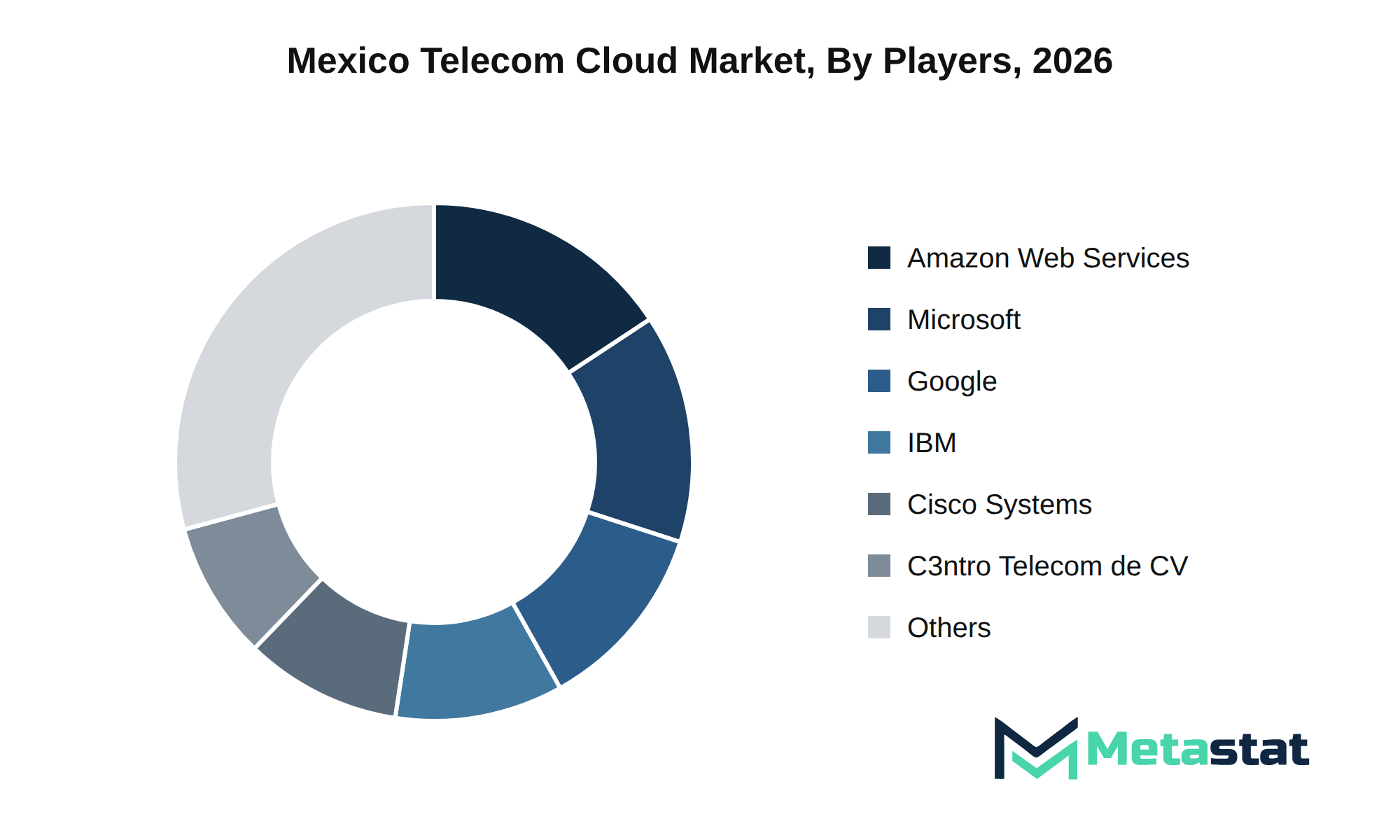
The Mexico Telecom Cloud market features a diverse range of players engaging in various strategic behaviors to strengthen their market positions. Companies like Amazon Web Services, Inc., Microsoft Corporation, and Google LLC focus on product differentiation and proprietary technology moats, employing advanced cloud service models to enhance their offerings. These firms invest heavily in research and development to maintain a competitive edge and cater to the growing demand for cloud solutions across different sectors.
Strategic alliances play a crucial role in the market, with companies including IBM Corporation, Ericsson, and Nokia Corporation forming joint ventures to expand their service capabilities. This collaborative approach allows firms to integrate value chains and capitalize on supply chain dominance, ensuring efficient delivery of telecom cloud services. Brand equity dynamics and customer retention strategies significantly influence market strategies, reflecting companies' efforts to build long-lasting relationships with clients.
The market faces barriers to entry, particularly in terms of technological defensibility and intellectual property portfolios. New entrants encounter challenges due to established players' strong positions, which include extensive patent landscapes and proprietary technologies. This dynamic shapes the competitive outlook, compelling existing companies to prioritize defensive imperatives and strategic growth vectors to sustain their market presence.
Overall, the competitive environment in the Mexico Telecom Cloud market reflects a blend of innovation, strategic partnerships, and a focus on customer-centric approaches, driving growth and encouraging technological advancement.
Market size is forecast to rise from USD 355.3 million in 2025 to over USD 2,405.1 million by 2033. The base case anticipates a growth trajectory at a 27.0% compound annual growth rate (CAGR). In a bullish scenario, innovations in next-generation technology and increasing enterprise demand could drive faster growth, leading to a more robust market presence and heightened investment in infrastructure. Conversely, a bearish outlook could arise from economic downturns or regulatory changes that restrict capital allocation and innovation, potentially hampering the market.
The macroeconomic scenario shows a strong correlation between technological advancements and market expansion. Downstream demand will play an important role, driven by core industry maturation and structural consumption shifts. Companies investing in research and development (R&D) and pursuing strategic capital allocation directives will likely gain a competitive edge. Evolving trade corridors and regional supply chain shifts create opportunities for enhanced operational efficiencies within the Mexico Telecom Cloud market.
Strategic imperatives will focus on meeting unmet enterprise needs and capturing high-growth pockets. Organizations pursuing defensibility roadmaps that align with imminent compliance milestones and regulatory evolution timelines will better position themselves for sustainable growth. Maintaining agility in operations and strategic foresight will support adaptation to the evolving environment, ensuring relevance in the competitive environment.
The report strategically identifies and profiles the key market players and analyses their core competencies in each sub-segment of the Telecom Cloud market.
Report Attributes | Details |
Study Period | 2021-2033 |
Base Year | 2025 |
Estimated Year | 2026 |
Forecast Period | 2026-2033 |
Historical Period | 2021-2025 |
Growth Rate | CAGR 27.0% from 2026 to 2033 |
Revenue Unit | USD million |
Segmentation | By Deployment Model, Cloud Service Model, Telecom Application, End User, and Region |
Find answers to common questions about this report
The Telecom Cloud market in Mexico was valued at USD 355.3 million in 2025, according to the Metastat Insights study.
The Telecom Cloud market is projected to grow at a CAGR of 27.0% during the forecast period from 2026 to 2033.
The Private Cloud segment leads the Mexico Telecom Cloud market, with a projected value of USD 852.8 million by 2033. This segment surpasses the others in terms of revenue potential.
Economic conditions in Mexico drive expansion in the Telecom Cloud market through a growing GDP and increased public and private sector investments. Enhanced digital transformation initiatives among enterprises and urbanization trends further stimulate demand for cloud-based services, creating opportunities for telecom operators to modernize their infrastructure and improve service delivery.
The Mexico Telecom Cloud market faces significant constraints due to complex regulatory compliance, high capital investment requirements, and supply chain disruptions. Smaller operators struggle with compliance burdens, while economic instability and inflation increase operational costs, limiting investments in infrastructure and technological upgrades. These factors collectively hinder the market's growth potential.
Economic conditions in Mexico, including a growing GDP and increased public and private sector investments, drive demand for cloud-based services. Urbanization trends and preferences for reliable connectivity enhance product adoption, prompting telecom operators to invest in cloud technologies to meet evolving consumer behaviors.
The Telecom Cloud market is estimated to reach a valuation of USD 2,405.1 million by 2033.
Key players in the Mexico Telecom Cloud market include Amazon Web Services, Inc., Microsoft Corporation, Google LLC, Oracle Corporation, IBM Corporation, Ericsson, and Nokia Corporation.
The private cloud segment is projected to grow at a compound annual growth rate of 24.5% through 2033.
The unified communications and collaboration segment is experiencing significant growth, driven by increasing demand for integrated communication solutions.
The analysts below cover Information & Technology research at Metastat Insights.
LEAD ANALYST
Utkarsh Khirodkar is a Lead Market Research Analyst at MetaStat Insight, specializing in market intelligence, technology sector assessments, and competitive strategy.

PRINCIPAL CONSULTANT - ENTERPRISE AI & EMERGING TECHNOLOGIES
Banking & Finance · Electronics and Semiconductor · Energy and Power · Healthcare IT · Information & Technology · Professional Services
Vijay Gunti is a Principal Consultant at MetaStat Insight, bringing over two decades of experience across enterprise digital transformation, technology strategy, and intelligent systems.

LEAD CONSULTANT - COMMUNICATION, TELECOM, AND IT
Electronics and Semiconductor · Information & Technology · Machinery & Equipment · Professional Services
Ravindra Sathe Consultants for Communication, Telecom, and IT at MetaStat Insight. He leads the firm's industry research initiatives across telecommunications infrastructure, digital connectivity, enterprise networking, and emerging information technology domains.
Tracking capacity expansion in single-use bioprocessing requires dependable data on raw material availability and cleanroom-grade polymer supply chains. The competitive landscape chapter gave a grounded evaluation of secondary component suppliers across North America and Asia-Pacific rather than simply reprinting press releases. Having that level of supplier benchmarking helped clarify dual-sourcing considerations for our clinical pipeline planning.
When evaluating distributed energy resource management systems, standard research summaries tend to gloss over the operational differences between front-of-the-meter utility deployments and behind-the-meter industrial sites. The MetaStat Insight report addressed those distinctions directly, especially regarding software interoperability standards and grid interconnection backlogs. The five-year market sizing across regional transmission organizations provided actionable context for our grid modernization strategy.
Most industry reports on warehouse automation bundle autonomous mobile robots and fixed conveyor installations into the same top-level numbers, which complicates advisory work. This study split the market cleanly by payload tiers, navigation technology, and fleet management software layers. The regional forecast for Western Europe gave our team defensible adoption benchmarks when evaluating capital allocation for logistics clients, saving us days of secondary data scrubbing.
Explore related market intelligence reports worth reading alongside this one.