
LEAD ANALYST
Utkarsh Khirodkar is a Lead Market Research Analyst at MetaStat Insight, specializing in market intelligence, technology sector assessments, and competitive strategy.

Global Infrastructure-as-a-Service Market Size, Share, By Service (Compute as a Service (CaaS), Storage as a Service (STaaS), Networking & CDN, Database / Analytics as a Service (DBaaS), Disaster-Recovery as a Service (DRaaS) and Others (Managed Hosting, Dedicated Cloud)), By Deployment (Public, Private and Hybrid), By Industry (BFSI, Retail & E-commerce, Healthcare, Education, Manufacturing, IT & Telecom and Others Industries), By Enterprise Size (Large Enterprises and SMEs), Industry Analysis, Growth, Trends, and Forecast, 2026-2033
Report ID
MSI-5100
Published
August, 2026
Pages
267 Pages
Format
Historical
Base year
Forecast
Forecast period
Report Details
Choose Your License
Global Infrastructure-as-a-Service Market
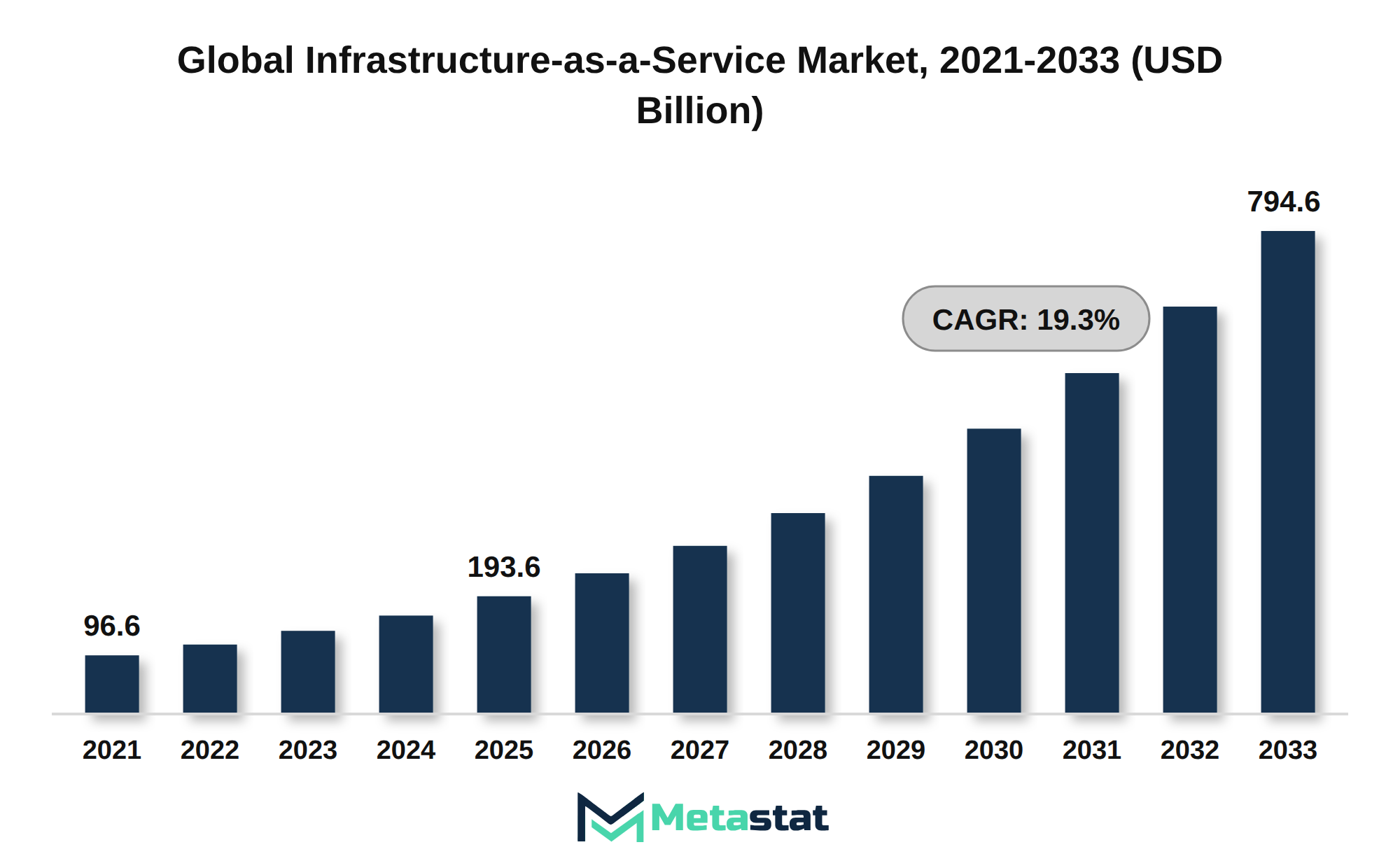
The global Infrastructure-as-a-Service market was valued at USD 193.6 billion in 2025 and is projected to reach USD 794.6 billion by 2033, growing at a CAGR of 19.3% over the forecast period.
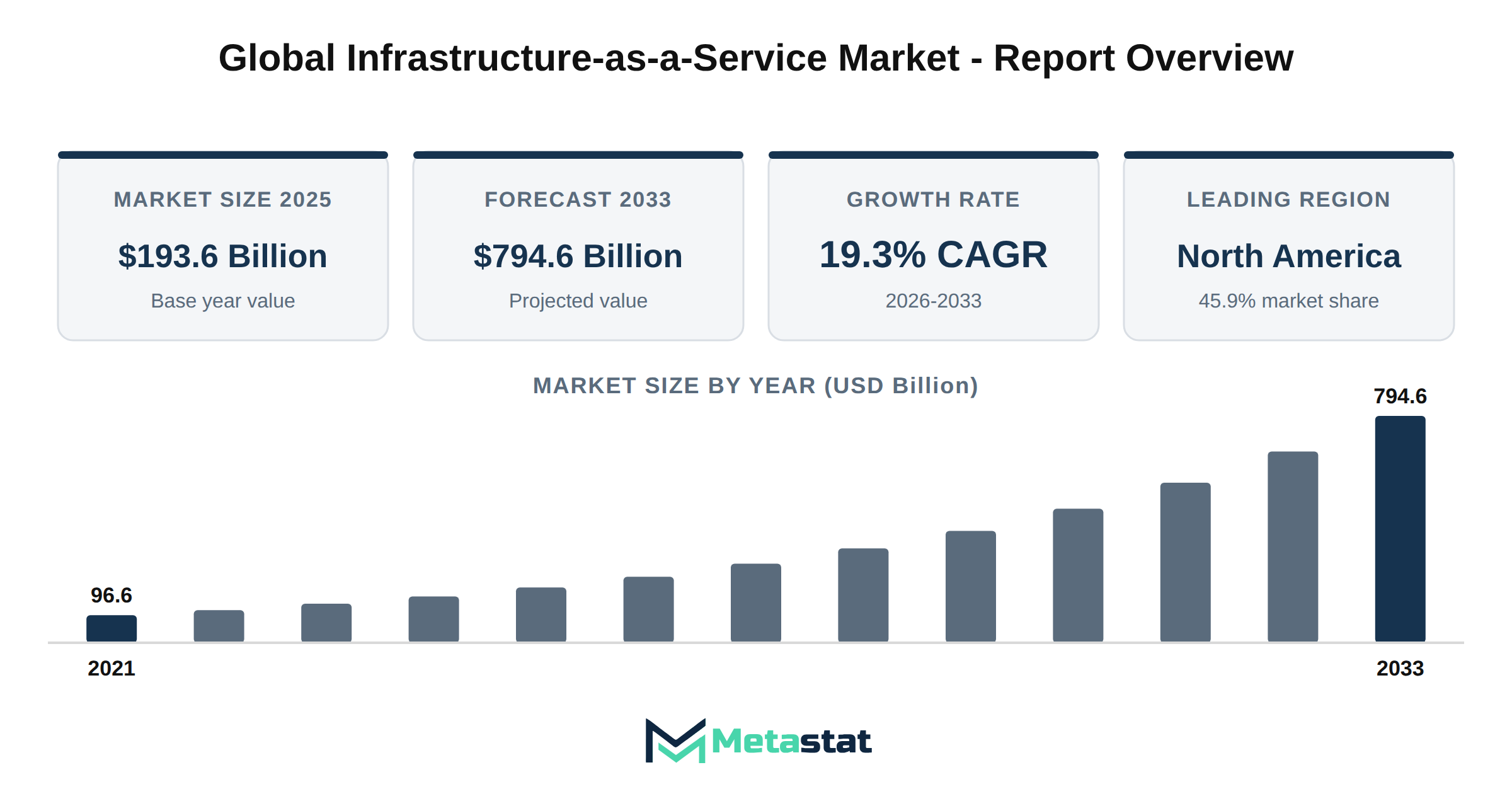
The Infrastructure-as-a-Service market reached a value of USD 193.6 billion in 2025, reflecting significant growth from USD 96.6 billion in 2021. This upward trajectory continues, with the market projected to reach USD 794.6 billion by 2033, resulting in a compound annual growth rate (CAGR) of 19.3% during the forecast period from 2026 to 2033. Increasing adoption of cloud computing solutions across various industries, coupled with rising demand for scalable IT infrastructure, drives this growth.
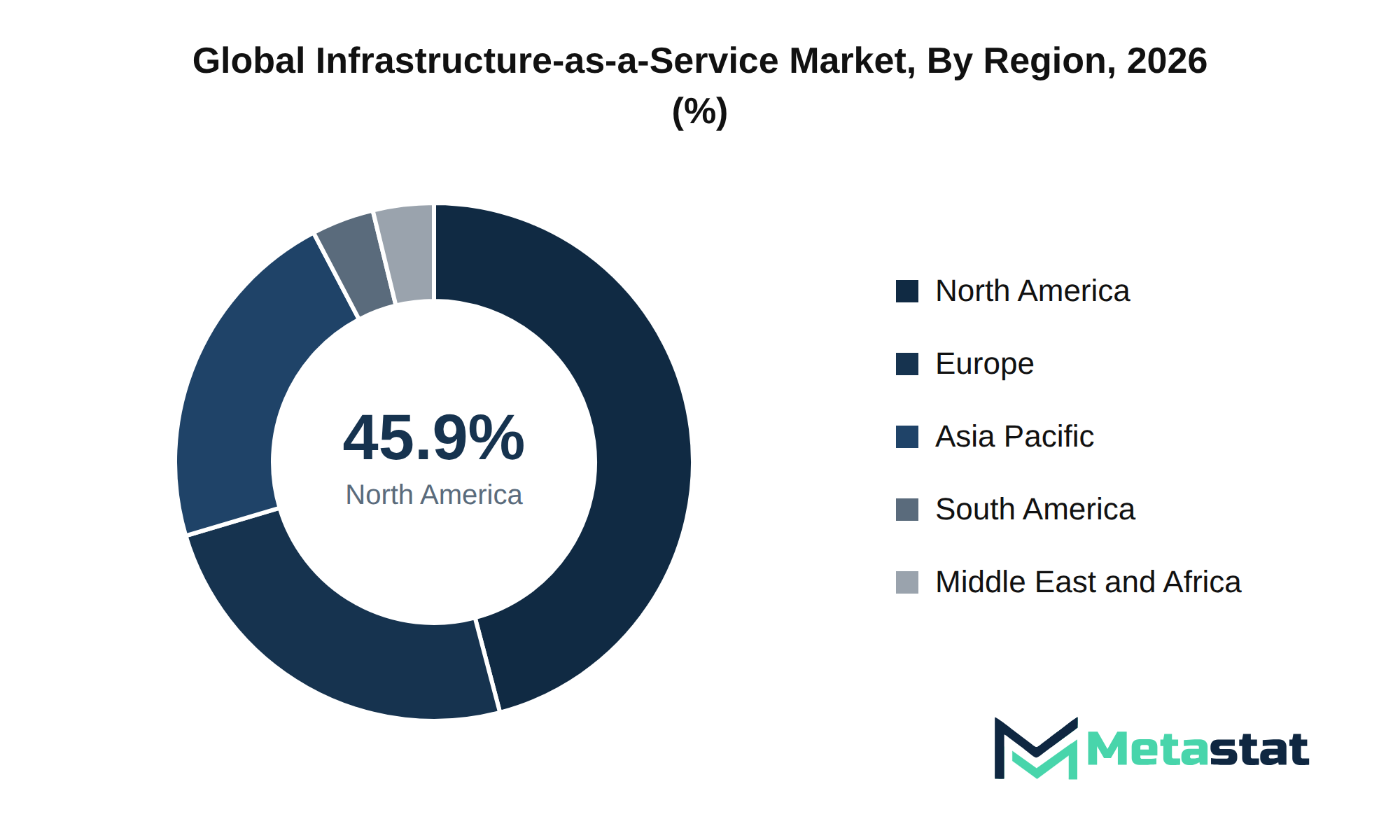
North America dominates the market with a share of 45.9%, followed by Europe at 24.5% and Asia Pacific at 21.9%. The regional distribution indicates a strong reliance on cloud services in North America, which is anticipated to generate USD 328.9 billion by 2033, maintaining a CAGR of 19.3%. Growing investments in digital transformation initiatives across industries including BFSI, retail, and healthcare significantly contribute to the market's expansion.
The Infrastructure-as-a-Service market experiences significant momentum driven by technological advancements and evolving customer needs. Organizations increasingly favor cloud-based solutions owing to their ability to provide flexibility, scalability, and cost efficiency. Industries including BFSI, retail and e-commerce, healthcare, and manufacturing are particularly inclined towards adopting these services, which enhance operational efficiency and support digital transformation initiatives.
Investment in research and development significantly shapes future offerings within the market. Providers focus on next-generation innovations, including AI-driven solutions, which facilitate enhanced analytics capabilities and automation of processes. This trend is expected to attract significant capital allocation, aligning with the growing demand for more sophisticated and integrated services.
The ongoing transformation towards sustainability influences the Infrastructure-as-a-Service market. Companies integrate decarbonization efforts into their strategies, addressing environmental concerns while optimizing resource utilization. This evolution contributes to market fragmentation, with newer entrants introducing innovative models aimed at reducing carbon footprints and promoting circular economy dynamics.
Logistics architecture and sourcing practices undergo changes, driven by the need for efficiency in service delivery. Streamlined supply chains enable faster response times and better alignment with customer expectations. Enhanced procurement processes support market growth by ensuring that organizations efficiently access a range of services that meet their evolving needs.
Future strategic outlook focuses on enhancing customer journey dynamics, ensuring that organizations prioritize user experience across all touchpoints. This approach increases customer retention and promotes loyalty, driving further investment into Infrastructure-as-a-Service solutions. Corporate imperatives reflect a commitment to evolving operational frameworks that align with technological advancements, ensuring organizations remain competitive in a rapidly changing market.
The Infrastructure-as-a-Service market experiences significant growth driven by digital transformation initiatives across various industries. Companies prioritize digitizing legacy systems to enhance operational efficiency and responsiveness to market demands. This shift towards modern technology infrastructure requires scalable solutions that ensure integration of advanced digital tools and processes.
Investment in automation, artificial intelligence, and software adoption fuels the demand for infrastructure services. Enterprises recognize that leveraging these technologies leads to improvements in productivity and customer engagement. Transitioning to cloud-based services enables organizations to manage resources more effectively while reducing overhead costs.
The market benefits from the growing emphasis on operational productivity and cost-efficiency initiatives. Businesses strive to optimize labor and streamline processes, which drives the need for flexible infrastructure solutions. The Infrastructure-as-a-Service market plays a critical role in supporting these efforts, allowing for agile responses to changing business environments.
The rise of digital transformation reflects shifting consumer behaviors, including increased reliance on digital channels for engagement and service delivery. This evolution presents opportunities for organizations to innovate and diversify their offerings, ultimately enhancing competitive positioning. Digital transformation continues to shape the business landscape, with the Infrastructure-as-a-Service market remaining central to enabling these strategic initiatives.
The Infrastructure-as-a-Service market experiences growth driven by the ongoing modernization of infrastructure across various sectors. Investments in upgrading physical and digital assets significantly influence demand for IaaS solutions, enabling organizations to enhance operational capabilities and service delivery. Companies increasingly seek to modernize their infrastructure to accommodate the rising need for agile and scalable solutions. This trend creates a favorable environment for IaaS providers.
Capital investment environments, characterized by favorable interest rates and increasing GDP growth, support substantial funding for infrastructure projects. This investment activity directly impacts the market because organizations pursue new technologies and infrastructure improvements. The push for modernization aligns with global trends in urbanization, where infrastructure upgrades enhance efficiency and support expanding urban populations.
The adoption of advanced technologies, including automation and artificial intelligence, further accelerates the need for modernized infrastructure. Organizations prioritize the digitization of legacy systems to enhance productivity and improve customer experiences. This shift leads to increased reliance on Infrastructure-as-a-Service solutions to provide the necessary computing power, storage, and networking capabilities.
Long-term infrastructure development initiatives, driven by public and private sector collaboration, create a robust pipeline for IaaS growth. Localized production strategies and enhanced supply chain resilience necessitate updated infrastructure, which benefits businesses seeking to optimize their operations. Ultimately, the ongoing modernization of infrastructure serves because a crucial driver for the Infrastructure-as-a-Service market, generating significant investment and innovation opportunities.
Regulatory tightening poses a significant barrier for the Infrastructure-as-a-Service market, causing various compliance hurdles for providers. Legal mandates lead to increased operational complexities, often resulting in extended timelines for service deployments. This situation affects small to medium enterprises particularly hard, limiting their potential to effectively utilize cloud capabilities.
Macroeconomic headwinds contribute to capital stagnation, affecting investment flows into the market. Inflationary pressures result in rising costs for infrastructure development and maintenance, compelling companies to reevaluate their strategies. Supply chain disruptions further exacerbate these challenges, delaying the delivery of essential components needed for service provision.
Geopolitical instability disrupts the global supply chain, affecting resource availability and driving up costs. High capital investment requirements for establishing and scaling infrastructure deter entry for new players, limiting competition. Escalating operating costs create challenges, particularly for services that require substantial energy and server resources.
Technological obsolescence poses another constraint, with rapid advancements necessitating continuous upgrades. This environment increases substitution risks, where clients opt for emerging technologies instead of traditional services. Infrastructure gaps and connectivity deficits hinder market growth, particularly in regions lacking robust digital frameworks.
Deployment bottlenecks and skilled labor deficiencies arise from the rapid pace of change in the market. Talent gaps in critical areas lead to increased workforce overhead, impacting overall efficiency. Data security vulnerabilities and privacy concerns complicate client trust and retention.
Intellectual property theft risks fuel apprehensions about adopting cloud-based solutions. Market fragmentation results in varied service offerings, making it difficult for clients to choose the optimal solutions for their needs. Cultural barriers and regional adoption resistors slow down market penetration in certain areas, further constraining growth trajectories.
Slowing downstream demand and industry cycle maturation contribute to market saturation, reflecting an increasingly competitive landscape. Addressing these challenges becomes essential for companies operating within the Infrastructure-as-a-Service market to sustain momentum and achieve long-term viability.
The Infrastructure-as-a-Service market faces challenges owing to geopolitical fragmentation. Political instability in various regions disrupts trade relationships, leading to increased tariff friction and trade deficits. These factors hinder smooth operations and increase costs, impacting both suppliers and consumers.
Technological disruptions further complicate the landscape, with rapid advancements often outpacing regulatory frameworks. Companies invest significantly in research and development to stay competitive, but complexities in integration lead to delays and increased costs. Such challenges affect the overall market growth and encourage firms to adopt cautious strategies.
Rising input costs and pricing compression exert margin pressures on providers within the market. The increasing costs of materials and technological components strain profitability, compelling firms to reassess pricing strategies. These dynamics influence the capacity for innovation and investment in new service offerings.
Workforce skill gaps pose additional challenges, resulting from companies struggling to find talent equipped with the necessary skills to thrive in an evolving environment. Increasing automation displaces certain job functions, leading to difficulties in talent retention. The combination of these factors compromises overall productivity, impacting market expansion capabilities.
Environmental concerns and the push for sustainability introduce further complexity. Companies navigate stringent decarbonization mandates and sustainability demands, which require significant investments in compliance frameworks. These requirements divert resources away from core operations, ultimately impacting the competitive positioning of firms within the market.
The Infrastructure-as-a-Service market contends with these multifaceted challenges, requiring strategic adaptations to address both immediate and long-term impacts on growth and competitiveness.
The Infrastructure-as-a-Service market benefits from increasing regional demands driven by the growing need for agile and scalable solutions. Organizations across various sectors recognize the necessity for modern infrastructure to support digital initiatives and optimize operational efficiency. This shift reflects in regions including North America, Europe, and Asia Pacific, where the urgency for cloud-enabled services creates market opportunities. Infrastructure-as-a-Service facilitates geographical expansion, enabling enterprises to deploy resources quickly and adapt to changing market conditions.
Technological disruptions contribute significantly to this market's growth trajectory. Innovations in cloud-native technologies, AI, and machine learning enhance service offerings, providing organizations with tools to improve performance and reduce operational costs. The demand for integrated platforms creates a competitive landscape, stimulating investment and innovation. Next-generation innovations, focusing on automation and sustainability, create pathways for new applications, enhancing engagement with diverse industries.
Digital procurement shifts and evolving buying behaviors indicate a preference for on-demand solutions, which supports the Infrastructure-as-a-Service market. Companies increasingly seek flexible pricing models and subscription-based services to optimize expenditures and maintain budget control. This transition to digital procurement aligns with broader trends in supply chain localization and asset lifecycle extensions, promoting an ecosystem where infrastructure investments yield higher returns.
Strategic consolidation through cross-industry mergers and acquisitions drives market growth further. Partnerships and collaborations between established players and emerging startups enable organizations to leverage complementary technologies, enhancing their market position. The Infrastructure-as-a-Service market supports such alliances owing to companies seeking to diversify their offerings and tap into new customer segments. ESG-driven alignments emphasize the importance of eco-friendly practices, which influence operational strategies and service delivery within the sector.
The Global Infrastructure-as-a-Service market is segmented based on Service, Deployment, Industry, and Enterprise Size.
Valued at USD 104.1 billion in 2026, the Compute because a Service (CaaS) segment is projected to reach USD 328.2 billion by 2033, at a CAGR of 17.8% during the forecast period. The segment experiences heightened demand driven by enterprises seeking flexibility and scalability in their IT resources. The shift to cloud-based computing solutions accelerates adoption, enabling organizations to optimize their operational efficiency while reducing capital expenditure on hardware.
Technological maturation significantly influences this segment, with advancements in virtualization and automation enhancing service capabilities. The introduction of next-generation upgrades facilitates integrations and improved performance. Product evolution around containerization and microservices architecture ensures enterprises leverage agile methodologies, further propelling consumption within the CaaS segment.
End-use dynamics reflect a growing inclination towards Infrastructure-as-a-Service solutions across various industries, including BFSI, healthcare, and manufacturing. This trend demonstrates the adaptability of CaaS offerings to meet diverse business needs. Regulatory compliance standards across industries necessitate robust data management and processing solutions, reinforcing the segment's relevance in facilitating compliance.
Cost structures remain critical, because competitive pricing strategies enhance market accessibility. Pricing volatility presents challenges, particularly in the face of fluctuating demand. Segment players proactively address margin pressures through operational efficiencies and innovative service models, ensuring resilience in supply chains while managing raw material sourcing complexities.
Strategic opportunity windows emerge, particularly for providers investing in advanced technologies including artificial intelligence and machine learning. These investments position players to meet evolving customer expectations while navigating potential disruptive alternatives. The outlook for the Compute because a Service segment aligns with the broader growth trajectory of the Infrastructure-as-a-Service market, reflecting an increasing reliance on cloud-based solutions.
Growth in the Storage because a Service (STaaS) segment reflects increasing reliance on cloud storage solutions across various industries. Factors including data explosion and the need for scalable storage options drive demand. Organizations seek efficient and flexible storage solutions to accommodate growing data volumes while managing costs effectively. The segment is estimated to reach USD 167.2 billion by 2033, at a CAGR of 18.8% during the forecast period.
Technological maturation significantly shapes the STaaS landscape. Advancements in data compression, encryption, and security protocols enhance service reliability and performance, attracting businesses to transition from traditional storage methods. Adoption is prominent across sectors including BFSI, healthcare, and retail, where data management and compliance requirements intensify the need for robust storage solutions.
Next-gen upgrades and product evolution contribute to the segment's growth by introducing innovative features including automated scaling and enhanced data analytics capabilities. These enhancements provide organizations with valuable insights, enabling them to optimize storage costs and improve operational efficiency. End-use dynamics reflect a shift towards hybrid solutions, where organizations integrate on-premises and cloud storage to leverage the benefits of both environments.
Consumption shifts towards STaaS indicate a broader industry trend favoring subscription-based models over capital-intensive investments in infrastructure. Regulatory compliance standards further influence adoption, since organizations align their data storage strategies with evolving legal frameworks. Companies that invest in compliant storage solutions enhance their competitive positioning in the market.
Cost structures in the segment exhibit variability influenced by technological advancements and pricing volatility. Providers refine their offerings to accommodate diverse client needs while maintaining profitability. Margin pressures arise from competition among players, encouraging continuous innovation and service differentiation.
Strategic opportunity windows exist for companies to explore partnerships and collaborations, enhancing their service portfolios. The focus on supply chain resilience and raw material sourcing becomes increasingly important since organizations seek to mitigate disruptions and ensure consistent service delivery. Overall, the Storage because a Service segment positions itself because a critical component of the Infrastructure-as-a-Service market, driving forward digital transformation and operational excellence.
Significant growth characterizes the Networking & CDN segment within the Infrastructure-as-a-Service market. An increasing reliance on digital content delivery and enhanced user experience drives demand for efficient networking and content delivery services. The surge in online services, streaming platforms, and cloud-based applications necessitates robust and reliable networking solutions, influencing enterprises to invest in these services.
Technological maturation influences the segment, with advancements in network functionalities and capabilities enhancing service offerings. Adoption of next-generation technologies, including edge computing and AI-driven networking, further supports segment expansion. Enterprises across various industries, including healthcare, retail, and entertainment, prioritize reliable connectivity and rapid data transfer, shaping end-use dynamics.
In terms of financial outlook, the Networking & CDN segment is projected to reach USD 78.7 billion by 2033. This growth stems from prioritizing high-performance network infrastructure and increasing investments in next-gen upgrades. The evolving regulatory landscape surrounding data security and privacy standards influences compliance requirements, impacting service offerings within the segment.
Cost structures and pricing volatility present challenges for service providers. Competition in the market exerts downward pressure on pricing, compelling providers to enhance service differentiation and value propositions. Strategic opportunity windows arise for companies capable of innovating their service models and creating tailored solutions for diverse customer needs, driving investment and market engagement.
The rapid expansion of data-driven decision-making across multiple industries has significantly propelled demand for Database / Analytics because a Service (DBaaS). Organizations increasingly seek to leverage analytics to enhance operational efficiency, improve customer experiences, and drive strategic initiatives. This trend is particularly evident in sectors including healthcare, finance, and e-commerce, where data analytics plays a critical role in gaining competitive advantages. Technological maturation facilitates the adoption of DBaaS, ensuring integration with existing IT infrastructures. Providers continuously evolve their offerings by incorporating advanced features, including artificial intelligence and machine learning capabilities. These enhancements address growing consumer expectations for real-time insights and data management solutions. The segment is projected to grow at a CAGR of 22.3% during the forecast period. Competitive pricing structures emerge because a significant factor influencing market dynamics, allowing various enterprises, including SMEs, to access sophisticated analytics solutions. Regulatory compliance standards drive investments in DBaaS, because organizations prioritize data security and privacy. Supply chain resilience and strategic opportunity windows further enhance the market outlook for DBaaS. The increasing need for organizations to adapt quickly to market changes highlights the importance of flexible data management solutions. By investing in DBaaS, businesses position themselves to capitalize on evolving market conditions and technological advancements, ultimately contributing to the overall growth of the Infrastructure-as-a-Service market.
Demand for Disaster-Recovery because a Service (DRaaS) stems from increasing awareness of the importance of business continuity and effective disaster recovery strategies. Organizations across various sectors prioritize safeguarding critical data and ensuring operational resilience against potential disruptions, including natural disasters and cyber threats. The rise in cyberattacks and data breaches drives the urgency for companies to implement robust recovery solutions, contributing to the growth of the Infrastructure-as-a-Service market.
Technological maturation enhances the expansion of DRaaS offerings. Advancements in cloud computing, automation, and artificial intelligence improve service capabilities, allowing for more efficient backup and recovery processes. This evolution attracts a diverse range of customers seeking reliable and cost-effective solutions for data protection and recovery. The ongoing integration of next-gen upgrades improves service reliability, performance, and scalability, aligning with the growing demand for effective recovery options.
Regulatory compliance standards significantly influence investment in DRaaS. Organizations face stringent requirements to protect sensitive information, which incentivizes the adoption of comprehensive disaster recovery solutions. Meeting these standards positions companies favorably in the market, allowing them to mitigate risks associated with non-compliance. In response, service providers enhance their offerings to align with regulatory frameworks, thereby facilitating market growth.
Cost structures and pricing dynamics remain essential considerations within the DRaaS segment. Organizations evaluate the total cost of ownership associated with disaster recovery solutions, seeking competitive pricing without compromising quality. The emergence of flexible pricing models enables businesses of all sizes to access essential recovery services, encouraging broader adoption across the market.
Strategic opportunity windows arise from increasing reliance on digital infrastructure, with businesses seeking solutions that address the complexities of data management and recovery. While organizations undergo digital transformation, the need for integrated disaster recovery strategies becomes critical. This trend creates avenues for innovation and collaboration among service providers, further supporting the market's growth trajectory.
Demand for managed hosting and dedicated cloud services continues to grow within the Infrastructure-as-a-Service market, driven by an increasing preference for flexible IT solutions among businesses. Organizations increasingly seek to streamline operations, reduce overhead costs, and enhance data security through reliable hosting services. Adoption of these services accelerates due to companies transitioning to cloud-based models, allowing for scalable resource allocation that adapts to changing needs.
Segment expansion recognizes the importance of technological maturation, with advancements in server virtualization and containerization providing enhanced performance and deployment efficiency. The evolution of product offerings has led to tailored solutions that cater to specific industry requirements, facilitating more effective downstream application integrations. End-use dynamics indicate a shift towards hybrid models, where businesses combine on-premises and cloud resources to achieve optimal performance.
Regulatory compliance standards exert influence, motivating organizations to adopt managed hosting solutions that ensure adherence to data protection regulations. This focus on compliance drives demand for services that offer robust security features and regular audits. Cost structures continue to evolve, with competitive pricing models attracting businesses looking to optimize budgets while maintaining service quality. Strategic opportunity windows arise because organizations navigate pricing volatility and margin pressures, prompting them to invest in resilient infrastructure solutions.
Supply chain resilience in the managed hosting segment emphasizes the importance of robust vendor relationships and diversified service offerings. Raw material sourcing and logistics vulnerabilities pose challenges that companies address through strategic partnerships. Substitution risks are minimal, given the unique value propositions of managed hosting and dedicated cloud services compared to traditional options. Disruptive alternatives emerge because businesses seek innovative methods to enhance service delivery and performance.
Investment outlooks reflect a positive trend, with significant capital infusion anticipated to support next-generation upgrades and product evolution. The managed hosting and dedicated cloud segment signifies a vital component of the Infrastructure-as-a-Service market, offering businesses a comprehensive solution to meet their evolving IT requirements.
Valued at USD 165.6 billion in 2026, the Public segment is projected to reach USD 544.7 billion by 2033, at a CAGR of 18.5% during the forecast period. This growth stems from increasing demand for scalable and cost-effective solutions, enabling businesses to optimize their IT infrastructure without significant upfront investments. Enhanced adoption of cloud computing across industries including BFSI, Retail & E-commerce, and Healthcare drives the expansion of this segment. Organizations leverage public cloud services to improve operational efficiency, enhance collaboration, and support remote work environments.
Technological maturation and advancements in infrastructure technologies significantly contribute to the market's trajectory. Enhanced security measures, compliance certifications, and performance guarantees increase the attractiveness of public cloud solutions. Consequently, enterprises prioritize public cloud offerings for mission-critical applications, further stimulating demand. The ongoing evolution of product features, including improved service delivery and integration capabilities, provides organizations with the flexibility required to adapt to changing business needs.
End-use dynamics shift towards adopting hybrid and multi-cloud environments, wherein public cloud services complement private infrastructures. This trend encourages organizations to diversify their cloud strategies, maximizing efficiency while minimizing risk. Competitive pricing among key players creates a favorable landscape for adoption, driving innovation in service offerings. Stakeholders recognize strategic opportunity windows, including investments in next-gen upgrades and disruptive technologies, to capture market share in the evolving Infrastructure-as-a-Service market.
Rapid adoption of cloud solutions drives significant interest in the Private segment of the Infrastructure-as-a-Service market. Organizations increasingly prioritize data security, regulatory compliance, and customization, which influences the shift toward private cloud deployments. Companies across various industries, including BFSI, healthcare, and manufacturing, seek tailored solutions that offer greater control over their data environments. This trend enhances the appeal of private cloud options, allowing enterprises to scale operations while maintaining stringent security and compliance standards.
The private segment is estimated to reach USD 155.8 billion by 2033, at a CAGR of 20.6% during the forecast period. This growth stems from an ongoing technological maturation process, where advancements in virtualization, automation, and orchestration enhance the capabilities of private cloud environments. Organizations increasingly leverage these technologies to optimize resource allocation and improve operational efficiency. The focus on next-generation upgrades, including AI and machine learning integration, further increases demand for sophisticated private infrastructure solutions.
Market participants recognize strategic opportunity windows for expanding their offerings in the private cloud space. Vendors enhance their product portfolios with innovative features, including advanced analytics and improved disaster recovery solutions. These developments align with end-use dynamics, where organizations value flexibility and responsiveness in their IT infrastructure. Consequently, private cloud solutions are positioned to capture a larger share of the overall market, driven by robust investments in infrastructure and services.
Growth within the hybrid deployment segment of the Infrastructure-as-a-Service market stems from increasing demand for flexible and scalable cloud solutions. Organizations prioritize hybrid models to balance on-premise infrastructure with cloud capabilities, enhancing operational efficiency while managing costs. This blend allows enterprises to optimize resource utilization and maintain control over sensitive data, effectively addressing compliance and regulatory standards.
Investment in hybrid deployments aligns with the trend of businesses seeking agility in their IT infrastructure. Enterprises across sectors including BFSI, retail, and healthcare recognize the advantages of combining public and private cloud services to support varied workloads. This strategic approach enhances productivity and drives innovation, attracting investors who recognize the segment's potential for sustained growth.
The hybrid segment is projected to reach USD 94.1 billion by 2033. This forecast reflects the increasing adoption of hybrid solutions driven by the necessity for continuity in operations and disaster recovery planning. Organizations continue to navigate digital transformation, with a focus on hybrid infrastructure expected to expand, influencing demand dynamics across the Infrastructure-as-a-Service market.
Financial organizations increasingly adopt Infrastructure-as-a-Service solutions to enhance operational efficiency and scalability. Digital transformation initiatives within the banking, financial services, and insurance (BFSI) sector emphasize the need for agile, cost-effective IT infrastructure. This shift encourages institutions to utilize cloud-based services for critical applications, including data analytics, customer relationship management, and regulatory compliance.
Technological advancements significantly influence adoption rates within the BFSI sector. Innovations in cybersecurity, data management, and artificial intelligence facilitate secure and efficient data handling, meeting stringent regulatory demands. Organizations invest in next-generation upgrades to enhance their infrastructure capabilities, focusing on reducing operational costs while improving service delivery.
Regulatory compliance remains a crucial factor affecting the adoption of Infrastructure-as-a-Service solutions in the BFSI industry. Institutions strive to meet various standards, including data privacy and security regulations, which necessitate robust cloud solutions. The focus on compliance drives investment in Infrastructure-as-a-Service platforms that offer built-in security features and compliance certifications.
Increased competition among financial institutions compels organizations to adopt cloud technologies that enable innovation and agility. The need for rapid deployment of new services and products accelerates demand for Infrastructure-as-a-Service solutions. Financial institutions recognize that cloud adoption streamlines operations and enhances customer experience by enabling personalized services.
Cost structures and pricing volatility play significant roles in shaping the BFSI sector's cloud adoption strategy. Organizations seek to balance investment in cloud infrastructure with cost efficiency, ensuring that solutions align with their financial objectives. The potential for operational savings aligns with the industry's focus on achieving sustainable growth and competitive advantage.
Investment in Infrastructure-as-a-Service solutions within the BFSI sector presents an opportunity for strategic growth. Organizations navigate disruptive alternatives and technological obsolescence. By embracing cloud-based infrastructure, financial institutions position themselves favorably to respond to evolving market demands while enhancing service offerings and maintaining compliance with regulatory standards.
Demand in the Retail & E-commerce segment benefits from the increasing shift toward online shopping and digital transactions. This transformation drives retailers to seek scalable and flexible infrastructure solutions, enabling them to manage fluctuating customer demands effectively. The reliance on data analytics and real-time processing further emphasizes the necessity for robust cloud services that improve customer experience and operational efficiency.
Technological advancements in cloud computing provide Retail & E-commerce companies with the tools required for improving supply chain management and inventory control. Real-time data analysis allows businesses to respond swiftly to market trends and consumer preferences, ensuring they stay competitive. This trend encourages investment in Infrastructure-as-a-Service offerings that support integration with existing systems.
Pricing volatility presents challenges specific to this segment, driven by retailers balancing operational costs against the need for advanced technological capabilities. Margins remain under pressure, prompting companies to explore cost-effective cloud solutions that provide enhanced performance without incurring significant expenses. Strategic partnerships with cloud providers facilitate access to innovative solutions, allowing businesses to adapt quickly to market changes.
Regulatory compliance further influences operational dynamics within the segment. Retailers adhere to data protection laws and industry standards, which necessitate robust security measures in their cloud infrastructure. Compliance with these regulations builds trust among consumers, enhancing brand loyalty and driving sales in the increasingly competitive landscape of the Infrastructure-as-a-Service market.
Investment in next-gen upgrades and product evolution remains crucial for businesses operating in Retail & E-commerce. Companies focusing on enhancing customer engagement through personalized experiences are more likely to succeed in capturing market share. The Infrastructure-as-a-Service market provides a solid foundation for these initiatives, supporting the growth of innovative applications that cater to diverse consumer needs.
Increasing adoption of cloud-based solutions reshapes the healthcare industry, driving significant demand for Infrastructure-as-a-Service offerings. This shift supports the need for scalable, flexible, and cost-effective IT solutions to manage patient data, comply with regulations, and enhance service delivery.
Technological maturation influences the sector, with advancements in artificial intelligence, machine learning, and data analytics driving the evolution of healthcare applications. These innovations facilitate the integration of various systems, enabling real-time data sharing and improving patient outcomes.
Regulatory compliance standards present challenges, requiring healthcare providers to adhere to stringent data protection protocols and maintain high standards of patient care. The necessity for certifications and adherence to policies drives demand for reliable Infrastructure-as-a-Service solutions that ensure data security and compliance.
Cost structures and pricing volatility significantly impact investment decisions within the sector. Healthcare organizations continuously seek efficient solutions to manage operational expenses while enhancing service quality. Strategic opportunity windows arise from firms exploring next-generation upgrades and innovative service models that address specific healthcare needs, including telemedicine, electronic health records, and patient management systems.
The healthcare segment's resilience relies on robust supply chain management and the ability to adapt to disruptive alternatives. Investments in Infrastructure-as-a-Service solutions enable organizations to remain agile and responsive to changing market dynamics, ultimately driving growth and enhancing the sector's overall performance.
Increasing reliance on digital tools and technology in educational institutions drives demand for Infrastructure-as-a-Service market solutions. Educational organizations seek to enhance learning experiences, improve administrative operations, and reduce costs through cloud-based infrastructures. The shift toward remote and hybrid learning models necessitates scalable and flexible IT resources, allowing educational entities to adapt to fluctuating enrollment numbers and diverse learning environments.
Technological maturation influences adoption rates within the education sector. Advanced cloud technologies enable integration of Learning Management Systems (LMS), providing educators and students with easy access to educational content and collaboration tools. The ongoing evolution of educational content delivery methods creates a need for Infrastructure-as-a-Service solutions that support high availability and reliability.
End-use dynamics highlight the growing preference for digital and remote learning solutions among students and educators. Educational institutions leverage Infrastructure-as-a-Service offerings to support innovative teaching methods and personalized learning experiences. This trend reflects a broader consumption shift, emphasizing the need for enhanced digital infrastructures to facilitate effective learning outcomes.
Regulatory compliance standards in the education sector further influence Infrastructure-as-a-Service adoption. Institutions adhere to data protection regulations, requiring secure and compliant cloud environments to safeguard sensitive student information. This regulatory landscape drives demand for robust IaaS solutions that align with compliance requirements while supporting educational objectives.
Cost structures within educational institutions create a favorable environment for Infrastructure-as-a-Service market growth. By transitioning to cloud-based solutions, schools and universities reduce capital expenditures associated with traditional IT infrastructures. This shift enables organizations to allocate resources more effectively toward academic programs and student services.
Strategic opportunity windows present themselves owing to institutions investing in digital transformation initiatives. Increased funding for educational technology facilitates the adoption of Infrastructure-as-a-Service solutions, allowing organizations to enhance operational efficiencies while creating a culture of innovation. Investment in these cloud-based technologies enables educational institutions to remain competitive in an evolving landscape.
Manufacturing increasingly relies on Infrastructure-as-a-Service solutions to enhance operational efficiency and optimize production processes. Key drivers include the need for greater flexibility in resource management and the demand for scalable solutions that accommodate fluctuating production volumes. Enhanced data analytics capabilities enable manufacturers to streamline operations, improve supply chain visibility, and make informed decisions based on real-time data.
Technological maturation significantly contributes to the expansion of the market within the manufacturing sector. With advancements in automation, Internet of Things (IoT) technologies, and artificial intelligence, manufacturers leverage cloud-based services to integrate these innovations into their operations effectively. Next-generation upgrades, including real-time monitoring and predictive maintenance, further support the competitive edge sought by manufacturers.
End-use dynamics highlight a shift towards more efficient and sustainable manufacturing processes. Manufacturers prioritize environmentally friendly practices, often supported by cloud solutions that promote energy efficiency and resource conservation. Regulatory compliance standards continue to influence manufacturing practices, driving organizations to adopt Infrastructure-as-a-Service solutions that provide necessary reporting and compliance capabilities.
Strategic opportunity windows emerge when manufacturers evaluate their capital investment outlook. The market offers avenues for cost reduction and improved resource allocation, allowing manufacturers to invest in innovation and technology upgrades. This proactive approach creates a resilient supply chain, enhancing overall productivity while mitigating risks associated with market volatility.
Overall, the Infrastructure-as-a-Service market serves because a significant enabler of transformation within the manufacturing industry, providing the tools necessary to adapt to evolving market demands and competitive pressures.
Telecommunications and IT sectors experience strong demand for Infrastructure-as-a-Service solutions, driven by the increasing need for scalable and flexible IT resources. Organizations within these industries prioritize rapid deployment and efficient resource management, seeking cost-effective solutions to support operations and enhance service delivery.
Technological advancements play a crucial role in the expansion of the market. The adoption of next-generation technologies, including 5G and edge computing, drives the need for cloud-based infrastructure that supports increased data traffic and improved connectivity. This shift enables IT and telecommunications companies to enhance service offerings while maintaining operational efficiency.
Investment in digital transformation remains a significant catalyst for growth within the sector. Organizations continuously seek innovative solutions to streamline operations, improve customer engagement, and drive competitive advantage. Infrastructure-as-a-Service provides the necessary foundation for these transformations, allowing companies to utilize cloud capabilities without heavy capital expenditures.
Regulatory compliance poses challenges for IT and telecommunications firms. Adhering to data protection and privacy regulations requires robust infrastructure solutions that ensure security and compliance. Consequently, enterprises prioritize IaaS providers with established security protocols and certifications to mitigate risks associated with regulatory demands.
Market dynamics shift owing to organizations increasingly preferring consumption-based pricing models. This approach offers greater financial flexibility, allowing companies to scale IT resources according to demand. Such models enable businesses to allocate budgets more effectively, aligning expenditures with actual usage while minimizing waste.
Emerging technologies create strategic opportunities for innovation in this segment. Firms focus on utilizing artificial intelligence, machine learning, and data analytics to drive insights and improve decision-making processes. Infrastructure-as-a-Service facilitates the integration of these technologies, enabling organizations to remain competitive in an evolving environment.
Overall, the IT and Telecom sectors are vital components of the Infrastructure-as-a-Service market, characterized by strong demand for scalable solutions, technological advancements, and a focus on regulatory compliance. Continuous investment in digital transformation and strategic adoption of innovative technologies will shape the future of this segment.
Growth in the Others Industries sub-segment of the Infrastructure-as-a-Service market arises from a diverse range of factors. Companies in sectors including entertainment, logistics, and government increasingly adopt cloud-based solutions to enhance flexibility and reduce operational costs. Technological maturation enables organizations to access advanced tools that drive efficiency and improve service delivery.
Segment expansion catalysts include the shift towards multi-cloud strategies, allowing organizations to leverage the strengths of various providers. Growing cybersecurity concerns further encourage businesses to adopt robust Infrastructure-as-a-Service solutions to safeguard data integrity while ensuring compliance with regulatory standards. The need for agility in operations drives demand for scalable solutions that adapt to changing market dynamics.
Cost structures reflect ongoing investments in next-generation upgrades, with firms seeking to enhance their cloud infrastructure to support increasing workloads. Pricing volatility in the market often prompts enterprises to explore various service offerings to optimize expenses while maintaining performance. Margin pressures arise, particularly for smaller players striving to compete with established providers.
Strategic opportunity windows exist for emerging technologies, including artificial intelligence and machine learning, which enhance service functionalities and customer engagement. Companies that invest in innovative solutions position themselves favorably within the competitive landscape. Overall, the Others Industries segment benefits from the ongoing evolution of Infrastructure-as-a-Service, creating substantial potential for growth and investment in the coming years.
Large enterprises increasingly exhibit a strong demand for Infrastructure-as-a-Service solutions, driven by the need for digital transformation and operational efficiency. Adoption of cloud-based infrastructure enables these organizations to scale their operations while reducing capital expenditure on physical hardware. The shift toward remote work and digital collaboration tools has further accelerated this trend, leading to a higher reliance on cloud services for data management and storage.
Segment expansion drives growth through technological maturation, with advancements in cloud computing technologies enhancing service offerings. Next-gen upgrades, including improved security measures and automation capabilities, contribute to the attractiveness of Infrastructure-as-a-Service within the large enterprise segment. Organizations invest heavily in product evolution, seeking tailored solutions that align with their specific operational requirements.
End-use dynamics highlight a significant shift in consumption patterns, with large enterprises prioritizing flexibility and agility in their IT strategies. Regulatory compliance standards increasingly influence purchasing decisions, compelling organizations to adopt cloud solutions that meet industry-specific requirements. Margin pressures associated with traditional IT models drive a re-evaluation of cost structures, making Infrastructure-as-a-Service an appealing alternative.
Strategic opportunity windows arise for service providers who demonstrate resilience in supply chain management and address potential risks associated with technological obsolescence. Large enterprises exhibit a strong interest in disruptive alternatives that promise to enhance their competitive positioning in a changing market. Capital investment outlook remains positive, with organizations committing resources to infrastructure upgrades and innovations that support their long-term growth strategies.
SMEs increasingly adopt Infrastructure-as-a-Service solutions to enhance flexibility and reduce capital expenditures. Rapid technological advancements, including improvements in security and scalability, significantly influence their adoption rates. Many SMEs prioritize cost-effective solutions that align with their operational budgets, making Infrastructure-as-a-Service an attractive option. The market's focus on providing tailored services for SMEs enables these companies to benefit from advanced technologies without the associated high costs of traditional IT infrastructure.
Industry trends indicate that SMEs favor cloud solutions that support remote work and collaboration. The shift towards digital transformation accelerates the demand for scalable infrastructure that quickly adapts to changing business needs. Regulatory compliance standards drive SMEs to seek out Infrastructure-as-a-Service options that ensure secure data management and storage. This demand for compliance further strengthens the position of the market, reflecting a crucial resource for SMEs navigating complex regulatory landscapes.
Cost structures within the Infrastructure-as-a-Service market provide SMEs with favorable pricing models, enhancing overall accessibility. Subscription-based pricing allows SMEs to manage expenses more effectively, directly correlating with their cash flow management strategies. The market's ongoing evolution reflects a commitment to meeting the specific needs of SMEs, resulting in a more resilient and adaptive infrastructure that supports long-term growth and sustainability.
Based on geography, the Global Infrastructure-as-a-Service market is divided into North America, Europe, Asia-Pacific, South America, Middle East, and Africa.
North America Infrastructure-as-a-Service Market is set to expand at a CAGR of 19.3% within the forecast period, reaching a market size (TAM) of USD 328.9 billion by the end of 2033. The region accounts for 45.9% of the global market in 2025. Strong demand for Infrastructure-as-a-Service solutions arises from various sectors, including healthcare, finance, and manufacturing, all seeking to enhance efficiency and reduce operational costs.
The emphasis on infrastructure modernization across the United States, Canada, and Mexico drives market expansion. Local compliance mandates and the demand for reliable digital infrastructure influence investment in cloud solutions and services. The presence of major domestic players creates a competitive landscape, while localized procurement dynamics influence purchasing behaviors among regional enterprises.
Cross-border trade corridors and geopolitical elements affect market operations within the region. The ongoing regionalization of supply chains and nearshoring initiatives enhance resilience and responsiveness, contributing positively to market growth. Energy grid resiliency and robust local infrastructure readiness support the adoption of Infrastructure-as-a-Service offerings, ensuring integration for prospective users.
The Infrastructure-as-a-Service market in Europe displays significant growth potential, driven by increasing demand for digital transformation across various industries. Countries like Germany, France, and the UK exhibit strong adoption rates, creating a competitive environment that encourages innovation and investments in cloud solutions. These nations benefit from robust technological infrastructure and regulatory frameworks that support cloud deployment and data protection.
Key drivers of growth include the ongoing modernization of IT infrastructure, which prompts organizations to shift from traditional hosting to more agile, scalable cloud environments. Segment expansion occurs across various service categories, particularly within Compute because a Service and Storage because a Service. The emphasis on data analytics and enhanced networking capabilities further strengthens the market's appeal, attracting investments from both established players and emerging local vendors.
Russia's unique market dynamics and regulatory environment create distinct opportunities and challenges. The market remains underpenetrated in specific sectors, particularly in the public and private segments, indicating substantial potential for future growth. Implementation of localized compliance mandates influences procurement strategies, encouraging companies to engage with domestic suppliers and service providers.
Supply chain regionalization trends contribute to the Infrastructure-as-a-Service market's expansion, because organizations seek to optimize costs and improve service delivery through nearshoring initiatives. Cultural nuances and regional B2B buying behaviors impact vendor selection and partnership strategies, further shaping the competitive landscape. Overall, Europe represents a dynamic market, poised for sustained growth driven by technological advancements and evolving consumer expectations.
In the Asia-Pacific region, significant growth within the Infrastructure-as-a-Service market stems from increasing digital transformation initiatives across various industries. Countries including China, Japan, and India lead the charge, driven by strong investments in cloud infrastructure and related services.
The demand for advanced cloud solutions in South Korea and Australia furthers the expansion of Infrastructure-as-a-Service offerings. Enterprises in these countries prioritize enhanced operational efficiency and scalability, resulting in higher adoption rates of cloud technologies.
Emerging markets within Southeast Asia and the Rest of Asia Pacific show potential for future growth. These areas remain underpenetrated, presenting opportunities for service providers to capture new customers and expand their market presence.
Local compliance mandates and geographic regulatory frameworks influence procurement dynamics within the region. Vendors navigate these complexities while addressing unique cultural nuances and B2B buying behaviors, which vary significantly among countries.
Investment in regional infrastructure readiness and energy grid resiliency supports the growth of the market. Strategic entry barriers, foreign direct investment flows, and localized manufacturing densities enhance the competitive landscape, leading to increased vendor consolidation trends.
The Asia-Pacific region accounts for a share of 21.9% of the global market in 2025. While infrastructure modernization continues, the market experiences robust expansion, driven by high-value replacement cycles and incremental growth vectors.
The Infrastructure-as-a-Service market in South America reflects a growing interest in cloud solutions, driven by the digital transformation goals of various industries. Brazil and Argentina lead the region in adoption, with local businesses seeking scalable and cost-effective IT resources to compete in the global market. The expansion of digital infrastructure and increasing internet penetration have facilitated access to these services, further propelling the market’s growth.
Infrastructure modernization plays a critical role in driving demand, owing to organizations striving to enhance operational efficiency and reduce technology-related expenses. The region faces unique challenges, including varying regulatory frameworks across countries and local compliance mandates, which influence the adoption rates of Infrastructure-as-a-Service solutions. Despite being a smaller player on the global stage, South America holds significant potential for growth, particularly in underpenetrated territories including emerging markets.
Investment in foreign direct investment (FDI) flows has strengthened the market's competitive landscape by attracting global players to establish a presence in the region. Domestic market leaders focus on offering tailored solutions that meet local demands while navigating cultural nuances and regional B2B buying behaviors. These factors contribute to the incremental growth vectors shaping the Infrastructure-as-a-Service market, positioning it for increased relevance in the coming years.
Growth in the Middle East and Africa Infrastructure-as-a-Service market reflects rising demand for digital transformation across various industries. Key factors driving this trend include increased cloud adoption, infrastructure modernization initiatives, and the pursuit of enhanced operational efficiency among enterprises. Countries including Saudi Arabia and the UAE lead the charge, creating environments conducive to technology investments through favorable regulatory frameworks and government support.
Infrastructure readiness exhibits significant variability across the region, with South Africa demonstrating advanced capabilities in certain urban areas. However, challenges remain in underpenetrated territories within the Rest of Middle East and Africa, where localized procurement dynamics and resource availability influence market expansion. Increasing foreign direct investment (FDI) flows highlight confidence in the region's market potential.
Emerging market front-runners in the region leverage localized manufacturing densities to enhance service delivery and meet growing customer expectations. The Infrastructure-as-a-Service market continues to evolve, driven by strategic entry barriers and the competitive landscape among domestic market participants. Vendor consolidation trends, along with geopolitical fragmentation, shape the operational landscape, necessitating adaptation among service providers.
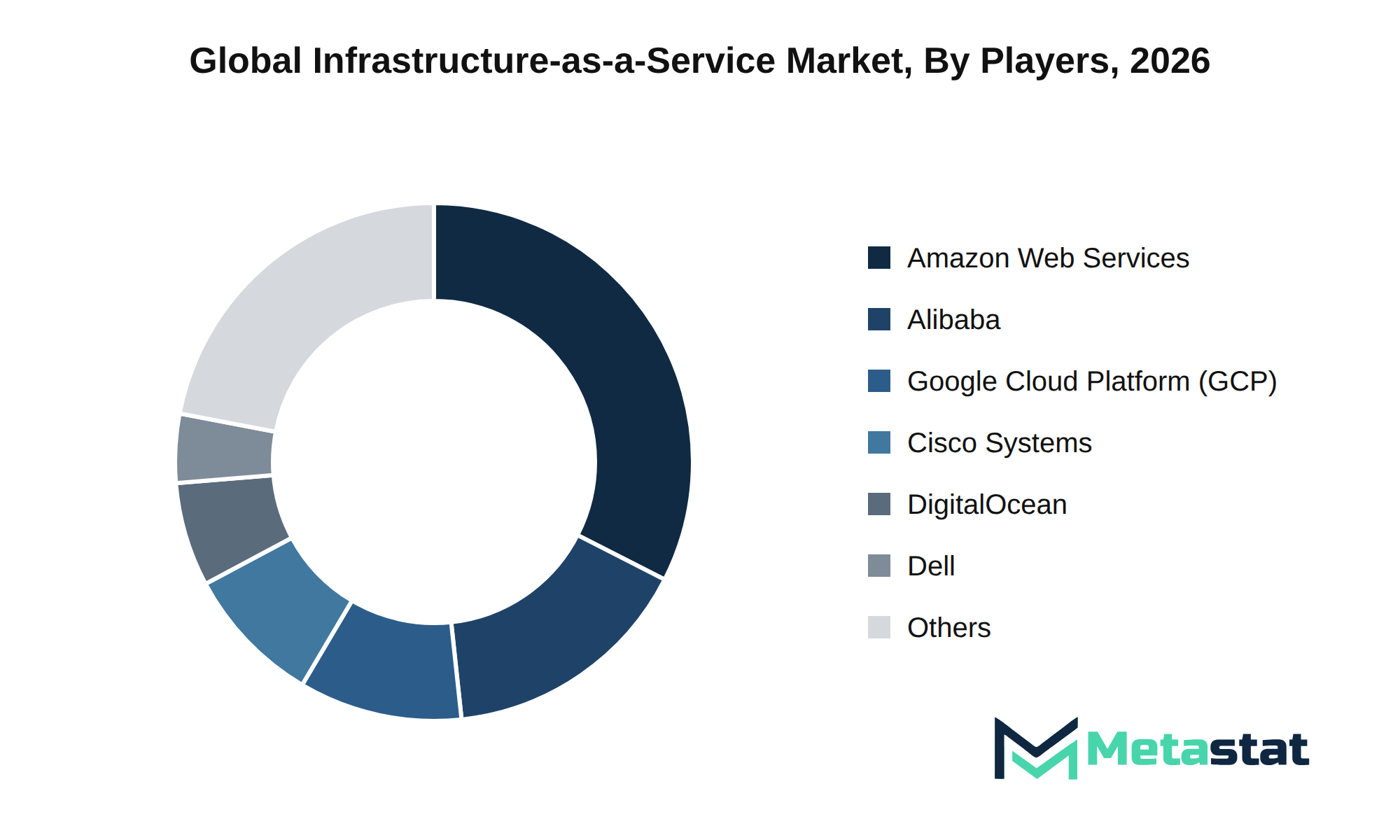
The Infrastructure-as-a-Service market features a dynamic competitive environment characterized by a mix of established players and emerging companies. Key players including Alibaba Group Holding Limited, Amazon Web Services, Inc., and Microsoft Corporation compete on multiple fronts, including pricing strategies, product differentiation, and technological innovation. These companies invest significantly in research and development, creating proprietary technology moats that enhance their market positions.
Strategic alliances and partnerships play a crucial role in the market, enabling companies to expand their service offerings and enhance customer retention strategies. Collaborations among industry leaders help create comprehensive solutions tailored to specific industry needs, including healthcare, finance, and education. The threat of new entrants, supported by a growing pool of startups, drives innovation and competition, compelling established players to refine their go-to-market strategies continually.
Customer switching costs and brand equity dynamics influence the competitive landscape, with companies focusing on enhancing user experience and long-term relationships. Firms including Google Cloud Platform (GCP) and IBM Corporation leverage their vast intellectual property portfolios to maintain a technological edge, while others like Cloudflare Workers and DigitalOcean Holdings, Inc. prioritize niche markets to protect their positions. Overall, the future competitive outlook for the Infrastructure-as-a-Service market remains robust, with ongoing investment in technology and strategic growth vectors shaping the industry's trajectory.
Market size is forecast to rise from USD 193.6 billion in 2025 to over USD 794.6 billion by 2033. This growth reflects a compound annual growth rate (CAGR) of 19.3%. Several macroeconomic factors will contribute to these dynamics, including shifts in downstream demand across various industries, including BFSI, healthcare, and IT & telecom. Each sector's maturation influences the adoption rate of Infrastructure-as-a-Service solutions, driven by organizations increasingly seeking to enhance their operational efficiency and scalability.
Next-generation technology integration significantly shapes the market's trajectory. Advancements in artificial intelligence, machine learning, and automation will drive demand for innovative Infrastructure-as-a-Service offerings. R&D commercialization timelines will affect how quickly these technologies become mainstream, impacting the market's overall growth potential.
Regulatory evolution will dictate compliance requirements for service providers, creating both challenges and opportunities. Imminent compliance milestones will necessitate investments in infrastructure and operational capabilities, ensuring that organizations meet evolving standards. Geopolitical realignments and changing trade corridors disrupt supply chains, prompting businesses to reconsider their Infrastructure-as-a-Service strategies and partnerships.
Strategic capital allocation directives will influence investment in infrastructure commitments and capital expenditure. Companies will prioritize high-growth pockets and emerging white-space opportunities to address unmet enterprise needs. Executive-level strategic imperatives focusing on digital transformation and cloud migration will further increase demand in the market.
Overall, the Infrastructure-as-a-Service market is poised for significant expansion owing to organizations navigating a complex environment of technological advancements, regulatory challenges, and shifting economic conditions. These factors will shape the future outlook, driving ongoing investment and innovation in the sector.
The report strategically identifies and profiles the key market players and analyses their core competencies in each sub-segment of the Infrastructure-as-a-Service market.
Report Attributes | Details |
Study Period | 2021-2033 |
Base Year | 2025 |
Estimated Year | 2026 |
Forecast Period | 2026-2033 |
Historical Period | 2021-2025 |
Growth Rate | CAGR 19.3% from 2026 to 2033 |
Revenue Unit | USD billion |
Segmentation | By Service, Deployment, Industry, Enterprise Size, and Region |
By Region | North America (By Service, Deployment, Industry, Enterprise Size, and Country)
|
Europe (By Service, Deployment, Industry, Enterprise Size, and Country)
| |
Asia Pacific (By Service, Deployment, Industry, Enterprise Size, and Country)
| |
South America (By Service, Deployment, Industry, Enterprise Size, and Country)
| |
Middle East and Africa (By Service, Deployment, Industry, Enterprise Size, and Country)
|
Find answers to common questions about this report
The Infrastructure-as-a-Service market size was valued at USD 193.6 billion in 2025, according to the Metastat Insights study.
The Infrastructure-as-a-Service market is projected to grow at a CAGR of 19.3% during the forecast period from 2026 to 2033.
The North America Infrastructure-as-a-Service market size is estimated to reach USD 328.9 billion by 2033.
The segment leading the Infrastructure-as-a-Service market is Public Deployment, with a projected value of USD 544.7 billion by 2033. This segment demonstrates significant growth potential compared to other deployment types.
Key drivers for the Infrastructure-as-a-Service market include ongoing digital transformation across industries, which necessitates scalable solutions for modernizing legacy systems. Investments in automation, artificial intelligence, and infrastructure upgrades enhance operational capabilities and service delivery, creating significant growth opportunities for IaaS providers.
North America holds the dominant share of the Infrastructure-as-a-Service market, with a projected value of USD 328.9 billion by 2033, representing 45.9 percent of the total market.
Regulatory tightening creates compliance hurdles that complicate operations for Infrastructure-as-a-Service providers, particularly affecting small to medium enterprises. Macroeconomic headwinds and inflationary pressures increase costs for infrastructure development, while supply chain disruptions delay essential components. These factors collectively hinder market growth and limit the ability of companies to effectively harness cloud capabilities.
The Infrastructure-as-a-Service market benefits from digital transformation initiatives that prioritize the modernization of legacy systems, enhancing operational efficiency and responsiveness. Investment in automation and artificial intelligence drives demand for scalable infrastructure solutions, enabling organizations to improve productivity and customer engagement while managing resources more effectively.
The Infrastructure-as-a-Service market is estimated to reach a valuation of USD 794.6 billion by 2033.
Key players in the Infrastructure-as-a-Service market include Alibaba Group Holding Limited, Amazon Web Services, Inc., Cisco Systems Inc., Google Cloud Platform (GCP), Microsoft Corporation, IBM Corporation, Oracle Corporation, and DigitalOcean Holdings, Inc.
The analysts below cover Information & Technology research at Metastat Insights.
LEAD ANALYST
Utkarsh Khirodkar is a Lead Market Research Analyst at MetaStat Insight, specializing in market intelligence, technology sector assessments, and competitive strategy.

PRINCIPAL CONSULTANT - ENTERPRISE AI & EMERGING TECHNOLOGIES
Banking & Finance · Electronics and Semiconductor · Energy and Power · Healthcare IT · Information & Technology · Professional Services
Vijay Gunti is a Principal Consultant at MetaStat Insight, bringing over two decades of experience across enterprise digital transformation, technology strategy, and intelligent systems.

LEAD CONSULTANT - COMMUNICATION, TELECOM, AND IT
Electronics and Semiconductor · Information & Technology · Machinery & Equipment · Professional Services
Ravindra Sathe Consultants for Communication, Telecom, and IT at MetaStat Insight. He leads the firm's industry research initiatives across telecommunications infrastructure, digital connectivity, enterprise networking, and emerging information technology domains.
Assessing 200mm wafer transition schedules and substrate supply bottlenecks requires precise technical intelligence. MetaStat Insight supplied an actionable breakdown comparing planar and trench MOSFET architectures across automotive and industrial drive markets. The regional capacity estimates for Asia-Pacific foundries helped clarify lead-time uncertainties during our strategic planning session. When we needed additional clarification on high-purity raw material sourcing, their analyst team responded with helpful context within twenty-four hours.
Tracking maintenance cycle demand for secondary flight display units and terrain collision avoidance systems across regional jet fleets involves complex aftermarket dynamics. MetaStat Insight provided practical analysis separating airline retrofit programs from OEM forward-fit production schedules in North America and Southeast Asia. The supplier matrix highlighted component obsolescence timelines without resorting to vague generalizations. The dataset served as a dependable reference during our annual program review meetings.
Evaluating secondary resin quality across post-consumer packaging streams requires reliable technical segmentation. MetaStat Insight delivered an objective assessment that distinguished between extrusion-grade flake pricing and optical sorting throughput limitations across Western Europe. The competitive positioning breakdown for licensed depolymerization technology providers answered several questions during our feedstock feasibility audit. Their team clarified regional trade restrictions on mixed plastic scrap quickly when our team submitted follow-up requests.
Explore related market intelligence reports worth reading alongside this one.
Starting from
$2950