
LEAD ANALYST
Utkarsh Khirodkar is a Lead Market Research Analyst at MetaStat Insight, specializing in market intelligence, technology sector assessments, and competitive strategy.

United States Telecom Infrastructure Services Market Size, Share, By Type (Telecom Towers, Data Centers, Fiber Networks, and Data Center Support Infrastructure), By Application (Design and Engineering Services, Construction and Installation Services, Utility Locating and Permitting Services, Network and System Integration Services, Consulting and Regulatory Advisory Services, and Others), By Industry Analysis, Growth, Trends, and Forecast, 2026-2033
Report ID
MSI-4535
Published
January, 2026
Pages
310 Pages
Format
Report Details
Choose Your License
United States Telecom Infrastructure Services Market
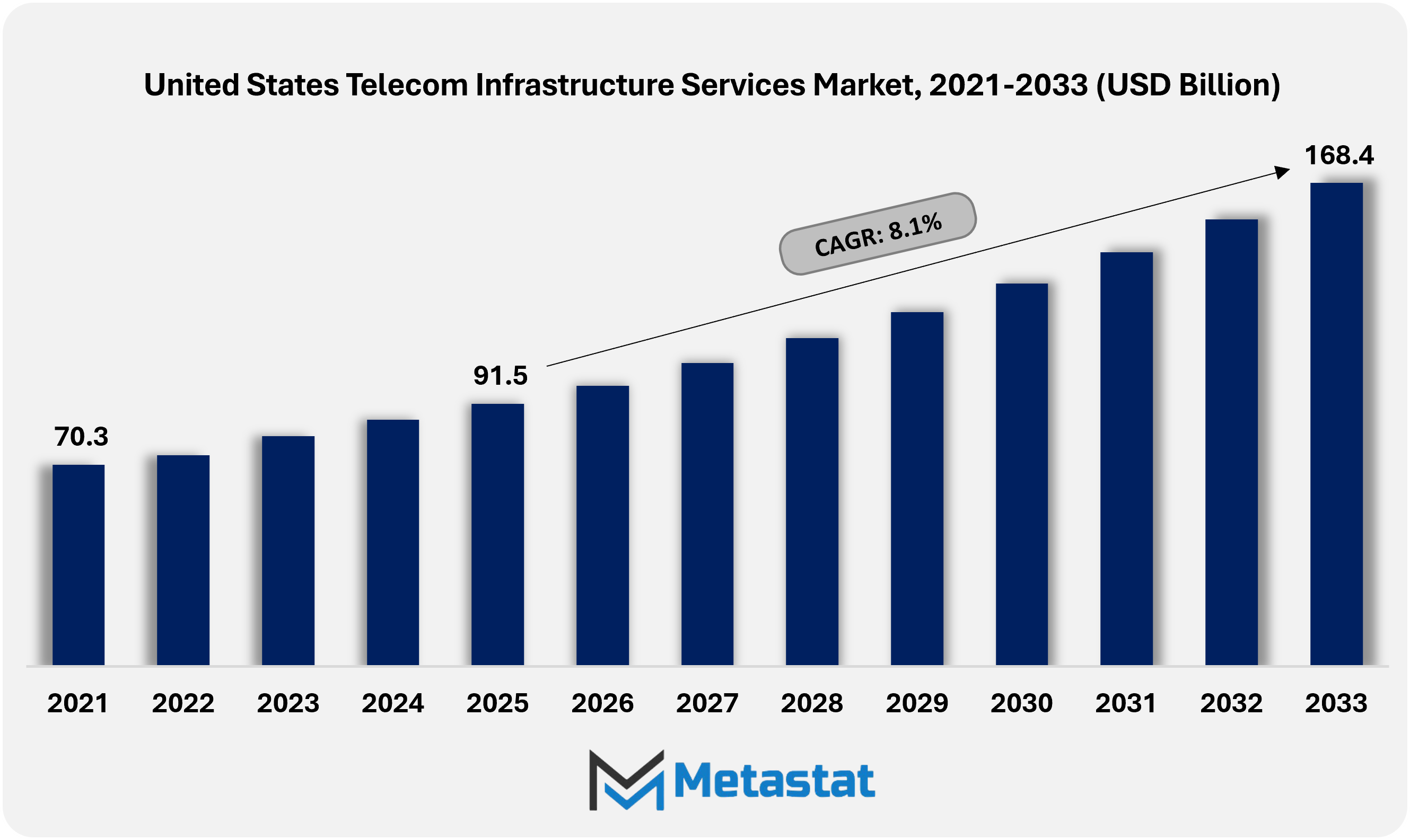
United States Telecom Infrastructure Services market valued at USD 91.5 billion in 2025, expanding at a CAGR of 8.1% through 2033, reaching USD 168.4 billion by 2033.
The United States telecom infrastructure services market is evolving into a structural backbone for national digital continuity rather than a supporting function. In the coming years, the industry will be shaped by how infrastructure services anticipate emerging requirements, particularly as communications networks operate with near-zero tolerance for disruption, latency, or fragmentation.
Service providers are evaluated on scale and on their ability to integrate foresight into physical and virtual network planning. Infrastructure strategies are shifting toward extended-horizon deployment models, with assets designed to accommodate evolving technology roadmaps. Network buildouts are shifting toward resilience engineering, redundancy planning, and adaptive capacity across urban, suburban, and remote geographies.
Accelerated 5G network expansion propels sustained funding across towers, fiber routes, and small cell installations. Dense urban coverage and lower network latency will support advanced applications, smart infrastructure, and connected services. The long-term plan prioritizes coverage depth and performance consistency across metropolitan and semi-urban regions.
Remote models and cloud-based systems increase reliance on high-speed broadband networks. Business operations, education systems, and digital health offerings demand seamless connectivity. Infrastructure vendors will strengthen fiber networks and upgrade transmission capacity to meet rising data consumption while maintaining network efficiency.
Infrastructure development requires substantial upfront capital for equipment, labor, and maintenance. Smaller service providers face challenges in meeting the financial commitments required for large-scale deployment. Market concentration is likely to increase as financially stronger players expand footprints through sustained investment capacity.
Local zoning laws and regulatory approvals slow the rollout of infrastructure across many areas. Approval timelines and compliance costs will impact deployment schedules and increase project costs. Well-organized regulatory coordination is important to preserve the tempo of the boom and meet connectivity expansion objectives.
Edge computing facilities and fiber backhaul expansion gain importance as data processing shifts closer to end users. Smart gadgets, business automation, and cloud packages drive the call for low-latency infrastructure. Strategic investments support scalable networks aligned with evolving digital ecosystem requirements.
The United States Telecom Infrastructure Services market is primarily segmented by Type and Application.
Telecom towers continue to support expanded wireless coverage and higher network capacity. The increased rollout of advanced mobile standards leads to infrastructure upgrades, shared tower usage and smart site management. The long-term plan focuses on space efficiency, power optimization and balancing regional coverage.
Data Centers segment was valued at USD 22.9 billion in 2026 and is projected to reach USD 39.7 billion by 2033, at a CAGR of 8.1% during the forecast period.
Data centers play a central role in handling rising data traffic and cloud-based operations. The expansion emphasizes location strategy, energy efficiency and low latency performance. Future development aligns with digital service expansion, enterprise storage requirements, and secure data processing priorities.
Fiber Networks segment was valued at USD 15.6 billion in 2026 and is projected to reach USD 27.1 billion by 2033, at a CAGR of 8.2% during the forecast period.
Fiber networks strengthen backbone connectivity and enable high-speed transmission across urban and rural areas. Deployment supports advanced communication systems and smart infrastructure. The long-range approach highlights deep fiber penetration, network redundancy and support for data-heavy applications.
Data Centre Support Infrastructure segment was valued at USD 14.9 billion in 2026 and is projected to reach USD 27.5 billion by 2033, at a CAGR of 9.2% during the forecast period.
Data center support infrastructure focuses on power systems, cooling solutions, and physical security. Forward-looking strategies align infrastructure resilience with sustainability goals and seamless service delivery.
Design & Engineering Services segment is projected to reach USD 22.6 billion by 2033, at a CAGR of 9.7% during the forecast period.
Design and engineering services guide efficient network planning and infrastructure layout. Technical expertise shapes scalable designs that will support future upgrades. Emphasis is placed on accuracy, compliance standards, and cost-conscious planning aligned with long-term connectivity goals.
Construction & Installation Services segment is projected to reach USD 49.5 billion by 2033, at a CAGR of 7.8% during the forecast period.
Construction and installation services handle physical network expansion and equipment deployment. Speed, safety and accuracy are given priority in future activities. Workforce coordination and advanced construction methods support timely infrastructure execution in diverse geographical conditions.
Utility Locating & Permitting Services segment is projected to reach USD 10.3 billion by 2033, at a CAGR of 7.9% during the forecast period.
Utility locating and permitting services reduce project delays and regulatory conflicts. Accurate mapping and approvals will aid in smooth infrastructure implementation. Future demand will increase with dense urban projects and large-scale network upgrades.
Network & System Integration Services segment is projected to reach USD 35.9 billion by 2033, at a CAGR of 8.5% during the forecast period.
Network and system integration services ensures compatibility across all platforms and technologies. A seamless connection between hardware and software supports performance stability. Long-term priorities include automation, scalability, and secure data flow management.
Consulting & Regulatory Advisory Services segment is projected to reach USD 13.5 billion by 2033, at a CAGR of 7.1% during the forecast period.
Consulting and regulatory advisory services assist with compliance, planning, and risk management. Expert guidance will align infrastructure projects with the policy framework. Dependence will increase in the future as regulations adapt to advanced communication systems.
Others segment is projected to reach USD 36.7 billion by 2033, at a CAGR of 7.6% during the forecast period.
Other services assist with specific operational needs, maintenance planning and adoption of emerging technology. These areas will evolve with new infrastructure models and service demands, contributing to overall system efficiency and adaptability.
The United States telecom infrastructure services market plays a critical role in supporting digital communications across the country. Increased data usage, cloud adoption, remote work adoption, and expanding wireless coverage sustain demand for advanced infrastructure services. Network upgrades, fiber deployments, and data center expansions will shape how service providers respond to evolving consumer and enterprise requirements. The market prioritizes reliable systems that support high-speed connectivity while maintaining service continuity across urban and rural areas.
Infrastructure development focused on rapid scalability and long-term efficiency enhances overall performance. Telecom operators invest in tower deployment, fiber networks, and edge facilities to manage higher traffic volumes. These efforts help 5G rollouts, private networks, and smart connectivity projects across industries. Service carriers will also prioritize power efficiency and gadget flexibility to deal with operational pressures. Technology upgrades will proceed with a pragmatic approach that balances cost control and performance.
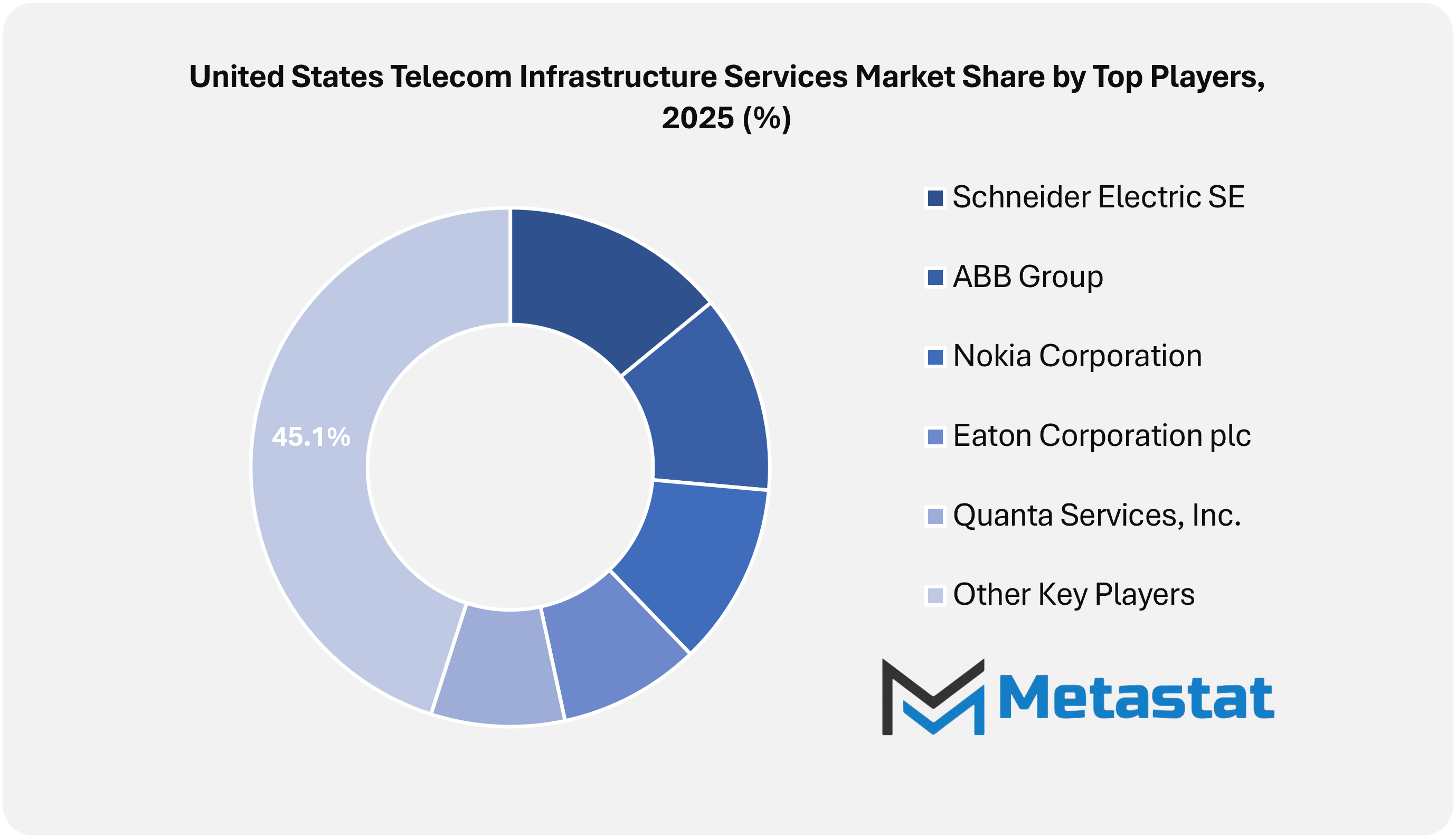
Many established companies continue to shape the competitive landscape. Major Telecom Infrastructure Services industry players in the United States include American Tower Corporation, Crown Castle International Corp., SBA Communications Corporation, MasTec, Inc., Quanta Services, Inc., Zayo Group, LLC, Lumen Technologies, Dycom Industries Inc., Equinix, Inc., Digital Realty Trust, Inc., Vertiv Group Corp., CyrusOne Inc., Schneider Electric SE, Eaton Corporation PLC, Corning Incorporated, Ciena Corporation, Nokia Corporation, Lumentum Operations, LLC, VIAVI Solutions Inc., and ABB Group. The key organizations will support network expansion through tower assets, construction services, fibre systems, power management and digital infrastructure solutions.
The market fosters innovation while minimizing operational complexity. Early efforts concentrate on enhancing quality, accelerating deployment timelines, and reducing downtime. Infrastructure providers and telecom operators strengthen execution capabilities through coordinated collaboration, ensuring data demands are managed efficiently across stable and reliable networks.
The telecommunications infrastructure services market in the United States will develop through long-term investments and not necessarily by moves. Telecommunications and digital transformation are integral to the healthcare, finance, manufacturing, and education sectors. Telecommunications infrastructure services will continue to be the driving forces behind the possible connectivity requirements of the future. Market shifts will be shaped by upgrades aligned with evolving usage patterns and connectivity requirements.
Market size is forecast to rise from USD 91.5 billion in 2025 to over USD 168.4 billion by 2033.
Beyond connectivity, telecommunications infrastructure services support national priorities related to public safety, autonomous systems, and secure data transmission. This sector increasingly integrates with defense readiness, disaster response infrastructure, and critical public utilities. With this alignment strengthening, infrastructure decisions are treated as long-term national investments rather than short-term operating expenditures. Looking ahead, the United States telecom infrastructure services market will redefine its purpose by preparing networks for uncertainty. Its future importance will depend on how effectively it enables continuity, adaptability, and strategic readiness in a communications landscape that will demand more than transmission capacity alone.
This research report categorizes the Telecom Infrastructure Services market based on key segments and regions, forecasts revenue growth, and analyzes trends in each submarket. The report analyzes the key growth drivers, opportunities, and challenges influencing the Telecom Infrastructure Services market. Recent market developments and competitive strategies such as expansion, service launch, partnership, merger, and acquisition are included to outline the competitive landscape.
The report strategically identifies and profiles the key market players and analyzes their core competencies in each sub-segment of the Telecom Infrastructure Services market.
|
Report Attributes |
Details |
|
Study Period |
2021-2033 |
|
Base Year |
2025 |
|
Estimated Year |
2026 |
|
Forecast Period |
2026-2033 |
|
Historical Period |
2021-2025 |
|
Growth Rate |
CAGR 8.1% from 2026 to 2033 |
|
Revenue Unit |
USD Billion |
|
Segmentation |
By Type, Application, and Region |
|
By Type |
|
|
By Application |
|
Find answers to common questions about this report
The Metastat Insights study shows that the United States Telecom Infrastructure Services market size was USD 91.5 billion in 2025.
The United States Telecom Infrastructure Services market is likely to grow at a CAGR of 8.1% over the forecast period (2026-2033).
Telecom Towers is the leading type segment in the United States market.
Rising 5G rollout and small cell deployment driving infrastructure investments and increasing demand for high-speed broadband fueled by remote work and digital services are key driving factors, boosting the market.
United States Telecom Infrastructure Services market is estimated to reach USD 168.4 billion by 2033.
Top players operating in the Telecom Infrastructure Services industry include American Tower Corporation, Crown Castle International Corp., SBA Communications Corporation, MasTec, Inc., and Quanta Services, Inc.
The analysts below cover Information & Technology research at Metastat Insights.
LEAD ANALYST
Utkarsh Khirodkar is a Lead Market Research Analyst at MetaStat Insight, specializing in market intelligence, technology sector assessments, and competitive strategy.

PRINCIPAL CONSULTANT - ENTERPRISE AI & EMERGING TECHNOLOGIES
Banking & Finance · Electronics and Semiconductor · Energy and Power · Healthcare IT · Information & Technology · Professional Services
Vijay Gunti is a Principal Consultant at MetaStat Insight, bringing over two decades of experience across enterprise digital transformation, technology strategy, and intelligent systems.

LEAD CONSULTANT - COMMUNICATION, TELECOM, AND IT
Electronics and Semiconductor · Information & Technology · Machinery & Equipment · Professional Services
Ravindra Sathe Consultants for Communication, Telecom, and IT at MetaStat Insight. He leads the firm's industry research initiatives across telecommunications infrastructure, digital connectivity, enterprise networking, and emerging information technology domains.
Ambulatory surgical centers have very different purchasing cycles for robotic-assisted surgery platforms than major hospital networks. The MetaStat Insight study focused squarely on capital expenditure depreciation, procedural reimbursement pathways, and surgeon training overhead. That operational clarity made it much simpler to validate multi-year procedure growth forecasts against actual ambulatory center adoption patterns.
When planning edge sensor rollouts across refinery environments, generic IoT reports typically miss the harsh-environment certification bottlenecks. MetaStat Insight gave an objective evaluation of ATEX and Class 1 Division 2 hardware availability, along with realistic five-year maintenance cycle cost projections. The comparison of wireless mesh versus private cellular backhaul helped our team pressure-test network reliability models for remote processing facilities.
In the biological seed treatment space, registration timelines vary drastically between the European Union, Brazil, and North America. The MetaStat Insight research handled these cross-border regulatory barriers with genuine nuance, mapping commercialization pathways alongside historical field adoption rates. The segmentation between microbial strains and biochemical active ingredients was particularly well structured.
Explore related market intelligence reports worth reading alongside this one.