
Explore the top 25 organ preservation companies driving innovation in the Global Organ Preservation Market, valued at USD 291.8 Million in 2025.
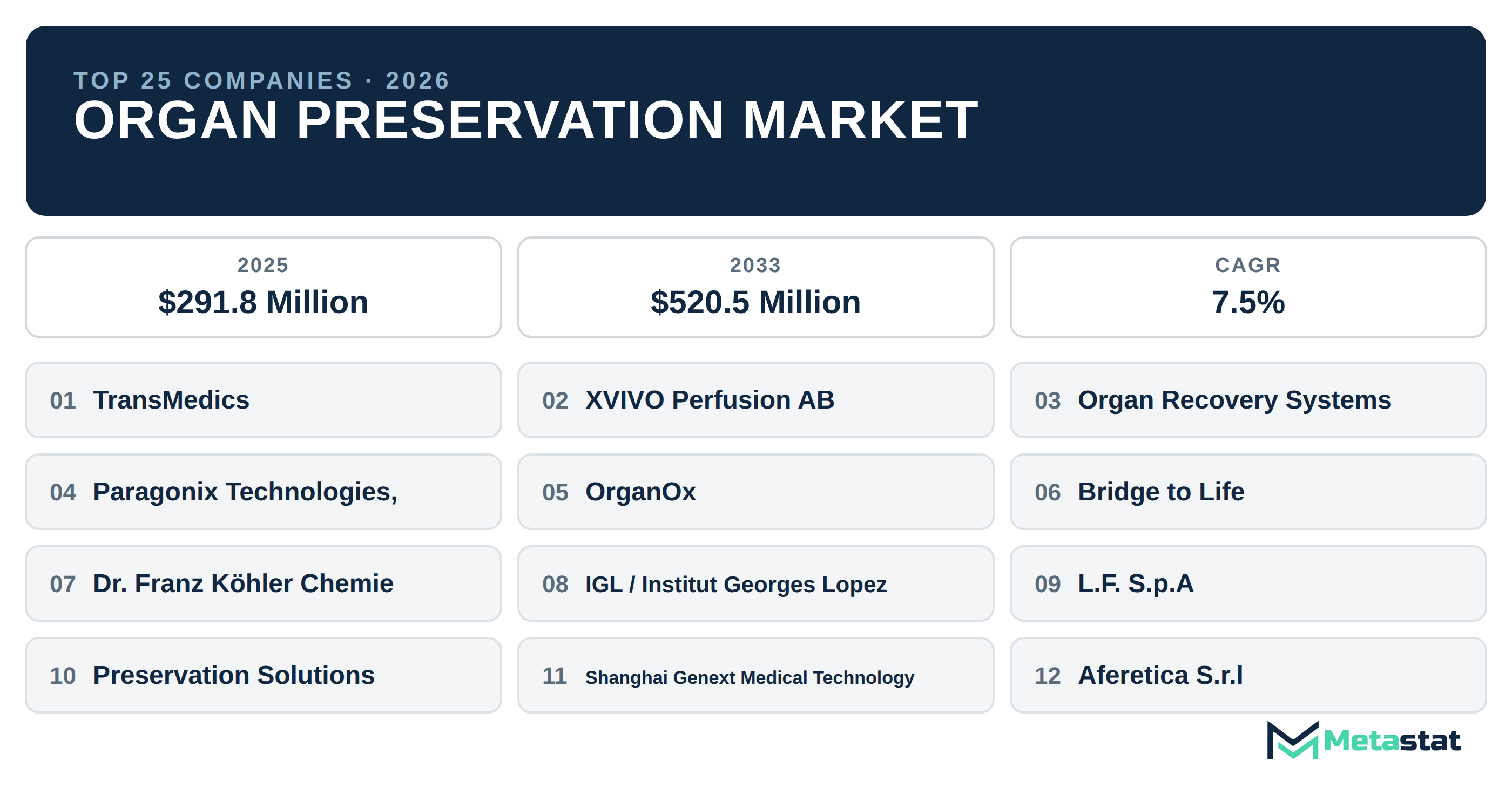
The Global Organ Preservation Market is valued at USD 291.8 Million in 2025 and is projected to reach USD 520.5 Million by 2033, growing at a CAGR of 7.5%. This market encompasses a range of technologies and solutions aimed at extending the viability of organs for transplantation. Increased demand for organ transplants, coupled with advancements in preservation techniques, drive growth in this critical sector.
As the market evolves, factors such as enhanced awareness about organ donation and technological innovations in preservation methods play significant roles. With the ongoing need to address organ shortages worldwide, the focus on improving preservation techniques will continue to be a priority for various stakeholders.
Global Organ Preservation Market Size, Data, & Statistics
In 2021, the Global Organ Preservation Market was valued at USD 221 Million. The market experienced growth to USD 235.6 Million in 2022 and further increased to USD 254.2 Million in 2023. By 2024, the market is expected to reach USD 270.5 Million.
Projected growth continues with the market anticipated to attain USD 291.8 Million in 2025. The forecast estimates a rise to USD 314.5 Million in 2026, USD 338.7 Million in 2027, and USD 364.9 Million in 2028. By 2033, the market is set to reach USD 520.5 Million.
The compound annual growth rate (CAGR) from 2025 to 2033 is 7.5%. Such growth highlights the increasing investment in organ preservation methodologies and technologies.
The regional distribution of the market reveals North America accounting for 45.1%, followed by Europe at 26.6%. The Asia Pacific region holds a 16.2% share, while South America and the Middle East and Africa account for 7.6% and 4.4%, respectively.
Top 10 Trends in the Global Organ Preservation Market
Innovations in preservation techniques
Advancements in organ preservation techniques contribute significantly to the market. Techniques such as normothermic machine perfusion exhibit potential for enhancing organ viability, leading to improved transplantation outcomes.
Increasing demand for organ transplants
Rising awareness regarding the importance of organ donation fuels demand for organ transplants. This trend emphasizes the need for effective preservation solutions to ensure successful transplant processes.
Focus on research and development
Investment in research and development continues to drive innovation in organ preservation technologies. Companies are expanding their portfolios to include more advanced solutions that meet evolving healthcare needs.
Collaborative efforts among stakeholders
Collaboration among transplant centers, organ procurement organizations, and technology providers enhances the organ preservation ecosystem. These partnerships facilitate knowledge sharing and improve preservation outcomes.
Expansion into emerging markets
Emerging markets present opportunities for growth in the organ preservation sector. Companies are exploring these regions to address increasing organ transplant demands, leveraging localized solutions.
Regulatory advancements
Regulatory improvements are promoting the development of safe and effective preservation technologies. These advancements can lead to faster approvals and broader market access for innovative solutions.
Shift towards personalized medicine
Personalized medicine's growth influences organ preservation strategies, allowing for tailored solutions that enhance patient outcomes. This trend highlights the need for adaptive preservation technologies.
Integration of automation and AI
Automation and artificial intelligence streamline organ preservation processes, improving efficiency and accuracy. These technologies support better decision-making during the preservation phase.
Education and training initiatives
Increasing emphasis on education and training within the organ preservation field enhances competency among healthcare professionals. These initiatives ensure the effective implementation of preservation technologies.
Environmental sustainability considerations
As sustainability becomes a priority, companies are exploring eco-friendly practices in organ preservation. This trend aligns with broader healthcare objectives to minimize environmental impact.
Top 25 Companies in the Global Organ Preservation Market
1. TransMedics Group, Inc.
Headquarters: Andover, United States · Founded: 2006. TransMedics Group, Inc. specializes in developing organ preservation solutions focused on improving patient outcomes. Their OCS™ (Organ Care System) technology enhances organ viability during transport and transplantation, addressing critical challenges in traditional preservation methods.
By integrating innovative solutions, TransMedics enhances the functionality of preserved organs. Their focus on research and development fosters continuous improvement in organ preservation methodologies, contributing to advancements in transplantation success rates.
2. XVIVO Perfusion AB
Headquarters: Gothenburg, Sweden · Founded: 1998. XVIVO Perfusion AB is dedicated to developing organ preservation solutions, particularly for lung and kidney transplants. Their proprietary perfusion technology enhances the viability of organs during transportation, improving transplantation outcomes.
XVIVO's commitment to research and development ensures the continuous advancement of their products. By collaborating with leading transplant centers, they enhance the overall transplantation process, supporting better patient care.
3. Organ Recovery Systems, Inc.
Headquarters: Des Plaines, United States · Founded: 2005. Organ Recovery Systems, Inc. focuses on developing innovative organ preservation solutions, with an emphasis on improving organ viability during transport. Their products, including machine perfusion systems, enhance the preservation process.
The company's approach combines technology with rigorous research, which aids in advancing organ transplant success rates. Collaborations with healthcare facilities support their mission to improve the organ recovery process.
4. Paragonix Technologies, Inc. (Getinge)
Headquarters: Boston, United States · Founded: 2015. Paragonix Technologies, Inc., a subsidiary of Getinge, specializes in organ preservation and transport solutions. Their innovative devices focus on enhancing the viability of organs during transportation, ensuring improved outcomes for transplant recipients.
The company emphasizes research-driven product development and collaboration with clinical partners. This approach allows them to remain at the cutting edge of organ preservation technology.
5. OrganOx Limited
Headquarters: Oxford, United Kingdom · Founded: 2012. OrganOx Limited is known for developing advanced preservation techniques, specifically for liver transplants. Their OrganOx metra system provides normothermic preservation, which significantly improves organ viability.
The company's innovative approach to organ preservation enhances transplantation success rates. Collaborations with transplant centers strengthen their commitment to advancing organ preservation methodologies.
6. Bridge to Life Ltd.
Headquarters: Columbia, United States · Founded: 2008. Bridge to Life Ltd. specializes in organ preservation solutions, focusing on enhancing organ viability during transport. Their Perfadex® solution is widely used for lung preservation.
Their commitment to research and close collaboration with transplant professionals ensure that they provide effective solutions tailored to clinicians' needs. This dedication supports improved patient outcomes in organ transplantation.
7. Dr. Franz Köhler Chemie GmbH
Headquarters: Bensheim, Germany · Founded: 1979. Dr. Franz Köhler Chemie GmbH develops preservation solutions for organ transplantation. Their innovative products support the safe transport and storage of organs, ensuring optimal conditions for viability.
The company's focus on quality and research sets them apart in the market. By collaborating with healthcare professionals, they enhance their product offerings to better meet the needs of the transplantation community.
8. IGL Group / Institut Georges Lopez
Headquarters: Paris, France · Founded: 1998. IGL Group offers organ preservation solutions with a focus on cold storage techniques. Their IGL-1 solution is recognized for its effectiveness in preserving organs for transplantation.
The company's dedication to research and development facilitates continuous improvement in preservation methods. They actively collaborate with transplant centers to ensure their solutions align with clinical requirements.
9. S.A.L.F. S.p.A.
Headquarters: Bologna, Italy · Founded: 1980. S.A.L.F. S.p.A. specializes in organ preservation and transportation solutions. Their product range includes preservation solutions that improve the viability of organs during transit.
With a commitment to innovation and quality, S.A.L.F. maintains strong partnerships with healthcare providers to enhance the efficacy of their solutions. This focus supports improved outcomes in organ transplantation.
10. Preservation Solutions, Inc.
Headquarters: United States · Founded: 2001. Preservation Solutions, Inc. focuses on developing solutions that enhance organ preservation during transit. Their innovative products address the critical challenges involved in organ transportation.
By emphasizing quality and research-driven approaches, Preservation Solutions strengthens its position in the market. Their partnerships with transplant centers ensure their solutions meet the evolving needs of the healthcare community.
11. Shanghai Genext Medical Technology Co., Ltd.
Headquarters: Shanghai, China. Shanghai Genext Medical Technology Co., Ltd. specializes in organ preservation products and solutions. Their focus is on developing technologies that enhance the viability of organs during transportation.
The company's commitment to innovation and quality drives its operations. By collaborating with healthcare professionals, Genext aims to meet the growing demands of the organ transplantation sector.
12. Aferetica S.r.l.
Headquarters: Bologna, Italy · Founded: 2012. Aferetica S.r.l. is dedicated to developing organ preservation technologies that improve transplant outcomes. They focus on creating innovative solutions tailored to the needs of the medical community.
With a commitment to research and collaboration, Aferetica seeks to enhance the efficiency of organ preservation processes. Their products aim to address the evolving challenges faced in organ transplantation.
13. X-Therma, Inc.
Headquarters: San Diego, United States · Founded: 2016. X-Therma, Inc. focuses on developing technologies for organ preservation through hypothermic preservation methods. Their solutions aim to improve organ viability during transit.
The company's innovative approach, combined with a strong research background, positions them as a key player in the organ preservation market. Collaborations with healthcare facilities support their mission to enhance transplantation outcomes.
14. 21st Century Medicine, Inc.
Headquarters: California, United States · Founded: 1996. 21st Century Medicine, Inc. specializes in cryopreservation and organ preservation techniques. Their innovative approaches focus on extending the viability of organs for transplantation.
The company emphasizes research-driven solutions to enhance organ preservation outcomes. With a commitment to advancing technology, they actively pursue partnerships with the transplantation community.
15. BioLife Solutions, Inc.
Headquarters: Bothell, United States · Founded: 1987. BioLife Solutions, Inc. develops biopreservation media, which are critical for preserving organs and tissues. Their solutions support various applications in the organ preservation market.
BioLife emphasizes quality and innovation in its product offerings. By collaborating with healthcare providers, they work to enhance organ preservation techniques and improve transplantation success rates.
16. Vascular Perfusion Solutions, Inc.
Headquarters: United States · Founded: 2010. Vascular Perfusion Solutions, Inc. specializes in organ preservation through perfusion systems. Their products focus on enhancing the viability of organs during transit and transplantation.
The company is dedicated to research and product development, working closely with healthcare professionals to advance organ preservation methodologies. Their commitment supports improved outcomes in organ transplantation.
17. Hibernicor
Headquarters: United States · Founded: 2014. Hibernicor develops organ preservation solutions that focus on maintaining organ viability during transportation. Their innovative products enhance the preservation process.
The company emphasizes research and collaboration with healthcare providers to ensure their solutions meet industry needs. Their focus on quality supports advancements in organ transplantation.
18. Traferox Technologies Inc.
Headquarters: United States · Founded: 2017. Traferox Technologies Inc. focuses on developing solutions for organ preservation and transportation. Their products are designed to enhance organ viability during transit.
By prioritizing research and collaboration with the medical community, Traferox aims to advance the field of organ preservation, contributing to improved patient outcomes.
19. BMI OrganBank
Headquarters: United States. BMI OrganBank specializes in organ preservation and transplant solutions. Their focus is on enhancing organ viability and transportation processes.
The company is dedicated to innovation and quality, working closely with healthcare professionals to address organ preservation challenges effectively. Their efforts contribute to improving transplantation success rates.
20. CardInnov Devices
Headquarters: United States. CardInnov Devices develops preservation solutions for organs, focusing on enhancing viability during transport. Their products cater to the needs of the transplantation sector.
With a commitment to research and development, the company ensures that its solutions are effective and reliable. Collaboration with healthcare professionals enhances their offerings in the organ preservation market.
21. Revive Organtech, Inc.
Headquarters: United States. Revive Organtech, Inc. specializes in organ preservation solutions that focus on improving organ viability during transportation. Their innovative technologies aim to enhance the preservation process.
The company emphasizes research-driven approaches and partnerships with healthcare providers. This focus supports their mission to improve outcomes in organ transplantation.
22. Terumo Corporation
Headquarters: Tokyo, Japan · Founded: 1921. Terumo Corporation is a global leader in medical technology, including organ preservation solutions. Their products focus on enhancing organ viability during transport processes.
With a commitment to quality and innovation, Terumo collaborates with healthcare professionals to ensure their solutions effectively meet the demands of organ transplantation. Their extensive experience supports advancements in this critical field.
23. Duraent
Headquarters: United States. Duraent specializes in developing organ preservation solutions that enhance viability during transportation. Their focus is on creating innovative products tailored to the transplantation sector.
The company prioritizes research and collaboration, ensuring their solutions align with industry needs. Their commitment contributes to improving patient care in organ transplantation.
24. Lifeline Scientific, Inc.
Headquarters: United States · Founded: 2009. Lifeline Scientific, Inc. develops innovative organ preservation technologies that focus on enhancing organ viability during transport. Their solutions aim to improve transplantation outcomes.
By emphasizing research and collaboration with healthcare providers, Lifeline Scientific seeks to advance the field of organ preservation. Their dedication supports better patient outcomes in organ transplantation.
25. Essential Pharmaceuticals, LLC
Headquarters: United States. Essential Pharmaceuticals, LLC specializes in organ preservation solutions, focusing on enhancing viability during transportation. Their products cater to the needs of the transplantation community.
The company prioritizes quality and innovation, working closely with healthcare professionals to provide effective solutions that improve organ preservation processes. Their commitment supports advancements in the field.
Conclusion
The Global Organ Preservation Market is positioned for continued growth, driven by advancements in preservation technologies and an increasing need for organ transplants. The prominent companies listed exemplify innovation and commitment to improving organ viability, which is crucial for successful transplant outcomes.
Investors and stakeholders in the healthcare sector should consider the diverse offerings and strategies of these organ preservation companies, as they play a vital role in shaping the future of transplantation. Engaging with these companies can provide valuable insights and opportunities in the evolving organ preservation landscape.
Tags
About the Authors

LEAD ANALYST
Utkarsh Khirodkar is a Lead Market Research Analyst at MetaStat Insight, specializing in market intelligence, technology sector assessments, and competitive strategy.

LEAD PRINCIPAL ANALYST, PHARMA AND HEALTHCARE
Food and Beverages · Healthcare · Healthcare IT · Medical Devices
Ajay Devgire is the Lead Healthcare Analyst at MetaStat Insight, leading strategic research and market intelligence initiatives across the global healthcare domain.

SENIOR RESEARCH ANALYST
Biotechnology · Food and Beverages · Medical Devices · Packaging
Snehal Pasalkar is a Research Analyst at MetaStat Insight, operating at the intersection of life sciences research, competitive strategy, and market intelligence.