
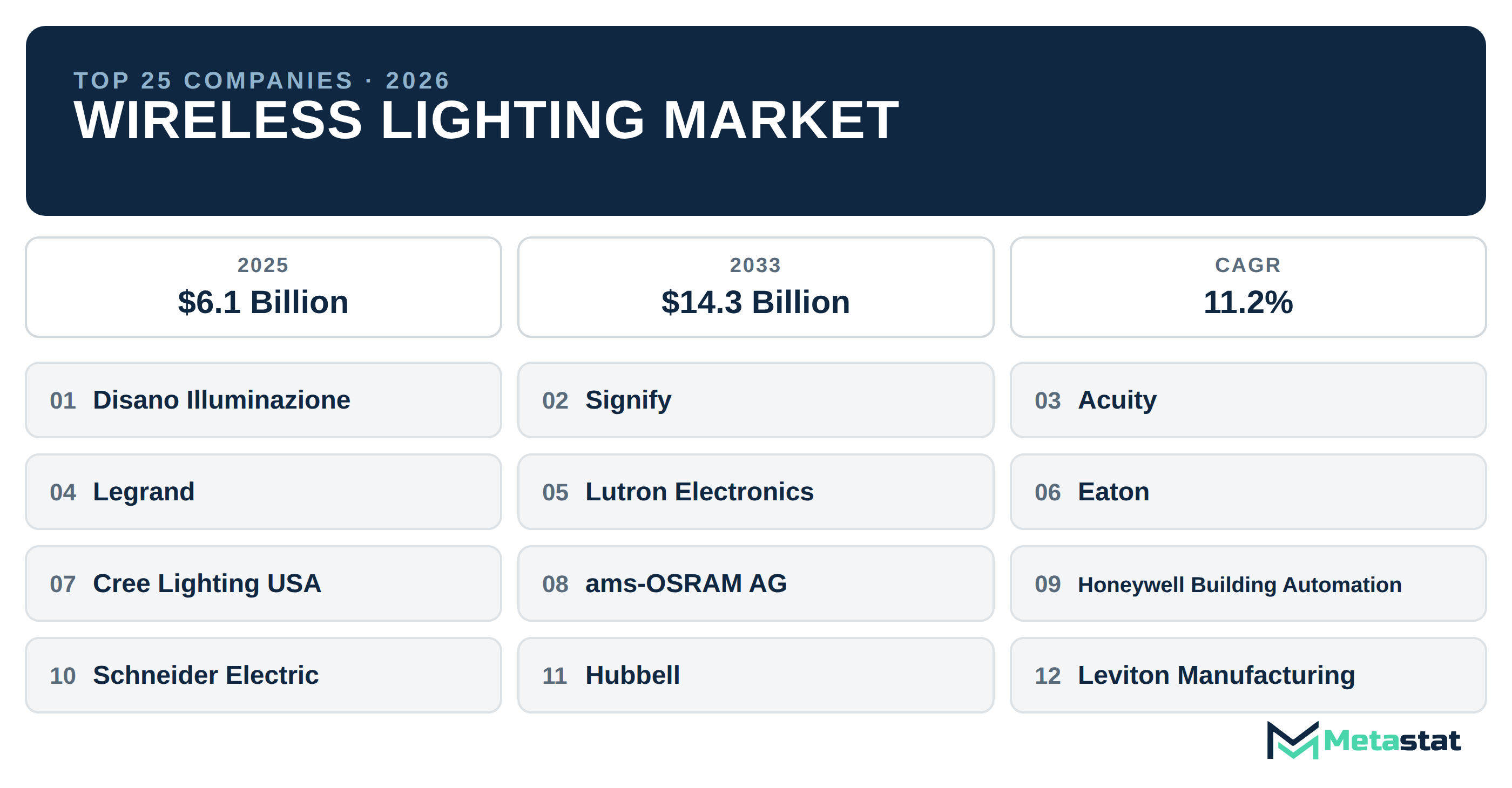
Discover the top 25 companies in the Global Wireless Lighting Market, projected to grow from USD 6.1 billion in 2025 to USD 14.3 billion by 2033.
The Global Wireless Lighting Market is valued at USD 6.1 Billion in 2025 and is projected to reach USD 14.3 Billion by 2033, growing at a CAGR of 11.2%. This market encompasses a range of wireless-enabled lighting solutions, including luminaires, controls, sensors, and software, used in various applications such as commercial, industrial, and outdoor environments. Factors driving growth include increasing energy efficiency mandates, the push for smart building technologies, and the rising preference for connected devices.
Wireless Lighting solutions enhance flexibility, increase energy savings, and improve user experience. The integration of advanced technologies like IoT and AI into lighting systems encourages innovation, fostering widespread adoption across multiple sectors.
Global Wireless Lighting Market Size, Data, & Statistics
The market size for the Global Wireless Lighting Market was USD 4 Billion in 2021 and grew to USD 4.4 Billion in 2022. For 2023, the market value reached USD 5 Billion, and it is forecasted to increase to USD 5.5 Billion in 2024. By 2025, the market is projected to be valued at USD 6.1 Billion.
Looking ahead, the market is expected to grow significantly, with a forecast of USD 6.8 Billion in 2026 and continuing to USD 14.3 Billion by 2033. This growth represents a CAGR of 11.2% from 2025 to 2033, indicating a robust upward trajectory.
The market demonstrates a regional split, with North America taking the largest share at 35.3%, followed by Asia Pacific at 25%, Europe at 24.6%, South America at 10.1%, and the Middle East and Africa at 5%.
Top 10 Trends in the Global Wireless Lighting Market
Smart integration drives market growth
The rise of smart home technology influences the wireless lighting market, with consumers increasingly seeking integrated systems. Advanced features such as smartphone controls, voice commands, and automation enhance user satisfaction, leading to greater adoption in residential and commercial settings.
Sustainability initiatives push demand
Growing environmental concerns inspire organizations to adopt sustainable practices, including energy-efficient lighting solutions. Wireless lighting technologies, which typically consume less power, align with these initiatives, making them attractive options for eco-conscious consumers and businesses.
Remote monitoring becomes essential
The need for remote monitoring capabilities in lighting systems is increasing, driven by the rise of smart buildings. This trend allows for improved management of lighting resources, enabling users to optimize usage patterns and reduce operational costs.
Increased demand for control systems
As consumers and businesses prioritize customization and comfort, the demand for sophisticated wireless lighting control systems rises. These systems provide enhanced user experiences and allow for tailored lighting scenarios, leading to broader acceptance across various applications.
Focus on interoperability grows
Interoperability among different wireless lighting technologies has become a crucial consideration for consumers. The market sees a shift toward solutions that seamlessly connect with other smart devices, ensuring compatibility and functionality across diverse platforms.
Health-focused innovations gain traction
Health and well-being considerations drive the development of wireless lighting solutions that promote better living environments. Technologies such as tunable white lighting contribute to improved mood, productivity, and overall well-being, appealing to consumers.
Wireless technology adoption accelerates
The increasing affordability and accessibility of wireless technologies result in accelerated adoption rates. As these technologies become mainstream, more industries embrace wireless lighting solutions, expanding the market further.
Government regulations support growth
Government initiatives aimed at reducing energy consumption and enhancing energy efficiency fuel the growth of the wireless lighting market. These regulations encourage the adoption of modern, efficient lighting solutions across residential, commercial, and industrial sectors.
Emerging markets show potential
Emerging markets are set to play a significant role in the growth of the wireless lighting sector. Expanding urbanization and rising income levels in these regions drive demand for advanced lighting technology, creating new opportunities for industry players.
Technological advances reshape offerings
Continuous technological advancements lead to innovative features and functionalities in wireless lighting products. Companies focus on improving product performance, energy efficiency, and user-friendliness, enhancing competitiveness in the market.
Top 25 Companies in the Global Wireless Lighting Market
1. Disano Illuminazione
Founded: 1957
Disano Illuminazione specializes in designing and manufacturing lighting solutions that blend functionality with aesthetics. The company offers a diverse range of products, including industrial, commercial, and outdoor lighting. Their approach to innovation drives the development of energy-efficient and sustainable solutions within the wireless lighting market.
2. Signify Holding
Founded: 2016
Signify Holding is a global leader in lighting solutions, offering a vast array of innovative products and services. Their portfolio includes smart lighting systems that enhance user experience through connectivity and control. The company’s commitment to sustainability and energy efficiency positions it as a key player in the wireless lighting market.
3. Acuity Inc.
Founded: 2001
Acuity Inc. is renowned for its advanced lighting solutions that cater to various applications, including commercial and industrial sectors. The company emphasizes the integration of technology, providing smart lighting systems that promote energy efficiency and operational effectiveness.
4. Legrand (Legrand North America, LLC)
Founded: 1904
Legrand specializes in electrical and digital building infrastructures, including wireless lighting solutions. The company prioritizes innovation and sustainability, developing products that enhance building efficiency and user comfort. Legrand’s comprehensive approach caters to diverse market needs.
5. Lutron Electronics Co.
Founded: 1961
Lutron Electronics Co. is a pioneer in lighting control systems that provide innovative solutions for both residential and commercial applications. Their products emphasize automation and energy management, making a notable contribution to the growth of the wireless lighting market.
6. Eaton
Founded: 1911
Eaton provides electrical solutions that include a wide range of wireless lighting products. The company focuses on improving energy efficiency and enhancing safety through smart technologies. Eaton’s commitment to sustainability positions it as a notable player in the wireless lighting market.
7. Cree Lighting USA, LLC
Founded: 1987
Cree Lighting USA, LLC specializes in LED lighting solutions that are designed for performance and energy efficiency. The company is recognized for its innovative technology, which plays a significant role in the evolution of wireless lighting systems.
8. ams-OSRAM AG
Founded: 1981
ams-OSRAM AG is a leading global provider of advanced sensor solutions and lighting products. The company's innovative LED technologies and wireless systems are integral to modern lighting applications, catering to a growing demand for connected lighting solutions.
9. Honeywell Building Automation
Founded: 1906
Honeywell Building Automation is renowned for integrating advanced controls and automation technologies into building systems. Wireless lighting solutions from Honeywell enhance energy management and operational efficiency, aligning with the increasing trend towards smart building solutions.
10. Schneider Electric
Founded: 1836
Schneider Electric specializes in energy management and automation solutions, including advanced wireless lighting technologies. The company's focus on sustainability and digital transformation makes it a significant contributor to the growth of the wireless lighting market.
11. Hubbell
Founded: 1888
Hubbell provides a broad range of lighting products, including innovative wireless lighting solutions designed for both indoor and outdoor applications. Their commitment to quality and performance makes them a reliable choice in the wireless lighting industry.
12. Leviton Manufacturing Co., Inc.
Founded: 1906
Leviton Manufacturing Co., Inc. is known for its comprehensive range of electrical wiring devices and lighting products. Their wireless lighting controls focus on efficiency and user convenience, catering to both residential and commercial markets.
13. Zumtobel Lighting
Founded: 1950
Zumtobel Lighting specializes in intelligent lighting solutions for various applications. Their innovative technology focuses on energy efficiency and user comfort, contributing significantly to the development of smart wireless lighting systems.
14. General Electric Company
Founded: 1892
General Electric Company is a leading provider of lighting solutions, offering a range of wireless lighting products. Their commitment to technological innovation and sustainability enhances their position in the wireless lighting market.
15. RAB Lighting Inc.
Founded: 1946
RAB Lighting Inc. specializes in LED lighting solutions that provide energy-efficient products for a variety of applications. Their focus on innovation and customer satisfaction drives the growth of wireless lighting technologies.
16. Belkin
Founded: 1983
Belkin is a prominent provider of connectivity solutions, including wireless lighting products designed for smart homes. The company's emphasis on user-friendly technology enhances market adoption of wireless lighting solutions.
17. Helvar
Founded: 1901
Helvar focuses on intelligent lighting solutions, developing products that cater to energy efficiency and automation. Their innovative approach contributes significantly to the advancement of wireless lighting technologies.
18. WAGO Corporation
Founded: 1951
WAGO Corporation specializes in electrical interconnections and automation technology, including wireless lighting solutions. Their commitment to quality and innovation enhances their influence in the wireless lighting market.
19. EnOcean GmbH
Founded: 2001
EnOcean GmbH is known for its energy harvesting wireless technology, which is significant in developing wireless lighting solutions. Their innovative approach supports the growing demand for energy-efficient lighting systems.
20. Lightwave
Founded: 1997
Lightwave specializes in smart lighting and home automation solutions that focus on connectivity and user experience. Their products enhance the appeal of wireless lighting technologies among consumers.
21. ABB
Founded: 1988
ABB is a global leader in electrification and automation technologies, offering a range of wireless lighting products. Their focus on innovation and sustainability positions them as a key player in the wireless lighting market.
22. GE Lighting
Founded: 1892
GE Lighting, a division of General Electric Company, specializes in innovative lighting solutions, including wireless products. Their dedication to energy efficiency and technological advancements contributes to a strong presence in the wireless lighting market.
23. Panasonic Life Solutions India Pvt. Ltd. (Panasonic Holdings Corporation)
Founded: 1918
Panasonic Life Solutions India Pvt. Ltd. focuses on providing advanced electrical and lighting solutions. Their commitment to innovation and quality enhances the appeal of wireless lighting systems in the Indian market.
24. Philips Lighting Company
Founded: 1891
Philips Lighting Company is a leading player in the lighting industry, known for its innovative wireless solutions. Their focus on smart lighting technologies aligns with market trends toward connectivity and energy efficiency.
25. Samsung
Founded: 1938
Samsung is a global technology leader that offers a range of wireless lighting solutions as part of its broader smart home ecosystem. Their commitment to innovation and quality drives significant growth in the wireless lighting market.
Conclusion
The Global Wireless Lighting Market is on a strong growth trajectory, projected to reach USD 14.3 Billion by 2033. This expansion reflects a greater demand for energy-efficient, smart lighting solutions that enhance user experience across various applications.
The presence of these top Wireless Lighting companies highlights the industry's shift towards innovation and sustainability. Companies are focusing on advanced technologies and smart integrations, offering buyers a wealth of options to improve their lighting systems while contributing to energy savings and environmental goals.
Tags
About the Authors

LEAD ANALYST
Utkarsh Khirodkar is a Lead Market Research Analyst at MetaStat Insight, specializing in market intelligence, technology sector assessments, and competitive strategy.

PRINCIPAL CONSULTANT - ENTERPRISE AI & EMERGING TECHNOLOGIES
Banking & Finance · Electronics and Semiconductor · Energy and Power · Healthcare IT · Information & Technology · Professional Services
Vijay Gunti is a Principal Consultant at MetaStat Insight, bringing over two decades of experience across enterprise digital transformation, technology strategy, and intelligent systems.

PRINCIPAL CONSULTANT - QUALITY SYSTEMS & COMPLIANCE
Electronics and Semiconductor · Machinery & Equipment · Professional Services
Omkar Phadtare is an Industry Consultant at MetaStat Insight, specializing in quality systems, regulatory compliance, and standards benchmarking to drive data-driven market intelligence and strategic industry research.

ENERGY & INFRASTRUCTURE INDUSTRY CONSULTANT
Automotive and Transportation · Electronics and Semiconductor · Energy and Power · Machinery & Equipment
Saurabh Vasant Ganvir consults for Energy & Infrastructure Industry at MetaStat Insight, specializing in renewable energy, solar EPC, and electric vehicle (EV) infrastructure markets.

LEAD CONSULTANT - COMMUNICATION, TELECOM, AND IT
Electronics and Semiconductor · Information & Technology · Machinery & Equipment · Professional Services
Ravindra Sathe Consultants for Communication, Telecom, and IT at MetaStat Insight. He leads the firm's industry research initiatives across telecommunications infrastructure, digital connectivity, enterprise networking, and emerging information technology domains.