
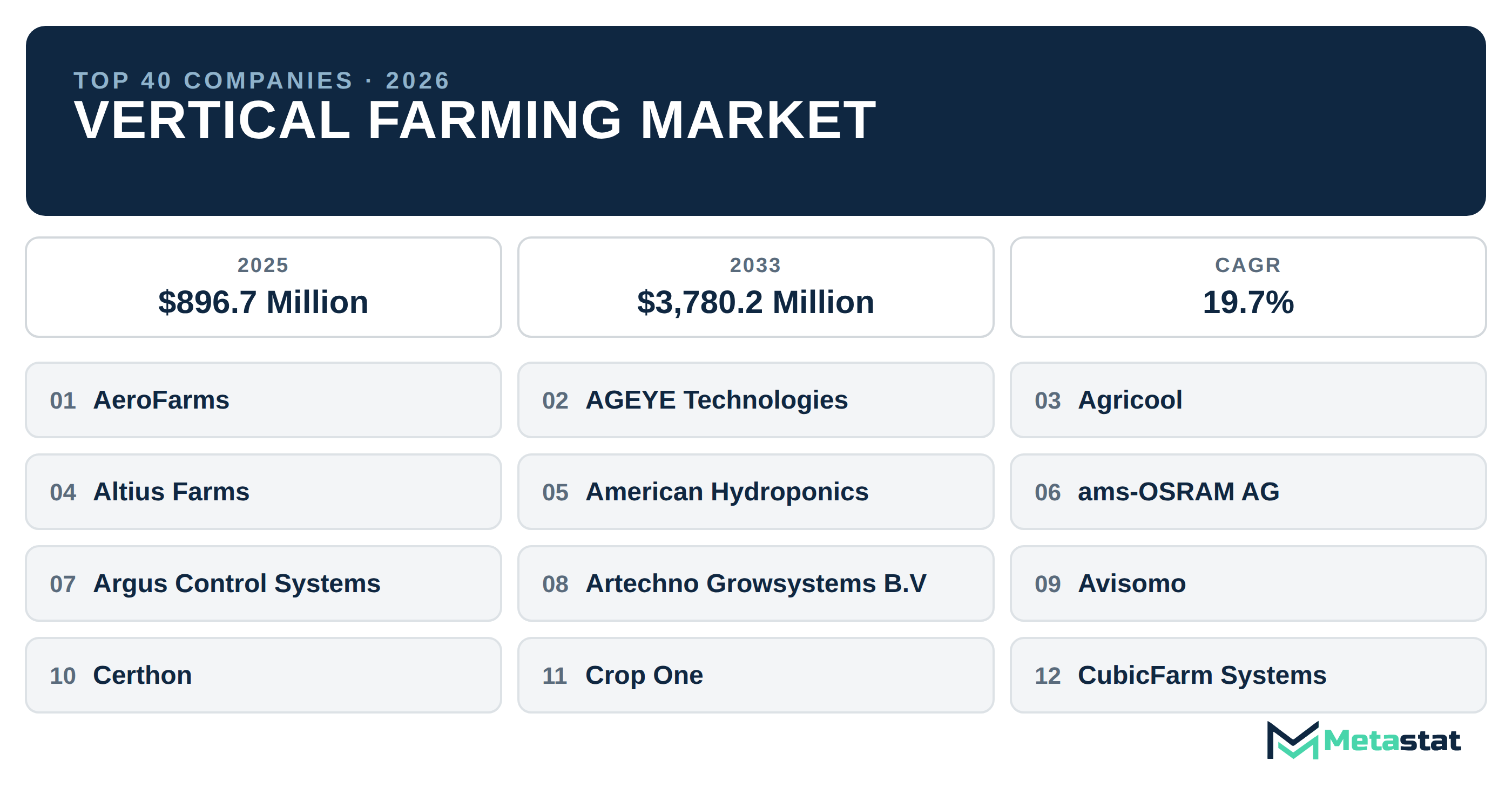
Explore the Top 40 Vertical Farming companies and their impact on the Global Vertical Farming Market projected to grow from USD 896.7 Million in 2025 to USD 3,780.2 Million by 2033.
The Global Vertical Farming Market is valued at USD 896.7 Million in 2025 and is projected to reach USD 3,780.2 Million by 2033, growing at a CAGR of 19.7%. This market encompasses innovative farming practices that optimize vertical space to grow crops, significantly reducing the need for arable land. Factors such as increasing urbanization, the demand for fresh produce, and advancements in technology drive the growth of vertical farming.
Companies in this sector leverage advanced technologies and sustainable practices to enhance yield and resource use. By adopting solutions like hydroponics, aeroponics, and climate control systems, they contribute to food security and sustainable urban development.
Global Vertical Farming Market Size, Data, & Statistics
The market size for the Global Vertical Farming Market in 2021 was USD 441.3 Million. This figure illustrates the market's initial growth phase as it began to attract attention for its innovative solutions.
In 2022, the market size increased to USD 524.3 Million, further indicating a strong interest in vertical farming technologies and methods.
By 2023, the market reached USD 629.6 Million, reflecting ongoing investments and advancements in the sector.
The forecast for 2033 stands at USD 3,780.2 Million, showcasing the significant potential for expansion in the vertical farming industry.
The anticipated CAGR of 19.7% from 2025 to 2033 highlights the expected growth as more stakeholders enter the market and operational efficiencies are achieved.
Regionally, the market is distributed as follows: North America 34.1%, Europe 25%, Asia Pacific 31.7%, South America 4.5%, Middle East and Africa 4.7%.
Top 10 Trends in the Global Vertical Farming Market
Inline metrology moves onto the production line
As technology progresses, inline metrology becomes essential for maintaining quality control in vertical farms. This trend enables farmers to monitor crop health and optimize resource usage continuously.
Increased focus on sustainability
Vertical farming companies prioritize sustainable practices, such as reducing water usage and minimizing carbon footprints, which aligns with global environmental goals and enhances market appeal.
Integration of AI and machine learning
Artificial intelligence and machine learning are integrated into vertical farming operations, allowing for better data analysis, crop monitoring, and yield prediction, which leads to improved efficiency.
Expansion of urban farming initiatives
Urban farming initiatives gain traction as cities seek local food sources to reduce transportation emissions and boost food security, creating new opportunities for vertical farming companies.
Advancements in lighting technology
Innovations in LED and other lighting technologies enhance energy efficiency in vertical farms, allowing for better crop growth while reducing operational costs.
Diverse crop offerings
Vertical farming is expanding beyond leafy greens to include a wider variety of crops, such as berries and herbs, catering to diverse consumer preferences and market demands.
Partnerships for technology sharing
Collaborations between vertical farming companies and technology providers are increasing, encouraging innovation and improving operational efficiencies through shared expertise.
Focus on local food systems
A rising emphasis on developing local food systems supports vertical farming by providing fresh produce to urban populations, enhancing community resilience.
Investment in research and development
Companies increase their investment in R&D to drive innovation in vertical farming techniques, ensuring they remain competitive in a changing market.
Regulatory support for urban agriculture
Governments implement policies that support urban agriculture and vertical farming, facilitating market growth through funding and incentives for sustainable practices.
Top 40 Companies in the Global Vertical Farming Market
1. AeroFarms, LLC
Founded: 2004
AeroFarms specializes in aeroponic systems and vertical farming technologies. The company focuses on growing leafy greens and herbs without soil, using significantly less water than traditional farming methods. Their innovative approach emphasizes sustainability and local food production, aiming to transform the urban agriculture space.
2. AGEYE Technologies
Headquarters: Canada
AGEYE Technologies develops advanced agricultural technologies that enhance crop monitoring and management. By employing AI-driven solutions, the company aims to optimize yields in vertical farms, helping farmers make data-driven decisions. Their technology supports various crops, focusing on improving efficiency and sustainability.
3. Agricool
Founded: 2015
Agricool operates urban farms in containers, primarily growing strawberries. Their approach involves using recycled shipping containers equipped with hydroponic systems to produce fresh fruits in urban settings. The company emphasizes local supply chains and aims to make fresh produce accessible to city dwellers.
4. Altius Farms
Headquarters: United States
Altius Farms is committed to sustainable farming practices and employs vertical farming techniques to grow a variety of crops. The company focuses on creating energy-efficient environments that maximize crop yield while minimizing environmental impact, contributing to local food systems.
5. American Hydroponics (AmHydro)
Headquarters: California, United States
American Hydroponics, known as AmHydro, provides hydroponic equipment and systems for commercial growers. Their solutions support various crops and emphasize reducing resource consumption while maximizing yields. The company offers educational resources and support for successful hydroponic farming.
6. ams-OSRAM AG
Headquarters: Austria
ams-OSRAM AG specializes in advanced lighting technologies for vertical farming. Their solutions improve plant growth and optimize energy use, enabling farmers to achieve higher yields. The company's focus on innovation helps meet the growing demands of the vertical farming sector.
7. Argus Control Systems Limited
Headquarters: Canada
Argus Control Systems provides environmental control solutions tailored for greenhouse and vertical farming applications. Their technology enables precise control over climate conditions, helping farmers optimize growing environments and improve crop quality through advanced automation.
8. Artechno Growsystems B.V.
Headquarters: Netherlands
Artechno Growsystems designs and implements vertical farming systems that use advanced technology to enhance crop production. Their focus on sustainability and efficiency drives their solutions, aiming to meet the increasing demand for fresh produce in urban environments.
9. Avisomo
Headquarters: United States
Avisomo focuses on developing technological solutions for vertical farms, specifically in the areas of climate control and monitoring. Their innovations aim to enhance operational efficiency, providing farmers with tools to manage and optimize their growing systems effectively.
10. Certhon
Headquarters: Netherlands
Certhon provides complete solutions for greenhouse and vertical farming. The company specializes in energy-efficient systems and advanced technology to optimize yields, focusing on sustainable practices that contribute to food security and environmental responsibility.
11. Crop One Holdings
Headquarters: United States
Crop One Holdings operates advanced vertical farms that utilize hydroponic systems to grow fresh produce year-round. Their focus on technology and sustainability allows them to scale operations while minimizing environmental impact, providing fresh food to urban areas.
12. CubicFarm Systems Corp.
Headquarters: Canada
CubicFarm Systems specializes in creating automated growing systems for various crops. Their technology integrates hydroponic and aquaponic systems to optimize resource use and enhance crop yields, supporting sustainable agriculture practices.
13. Eden Green Technology
Headquarters: United States
Eden Green Technology focuses on developing vertical farming solutions that emphasize local food production and sustainability. Their farms use innovative technologies to grow a variety of crops, aiming to make fresh produce accessible in urban areas.
14. Everlight Electronics Co., Ltd.
Headquarters: Taiwan
Everlight Electronics specializes in LED lighting solutions for vertical farming applications. Their products are designed to enhance plant growth while maintaining energy efficiency, supporting the operational needs of vertical farms.
15. Farm8 Co., Ltd.
Headquarters: Japan
Farm8 operates vertical farms that leverage advanced technologies to grow fresh produce in urban settings. Their focus on sustainability and efficiency positions them as a key player in the vertical farming market, catering to local demand.
16. FarmBox Foods
Headquarters: United States
FarmBox Foods designs and builds modular vertical farms that can be deployed in various urban environments. Their focus on providing fresh, locally grown produce aims to improve food accessibility while minimizing environmental impact.
17. Fischer Farms
Headquarters: United States
Fischer Farms focuses on sustainable agriculture through vertical farming techniques. Their operations emphasize resource efficiency and aim to provide fresh produce to local communities, supporting the growth of urban agriculture.
18. Foshan Reinfa Agtech Co., Ltd.
Headquarters: China
Foshan Reinfa Agtech develops advanced technology solutions for vertical farming, focusing on enhancing crop yields through innovative systems. Their commitment to sustainability drives their solutions for modern agriculture.
19. Freight Farms, Inc.
Headquarters: United States
Freight Farms specializes in container farming, converting shipping containers into modular vertical farms. Their approach allows for fresh produce cultivation in urban areas and aims to support local food systems through innovative technology.
20. GoodLeaf Community Farms Ltd.
Headquarters: Canada
GoodLeaf Community Farms grows a variety of leafy greens using vertical farming techniques. Their commitment to sustainability and local food production positions them as a prominent player in the vertical farming market.
21. GrowUp Farms
Headquarters: United Kingdom
GrowUp Farms focuses on innovative vertical farming solutions that combine aquaponics and hydroponics. Their operations aim to provide fresh, local produce while promoting sustainability and resource efficiency in urban environments.
22. Heliospectra AB
Headquarters: Sweden
Heliospectra AB specializes in smart lighting solutions for vertical farming. Their innovative products enhance plant growth and improve energy efficiency, catering to the needs of modern agricultural practices.
23. iFarm
Headquarters: Finland
iFarm develops vertical farming solutions that utilize automation and advanced technologies to improve crop production. Their focus on sustainability and efficiency supports diverse agricultural practices in urban environments.
24. InFarm
Headquarters: Germany
InFarm operates urban farms that integrate vertical farming systems into grocery stores and restaurants. Their innovative approach aims to make fresh produce accessible while emphasizing sustainability and local sourcing.
25. Intelligent Growth Solutions Limited
Headquarters: United Kingdom
Intelligent Growth Solutions specializes in developing advanced vertical farming systems that optimize resource use and enhance crop yields. Their commitment to sustainability drives their innovative solutions for modern agriculture.
26. LOGIQS B.V.
Headquarters: Netherlands
LOGIQS B.V. provides software and hardware solutions for managing vertical farms. Their technology aims to enhance operational efficiency and support sustainable practices in agriculture.
27. N.THING Inc.
Headquarters: South Korea
N.THING Inc. specializes in smart farming solutions, aiming to transform urban agriculture through vertical farming technologies. Their focus on efficiency and sustainability supports the growing demand for fresh produce in cities.
28. Oishii
Headquarters: United States
Oishii is known for its specialty strawberries grown in vertical farms. Their innovative approach emphasizes quality and freshness, catering to the growing consumer demand for locally sourced produce.
29. OnePointOne
Headquarters: United States
OnePointOne focuses on developing vertical farming systems that utilize advanced technology to optimize crop production. Their commitment to innovation and sustainability positions them at the forefront of the vertical farming market.
30. Planet Farms
Headquarters: Italy
Planet Farms operates large-scale vertical farms that leverage advanced technology for crop production. Their emphasis on sustainability and efficiency supports their goal of providing fresh produce to urban consumers.
31. Plenty Unlimited Inc.
Headquarters: United States
Plenty Unlimited Inc. focuses on developing vertical farms that utilize advanced robotics and AI for efficient crop production. Their innovative approach aims to change the agricultural landscape by enhancing sustainability and productivity.
32. Priva
Headquarters: Netherlands
Priva specializes in environmental control solutions for greenhouses and vertical farms. Their technology enables precise climate management, contributing to improved crop quality and resource efficiency.
33. SANANBIO
Headquarters: China
SANANBIO develops vertical farming technologies that emphasize high efficiency and sustainability. Their solutions cater to various crops, enhancing yield while minimizing environmental impact.
34. Signify Holding
Headquarters: Netherlands
Signify Holding is known for its advanced lighting solutions for vertical farming applications. Their innovative products support plant growth while striving for energy efficiency, helping farmers optimize their operations.
35. Sky Greens
Headquarters: Singapore
Sky Greens operates vertical farms that utilize a unique rotating system to maximize sunlight exposure. Their sustainable approach aims to provide fresh produce to urban populations while minimizing resource use.
36. Spread Co., Ltd.
Headquarters: Japan
Spread Co., Ltd. focuses on automated vertical farming solutions that enhance efficiency and production capabilities. Their commitment to innovation positions them as a leader in the vertical farming market.
37. Stacked Farm
Headquarters: United Kingdom
Stacked Farm specializes in vertical farming technologies that optimize crop production within urban settings. Their focus on sustainability and local sourcing helps support food security in cities.
38. SweGreen AB
Headquarters: Sweden
SweGreen AB develops vertical farming solutions that prioritize sustainability and resource efficiency. Their innovative technologies aim to enhance crop yields while minimizing environmental impact.
39. Urban Crop Solutions
Headquarters: Belgium
Urban Crop Solutions designs and builds vertical farming facilities that utilize advanced technology for efficient crop production. Their focus on sustainability supports the growing demand for local food systems.
40. Valoya
Headquarters: Finland
Valoya develops specialized LED lighting solutions for vertical farming applications. Their commitment to innovation helps optimize plant growth and support the operational needs of vertical farms.
Conclusion
The Global Vertical Farming Market is positioned for substantial growth, driven by technological advancements and increasing demand for local produce. Companies in this space are leveraging innovative solutions to optimize crop production and sustainability, meeting the needs of urban consumers.
Vertical Farming companies play a crucial role in addressing food security and resource efficiency challenges. As the market expands, stakeholders should explore partnerships and investments in technology to capitalize on the opportunities presented by this evolving sector.
Tags
About the Author

LEAD ANALYST
Utkarsh Khirodkar is a Lead Market Research Analyst at MetaStat Insight, specializing in market intelligence, technology sector assessments, and competitive strategy.