
The 5G Capacitor market is undergoing significant transformation due to advancements in telecommunications, investment trends, and emerging technologies. This blog explores the key factors driving growth and the challenges that lie ahead.
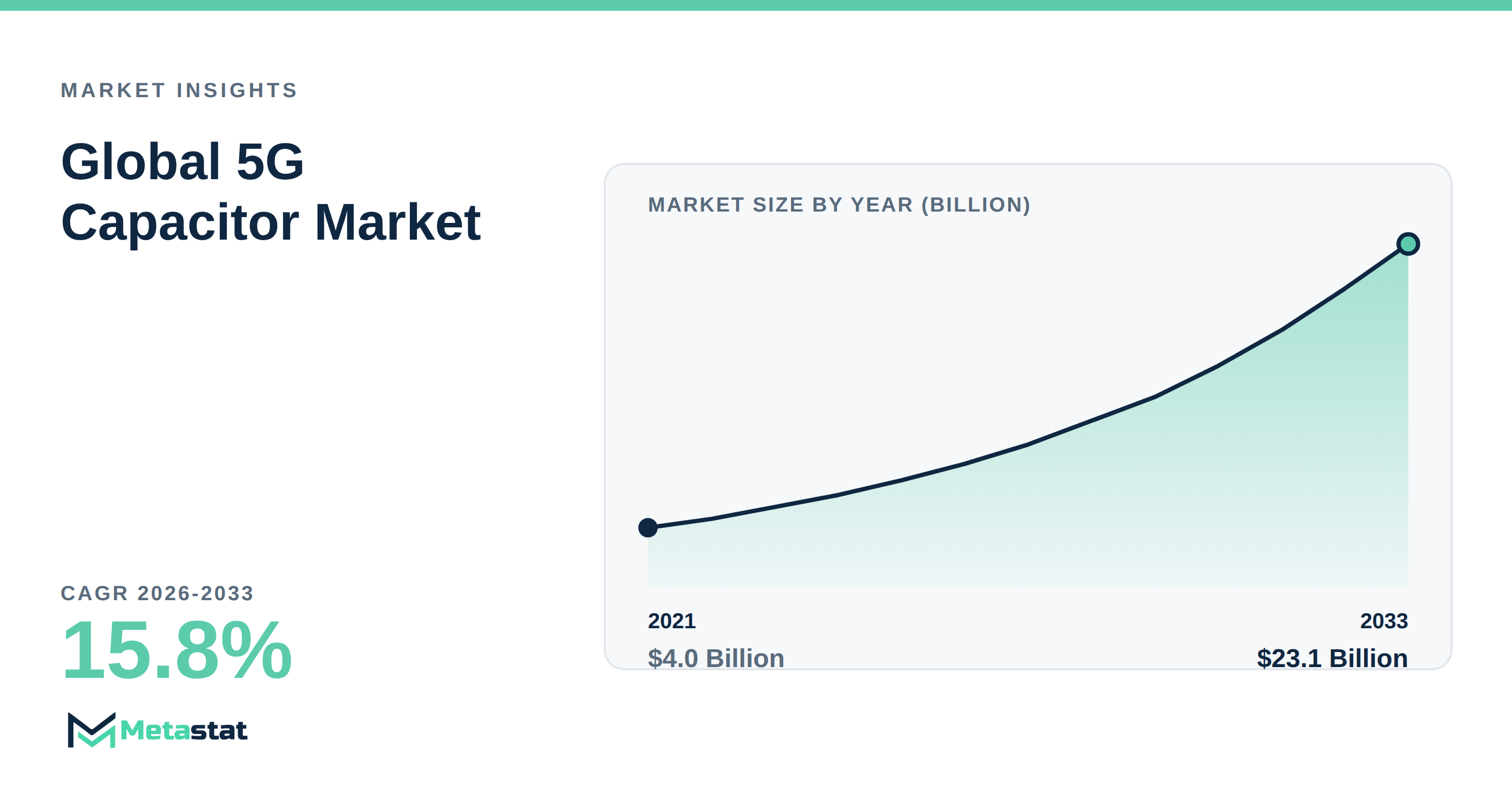
The 5G Capacitor market is witnessing significant expansion due to rapid advancements in telecommunications infrastructure. With a projected market value surging from USD 7.2 billion in 2025 to USD 23.1 billion by 2033, this growth showcases a compound annual growth rate of 15.8%. Despite this promising trajectory, critical factors influencing the market are often misunderstood or overlooked.
What drives the demand for 5G capacitors?
Demand for capacitors is escalating owing to global priorities shifting towards digital transformation. The ongoing rollout of 5G technology significantly impacts the telecommunications landscape, necessitating enhanced infrastructure. Increasing capital investments serve because a primary driver; nations prioritize funding for advanced telecommunications systems, resulting in robust demand for related components, including capacitors.
Investment trends indicate crucial sectors focus on modernizing existing networks to enhance operational efficiency. Upgrades to these networks create a ripple effect, spurring advancements in capacitor technology aimed at supporting new applications. This dynamic highlights the need for reliable capacitors that fulfill the stringent requirements of next-generation telecommunications systems.
How do economic pressures impact the 5G Capacitor market?
Economic pressures present notable challenges to the 5G Capacitor market. Rising inflation and increased operational costs impose financial burdens on manufacturers, potentially stalling capital investments essential for market expansion. Regulatory compliance adds another layer of complexity, because stringent safety and performance standards often lead to higher production costs, delaying product launches and impacting competitive positioning.
Supply chain disruptions, particularly influenced by geopolitical factors, complicate the procurement of essential materials. These disruptions not only affect production capacity but increase operational costs. Consequently, the combination of regulatory compliance and economic pressures poses significant constraints, challenging manufacturers to navigate these complexities effectively to maintain competitiveness.
What role does technological advancement play?
Technological advancements significantly drive growth within the 5G Capacitor market. Innovations in capacitor design and performance characteristics are crucial for meeting the evolving demands of high-frequency applications. The push for miniaturization and energy efficiency in electronic devices enhances the appeal of capacitors that deliver superior performance in diverse applications.
Emerging technologies, including artificial intelligence and the Internet of Things, necessitate advanced capacitor solutions that cater to specific requirements. Organizations leveraging these next-generation technologies stimulate demand for capacitors designed to support high-density and high-frequency operations effectively.
How does market segmentation reveal opportunities?
Segmentation within the 5G Capacitor market highlights various opportunities for growth. The market encompasses multiple capacitor types, including Multilayer Ceramic Capacitors, RF/Microwave Capacitors, and Polymer Aluminum Capacitors, each addressing distinct applications. The Remote Radio Units and Active Antenna Units segments are particularly attractive due to their critical role in the deployment of 5G networks.
For instance, the Multilayer Ceramic Capacitors segment is projected to reach USD 16.1 billion by 2033, reflecting a growth trend driven by increasing demand for reliable components in telecommunications. This indicates a robust opportunity for manufacturers focusing on this segment.
What does the future hold for the 5G Capacitor market?
The future for the 5G Capacitor market appears promising, driven by continued investment in telecommunications infrastructure and the ongoing rollout of 5G technology. Companies prioritizing innovation and adaptability to evolving market demands are likely to thrive. Strategic partnerships and mergers enhance competitive positioning, enabling firms to leverage combined resources and capabilities.
However, the market remains cognizant of external pressures, including regulatory compliance and economic challenges. Maintaining profitability while navigating market complexities will be vital for sustained growth. The ongoing digital transformation across industries reinforces the necessity for advanced capacitor solutions, positioning the 5G Capacitor market because a critical component in the future of telecommunications.
For more detailed insights into the trends, dynamics, and projections for the 5G Capacitor market, refer to the Global 5G Capacitor Market.
Tags
About the Authors

LEAD ANALYST
Utkarsh Khirodkar is a Lead Market Research Analyst at MetaStat Insight, specializing in market intelligence, technology sector assessments, and competitive strategy.

PRINCIPAL CONSULTANT - ENTERPRISE AI & EMERGING TECHNOLOGIES
Banking & Finance · Electronics and Semiconductor · Energy and Power · Healthcare IT · Information & Technology · Professional Services
Vijay Gunti is a Principal Consultant at MetaStat Insight, bringing over two decades of experience across enterprise digital transformation, technology strategy, and intelligent systems.

PRINCIPAL CONSULTANT - QUALITY SYSTEMS & COMPLIANCE
Electronics and Semiconductor · Machinery & Equipment · Professional Services
Omkar Phadtare is an Industry Consultant at MetaStat Insight, specializing in quality systems, regulatory compliance, and standards benchmarking to drive data-driven market intelligence and strategic industry research.

ENERGY & INFRASTRUCTURE INDUSTRY CONSULTANT
Automotive and Transportation · Electronics and Semiconductor · Energy and Power · Machinery & Equipment
Saurabh Vasant Ganvir consults for Energy & Infrastructure Industry at MetaStat Insight, specializing in renewable energy, solar EPC, and electric vehicle (EV) infrastructure markets.

LEAD CONSULTANT - COMMUNICATION, TELECOM, AND IT
Electronics and Semiconductor · Information & Technology · Machinery & Equipment · Professional Services
Ravindra Sathe Consultants for Communication, Telecom, and IT at MetaStat Insight. He leads the firm's industry research initiatives across telecommunications infrastructure, digital connectivity, enterprise networking, and emerging information technology domains.