
Explore the intricacies of the Poland Courier, Express, and Parcel market, revealing how various segments are affected differently by growth trends.
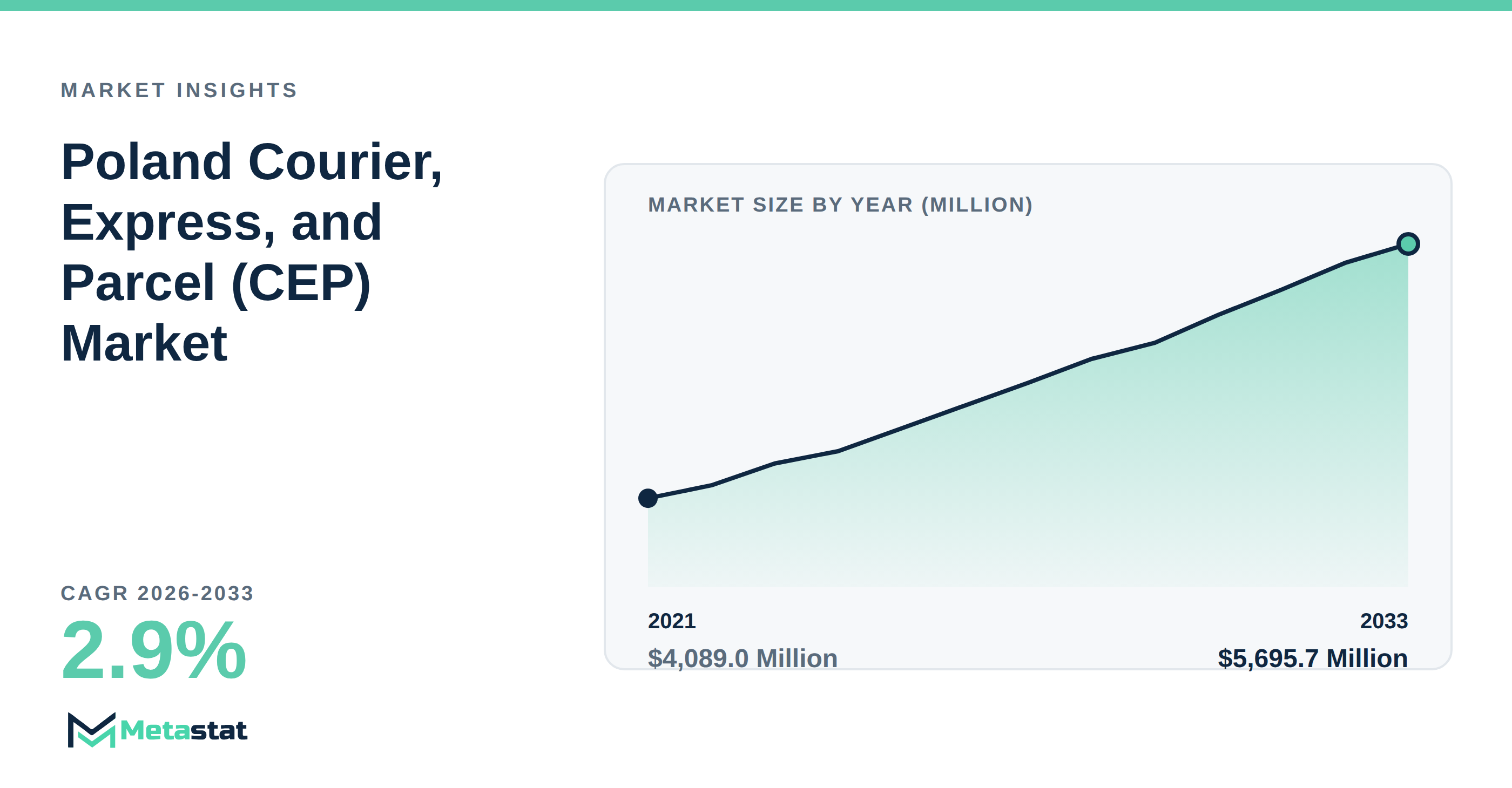
The growth trajectory of the Poland Courier, Express, and Parcel (CEP) market is often misinterpreted, because the trends are not uniformly strong across all segments. While the market is set to transition from a valuation of USD 4,529.8 million in 2025 to USD 5,695.7 million by 2033, examining the details uncovers significant differences in performance among various sectors.
One prevalent misconception is that the substantial size of the Business-to-Consumer (B2C) segment suggests an equivalent growth potential throughout the market. The B2C segment currently commands a notable share of 57.2% and is expected to rise at a solid CAGR of 3.3%, reaching approximately USD 3,358.7 million by 2033. This growth is largely influenced by the continuous expansion of e-commerce, prompting businesses to enhance last-mile delivery efficiencies to meet escalating consumer demands for speed and reliability. The adaptability of this segment directly correlates with evolving consumer behavior, making it inherently more responsive to shifts in market conditions.
In contrast, the Business-to-Business (B2B) segment, though significant, is projected to experience more subdued growth. Expected to reach USD 1,650 million by 2033, this segment is growing at a CAGR of only 1%. This slower trajectory reflects the challenges many businesses face in keeping pace with rapid technological advancements essential for improving operational efficiencies. Companies prioritize investments in logistics technology to refine services, but the intricate nature of B2B transactions often leads to a slower uptake of innovative solutions compared to B2C.
The Customer-to-Customer (C2C) segment contributes 9.3% to the market and is projected to achieve a valuation of USD 686.9 million by 2033. While C2C activities are becoming more popular, particularly among younger consumers preferring digital platforms for peer-to-peer transactions, the anticipated growth rate of 3% indicates it plays a more supportive role in the overall market dynamics.
Regional trends further complicate the narrative of uniform growth across the market. The domestic segment, which is valued at USD 3,646.2 million in 2026, is on track to expand at a CAGR of 2.1%, indicating stable demand. In contrast, the international segment is projected to grow at a higher rate of 5.3%, capitalizing on increasing global trade volumes and the demand for efficient cross-border logistics. This disparity highlights the diverse opportunities within the same market, underscoring that while domestic players concentrate on stabilizing their services, international operations pursue more rapid growth opportunities.
Inflationary pressures are presenting challenges for operational costs, significantly influencing market dynamics. Companies within the Poland Courier, Express, and Parcel market are grappling with rising operational expenses that affect profitability and consumer spending. Strategic pricing adjustments are becoming necessary, resulting in shifts in demand across service offerings. For instance, consumers tend to prioritize swift delivery in B2C transactions, but may show more price sensitivity in B2B or C2C interactions, further complicating market responsiveness.
Technological advancements are pivotal in shaping the future of growth and competition among service providers. Firms are increasingly exploring automation and artificial intelligence integration to optimize logistics operations and enhance customer experiences. Improved tracking and management capabilities are essential for maintaining service quality, making logistics partners more appealing across various segments. This innovative drive is critical for keeping pace with changing consumer expectations, especially in the B2C sector.
Compliance with regulatory standards adds another layer of complexity to market operations. The necessity to adhere to strict regulations creates challenges, particularly for smaller companies that find it disproportionately burdensome. The financial implications of compliance inhibits their competitive edge. Meanwhile, larger firms typically manage these costs, yet the collective effect raises service prices, ultimately hindering overall market growth.
Geopolitical tensions further complicate supply chain stability, posing additional operational challenges. Fluctuations in trade relationships affect logistics costs, thereby influencing pricing strategies. Companies remain vigilant regarding these geopolitical developments, because they disrupt established market patterns and lead to unforeseen shifts.
Stakeholders looking to engage with the Poland Courier, Express, and Parcel (CEP) market navigate a landscape marked by both growth potential and inherent complexities. Opportunities abound for companies willing to strategically invest in technology and infrastructure while managing challenges related to inflation, regulatory compliance, and geopolitical risks. For more insights and comprehensive analysis, readers explore the Poland Courier, Express, and Parcel (CEP) Market.
Tags
About the Authors

LEAD ANALYST
Utkarsh Khirodkar is a Lead Market Research Analyst at MetaStat Insight, specializing in market intelligence, technology sector assessments, and competitive strategy.

ENERGY & INFRASTRUCTURE INDUSTRY CONSULTANT
Automotive and Transportation · Electronics and Semiconductor · Energy and Power · Machinery & Equipment
Saurabh Vasant Ganvir consults for Energy & Infrastructure Industry at MetaStat Insight, specializing in renewable energy, solar EPC, and electric vehicle (EV) infrastructure markets.