
Explore the complexities driving growth in the Regulatory Reporting Platform market, including evolving needs, technology's impact, and emerging challenges.
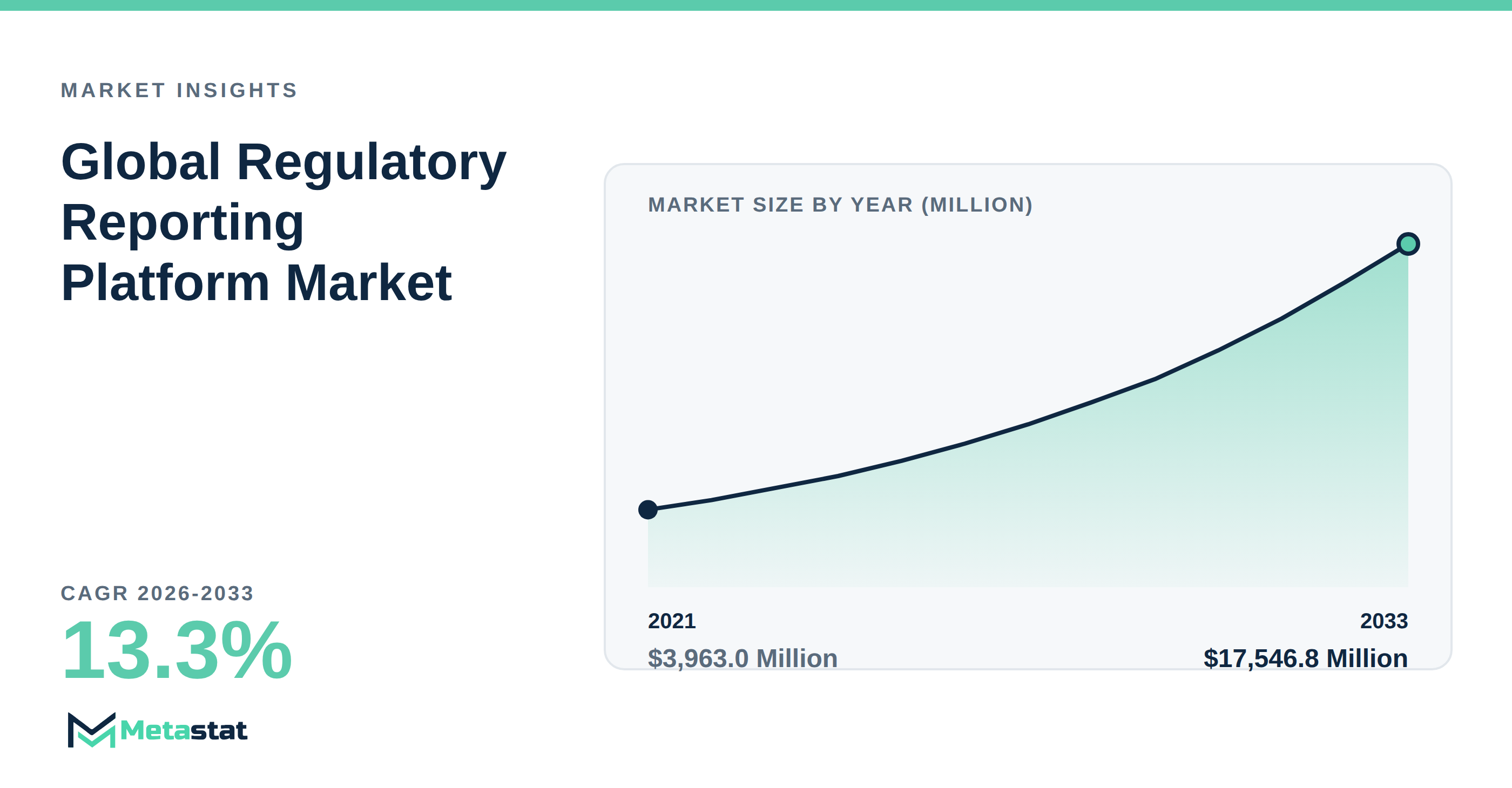
The growth of the Regulatory Reporting Platform market often gives rise to misunderstandings regarding its true dynamics. A common misperception involves evaluating the market solely by its impressive growth figures, which obscure the underlying factors influencing demand and supply. The market is expected to expand from USD 6,459.9 million in 2025 to USD 17,546.8 million by 2033, demonstrating a compound annual growth rate (CAGR) of 13.3%. This rapid expansion reflects a shift towards a more integrated and automated regulatory reporting landscape.
What drives the rapid growth of this market?
Several factors contribute to the momentum in the Regulatory Reporting Platform market. A significant driver is the escalating demand for effective compliance solutions within financial institutions. The market has shown considerable growth, increasing from USD 3,963 million in 2021 to USD 5,064.5 million in 2023. This increased demand is attributed to the urgent need for automation in regulatory reporting, which is driven by the evolving nature of regulations and the critical need for timely data submission.
Financial institutions face continuous pressure to enhance their compliance capabilities. This has led to a priority shift towards the integration of enterprise data and lineage, which significantly boosts overall compliance and operational accuracy. Innovations in technologies including AI and machine learning are reshaping traditional reporting processes. By streamlining data management and enabling predictive analytics, these technologies help organizations respond promptly to changes in the regulatory environment.
Why is demand exceeding supply in certain areas?
Despite the significant growth anticipated in the Regulatory Reporting Platform market, challenges related to supply remain prevalent. Complexities associated with regulatory compliance necessitate substantial investments in technology and infrastructure, leading to financial pressures that restrict smaller organizations from adopting advanced reporting solutions. This situation creates a disparity where larger entities leverage emerging technologies while smaller ones find it challenging to keep pace.
Macroeconomic factors, including inflation and geopolitical tensions, further exacerbate these challenges. Financial institutions encounter rising operational costs linked to compliance and technology integration. Consequently, these constraints lead to fragmented market dynamics, characterized by varying service quality among providers. Organizations lacking sufficient capital or technical expertise find themselves at a competitive disadvantage, unable to implement essential upgrades for effective regulatory reporting.
What role does technology play in shaping market dynamics?
Technology is at the core of the evolution of the Regulatory Reporting Platform market. The shift towards cloud and SaaS solutions is reshaping the industry, with projections indicating that this segment will reach USD 9,724.4 million by 2033, growing at a CAGR of 15.1%. This transition reflects a strategic decision among financial institutions to balance operational efficiency with compliance demands.
Integration of API-first architecture and regulation-as-code practices enables organizations to adapt quickly to changing regulatory environments. These advancements allow institutions to manage compliance requirements seamlessly, significantly reducing the overhead traditionally associated with regulatory reporting. Furthermore, AI and generative AI technologies are increasingly integrated into reporting workflows, improving data accuracy and facilitating real-time insights.
What does the future hold for the Regulatory Reporting Platform market?
The future of the Regulatory Reporting Platform market is closely tied to ongoing technological advancements. A prominent trend towards intelligent regulatory reporting platforms is emerging, characterized by automation and adaptive compliance solutions. Organizations anticipate leveraging these innovations to enhance reporting capabilities while effectively addressing evolving regulatory challenges.
Investment in regulatory technology (RegTech) solutions is becoming a priority for financial institutions due to the need for enhanced compliance efficiency. The focus on data quality and validation remains crucial, especially in light of increasing scrutiny from regulatory bodies. While the market continues to expand, firms prioritizing agility and innovation in their reporting processes are likely to lead the way.
Ultimately, understanding the nuances of the Regulatory Reporting Platform market is essential for decision-makers within financial institutions. By recognizing the interconnections between technology, compliance demands, and market dynamics, organizations better navigate the complexities of regulatory reporting. For a deeper dive into the market's specifications and trends, the Global Regulatory Reporting Platform Market provides comprehensive insights.
Tags
About the Authors

LEAD ANALYST
Utkarsh Khirodkar is a Lead Market Research Analyst at MetaStat Insight, specializing in market intelligence, technology sector assessments, and competitive strategy.

PRINCIPAL CONSULTANT - ENTERPRISE AI & EMERGING TECHNOLOGIES
Banking & Finance · Electronics and Semiconductor · Energy and Power · Healthcare IT · Information & Technology · Professional Services
Vijay Gunti is a Principal Consultant at MetaStat Insight, bringing over two decades of experience across enterprise digital transformation, technology strategy, and intelligent systems.