
LEAD ANALYST
Utkarsh Khirodkar is a Lead Market Research Analyst at MetaStat Insight, specializing in market intelligence, technology sector assessments, and competitive strategy.

Global Regulatory Reporting Platform Market Size, Share, By Deployment Model (Cloud and SaaS, On-Premises and Hybrid), By Reporting Domain (Prudential and Capital Reporting, Liquidity and Funding Reporting, Financial and Statistical Reporting, Trade and Transaction Reporting, Tax and Information Reporting, Recovery and Resolution Reporting, ESG and Sustainability Reporting), By Organization Size (Large Financial Institutions and Small and Medium-Sized Financial Institutions), By Financial Institution Type (Banks and Deposit-Taking Institutions, Broker-Dealers and Securities Firms, Asset and Fund Managers, Insurance and Reinsurance Companies, Fund Administrators and Asset Servicers, Financial Market Infrastructures and Trading Venues, Payment Institutions and FinTech Firms), Industry Analysis, Growth, Trends, and Forecast, 2026-2033
Report ID
MSI-5312
Published
September, 2026
Pages
278 Pages
Format
Historical
Base year
Forecast
Forecast period
Report Details
Market Valuation: Valued at $6,459.9 Million in 2025, projected to reach $17,546.8 Million by 2033 at a 13.3% CAGR.
Dominant Segment: The Prudential and Capital Reporting segment leads the market, driven by rising regulatory pressures that necessitate robust reporting solutions for compliance and risk management.
Geographic Lead: The market is experiencing significant growth in North America, where financial institutions are rapidly adopting advanced regulatory reporting technologies to meet stringent compliance requirements.
What's Inside: This report provides a comprehensive analysis of the competitive landscape, market dynamics, and detailed forecasts from 2026 to 2033, covering various deployment models and reporting domains.
Emerging Trends: The integration of AI and machine learning technologies is revolutionizing regulatory reporting, enhancing data accuracy and enabling real-time compliance monitoring across financial institutions.
Operational Productivity Focus: Financial institutions are increasingly prioritizing operational productivity, leveraging automation and advanced reporting solutions to streamline compliance processes and reduce costs.
Choose Your License
Global Regulatory Reporting Platform Market
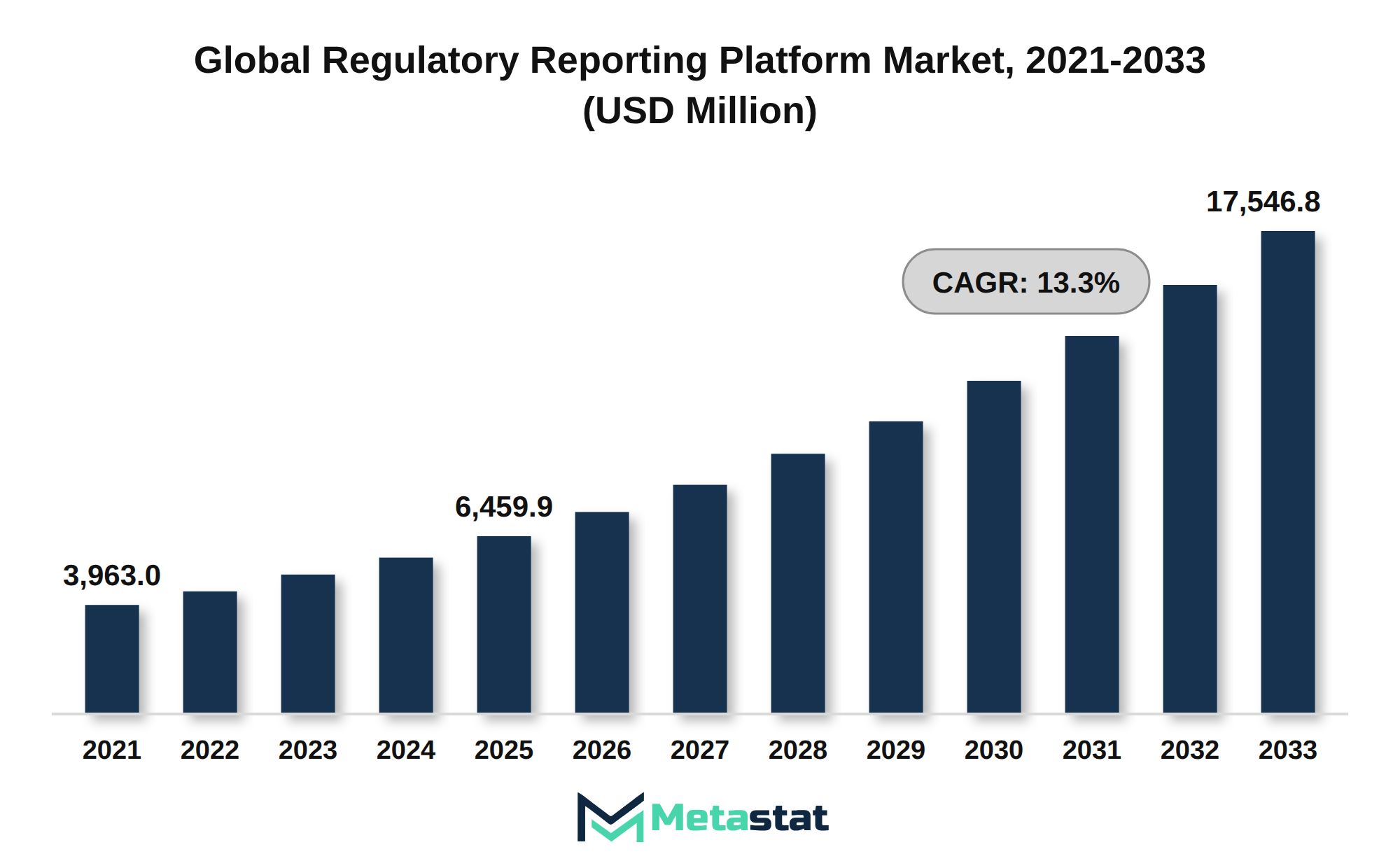
The global Regulatory Reporting Platform market was valued at USD 6,459.9 million in 2025 and is projected to reach USD 17,546.8 million by 2033, growing at a CAGR of 13.3% over the forecast period.
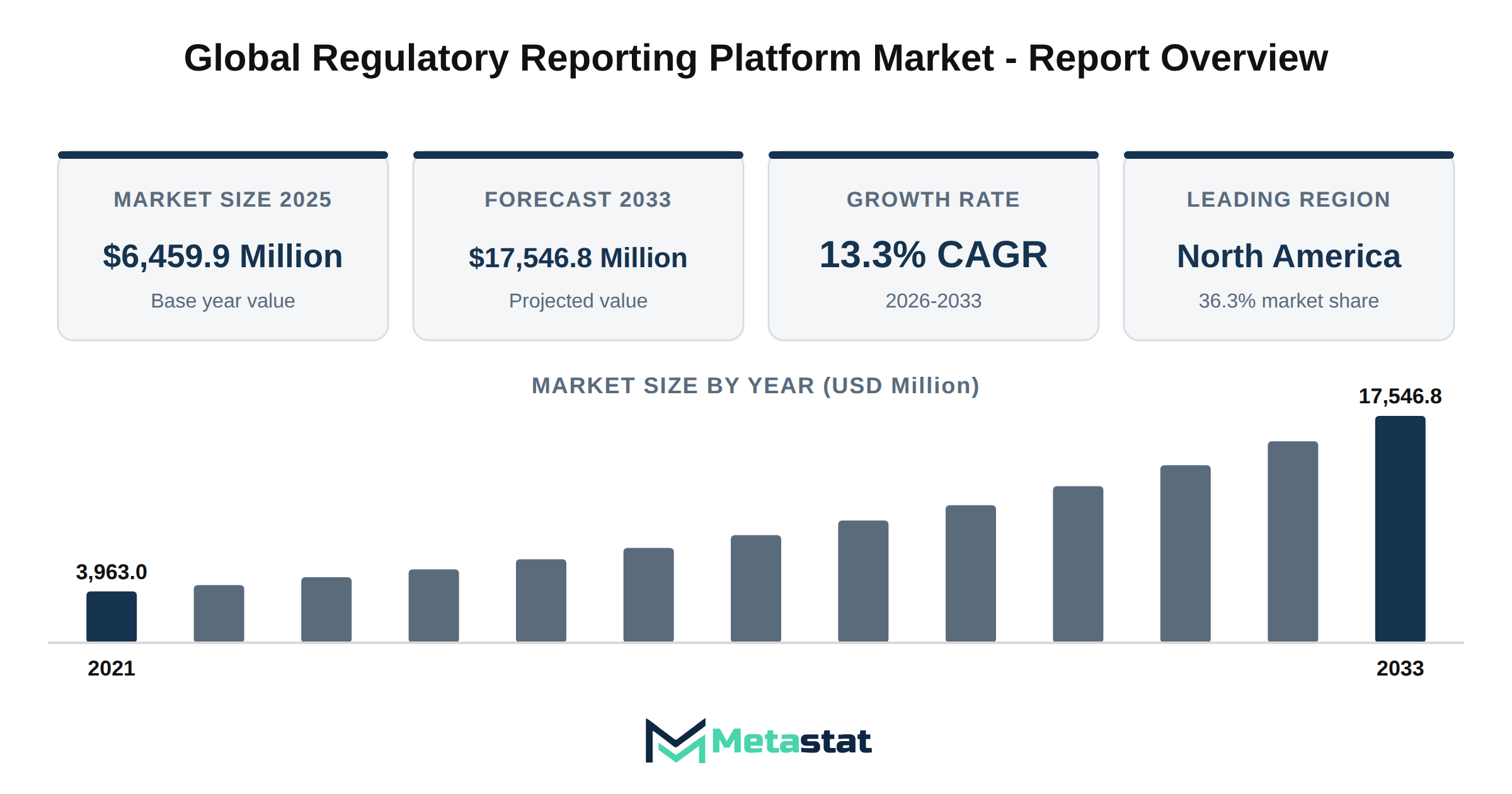
The Regulatory Reporting Platform market, valued at USD 6,459.9 million in 2025, is projected to reach USD 17,546.8 million by 2033, reflecting a compound annual growth rate (CAGR) of 13.3%. The market experienced significant growth from USD 3,963 million in 2021 to USD 5,064.5 million in 2023, highlighting the increasing demand for efficient regulatory compliance solutions.
Continuous advancements in end-to-end regulatory reporting automation drive growth within the market. Organizations increasingly prioritize the integration of enterprise data and lineage to enhance compliance capabilities. The emphasis on workflow orchestration and exception management simplifies regulatory processes, enabling organizations to respond swiftly to compliance changes.
Cross-jurisdiction compliance change presents challenges that demand innovative solutions. Adoption of AI-native and agentic reporting technologies influences operational efficiency within the market. The trend towards regulation-as-code and API-first architecture supports firms in adapting to dynamic regulatory environments, improving responsiveness and accuracy in reporting.
Real-time and granular reporting requirements fuel demand for advanced regulatory reporting platforms. Cloud and SaaS adoption continues to reshape the market, providing scalable solutions that meet the evolving needs of financial institutions. The integration of AI and generative AI into regulatory reporting workflows enhances data analysis and reporting accuracy.
Real-time regulatory reporting and continuous compliance initiatives emerge because critical components for financial institutions seeking to maintain regulatory integrity. Regulatory data integration and modernization of data lineage processes improve data quality and validation efforts within reporting frameworks.
Workflow automation and exception management strategies within regulatory reporting streamline compliance efforts. Cross-jurisdiction regulatory reporting compliance becomes increasingly essential since global financial markets continue to evolve. The increasing demand for regulatory reporting platforms among banks and other financial institutions reflects this trend.
Technological trends in prudential and capital reporting highlight the need for robust solutions that accommodate the complexities of regulatory requirements. The automation of trade and transaction reporting contributes to operational efficiencies, while liquidity and funding reporting digitalization enhances reporting capabilities.
ESG and sustainability regulatory reporting platforms are gaining traction in response to heightened awareness of environmental and social governance issues. An API-first regulatory reporting architecture facilitates integration with existing systems, ensuring adaptability in a rapidly changing regulatory landscape. Regulation-as-code adoption further enhances financial compliance, simplifying the process of updating regulatory requirements.
Data quality and validation are significant concerns within regulatory reporting platforms, ensuring accurate and reliable reporting. Standardization of supervisory reporting and data granularity play critical roles in enhancing compliance and reducing operational risks. Effective regulatory change management and automated rule updates are essential for maintaining compliance in a dynamic regulatory environment.
Investment in RegTech solutions within regulatory reporting infrastructure drives innovation and improves compliance efficiency. Competitive dynamics among regulatory reporting platform providers intensify, with firms seeking to differentiate themselves through advanced technology and service offerings. Managed regulatory reporting services adoption is on the rise, allowing institutions to leverage external expertise for improved compliance outcomes.
The Asia Pacific regulatory reporting technology expansion presents new opportunities for growth within the market, driven by increasing regulatory requirements and technological advancements. European regulatory reporting modernization initiatives focus on enhancing efficiency and compliance capabilities, while North American regulatory reporting platform adoption continues to gain momentum.
The future of intelligent regulatory reporting platforms appears promising, with ongoing advancements in technology and a commitment to enhancing compliance processes.
End-to-end regulatory reporting automation transforms compliance processes for financial institutions, leveraging advanced technologies to streamline data collection and reporting. This shift enhances operational efficiency, reduces manual errors, and ensures timely submissions to regulatory authorities.
Enterprise data integration and lineage support organizations in maintaining a comprehensive view of their data assets. By enabling data flow across various systems, this approach strengthens the integrity of regulatory reporting and promotes transparency across the organization.
Workflow orchestration and exception management play crucial roles in optimizing regulatory reporting processes. By automating routine tasks and effectively managing exceptions, organizations improve responsiveness to regulatory changes and enhance overall compliance efforts.
Cross-jurisdiction compliance change presents challenges for global financial institutions, requiring adaptable solutions to navigate varying regulatory environments. The ability to implement regulatory changes efficiently across jurisdictions ensures sustained compliance and reduces the risk of penalties.
AI-native and agentic reporting systems introduce intelligent capabilities into the regulatory reporting landscape. These technologies facilitate advanced analytics, enabling organizations to derive insights from their data and enhance decision-making processes.
Regulation-as-code and API-first architecture support agile development and integration of regulatory requirements into reporting systems. This modern approach ensures that organizations swiftly adapt to changing regulations while maintaining compliance standards.
Real-time and granular reporting evolution reflects the growing demand for timely insights in regulatory compliance. Organizations increasingly seek the ability to generate reports that provide detailed and immediate visibility into their compliance status, enabling proactive management of regulatory obligations.
Cloud and SaaS adoption in regulatory reporting platforms continues to gain traction, driven by the need for scalability, flexibility, and cost-effectiveness. Financial institutions benefit from reduced infrastructure costs and increased accessibility to advanced reporting tools.
AI and generative AI in regulatory reporting workflows enhance the efficiency and accuracy of reporting processes. These technologies enable automation of complex tasks, allowing organizations to focus on strategic initiatives while ensuring compliance with regulatory requirements.
Real-time regulatory reporting and continuous compliance become essential for organizations aiming to meet evolving regulatory expectations. The ability to provide up-to-date compliance data supports better risk management and enhances stakeholder confidence.
Regulatory data integration and data lineage modernization represent critical components of effective regulatory reporting strategies. Organizations prioritize investments in data management solutions to ensure the accuracy and reliability of reported information.
Workflow automation and exception management in regulatory reporting streamline operations and reduce the burden on compliance teams. By minimizing manual intervention, organizations enhance productivity and focus on critical compliance tasks.
Cross-jurisdiction regulatory reporting compliance requires robust frameworks to address diverse regulatory requirements. Financial institutions invest in solutions that facilitate efficient reporting across multiple jurisdictions, ensuring adherence to local and international regulations.
Demand for regulatory reporting platforms among global banks reflects a commitment to compliance excellence. Financial institutions prioritize investments in advanced reporting technologies to navigate complex regulatory landscapes and mitigate risks.
Prudential and capital reporting technology trends indicate a shift towards integrated solutions that offer comprehensive reporting capabilities. Financial institutions seek to enhance their reporting accuracy and efficiency through the adoption of innovative technologies.
Trade and transaction reporting automation emerges because a key focus area for financial institutions. Organizations strive to implement systems that facilitate timely and accurate reporting of trades, ensuring compliance with regulatory mandates.
Liquidity and funding reporting digitalization aligns with the growing importance of transparency in financial markets. Financial institutions prioritize automated solutions that provide real-time insights into liquidity positions and funding sources.
ESG and sustainability regulatory reporting platforms gain prominence because organizations respond to increasing stakeholder demand for responsible business practices. Financial institutions adopt specialized reporting frameworks to demonstrate compliance with environmental, social, and governance criteria.
API-first regulatory reporting architecture allows organizations to integrate regulatory requirements into their operations. This approach ensures that financial institutions remain agile in addressing changing compliance landscapes.
Regulation-as-code adoption in financial compliance enhances the speed and accuracy of regulatory updates. Organizations leverage this approach to ensure that their reporting systems align with evolving regulatory requirements efficiently.
Data quality and validation in regulatory reporting platforms represent critical factors for successful compliance. Financial institutions invest in advanced data management solutions to ensure the integrity and accuracy of reported data.
Supervisory reporting standardization and data granularity become increasingly important for organizations aiming for compliance excellence. The focus on standardized reporting frameworks enhances clarity and reduces the risk of misinterpretation of reported information.
Regulatory change management and automated rule updates streamline compliance processes for financial institutions. By implementing systems that automatically update to reflect regulatory changes, organizations mitigate the risk of non-compliance.
RegTech investment in regulatory reporting infrastructure supports financial institutions in enhancing their compliance capabilities. Organizations prioritize technology investments to improve the efficiency and effectiveness of their reporting processes.
Competitive dynamics among regulatory reporting platform providers drive innovation and improved service offerings. Financial institutions benefit from a diverse range of solutions that cater to their specific regulatory reporting needs.
Managed regulatory reporting services adoption becomes increasingly common because organizations seek to leverage external expertise. Financial institutions engage managed service providers to enhance their compliance capabilities while optimizing resource allocation.
Asia Pacific regulatory reporting technology expansion reflects the region's growing emphasis on compliance infrastructure. Financial institutions in this area prioritize investments in advanced technologies to meet local and international regulatory requirements.
European regulatory reporting modernization aligns with the region's commitment to enhancing financial stability and transparency. Financial institutions in Europe invest in technology solutions that streamline reporting processes and ensure compliance with evolving regulations.
North American regulatory reporting platform adoption highlights the region's focus on maintaining compliance excellence. Financial institutions prioritize advanced reporting solutions to navigate complex regulatory environments effectively.
The future of intelligent regulatory reporting platforms indicates a trend toward increasingly automated and adaptive compliance solutions. Financial institutions anticipate leveraging emerging technologies to enhance their reporting capabilities and address evolving regulatory challenges.
Digital transformation significantly influences the Regulatory Reporting Platform market by enhancing operational efficiency and compliance capabilities for financial institutions. The increasing adoption of cloud-based solutions and automated processes enables institutions to optimize their reporting procedures. This shift results from pressure to quickly adapt to evolving regulatory requirements and the need for timely data submission.
Organizations recognize the necessity for agile systems that improve reporting workflows. Integration of advanced technologies including artificial intelligence and machine learning supports data accuracy and reduces manual interventions, leading to lower operational costs. Financial institutions focusing on upgrading their legacy systems prioritize investments in digital tools that enable efficient information flow and real-time data analysis. The anticipated growth in the market reflects this trend, driven by institutions prioritizing technological integration to maintain competitive advantages in a rapidly changing environment.
With the market projected to expand at a compound annual growth rate (CAGR) of 13.3% through 2033, the adoption of digital solutions positions institutions favorably to meet regulatory mandates effectively. This proactive approach not only enhances compliance but drives innovation, ultimately leading to improved service delivery and customer satisfaction across the financial sector.
Operational productivity serves because a critical growth driver for the Regulatory Reporting Platform market. Financial institutions face increasing pressure to streamline their processes to enhance efficiency and reduce costs. Investments in automation and software solutions enable organizations to optimize labor allocation, minimize manual entry errors, and improve reporting accuracy. This heightened focus on productivity aligns with the broader trend of digital transformation across industries, pushing institutions to adopt innovative technologies.
Organizations emphasize cost-efficiency initiatives, seeking ways to reduce overhead and margin pressures. By leveraging advanced regulatory reporting platforms, institutions automate routine tasks, thus freeing resources to focus on strategic decisions. This shift results in significant operational savings and supports enhanced compliance with regulatory requirements. Ultimately, the commitment to operational productivity strengthens the competitive position of participants within the market, driving overall growth.
The integration of these solutions correlates with improved adaptability to shifting market demands and regulatory changes. While organizations enhance their operational frameworks, the demand for effective regulatory reporting platforms is expected to rise, contributing to a robust market outlook through the forecast period.
Regulatory Reporting Platform market expansion faces significant constraints stemming from regulatory compliance challenges and high capital investment requirements. Financial institutions encounter complex compliance hurdles driven by regulatory frameworks, necessitating substantial investments in technology and infrastructure. These requirements create financial pressures that limit the agility of smaller organizations, hindering their ability to adopt advanced regulatory reporting solutions.
Escalating operating costs represent an additional barrier to market growth. Organizations grapple with rising costs associated with compliance and technology integration, impacting operational efficiency and profitability. This scenario particularly affects small and medium-sized financial institutions, which struggle to allocate sufficient resources for necessary compliance investments.
Technological obsolescence poses another challenge. Rapid advancements in technology require continuous updates to regulatory reporting systems, exacerbating the financial burden on organizations lacking the necessary capital or technical expertise. Consequently, the market experiences fragmentation, with several players unable to keep pace with technological requirements, leading to a disparity in service quality across different providers.
Macroeconomic headwinds, including inflationary pressures and geopolitical instability, further complicate the market landscape. Economic uncertainty discourages investment in new solutions, causing potential delays in the adoption of updated regulatory reporting platforms. This hesitation stalls progress and limits the market's overall growth potential.
The combination of these factors creates a challenging environment for the Regulatory Reporting Platform market, where financial institutions navigate increasing operational complexities while striving to comply with evolving regulations. Effectively addressing these constraints remains critical for organizations aiming to enhance their compliance capabilities and drive market growth.
Geopolitical fragmentation significantly impacts the Regulatory Reporting Platform market, introducing challenges including tariff friction and trade deficits. These elements increase uncertainty for financial institutions that rely on cross-border operations, complicating compliance and regulatory adherence. Heightened tensions between nations disrupt supply chains, creating volatility in feedstock and component availability. This disruption results in increased costs and operational delays, which affect the overall efficiency of regulatory reporting systems.
Technological disruptions continue to pose challenges within the market. Rapid advancements in technology create an environment where firms integrate new systems while navigating interoperability friction. Failure to achieve effective integration leads to inefficiencies and potential compliance risks, undermining the effectiveness of regulatory reporting platforms. Tightening global regulatory standards increase compliance overhead, further straining resources for financial institutions.
Market pressures from rising input costs and pricing compression constrain operational margins for firms. Organizations face the dual challenge of maintaining competitive pricing while investing in advanced technologies and skilled personnel. This situation intensifies talent retention pressures, resulting from institutions struggling to attract and retain skilled workers capable of navigating complex regulatory landscapes. The overall outcome is a market environment where financial institutions prioritize cost efficiency while grappling with evolving legal liabilities and sustainability demands.
Infrastructure gaps and implementation bottlenecks hinder market growth. Many financial institutions operate with legacy systems that require retrofitting to comply with modern requirements. The integration of new technologies necessitates substantial investment and leads to operational interruptions. Addressing these gaps involves overcoming substantial barriers, which slow the adoption of innovative regulatory reporting solutions.
The Regulatory Reporting Platform market faces multiple challenges stemming from geopolitical fragmentation, technological disruptions, and evolving regulatory demands. These factors collectively contribute to an unstable market environment and influence strategic decisions for financial institutions operating in this space.
The Regulatory Reporting Platform market benefits from emerging regional demands characterized by increasing regulatory scrutiny and digital procurement shifts. These demands prompt financial institutions to adopt advanced reporting solutions that enhance compliance and operational efficiency. Infrastructure modernization initiatives across various regions compel institutions to invest in regulatory reporting systems, ensuring timely data processing and adherence to compliance standards. Growth in digital transformation efforts drives the adoption of cloud-based solutions, enabling organizations to streamline processes and improve data integrity.
Technological disruptions, including the integration of artificial intelligence and machine learning, facilitate the development of sophisticated reporting platforms that adapt to changing regulatory landscapes. These innovations support niche application growth and the implementation of eco-friendly compliance measures, aligning with sustainability imperatives that influence buying behaviors. The shift toward asset lifecycle extensions and maintenance upgrades requires financial institutions to enhance their reporting capabilities, ensuring accurate and timely data dissemination across the value chain.
Strategic consolidation efforts within the market enable companies to strengthen their competitive positioning, leveraging cross-industry mergers and acquisitions to expand their service offerings. This consolidation enhances the capacity for meeting diverse client needs while accelerating the development of next-generation innovations. The evolving regulatory environment, coupled with the demand for eco-friendly compliance, drives organizations to reassess their operational frameworks, further emphasizing the importance of effective regulatory reporting solutions. Overall, the market exhibits significant growth potential driven by these multifaceted opportunities.
The Global Regulatory Reporting Platform market is segmented based on Deployment Model, Reporting Domain, Organization Size, and Financial Institution Type.
Growth in the Regulatory Reporting Platform market is driven by increasing regulatory requirements and the need for enhanced compliance mechanisms. The adoption of cloud and SaaS solutions reflects a strategic shift among financial institutions aiming to improve operational efficiency while meeting compliance demands. Cloud and SaaS segment is valued at USD 3,626.2 million in 2026 and is projected to reach USD 9,724.4 million by 2033, at a CAGR of 15.1% during the forecast period.
Technological maturation plays a crucial role in the rapid advancement of cloud and SaaS offerings, allowing organizations to leverage scalable solutions that adapt to evolving regulatory landscapes. Continuous upgrades to these platforms enhance functionality, improving integration with existing systems and increasing reporting accuracy. This evolution creates downstream applications that cater to diverse financial reporting needs, further expanding market opportunities.
Increased focus on regulatory compliance standards heightens demand for robust reporting solutions. Organizations face pressure to maintain transparency and adhere to stringent regulations, resulting in heightened investments in compliant technologies. Consequently, strategic opportunity windows emerge for service providers that deliver innovative cloud and SaaS solutions tailored to specific industry requirements.
Cost structures within the cloud and SaaS segment exhibit variability due to factors including pricing volatility and margin pressures. Flexibility within these service models enables organizations to optimize expenses while maintaining compliance standards. The competitive landscape intensifies because firms continuously seek to differentiate their offerings through enhanced features and better service delivery.
Overall, the cloud and SaaS segment represents a significant growth area within the Regulatory Reporting Platform market. Continuous innovation, regulatory adherence, and technological advancements position this segment for sustained expansion, highlighting its important role in the evolving financial services ecosystem.
Adoption of On-Premises solutions within the Regulatory Reporting Platform market reflects a distinct preference among financial institutions for maintaining control over data security and compliance processes. This model provides enhanced customization opportunities, which align with the specific regulatory requirements of various jurisdictions. The On-Premises segment is estimated to reach USD 4,020 million by 2033, at a CAGR of 9.2% during the forecast period. Increased regulatory scrutiny across the financial sector drives investment in robust reporting frameworks, where on-premises solutions cater to complex data management needs.
Financial institutions, particularly large banks, invest significantly in on-premises solutions to ensure compliance with evolving regulations while safeguarding sensitive data. This segment benefits from a trend toward regulatory compliance standards that necessitate advanced reporting capabilities, which on-premises solutions effectively deliver. Ongoing technological maturation contributes to improvements in performance and reliability, enhancing the appeal of on-premises deployments among conservative financial entities.
Overall, the On-Premises segment is significant in the Regulatory Reporting Platform market, driven by organizations increasingly recognizing the advantages of tailored solutions that prioritize control, security, and customization. While the market evolves, further investments in on-premises solutions are expected to support compliance efforts and enhance operational efficiency across various financial sectors.
Demand for the Hybrid deployment model in the Regulatory Reporting Platform market reflects a growing trend among financial institutions seeking flexibility and cost-efficiency. The integration of hybrid solutions enables organizations to optimize resource allocation, balancing on-premises and cloud capabilities, contributing to an expected growth to USD 3,802.4 million by 2033. Increasing regulatory requirements drive the need for adaptable and comprehensive reporting systems, where hybrid models cater to diverse compliance needs.
Technological maturation plays a crucial role in the advancement of hybrid solutions, enabling organizations to upgrade their reporting infrastructure seamlessly. Innovations in data management and analytics enhance the efficiency of reporting processes, allowing financial institutions to respond promptly to regulatory changes. The resulting agility positions firms competitively, driving adoption rates further.
Next-generation upgrades provide significant advantages to organizations implementing hybrid models. The ability to incorporate advanced features, including artificial intelligence and machine learning, improves data processing capabilities, ensuring accurate and timely compliance reporting. These enhancements not only streamline operations but reduce risks associated with regulatory non-compliance, appealing to a broad spectrum of financial institutions.
Consumption shifts toward hybrid solutions reflect a growing preference for customizable reporting frameworks that align with specific organizational needs. Financial institutions increasingly recognize the importance of tailored systems capable of addressing unique regulatory landscapes. This trend presents strategic opportunity windows for providers focusing on hybrid deployment models, enhancing market penetration.
Capital investment outlook for hybrid solutions in the Regulatory Reporting Platform market remains positive, with organizations allocating resources toward integrated systems that facilitate collaboration across departments. The emphasis on regulatory compliance standards drives institutions to seek solutions that ensure comprehensive reporting capabilities while managing costs effectively. This focus on investment strengthens the hybrid model's position, reflecting a viable option for future growth.
Valued at USD 1,805.6 million in 2026, the Prudential and Capital Reporting segment is projected to reach USD 4,028.7 million by 2033, achieving a CAGR of 12.1% during the forecast period. Rising regulatory pressures across financial institutions drive demand for robust reporting solutions. An enhanced focus on compliance and risk management mandates adoption of advanced reporting platforms. Financial institutions prioritize accurate and timely reporting to satisfy regulatory requirements, leading to heightened market engagement.
The increasing complexity of regulatory frameworks necessitates continuous adaptation of reporting capabilities, influencing technology investments. Financial institutions leverage next-generation reporting tools to maintain compliance, streamline operations, and enhance data quality. The shift towards integrated solutions enables firms to automate and optimize reporting processes, reducing manual intervention and associated errors.
Regulatory Reporting Platform market dynamics reflect a strong emphasis on compliance standards, pushing financial institutions to invest in scalable solutions. Organizations facing stringent regulatory scrutiny pursue platforms that facilitate comprehensive reporting, providing insights into capital adequacy and liquidity positions. This strategic alignment ensures that institutions remain competitive while fulfilling obligations.
Technological advancements contribute to the segment's growth, with firms increasingly adopting cloud-based and SaaS models. These deployment options offer flexibility and scalability, allowing organizations to adapt rapidly to changing regulatory landscapes. While financial institutions embrace digital transformation, the focus on Prudential and Capital Reporting solutions intensifies, driving innovation and enhancing reporting capabilities.
Liquidity and Funding Reporting segment is estimated to reach USD 2,558.3 million by 2033, at a CAGR of 12.3% during the forecast period. Rapid regulatory changes and increasing emphasis on financial stability drive demand for enhanced liquidity management. Financial institutions prioritize compliance with stringent regulations, prompting investments in advanced reporting solutions. This segment's growth correlates with the rising need for institutions to demonstrate their liquidity positions and funding stability to regulators and stakeholders.
Technological advancements contribute significantly to the evolution of reporting tools. The adoption of automated reporting systems streamlines processes, reduces errors, and enhances data accuracy. Integration of next-gen technologies, including machine learning and artificial intelligence, enables predictive analytics, allowing institutions to better forecast liquidity trends and manage funding risks. Enhanced capabilities in data analysis and visualization improve decision-making for financial managers.
While regulatory environments evolve, organizations face increasing pressure to adapt to new compliance standards. Adopting comprehensive liquidity and funding reporting systems becomes essential for maintaining regulatory compliance, mitigating risks associated with funding shortfalls, and ensuring operational resilience. Financial institutions investing in robust reporting solutions position themselves favorably in the market, securing a competitive advantage through reliability and transparency in their reporting practices.
The Regulatory Reporting Platform market demonstrates strong growth potential, with increasing demand for liquidity and funding reporting solutions across various financial institution types. Organizations leveraging advanced reporting tools enhance their responsiveness to changing regulatory requirements, ultimately supporting their long-term sustainability and growth objectives.
Market dynamics within Financial and Statistical Reporting demonstrate strong growth potential, with the segment expected to reach USD 2,626.8 million by 2033. Increasing regulatory compliance standards drive demand for advanced reporting solutions that provide accuracy and timeliness in financial reporting. Financial institutions face mounting pressures to adhere to evolving regulations, prompting investments in robust reporting platforms that streamline data management and reporting processes.
Technological maturation plays an important role in segment expansion, with innovations in cloud and SaaS deployment models enhancing accessibility and scalability for users. Financial institutions prioritize next-generation upgrades that enable real-time data processing and analytics, significantly improving decision-making capabilities. Organizations increasingly recognize the importance of data integrity and accuracy; the adoption of specialized reporting tools becomes essential for maintaining competitive advantage.
End-use dynamics reflect a shift towards integrated reporting systems that consolidate multiple reporting domains. Financial and Statistical Reporting aligns closely with prudential and capital reporting, creating synergies that enhance overall compliance. Regulatory compliance standards increasingly require a unified approach to reporting, encouraging organizations to invest in solutions that address various reporting needs within a single platform.
Strategic opportunity windows arise due to organizations looking to optimize their reporting processes while minimizing costs and operational risks. Pricing volatility in traditional reporting solutions pushes financial institutions towards scalable solutions that offer flexible pricing models. Supply chain resilience within the financial services sector influences the adoption of regulatory reporting platforms that integrate seamlessly with existing systems, reducing operational disruptions and improving workflow efficiency.
Increased regulatory scrutiny across financial markets drives demand for Trade and Transaction Reporting solutions. Financial institutions prioritize transparency and compliance with evolving regulations, propelling the need for robust reporting platforms. This segment is projected to grow at a CAGR of 14.2% during the forecast period, reaching a significant market value by 2033.
Technological advancements contribute to the segment's growth, facilitating the automation of reporting processes. Enhanced data analytics capabilities enable institutions to generate accurate reports swiftly, allowing them to respond effectively to regulatory requirements. Financial institutions benefit from streamlined operations and reduced compliance costs, which enhance operational efficiency.
End-user dynamics show rising adoption among banks and deposit-taking institutions, which seek to mitigate risks associated with trading activities. The increasing complexity of transactions necessitates sophisticated reporting tools that ensure adherence to compliance standards. Consequently, the market experiences heightened investments in Trade and Transaction Reporting solutions, reflecting the industry's commitment to improving reporting capabilities.
Regulatory compliance standards impact the segment significantly. Financial institutions face stringent requirements that necessitate demonstrating transparency in transaction reporting. This environment drives innovation, prompting vendors to enhance their offerings continually. The market's growth trajectory reflects ongoing investment in advanced reporting technologies, creating opportunities for software providers.
Regulatory compliance standards exert significant influence over the Tax and Information Reporting sub-segment, prompting organizations to enhance their reporting capabilities. Increasing scrutiny from regulatory bodies drives financial institutions to adopt more sophisticated solutions, ensuring accurate and timely submission of relevant data. The focus on transparency and accountability aligns with the evolving landscape of financial regulations, which mandates comprehensive reporting practices.
Technological maturation in reporting platforms enhances analytical capabilities, enabling organizations to streamline their tax and information reporting processes. The integration of advanced analytics and automation tools allows for more efficient data collection and processing, reducing manual workloads and errors. This evolution in product offerings increases the demand for innovative solutions that provide real-time insights and improved compliance adherence.
Strategic opportunity windows emerge due to financial institutions seeking to leverage regulatory reporting solutions that enable cross-border compliance, reflecting the globalization of financial markets. The need for adaptable reporting frameworks becomes increasingly critical, allowing organizations to respond swiftly to changing regulations in various jurisdictions. This demand for flexibility in reporting systems drives investment in comprehensive solutions that address diverse regulatory requirements.
End-use dynamics highlight a growing preference for integrated platforms that consolidate multiple reporting functions within a single interface. Financial institutions look for ways to optimize their reporting processes, and solutions that offer integration with existing financial systems present a compelling advantage. Consequently, organizations benefit from reduced operational costs and improved efficiency, positioning themselves competitively in the regulatory reporting landscape.
With pricing volatility impacting investment decisions, organizations assess the total cost of ownership associated with regulatory reporting platforms. Strategic investment in next-generation upgrades and product evolution reflects a commitment to maintaining compliance because regulations tighten. This focus on sustainable solutions aligns with broader industry trends toward responsible financial practices, enhancing the overall credibility of institutions within the market.
Regulatory compliance standards and evolving regulations significantly impact the Recovery and Resolution Reporting segment within the Regulatory Reporting Platform market. Financial institutions prioritize adherence to regulations, driving demand for robust reporting solutions that facilitate compliance and enhance operational efficiency. Increased emphasis on liquidity management and resolution planning encourages institutions to adopt comprehensive reporting frameworks that integrate recovery and resolution metrics.
Technological maturation enhances the growth of this segment, with advancements in automation and data analytics improving reporting capabilities. Integration of next-generation technologies, including artificial intelligence and machine learning, streamlines data processing and improves the accuracy of reporting outputs. This evolution supports the market's transition towards more sophisticated reporting tools that address complex regulatory requirements.
Strategic opportunity windows arise from the need for financial institutions to enhance their operational resilience. Institutions increasingly seek solutions that not only meet current regulatory demands but adapt to future requirements, ensuring long-term sustainability. This proactive approach influences investment decisions in technology and reporting solutions, ultimately driving innovation within the sector.
Price volatility and margin pressures remain critical concerns for institutions aiming to balance operational costs with the necessity for compliance. Institutions leverage technology to optimize cost structures while maintaining compliance, thus achieving a competitive edge in the market. The shift towards digital solutions facilitates more efficient resource allocation and provides avenues for cost reduction.
Overall, the Recovery and Resolution Reporting segment reflects a complex environment characterized by evolving regulations, technological advancements, and strategic investment priorities. Institutions navigate these complexities by investing in robust reporting solutions that enhance compliance and operational effectiveness, positioning themselves effectively within the Regulatory Reporting Platform market.
Growing emphasis on environmental, social, and governance (ESG) factors drives demand for ESG and Sustainability Reporting within the Regulatory Reporting Platform market. Stakeholders across various sectors increasingly recognize the importance of sustainable practices, influencing organizations to adopt comprehensive reporting solutions that enhance transparency and accountability. This shift aligns with evolving regulatory compliance standards, which require detailed disclosures regarding sustainability practices and their impact on business operations.
Technological advancements play a crucial role in the maturation of this segment, enabling organizations to implement more sophisticated reporting frameworks. The increasing integration of data analytics and automation in reporting processes streamlines compliance efforts, facilitating timely and accurate submissions. Enhanced reporting capabilities allow organizations to provide stakeholders with valuable insights, promoting the adoption of ESG reporting solutions.
Organizations prioritize ESG initiatives, resulting in heightened scrutiny from investors, regulators, and consumers. This focus on sustainability creates strategic opportunities for market participants, driving competitive differentiation through innovative reporting solutions. Investment in ESG and Sustainability Reporting technologies is projected to enhance operational efficiency and support long-term growth objectives.
Regulatory compliance standards surrounding ESG reporting evolve continually, necessitating organizations to stay abreast of changes. Adopting advanced reporting solutions becomes imperative to navigate the complexities introduced by these regulations. Overall, the ESG and Sustainability Reporting segment within the market reflects a rapidly changing environment characterized by increasing demand, technological advancements, and regulatory pressures.
Demand for reporting solutions within the Others (Payment Statistics, Supervisory Ad Hoc Reporting) segment reflects the growing importance of accurate financial data management across various sectors. Increased regulatory scrutiny mandates timely and precise reporting, driving financial institutions to adopt comprehensive reporting solutions. Enhanced focus on transparency and compliance creates an environment where organizations prioritize the implementation of advanced reporting frameworks.
Technological maturation significantly impacts this segment, with emerging technologies facilitating more efficient data processing and reporting capabilities. Innovations in analytics and data integration streamline workflows, enabling institutions to respond swiftly to regulatory changes. Next-generation upgrades in software improve functionality and support evolving compliance standards, ensuring organizations remain competitive in the market.
End-use dynamics demonstrate a shift toward integrated reporting solutions. Organizations seek to consolidate their reporting needs, encouraging providers to offer tailored solutions that align with specific regulatory requirements. Enhanced client engagement through customizable reporting options aids in meeting compliance obligations and supports strategic decision-making.
Investment in this segment signals strategic opportunity windows for providers aiming to capitalize on the growing demand for specialized reporting solutions. Market players focusing on continuous innovation, alongside robust customer support, position themselves favorably within the competitive landscape. Overall, the Others (Payment Statistics, Supervisory Ad Hoc Reporting) segment within the Regulatory Reporting Platform market evolves, driven by regulatory imperatives and technological advancements.
Valued at USD 4,940.2 million in 2026, the Large Financial Institutions segment is projected to reach USD 11,084.3 million by 2033, at a CAGR of 12.2% during the forecast period. Growth in this segment arises from increasing regulatory requirements and the need for robust compliance frameworks. Financial institutions face pressure to enhance their reporting capabilities to address the complexities of evolving regulations. This environment stimulates demand for advanced regulatory reporting solutions that ensure accuracy and timeliness in submissions.
Technological maturation drives the adoption of next-generation reporting platforms, enabling these institutions to streamline operations and reduce compliance risks. The growing importance of data analytics and automation further supports the transition to sophisticated reporting solutions. Investment in these technologies enhances operational efficiency and improves decision-making processes across large financial institutions.
In addition, the segment benefits from a shift in consumption patterns toward cloud-based solutions, allowing for scalable and flexible reporting capabilities. Organizations recognize the value of integrating cloud infrastructure with regulatory reporting processes, facilitating real-time data access and collaboration among stakeholders. Financial institutions prioritize digital transformation, making regulatory reporting platforms essential components of their strategic initiatives.
Regulatory compliance standards impose significant demands on large financial institutions, prompting a heightened focus on risk management and transparency. The increasing complexity of financial products and services necessitates advanced reporting tools to navigate the regulatory landscape effectively. Consequently, market players are positioned to capitalize on the growing need for innovative solutions that address compliance challenges while optimizing operational workflows.
Strategic investment in regulatory reporting platforms reflects institutions' commitment to maintaining competitive advantages amid evolving industry dynamics. While regulatory landscapes continue to shift, the market for large financial institutions remains poised for substantial growth, driven by the need for compliance, efficiency, and accuracy in reporting.
Growth within the Small and Medium-Sized Financial Institutions segment aligns with increasing regulatory requirements and a heightened focus on accurate reporting. Financial institutions of this size often face unique challenges related to compliance, necessitating robust reporting solutions. The segment is estimated to reach USD 6,462.5 million by 2033, at a CAGR of 15.2% during the forecast period. This growth results from a shift towards modernized regulatory technologies, which enhance efficiency and reduce the risk of errors in compliance reporting.
Technological advancements contribute significantly, with solutions evolving to address specific needs of smaller institutions. Next-gen upgrades enable these organizations to use cloud-based platforms, ensuring flexibility and scalability. Increased competition in the market pushes providers to innovate, resulting in tailored products that meet the distinct requirements of small and medium-sized institutions. Such innovation drives greater adoption of these platforms, driven by organizations seeking to remain competitive while adhering to stringent regulatory standards.
These dynamics lead to a growing demand for comprehensive data analytics capabilities within the segment. Enhanced reporting solutions not only streamline compliance processes but enable institutions to derive insights from their data, informing strategic decisions. Consequently, regulatory reporting platforms emerge because essential tools, ensuring compliance while driving business growth.
Valued at USD 2,665.1 million in 2026, the segment for Banks and Deposit-Taking Institutions is projected to reach USD 5,990.5 million by 2033, exhibiting a CAGR of 12.3% during the forecast period. Demand drivers in this sub-segment include stringent regulatory compliance requirements and the need for enhanced risk management capabilities. Financial institutions prioritize advanced regulatory reporting solutions to ensure adherence to evolving regulations, driving the adoption of sophisticated platforms.
The influx of technological advancements facilitates the development of next-generation reporting solutions, enabling banks to streamline compliance processes. Enhanced data analytics and automation capabilities improve reporting accuracy and efficiency, reducing operational costs while allowing institutions to focus on core business activities. This shift aligns with broader trends in the Regulatory Reporting Platform market, where institutions seek to optimize reporting functions through technological maturation and product evolution.
Cost structures and pricing volatility present challenges, prompting banks to seek solutions that offer flexibility and scalability. With increasing pressure on profit margins, financial institutions pursue technologies that enhance their capabilities without significantly escalating costs. Compliance with regulatory standards necessitates continuous investment in reporting solutions, creating strategic opportunity windows for technology providers in this segment.
Overall, the growth trajectory of the Banks and Deposit-Taking Institutions segment highlights the importance of robust reporting frameworks that meet regulatory expectations and drive operational efficiency. While institutions adapt to changing market dynamics, investments in advanced regulatory reporting platforms are expected to flourish, contributing to the sustained growth of the market.
Significant growth is anticipated within the Broker-Dealers and Securities Firms segment of the Regulatory Reporting Platform market. This segment is estimated to reach USD 2,670.6 million by 2033, at a CAGR of 12.9% during the forecast period. Increasing regulatory demands regarding compliance and reporting accuracy stimulate adoption among these financial entities. The need for advanced reporting solutions enhances operational efficiency and transparency, addressing regulatory requirements and investor expectations.
Technological advancements drive this segment's evolution, with firms increasingly adopting cloud-based platforms. These solutions facilitate real-time data processing and reporting capabilities, allowing firms to respond promptly to regulatory changes. The ongoing transition toward digital transformation within financial services influences organizations to invest in next-generation regulatory reporting technologies.
End-use dynamics indicate a shift toward automation and integration within existing operational systems. This shift reduces manual processes, thereby minimizing the risk of errors in regulatory submissions. With increased focus on compliance, Broker-Dealers and Securities Firms recognize the strategic value of investing in sophisticated regulatory frameworks that enhance market standing and operational resilience.
Within the Regulatory Reporting Platform market, the Asset and Fund Managers segment is characterized by increasing demand for compliance with stringent regulatory requirements. Financial institutions face mounting pressure to enhance transparency and accountability, driving the adoption of advanced reporting solutions. This segment is projected to reach USD 2,540.8 million by 2033, reflecting significant growth potential driven by evolving regulations and technological advancements.
The growing emphasis on automation and data integration significantly influences the operational efficiency of asset and fund managers. Investment in next-generation reporting systems enables organizations to streamline data management processes, leading to reduced costs and improved accuracy in reporting. Consequently, firms strengthen their competitive positioning in the market.
Technological maturation shapes the asset and fund managers segment. The evolution of cloud-based solutions and software-as-a-service (SaaS) offerings enhances accessibility and flexibility, allowing institutions to adapt to various regulatory frameworks globally. This shift supports the segment's expansion and positions it for sustained growth within the broader market.
In response to an increasingly complex financial landscape, asset and fund managers prioritize compliance and risk management. Implementing robust reporting frameworks aligns with industry standards and certifications, ensuring adherence to regulatory mandates. This strategic focus on regulatory compliance cultivates trust with stakeholders and enhances market credibility.
The segment's outlook reflects a proactive approach toward evolving consumer preferences and market dynamics. Heightened awareness of sustainability factors and their integration into reporting practices drives demand for comprehensive solutions that address both traditional and emerging regulatory requirements. Such developments will further fuel growth within the Regulatory Reporting Platform market.
Insurance and Reinsurance Companies exhibit significant potential within the Regulatory Reporting Platform market, driven by increasing regulatory requirements and a focus on risk management. With a projected growth rate of 12.6% CAGR during the forecast period, demand for compliance solutions highlights the critical nature of accurate and timely reporting in this sector. Financial institutions within this segment face heightened scrutiny from regulatory bodies, necessitating advanced reporting systems to mitigate risks associated with compliance failures.
Investment in next-generation reporting technologies facilitates improved data analytics and integration capabilities, enhancing the ability of insurance and reinsurance firms to respond to evolving market conditions. Adoption of cloud-based solutions and SaaS models supports scalability and flexibility, allowing organizations to efficiently manage regulatory changes while optimizing operational efficiencies. This transition toward modernized reporting tools illustrates the necessity for these firms to remain competitive in a rapidly changing financial environment.
The emphasis on transparency and accountability in financial practices drives demand for comprehensive reporting solutions tailored specifically for insurance and reinsurance companies. The market anticipates a surge in capital investments, reflecting a strategic opportunity for technology providers to enhance their offerings and better cater to the unique needs of these financial institutions. Overall, the growth trajectory within this segment signifies a robust commitment to compliance and operational excellence in the Regulatory Reporting Platform market.
Regulatory compliance standards significantly shape the landscape for Fund Administrators and Asset Servicers within the Regulatory Reporting Platform market. Increasing regulatory scrutiny drives demand for comprehensive reporting solutions, ensuring firms meet evolving requirements effectively. Enhanced data analytics capabilities facilitate accurate and timely reporting, which is essential for compliance in a complex environment. The shift towards robust technological infrastructure enables these firms to streamline their reporting processes, resulting in improved operational efficiency.
Adoption of cloud-based solutions and Software because a Service (SaaS) models offers scalability and flexibility, allowing Fund Administrators and Asset Servicers to adapt to changing market conditions. Next-gen upgrades in reporting tools enhance data integration and accessibility, improving decision-making. The growing need for transparency among stakeholders further accelerates investments in advanced reporting technologies, positioning firms to address both current and future reporting challenges.
Strategic opportunity windows emerge because firms seek to enhance their service offerings with innovative reporting solutions. Increased focus on sustainability and ESG reporting aligns with market trends, compelling Fund Administrators and Asset Servicers to develop capabilities that cater to investor expectations. Investment in technology and skilled personnel becomes critical in navigating competitive pressures and maintaining market relevance within the broader Regulatory Reporting Platform market.
Increasing demand for transparency and efficiency drives the growth of the Financial Market Infrastructures and Trading Venues segment within the Regulatory Reporting Platform market. Stricter regulatory requirements necessitate advanced reporting solutions that enable institutions to maintain compliance while managing risks effectively. The adoption of automated reporting tools enhances operational efficiency, allowing financial market infrastructures to streamline compliance processes.
Technological advancements in data analytics and real-time reporting systems contribute to the segment's expansion. Enhanced capabilities for risk assessment and management attract investment into innovative reporting technologies. Financial institutions prioritize next-generation upgrades that facilitate accurate reporting and timely data submission.
Market participants experience cost pressures stemming from regulatory compliance and the need for continuous updates to reporting systems. The evolving landscape prompts institutions to evaluate their reporting strategies and invest in scalable solutions that adapt to regulatory changes. This shift in consumption patterns reflects a trend towards digital transformation in the financial services sector.
Strategic opportunities exist owing to firms seeking to enhance their reporting capabilities and gain a competitive edge. The implementation of robust reporting frameworks positions financial market infrastructures favorably within the market. Sustained investment in regulatory reporting solutions remains critical for compliance with evolving standards and for maintaining operational resilience.
Demand for reporting solutions among Payment Institutions and FinTech Firms continues to grow owing to increasing regulatory demands and the necessity for compliance. Advanced technologies are reshaping this segment, encouraging firms to adopt next-generation upgrades that enhance reporting accuracy and efficiency. Adoption of cloud-based solutions offers scalability and flexibility, further driving the market's expansion.
Regulatory compliance standards play a crucial role in shaping the operational landscape for these firms. Adhering to evolving regulations requires significant investment in robust reporting systems, leading to heightened pressure on cost structures and profit margins. The rapid nature of financial technology necessitates agility in report generation and submission, influencing consumption shifts within the market.
Technological maturation creates opportunities for innovation within the segment. Enhanced analytics capabilities allow Payment Institutions and FinTech Firms to leverage data for strategic decision-making, thus optimizing downstream applications. Ongoing product evolution supports adaptability to changing regulatory environments, ensuring operational resilience.
Strategic opportunity windows arise because firms seek to differentiate themselves through advanced reporting solutions. Investments in compliance technologies provide a competitive edge while addressing the challenges posed by regulatory landscapes. This segment's growth trajectory aligns with increased capital investment in technology-driven compliance solutions, reflecting the broader trends within the Regulatory Reporting Platform market.
Regulatory pressures influence the reporting practices of credit unions and specialty finance companies. These organizations increasingly seek efficient solutions to meet stringent regulatory compliance requirements, driving demand for advanced reporting platforms. Technological maturation and next-generation upgrades in reporting tools facilitate the adoption process, enabling these institutions to enhance their operational efficiencies.
The evolution of reporting products aligns with the need for robust data analytics capabilities. This shift allows credit unions and specialty finance companies to adapt to fluctuating regulatory landscapes effectively. Strategic opportunity windows emerge because these firms explore innovative reporting solutions that address unique operational challenges. Investment in advanced technologies becomes critical for achieving compliance while managing costs effectively.
Downstream applications highlight the importance of accurate and timely reporting. Enhanced reporting capabilities support organizational transparency and build trust among stakeholders. While financial institutions navigate complex regulatory frameworks, strong compliance measures become imperative for sustaining competitive advantages in the Regulatory Reporting Platform market.
Based on geography, the Global Regulatory Reporting Platform market is divided into North America, Europe, Asia-Pacific, South America, Middle East, and Africa.
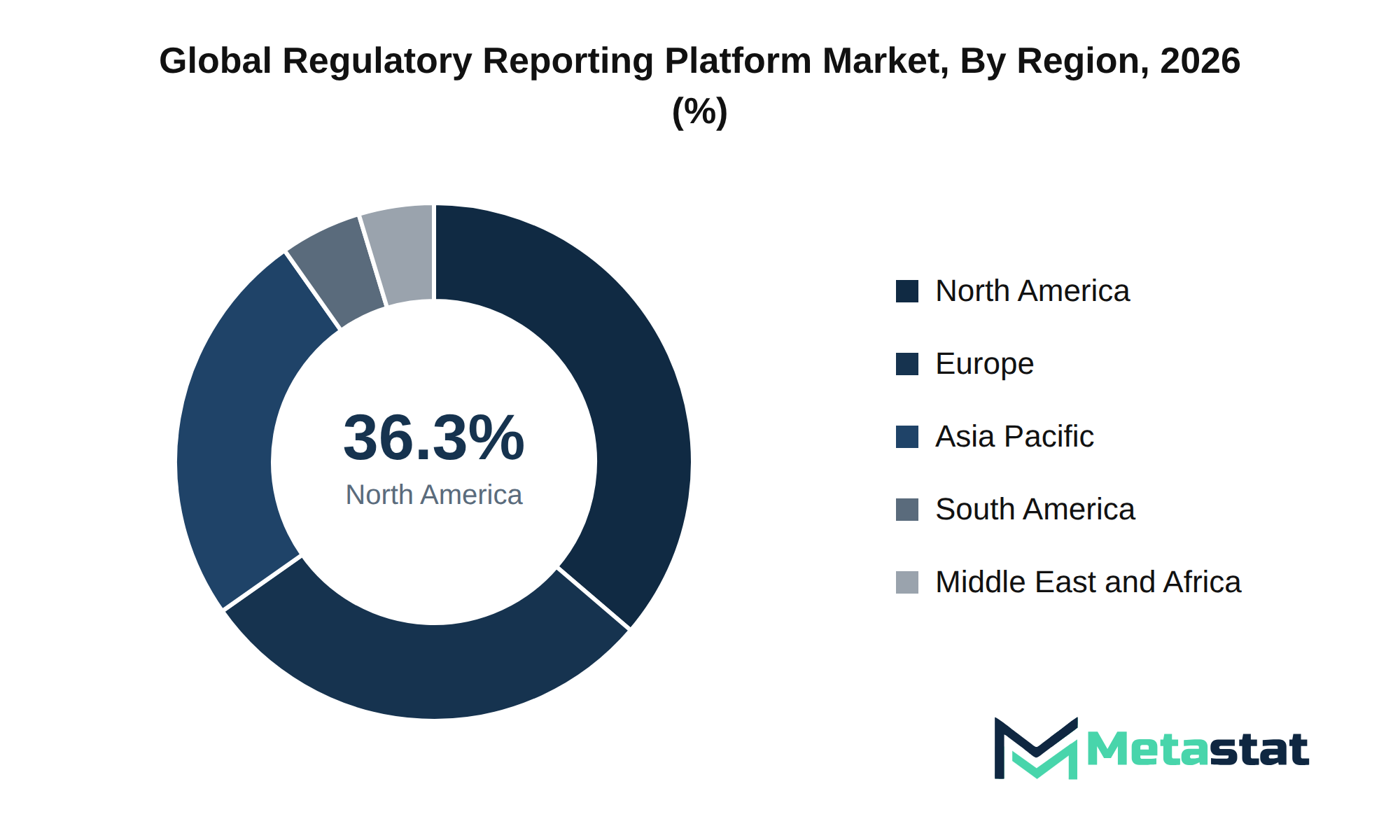
The North America Regulatory Reporting Platform market is set to expand at a CAGR of 13.3% within the forecast period, reaching a market size (TAM) of USD 6011.5 million by the end of 2033. This region accounts for 36.3% of the global market in 2025. Robust regulatory frameworks and local compliance mandates in the United States, Canada, and Mexico enhance the demand for efficient reporting solutions. Financial institutions in North America increasingly prioritize adherence to these stringent regulations, driving the adoption of advanced reporting platforms.
Infrastructure modernization continues to play a crucial role in the market's growth trajectory. Upgrading legacy systems to more agile, cloud-based solutions facilitates enhanced reporting capabilities. This transition supports the increasing complexity of regulatory requirements, enabling financial institutions to streamline their compliance processes. Localized procurement dynamics and cultural nuances influence B2B buying behaviors, leading to tailored solutions that meet specific regional needs.
The presence of domestic market participants and a competitive landscape characterized by vendor consolidation trends drives innovation and collaboration among service providers. Companies operating within the market strive to enhance their offerings, thus driving incremental growth vectors. Overall, the North America Regulatory Reporting Platform market presents significant opportunities for expansion, driven by evolving regulatory landscapes and increasing demand for compliance-driven solutions.
Europe's involvement in the Regulatory Reporting Platform market highlights a robust demand for compliance solutions across key countries, including Germany, France, the UK, Italy, Spain, and Russia. The market's share reached 29.00% in 2025, reflecting strong regulatory frameworks and compliance mandates driving investment in reporting technologies. Economic factors, including infrastructure modernization and a focus on localized procurement dynamics, contribute to the region's growth trajectory.
Emerging market front-runners within Europe demonstrate significant adoption rates, with large financial institutions prioritizing advanced reporting solutions to meet evolving regulatory requirements. Regional competitive landscapes show a concentration of domestic market participants, leading to vendor consolidation trends that enhance service offerings. Consequently, the market experiences incremental growth vectors through strategic entry barriers and foreign direct investment flows.
Local compliance mandates and trade policy shifts further influence the adoption of reporting solutions, creating a favorable environment for the Regulatory Reporting Platform market. Cultural nuances in regional B2B buying behaviors influence procurement strategies. Overall, Europe represents a mature market characterized by high-value replacement cycles and steady demand for innovative reporting technologies.
Asia-Pacific represents a growing share of the global Regulatory Reporting Platform market, accounting for 25% in 2025. The region experiences robust demand driven by increasing regulatory requirements and a focus on financial transparency. Countries including China, Japan, and India experience rapid modernization of their financial infrastructure, prompting a shift towards advanced reporting solutions.
Investment in technology and compliance frameworks serves because a catalyst for growth within the market. Local financial institutions, including banks and securities firms, emphasize enhancing reporting capabilities to meet evolving regulatory standards. Southeast Asia exhibits underpenetrated territories where the adoption of regulatory reporting solutions is expected to rise, fueled by emerging technologies and changing market dynamics.
Competition intensifies within the region, with domestic and international players vying for market share. Companies respond to localized procurement dynamics and cultural nuances, tailoring their offerings to meet the specific needs of each market. Strategic entry barriers exist, yet the potential for foreign direct investment flows into the region remains strong, facilitating geographic expansion windows for vendors in the Regulatory Reporting Platform market.
South America holds a modest share of the global Regulatory Reporting Platform market, estimated at 5.1% in 2025. Brazil and Argentina lead regional adoption, driven by increasing regulatory requirements and the necessity for financial institutions to enhance compliance processes. The presence of emerging technologies facilitates the modernization of existing reporting systems among financial entities.
Investment in technological infrastructure supports local compliance mandates, allowing financial institutions to streamline reporting processes. In light of regulatory changes, organizations prioritize solutions that enhance accuracy and efficiency in their reporting activities. The market benefits from a growing awareness of the importance of regulatory compliance, motivating investments in advanced reporting platforms.
Brazilian and Argentine institutions experience pressure to align with international standards, prompting them to seek robust reporting solutions. This trend encourages strategic partnerships with global vendors, because local entities aim to upgrade their systems. Companies operating in the region recognize the value of centralized reporting frameworks to address compliance challenges while improving operational efficiencies.
In the Middle East and Africa, the Regulatory Reporting Platform market demonstrates a modest share of 4.7% of the global market in 2025. This region includes Saudi Arabia, UAE, South Africa, and the Rest of Middle East and Africa, reflecting a developing landscape for regulatory compliance technology.
Adoption of regulatory reporting solutions is driven by the increasing emphasis on compliance with local regulations and international standards. Financial institutions in this region prioritize transparency and accountability, leading to rising demand for effective reporting platforms.
Investment in technology infrastructure supports the expansion of the market, particularly in Saudi Arabia and the UAE, where modernization initiatives enhance operational capabilities. The focus on efficiency and cost reduction accelerates the adoption of cloud-based solutions within the region.
Local compliance mandates, including those imposed by financial authorities, create a sense of urgency, compelling institutions to invest in advanced reporting tools. South Africa shows significant potential, with an increasing number of financial firms recognizing the importance of regulatory reporting in maintaining competitive advantage.
The market landscape in the Middle East and Africa features a blend of established players and emerging vendors. Domestic market participants leverage localized expertise and cultural understanding to cater to the unique needs of regional customers, driving growth in the sector.
Strategic entry barriers, including regulatory complexities and varying compliance requirements across countries, present challenges. However, opportunities for partnerships and collaborations among participants in the market enhance market penetration and responsiveness to evolving demands.
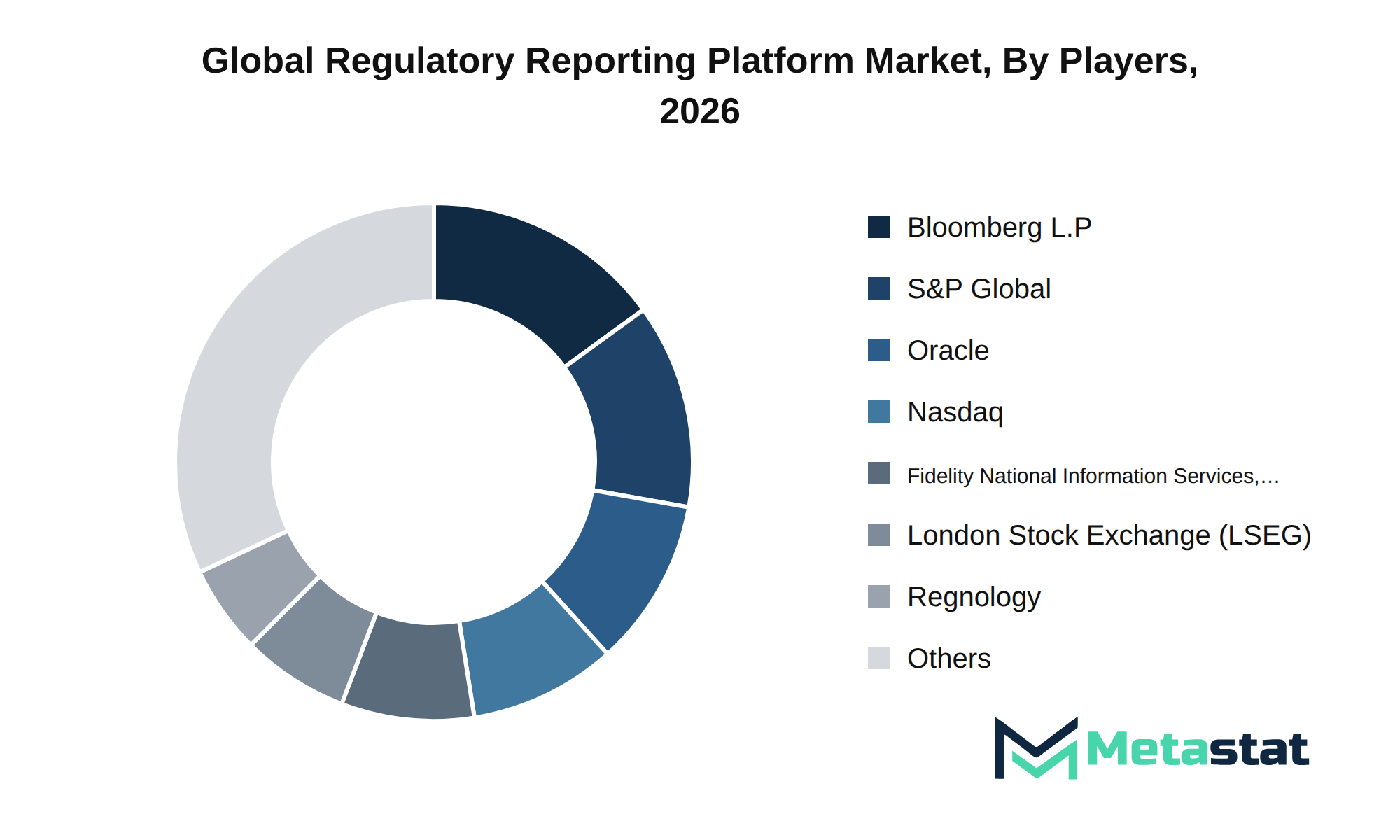
The Regulatory Reporting Platform market features a dynamic competitive environment where players deploy various strategies to maintain and enhance their market positions. Companies including Nasdaq, Inc., and S&P Global Inc. engage in strategic consolidation efforts, pursuing mergers and acquisitions that strengthen their technological offerings and market reach.
Product differentiation plays a critical role in the market, with firms like Bloomberg L.P. and Oracle Corporation focusing on proprietary technologies to create unique value propositions. This approach attracts clients and reinforces brand equity, making switching costs higher for customers. Strategic alliances and partnerships, exemplified by firms including Fidelity National Information Services, Inc. (FIS) and the London Stock Exchange Group plc (LSEG), enhance market penetration and broaden service offerings.
The competitive landscape experiences pressure from new entrants, emphasizing the importance of robust intellectual property portfolios and technological defensibility. Companies like Wolters Kluwer N.V. and SAS Institute prioritize R&D to innovate and respond effectively to evolving market demands. The future competitive outlook for the Regulatory Reporting Platform market hinges on effective customer retention strategies and the ability to leverage supply chain dominance to secure favorable procurement conditions.
Market size is forecast to rise from USD 6,459.9 million in 2025 to over USD 17,546.8 million by 2033. The base case reflects growth at a 13.3% CAGR, driven by advancements in technology, increasing regulatory requirements, and a growing emphasis on compliance across various industries. These factors encourage greater investment in regulatory reporting solutions.
In the bull case, accelerated adoption of next-generation technologies, including artificial intelligence and machine learning, enhances operational efficiency and compliance capabilities, leading to even higher demand within the Regulatory Reporting Platform market. The bear case considers economic fluctuations, potential regulatory changes, and geopolitical tensions that introduce uncertainties, thereby slowing market growth.
The evolving landscape of regulatory evolution, compliance milestones, and strategic capital allocation will significantly influence market dynamics. Businesses face pressure to align with imminent regulatory changes while navigating geopolitical realignments and global supply chain shifts. These factors create an environment rich with opportunities for innovation and investment in regulatory reporting solutions.
While consumer needs evolve, high-growth pockets emerge within the market, particularly among small and medium-sized financial institutions seeking scalable regulatory reporting solutions. Addressing unmet enterprise needs remains crucial for market participants aiming to capitalize on these opportunities. Companies that navigate these complexities enhance their competitive position and secure long-term growth in the Regulatory Reporting Platform market.
The report strategically identifies and profiles the key market players and analyses their core competencies in each sub-segment of the Regulatory Reporting Platform market.
Report Attributes | Details |
Study Period | 2021-2033 |
Base Year | 2025 |
Estimated Year | 2026 |
Forecast Period | 2026-2033 |
Historical Period | 2021-2025 |
Growth Rate | CAGR 13.3% from 2026 to 2033 |
Revenue Unit | USD million |
Segmentation | By Deployment Model, Reporting Domain, Organization Size, Financial Institution Type, and Region |
By Region | North America (By Deployment Model, Reporting Domain, Organization Size, Financial Institution Type, and Country)
|
Europe (By Deployment Model, Reporting Domain, Organization Size, Financial Institution Type, and Country)
| |
Asia Pacific (By Deployment Model, Reporting Domain, Organization Size, Financial Institution Type, and Country)
| |
South America (By Deployment Model, Reporting Domain, Organization Size, Financial Institution Type, and Country)
| |
Middle East and Africa (By Deployment Model, Reporting Domain, Organization Size, Financial Institution Type, and Country)
|
Find answers to common questions about this report
The Regulatory Reporting Platform market size was valued at USD 6,459.9 million in 2025, according to the Metastat Insights study.
The Regulatory Reporting Platform market is projected to grow at a CAGR of 13.3% during the forecast period from 2026 to 2033.
The North America Regulatory Reporting Platform market size is estimated to reach USD 6,011.5 million by 2033.
The largest segment in the Regulatory Reporting Platform market is the "Large Financial Institutions" segment, projected to reach USD 11,084.3 million by 2033. This segment leads based on its significant market value compared to other segments.
Key drivers for the Regulatory Reporting Platform market include digital transformation that enhances operational efficiency and compliance capabilities for financial institutions. The focus on operational productivity and the integration of advanced technologies, including artificial intelligence and machine learning, supports improved reporting accuracy and reduces costs, positioning institutions favorably in a competitive landscape.
North America holds the dominant share of the Regulatory Reporting Platform market, with a value of USD 6,011.5 million in 2033, representing 36.3 percent of the total market.
Regulatory Reporting Platform market growth faces constraints from regulatory compliance challenges, high capital investment requirements, and escalating operating costs. Financial institutions encounter complex compliance hurdles that necessitate substantial investments, particularly impacting smaller organizations. technological obsolescence and macroeconomic headwinds further complicate the market landscape, limiting the agility of participants in adopting advanced solutions.
Operational productivity and the integration of advanced technologies are favoring product adoption in the Regulatory Reporting Platform market. Financial institutions prioritize investments in digital tools that enhance compliance capabilities and streamline reporting processes, ultimately driving efficiency and reducing costs. This proactive approach positions organizations favorably to meet evolving regulatory mandates.
The Regulatory Reporting Platform market is estimated to reach a valuation of USD 17,546.8 million by 2033.
Key players in the Regulatory Reporting Platform market include Nasdaq, Inc., S&P Global Inc., Bloomberg L.P., Oracle Corporation, Fidelity National Information Services, Inc. (FIS), London Stock Exchange Group plc (LSEG), and The Depository Trust & Clearing Corporation (DTCC).
The analysts below cover Banking & Finance research at Metastat Insights.
LEAD ANALYST
Utkarsh Khirodkar is a Lead Market Research Analyst at MetaStat Insight, specializing in market intelligence, technology sector assessments, and competitive strategy.

PRINCIPAL CONSULTANT - ENTERPRISE AI & EMERGING TECHNOLOGIES
Banking & Finance · Electronics and Semiconductor · Energy and Power · Healthcare IT · Information & Technology · Professional Services
Vijay Gunti is a Principal Consultant at MetaStat Insight, bringing over two decades of experience across enterprise digital transformation, technology strategy, and intelligent systems.
Integrating zero-trust access controls across legacy electronic health record systems involves complex compliance overhead. Team produced an analysis that clearly separated identity governance and administration tools from privileged access management platforms. Their evaluation of HIPAA and GDPR compliance features across cloud native solutions gave our architecture group clear baseline criteria. The custom data request regarding biometric authentication adoption in hospital networks was returned promptly with clear documentation.
Evaluating calorific value requirements and air permit compliance across municipal waste facilities requires localized data. Metastat Insight structured their analysis around operational throughput capacity and feedstock composition variations in Latin America and Eastern Europe. Their competitive mapping of sorting equipment vendors helped clarify technology differences between optical separators and heavy media systems. The study provided an objective baseline during our capital expenditure reviews.
Decarbonizing industrial thermal processes hinges on refrigerant regulations and compressor efficiency limits. Metastat Insights delivered a thorough market analysis that evaluated natural refrigerants like CO2 and hydrocarbons against synthetic low-GWP alternatives. The breakdown of utility incentives and grid capacity constraints across key European manufacturing hubs offered valuable perspective. The follow-up conversation with their sector analysts addressed our specific questions on mechanical vapor recompression systems efficiently.
Explore related market intelligence reports worth reading alongside this one.
Starting from
$2950
Starting from
$2950