
LEAD ANALYST
Utkarsh Khirodkar is a Lead Market Research Analyst at MetaStat Insight, specializing in market intelligence, technology sector assessments, and competitive strategy.

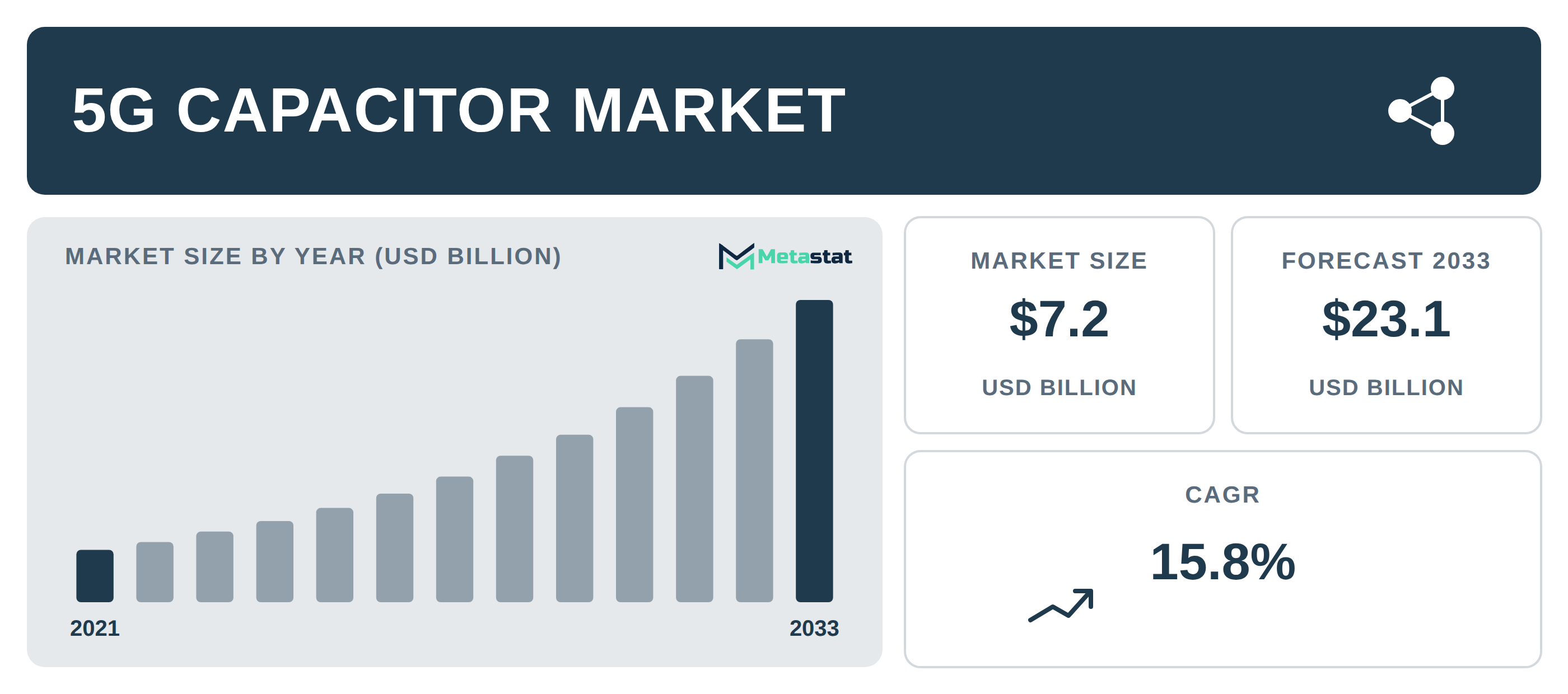
Metastat Insights releases a comprehensive report on the 5G Capacitor market, forecasting growth from USD 7.2 billion in 2025 to USD 23.1 billion by 2033, driven by increased demand for advanced telecommunications infrastructure.
Metastat Insights has published "Global 5G Capacitor Market Size, Share, By Capacitor Type (Multilayer Ceramic Capacitors (MLCCs), RF/Microwave Capacitors, Aluminum Electrolytic Capacitors, Polymer Aluminum Capacitors, Tantalum and Tantalum Polymer Capacitors, Film Capacitors, and Silicon Capacitors), By 5G Infrastructure Application (Remote Radio Units (RRU), Active Antenna Units (AAU), Baseband Units (BBU), Small Cells, RF Power Amplifiers, 5G Telecom Power Supplies, Microwave and mmWave Backhaul Equipment, and Edge and MEC Equipment), By Capacitor Function (DC-Link and Bulk Energy Storage, Decoupling and Bypass, EMI and Noise Suppression, RF Coupling and DC Blocking, RF Impedance Matching and Tuning, RF Filtering, and Power Amplifier Stabilization), By 5G Network Deployment (Macrocell Base Stations, Small Cell Networks, Distributed RAN, Centralized RAN, Massive MIMO Networks, Private 5G Networks, and Industrial 5G Networks), Industry Analysis, Growth, Trends, and Forecast, 2026-2033", with headline figures indicating a market value of USD 7.2 billion in 2025, projected to reach USD 23.1 billion by 2033, reflecting a compound annual growth rate (CAGR) of 15.8%.
The 5G Capacitor market experiences robust growth primarily due to increasing capital investments in advanced telecommunications infrastructure. Countries worldwide prioritize digital transformation, significantly driving the demand for 5G technology, which directly influences capacitor requirements. Enhanced operational productivity and initiatives focusing on cost efficiency among telecommunications providers create a strong need for reliable capacitors that support new technologies and applications. The ongoing modernization of existing networks, driven by consumer demand for faster and more reliable services, further supports market expansion.
Challenges within the 5G Capacitor market stem from stringent regulatory compliance requirements and persistent economic pressures. Manufacturers face heightened costs associated with adhering to high safety and performance standards, which delay product launches and negatively impact competitive positioning. Macroeconomic factors, including inflation and rising operational costs, impose additional financial burdens, potentially leading to stagnation in capital investments. Supply chain disruptions, influenced by geopolitical instability, further complicate the procurement of essential materials, thus limiting production capacity and hindering overall market growth.
The segmentation within the 5G Capacitor market encompasses various capacitor types, including Multilayer Ceramic Capacitors (MLCCs), RF/Microwave Capacitors, and Aluminum Electrolytic Capacitors, among others. The market is divided by applications in 5G infrastructure, including Remote Radio Units (RRU) and Active Antenna Units (AAU). Regionally, Asia Pacific leads the market with a 40.1% share, followed by North America at 28.8% and Europe at 20%. The rising deployment of 5G networks across these regions primarily drives capacitor demand.
Leading companies in the 5G Capacitor market include Murata Manufacturing Co., Ltd., Samsung Electro-Mechanics Co., Ltd., Taiyo Yuden Co., Ltd., and TDK Corporation, among others. These firms emphasize innovation and strategic partnerships to bolster their competitive positioning. Continuous investment in research and development proves critical for addressing evolving demands in high-frequency applications and enhancing energy efficiency, aligning with broader industry trends toward sustainable transformation.
For further insights, visit the full report: Global 5G Capacitor Market.
Related Report
Global 5G Capacitor MarketLEAD ANALYST
Utkarsh Khirodkar is a Lead Market Research Analyst at MetaStat Insight, specializing in market intelligence, technology sector assessments, and competitive strategy.

PRINCIPAL CONSULTANT - ENTERPRISE AI & EMERGING TECHNOLOGIES
Banking & Finance · Electronics and Semiconductor · Energy and Power · Healthcare IT · Information & Technology · Professional Services
Vijay Gunti is a Principal Consultant at MetaStat Insight, bringing over two decades of experience across enterprise digital transformation, technology strategy, and intelligent systems.

PRINCIPAL CONSULTANT - QUALITY SYSTEMS & COMPLIANCE
Electronics and Semiconductor · Machinery & Equipment · Professional Services
Omkar Phadtare is an Industry Consultant at MetaStat Insight, specializing in quality systems, regulatory compliance, and standards benchmarking to drive data-driven market intelligence and strategic industry research.

ENERGY & INFRASTRUCTURE INDUSTRY CONSULTANT
Automotive and Transportation · Electronics and Semiconductor · Energy and Power · Machinery & Equipment
Saurabh Vasant Ganvir consults for Energy & Infrastructure Industry at MetaStat Insight, specializing in renewable energy, solar EPC, and electric vehicle (EV) infrastructure markets.

LEAD CONSULTANT - COMMUNICATION, TELECOM, AND IT
Electronics and Semiconductor · Information & Technology · Machinery & Equipment · Professional Services
Ravindra Sathe Consultants for Communication, Telecom, and IT at MetaStat Insight. He leads the firm's industry research initiatives across telecommunications infrastructure, digital connectivity, enterprise networking, and emerging information technology domains.