
LEAD ANALYST
Utkarsh Khirodkar is a Lead Market Research Analyst at MetaStat Insight, specializing in market intelligence, technology sector assessments, and competitive strategy.

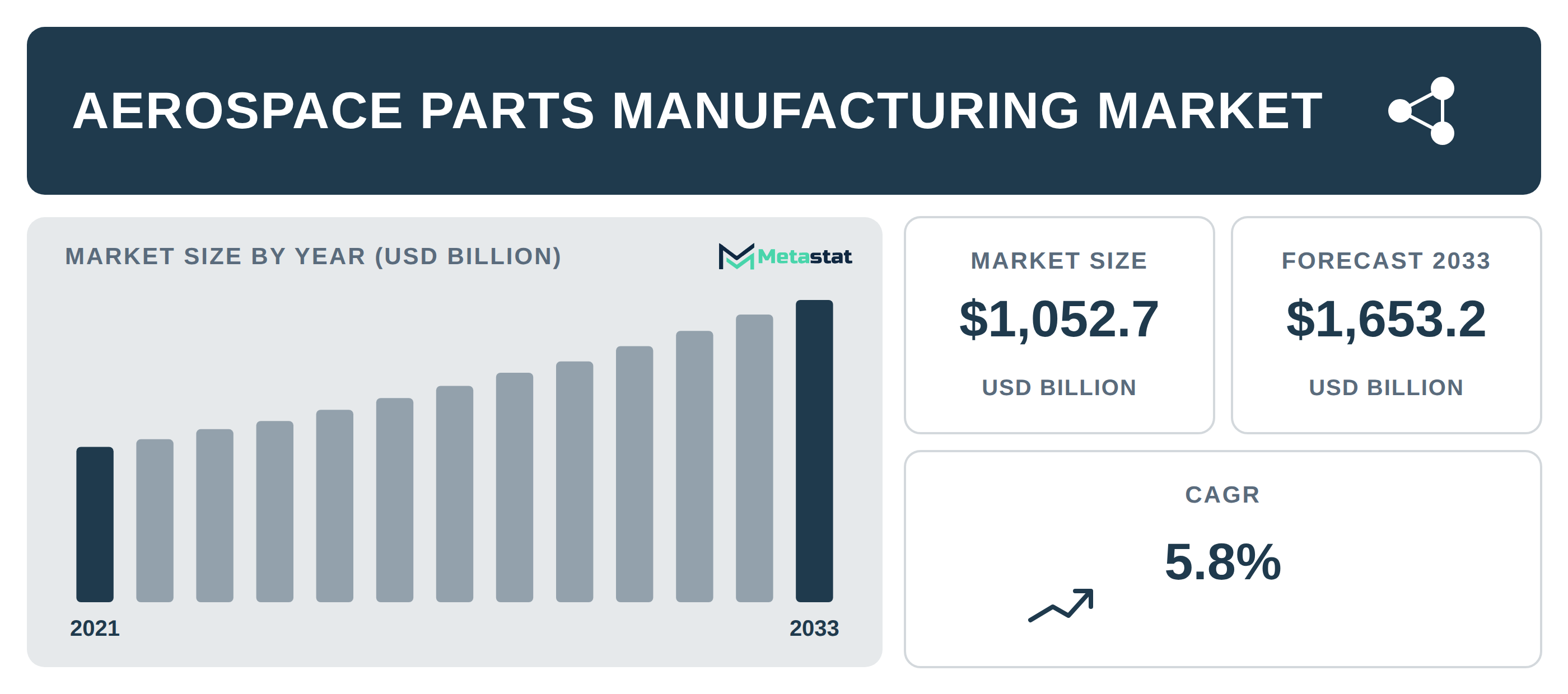
Metastat Insights reveals that the Aerospace Parts Manufacturing market is set to grow from USD 1,052.7 billion in 2025 to USD 1,653.2 billion by 2033, at a CAGR of 5.8%. Key segments include Aero-Engine Components and Commercial Aviation products.
Metastat Insights has published "Global Aerospace Parts Manufacturing Market Size, Share, By Product Type (Aero-Engine Components, Aerostructure Components, Aerospace Fasteners and Joining Hardware, Avionics and Electrical Components, Cabin Interior Components, Landing Gear, Wheel and Brake Components, Flight Control and Actuation Components, Fuel, Hydraulic, Pneumatic and Air-Management Components, Insulation Components, and Others), By Aircraft Type (Commercial Aviation, Military Aviation, Business and General Aviation, Helicopters and Rotorcraft, Unmanned Aerial Vehicles, Advanced Air Mobility Aircraft, and Others), By Material (Aluminum Alloys, Titanium Alloys, Nickel-Based Superalloys, Steel and Stainless Steel, Cobalt-Based Alloys, Magnesium Alloys, Carbon-Fiber and Glass-Fiber Composites, Plastics and High-Performance Polymers, Advanced Ceramics and Ceramic-Matrix Composites, and Others), By End User (OEM and Aftermarket), Industry Analysis, Growth, Trends, and Forecast, 2026-2033", followed by the headline figures (USD 1,052.7 billion in 2025, USD 1,653.2 billion by 2033, 5.8% CAGR).
Growth in the Aerospace Parts Manufacturing market is propelled by heightened demand for modern aircraft and substantial advancements in aerospace technologies. Increasing passenger traffic and an emphasis on fuel efficiency play pivotal roles in this trend. Significant investments in research and development, along with the evolution of regulatory frameworks, bolster the market's expansion. North America holds the largest market share at 36.3%, followed by Europe at 29.9% and Asia Pacific at 25.3%. This regional distribution underscores the established aerospace industries and strategic investments aimed at enhancing manufacturing capabilities.
Regulatory compliance poses considerable challenges for the Aerospace Parts Manufacturing market, escalating operational costs and creating barriers to entry for numerous suppliers. These complexities lead to delays in project timelines, adversely affecting market performance. Macroeconomic headwinds, including inflationary pressures and rising material costs, put strain on profit margins and limit innovation potential. Supply chain disruptions, compounded by geopolitical instability, further complicate the operational landscape for manufacturers.
The Aerospace Parts Manufacturing market is categorized by product type, aircraft type, material, and end user. Notable product segments include Aero-Engine Components, anticipated to reach USD 461.7 billion, and Aerostructure Components, projected to attain USD 454.8 billion by 2033. The Commercial Aviation segment is expected to experience significant growth, reaching USD 1,005.5 billion by 2033. These segments reflect continuous advancements in technology and a growing demand for efficient air transport solutions.
Prominent players in the Aerospace Parts Manufacturing market include Rolls-Royce plc, General Electric Company, Honeywell International Inc., and Safran Group. These companies prioritize innovation and sustainability to enhance operational efficiency and maintain competitive advantages. Collaboration among these key players further drives technological advancements and product offerings across the industry. The ongoing evolution of the market underscores the necessity for companies to adapt to shifting consumer preferences and regulatory requirements.
For more detailed insights, readers access the full report here: Global Aerospace Parts Manufacturing Market.
Related Report
Global Aerospace Parts Manufacturing MarketLEAD ANALYST
Utkarsh Khirodkar is a Lead Market Research Analyst at MetaStat Insight, specializing in market intelligence, technology sector assessments, and competitive strategy.