
LEAD ANALYST
Utkarsh Khirodkar is a Lead Market Research Analyst at MetaStat Insight, specializing in market intelligence, technology sector assessments, and competitive strategy.

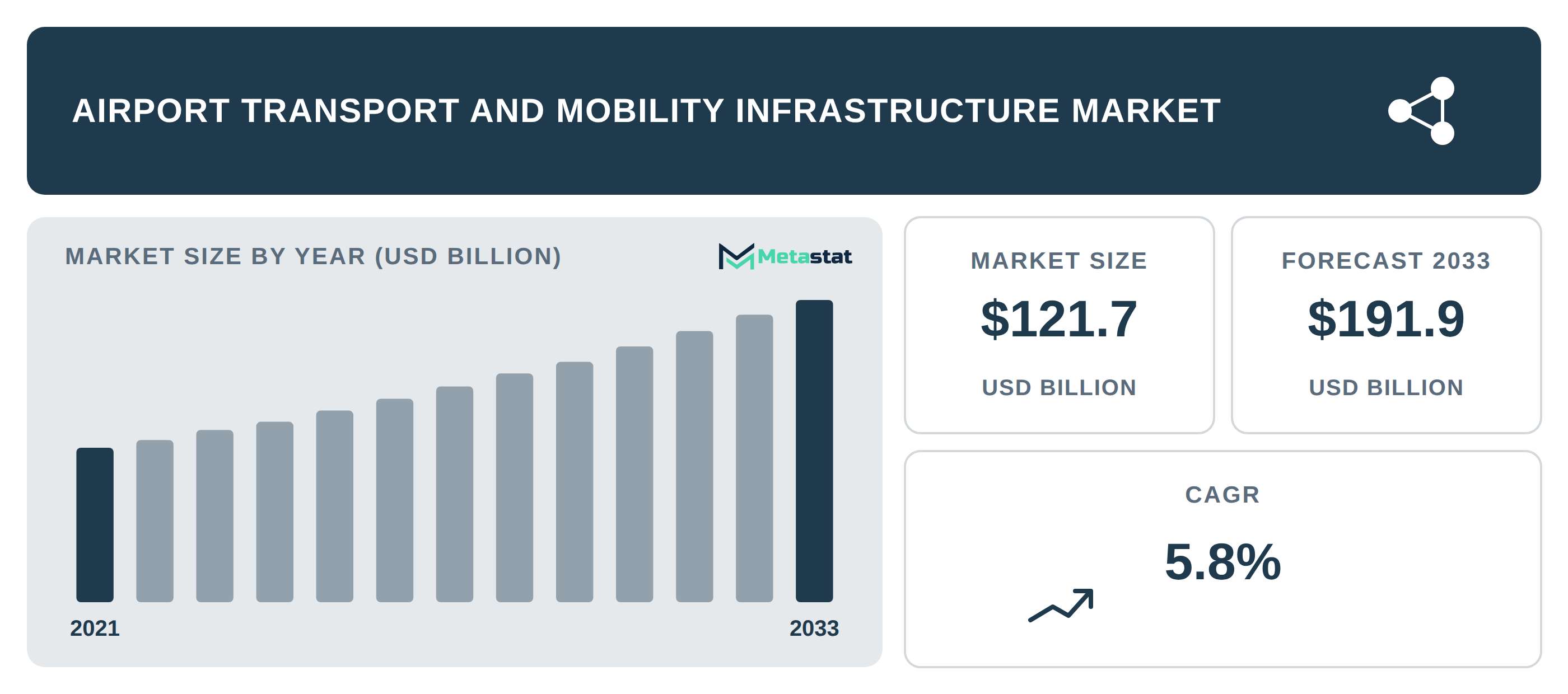
Metastat Insights reveals the Airport Transport and Mobility Infrastructure market is projected to grow from USD 121.7 billion in 2025 to USD 191.9 billion by 2033, driven by increased air travel and infrastructure modernization.
Metastat Insights has published "Global Airport Transport and Mobility Infrastructure Market Size, Share, By Airport Type (Commercial Airport, Military Airport, and General Aviation Airport), By Infrastructure Type (Terminal & Concourse Infrastructure, Landside & Intermodal Infrastructure, Baggage & Cargo Handling Infrastructure, Airport Ground-Service Infrastructure, and Others), By Solution Type (Automated People Movers, Airport Rail & Metro Link Systems, Passenger Boarding Bridges, Vertical & Horizontal Passenger Mobility Systems, Baggage Handling & Cargo Transport Systems, Airport Ground Support & Transport Equipment, Aircraft Service & Ground Power Equipment, and Others), By End User (Airport Operators and Airport Authorities, Airlines, Ground Handling Companies, Air Cargo and Freight Operators, Defense and Military Airport Operators, and Others), Industry Analysis, Growth, Trends, and Forecast, 2026-2033", which indicates that the Airport Transport and Mobility Infrastructure market was valued at USD 121.7 billion in 2025 and is projected to reach USD 191.9 billion by 2033, growing at a CAGR of 5.8%.
Increasing global air travel significantly drives demand for enhanced airport facilities and services. This surge is primarily attributed to the growth of commercial airports, which are expected to increase from USD 100.7 billion in 2026 to USD 145.7 billion by 2033, reflecting a CAGR of 5.4%. The necessity for modernization and improved operational capabilities has led to substantial public and private sector investments, creating an environment conducive to growth.
Challenges including rising operational costs, inflationary pressures, and supply chain logistics significantly affect the market. Regulatory compliance requirements necessitate substantial investments, deterring new entrants and constraining the expansion of existing operators. Geopolitical tensions disrupt supply chains and complicate project financing, leading to delays in infrastructure development.
The Airport Transport and Mobility Infrastructure market is characterized by diverse segments, including commercial, military, and general aviation airports. North America holds the largest market share, accounting for 34.6% of the total, with infrastructure investments projected to reach USD 56.6 billion by 2033. Europe and Asia Pacific follow, holding 26.5% and 30.1% of the market share, respectively. Investment in terminal infrastructure, landside connections, and baggage handling systems remains crucial, because airports aim to enhance passenger experiences and operational efficiency.
Leading companies in the Airport Transport and Mobility Infrastructure market include Siemens Mobility, ALSTOM SA, and Mitsubishi Heavy Industries, Ltd. These firms focus on innovative solutions that enhance operational efficiency and customer satisfaction. Their involvement in strategic partnerships and technological advancements positions them favorably in the competitive environment.
For a detailed analysis, insights, and forecasts, readers refer to the full report titled Global Airport Transport and Mobility Infrastructure Market.
LEAD ANALYST
Utkarsh Khirodkar is a Lead Market Research Analyst at MetaStat Insight, specializing in market intelligence, technology sector assessments, and competitive strategy.

ENERGY & INFRASTRUCTURE INDUSTRY CONSULTANT
Automotive and Transportation · Electronics and Semiconductor · Energy and Power · Machinery & Equipment
Saurabh Vasant Ganvir consults for Energy & Infrastructure Industry at MetaStat Insight, specializing in renewable energy, solar EPC, and electric vehicle (EV) infrastructure markets.