
LEAD ANALYST
Utkarsh Khirodkar is a Lead Market Research Analyst at MetaStat Insight, specializing in market intelligence, technology sector assessments, and competitive strategy.

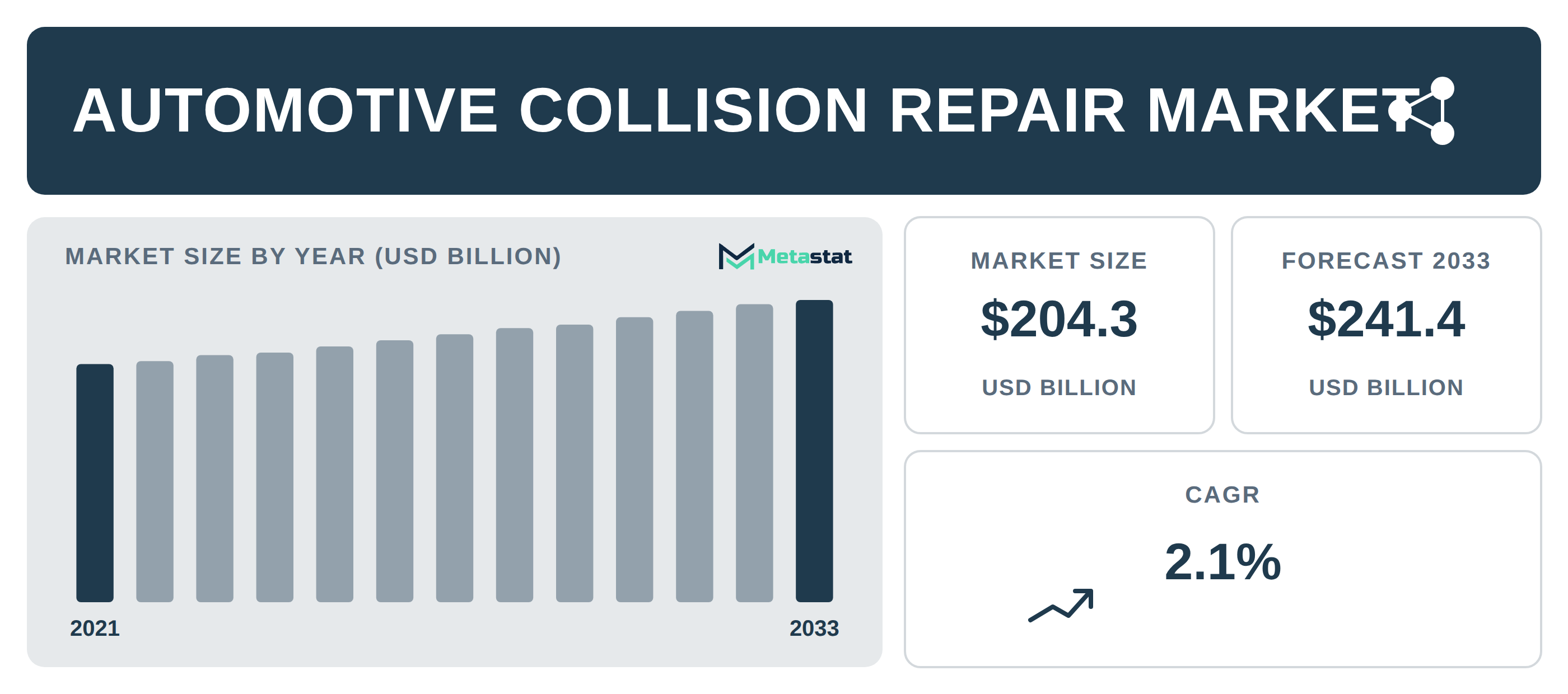
Metastat Insights announces the release of its latest report on the Automotive Collision Repair market, forecasting a growth from USD 204.3 billion in 2025 to USD 241.4 billion by 2033, at a CAGR of 2.1%. The report covers key segments, market drivers, and challenges.
Metastat Insights has published "Global Automotive Collision Repair Market Size, Share, By Product (Crash Parts, Paints and Coatings, Adhesives and Sealants, Abrasives and Finishing Compound), By Repair Type (Dent Removal, Auto Glass Replacement, Straightening Out Bent Metal, Replacing Doors or Panels, Paint Matching, Scratch Removal and Auto Detailing), By Vehicle Type (Passenger Cars and HCV & LCV), By Service Channel (OE and DIFM (Do it for Me)), Industry Analysis, Growth, Trends, and Forecast, 2026-2033", detailing the market's valuation of USD 204.3 billion in 2025 and projecting it to reach USD 241.4 billion by 2033, growing at a CAGR of 2.1% during the forecast period.
Several factors contribute to the growing demand in the Automotive Collision Repair market. Rising vehicle ownership and increased accident rates significantly impact the need for repair services. The expanding number of vehicles on the road correlates with a rise in accident frequency, leading to heightened demand for effective collision repair solutions. The introduction of advanced driver assistance systems (ADAS) has made repairs more complex, requiring specialized training and tools. This evolution in vehicle technology drives repair facilities to adapt their services, enhancing overall market demand.
Despite growth projections, the Automotive Collision Repair market faces multiple challenges. Regulatory tightening and compliance hurdles delay necessary certifications for repair service providers, impacting operational timelines. Rising labor costs and technician shortages create economic pressures that affect repair shop profitability. Supply chain disruptions, particularly for essential parts and materials, further complicate the market landscape, resulting in delays and increased costs for repair facilities. These challenges necessitate strategic planning and adaptation to maintain competitiveness.
The Automotive Collision Repair market segments into various categories, including crash parts, paints and coatings, adhesives and sealants, and repair types including dent removal and auto glass replacement. The crash parts segment is projected to grow, driven by the increasing demand for replacement components due to accidents. The market's regional dynamics indicate significant growth opportunities in the Asia Pacific region, fueled by urbanization and rising vehicle ownership. North America and Europe remain key markets, influenced by industry consolidation and evolving consumer preferences.
Numerous companies operate within the Automotive Collision Repair market, contributing to its dynamic environment. Key players include Caliber Holdings LLC, Crash Champions, Boyd Group Services Inc., Driven Brands Holdings Inc., and Mondofix Inc. These companies focus on enhancing service delivery and maintaining competitive advantages through innovation and strategic partnerships. Their presence in the market helps shape the landscape, influencing overall growth and consumer choices.
For more insights and detailed analysis, readers access the full report on the Global Automotive Collision Repair Market.
Related Report
Global Automotive Collision Repair MarketLEAD ANALYST
Utkarsh Khirodkar is a Lead Market Research Analyst at MetaStat Insight, specializing in market intelligence, technology sector assessments, and competitive strategy.

ENERGY & INFRASTRUCTURE INDUSTRY CONSULTANT
Automotive and Transportation · Electronics and Semiconductor · Energy and Power · Machinery & Equipment
Saurabh Vasant Ganvir consults for Energy & Infrastructure Industry at MetaStat Insight, specializing in renewable energy, solar EPC, and electric vehicle (EV) infrastructure markets.