
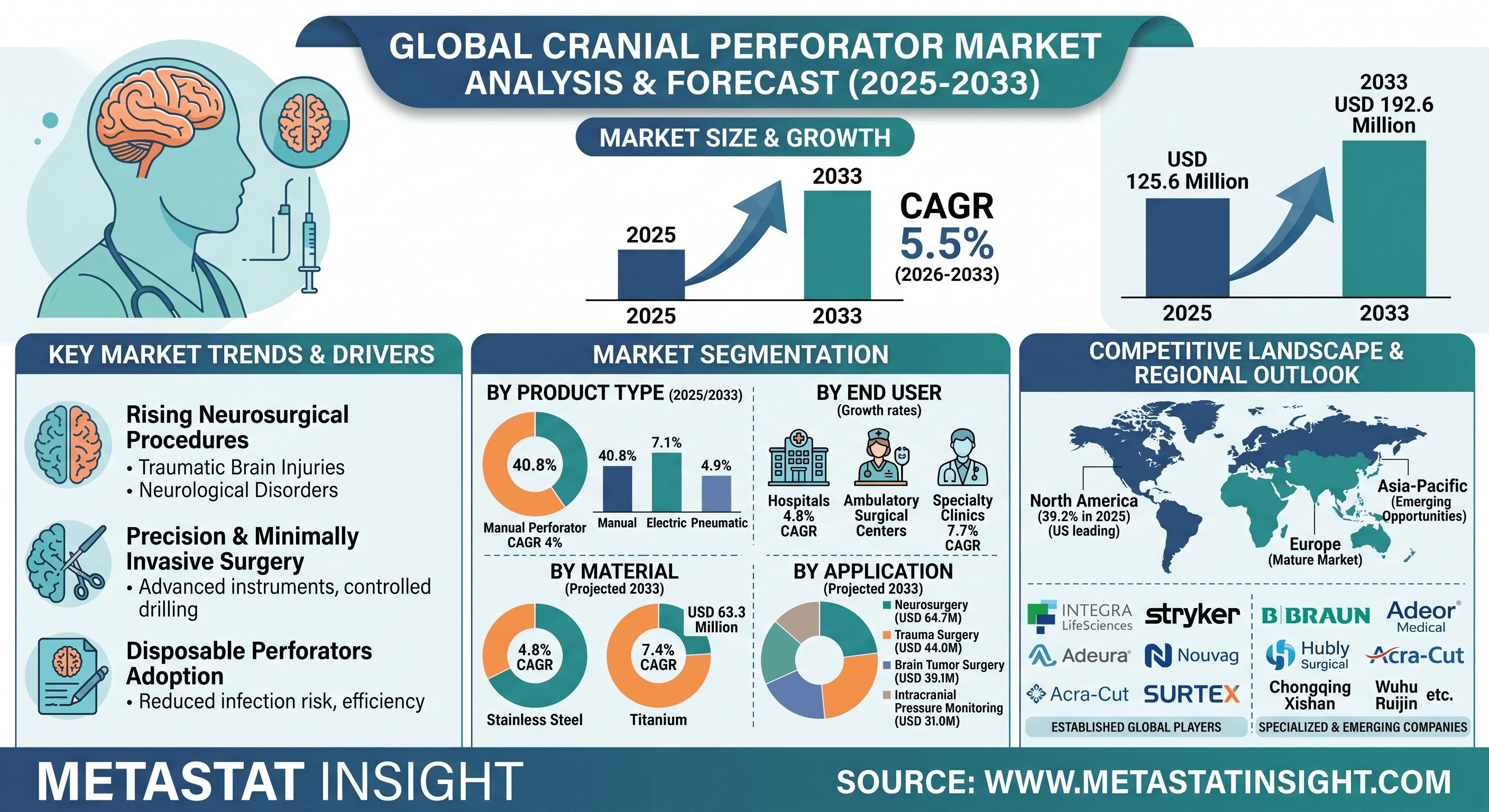
A comprehensive, data-driven market study published by MetaStat Insight reveals that the global cranial perforator market is positioned for sustained structural growth over the next decade. Valued at USD 125.6 million in 2025, the industry is projected to expand at a steady Compound Annual Growth Rate (CAGR) of 5.5% during the forecast period spanning 2026 to 2033, ultimately climbing to an estimated valuation of USD 192.6 million by 2033.
Cranial perforators serve an indispensable role across modern neurosurgical environments by establishing safe, highly controlled bone penetration to construct burr holes and deliver vital cranial access. These specialized systems are central to an array of high-stakes, time-sensitive clinical applications, including trauma interventions, tumor resections, hematoma evacuations, and emergency decompression workflows.
Core Dynamic Catalysts Propelling Market Expansion
According to the MetaStat Insight assessment, the long-term upward trajectory of the industry is anchored by a selection of prominent, interrelated systemic factors:
-
Escalating Neurosurgical Case Volumes: The global burden of neurological disorders is climbing alongside rising incidences of acute trauma. Factors such as a growing prevalence of stroke, brain tumors, epilepsy, vehicle collisions, workplace injuries, and age-linked neurological medical conditions are fundamentally increasing the net quantity of surgical procedures requiring secure cranial access tools.
-
Shift Toward Precision and Ergonomics: Modern operating rooms display a distinct preference for controlled bone drilling, maximized depth management, and reduced structural disruption to surrounding tissues. Medical practitioners are choosing advanced instruments that optimize clinical workflows, exhibit superior tactile response, and provide robust ergonomic stability.
-
Strategic Procurement Priorities: Healthcare systems are aggressively channeling investments into up-to-date operating environments, single-use sterile devices, and high-precision machinery. This shift encourages manufacturing entities to deliver innovations featuring improved blade geometries, enhanced user handling, and automatic disengagement features to mitigate procedural risks.
Key Segmentation and Structural Breakthroughs
The global framework is segmented comprehensively across Product Types, Base Materials, Applications, and End Users:
-
Product Segmentation: The manual cranial perforator sector commands a notable 40.8% market share in 2025, valued at USD 54.0 million in 2026 and trending toward USD 71.3 million by 2033 via a 4% CAGR due to low maintenance and dependable tactile feedback. Simultaneously, electric variations represent the fastest growing type, starting at USD 51.7 million in 2026 and scaling to USD 83.5 million by 2033 at an accelerated 7.1% CAGR. Pneumatic perforators are expected to move from USD 18.6 million in 2026 to USD 25.9 million by 2033 (4.9% CAGR), while alternate/hybrid systems move from USD 8.1 million to USD 11.9 million across the same span.
-
Material Breakdown: Reusable and cost-efficient Stainless Steel holds a primary baseline, projected to hit USD 111.7 million by 2033 with a 4.8% growth rate. Titanium is positioned for rapid advancement, climbing at a 7.4% CAGR to secure USD 63.3 million by 2033, driven by its lightweight structure and biocompatibility. Other blended alloys and coated materials are slated for a USD 17.6 million valuation by 2033.
-
Clinical Applications: General neurosurgery remains the largest operational pillar, projected to reach USD 64.7 million by 2033. Emergency trauma care tracking follows at USD 44.0 million, brain tumor interventions at USD 39.1 million, intracranial pressure monitoring setups at USD 31.0 million, and miscellaneous sub-specialties at USD 13.8 million.
-
End-User Networks:Hospitals remain the anchor buyer segment, growing at a 4.8% CAGR thanks to major capital budgets and emergency readiness. Ambulatory Surgical Centers (ASCs) are accelerating quickly at a 6.8% CAGR as selected procedures shift out-of-hospital, while targeted private Specialty Clinics lead the forward pace with a projected 7.7% CAGR.
Geographic Overview and Competitive Landscape
North America stands at the forefront of the global industry, securing a commanding 39.2% market share in 2025, with the United States acting as the major national engine. This regional strength is sustained by exceptional trauma center capacities, highly integrated neurosurgical networks, and rapid integration of medical technologies. Europe represents an incredibly mature, sophisticated marketplace with established clinical paths in Germany, the UK, France, Italy, and Spain. Meanwhile, the Asia-Pacific territory presents significant untapped potential fueled by hospital infrastructure builds, high traffic injury rates, and public medical funding expansions.
The supply structure features a mix of global medical device titans and agile specialized engineering firms. Tier-one leaders like Integra LifeSciences, Stryker, and B. Braun Melsungen maintain extensive multi-national footprints. Niche pioneers including Hubly Surgical, Phasor Health, and Cranial Cut are introducing modern, application-specific alternatives. Quality-driven European brands such as Adeor Medical, Nouvag, Evonos, and SURTEX Instruments supply highly precise instrumentation, while cost-competitive Asian producers like Wuhu Ruijin Medical, Well Trust Medical, and LZQ Precision Tool are successfully broadening accessibility across emerging markets.
About MetaStat Insight
MetaStat Insight is a premier global market research and consulting firm specializing in high-fidelity data syndication, custom industry reporting, and strategic advisory tracks. Our analytical coverage spans critical industrial sectors, enabling medical care groups, device manufacturers, and global institutions to navigate dynamic corporate landscapes with empirical precision.
Related Report
View full market research reportAbout the Authors

LEAD ANALYST
Utkarsh Khirodkar is a Lead Market Research Analyst at MetaStat Insight, specializing in market intelligence, technology sector assessments, and competitive strategy.

LEAD PRINCIPAL ANALYST, PHARMA AND HEALTHCARE
Food and Beverages · Healthcare · Healthcare IT · Medical Devices
Ajay Devgire is the Lead Healthcare Analyst at MetaStat Insight, leading strategic research and market intelligence initiatives across the global healthcare domain.

SENIOR RESEARCH ANALYST
Biotechnology · Food and Beverages · Medical Devices · Packaging
Snehal Pasalkar is a Research Analyst at MetaStat Insight, operating at the intersection of life sciences research, competitive strategy, and market intelligence.