
LEAD ANALYST
Utkarsh Khirodkar is a Lead Market Research Analyst at MetaStat Insight, specializing in market intelligence, technology sector assessments, and competitive strategy.

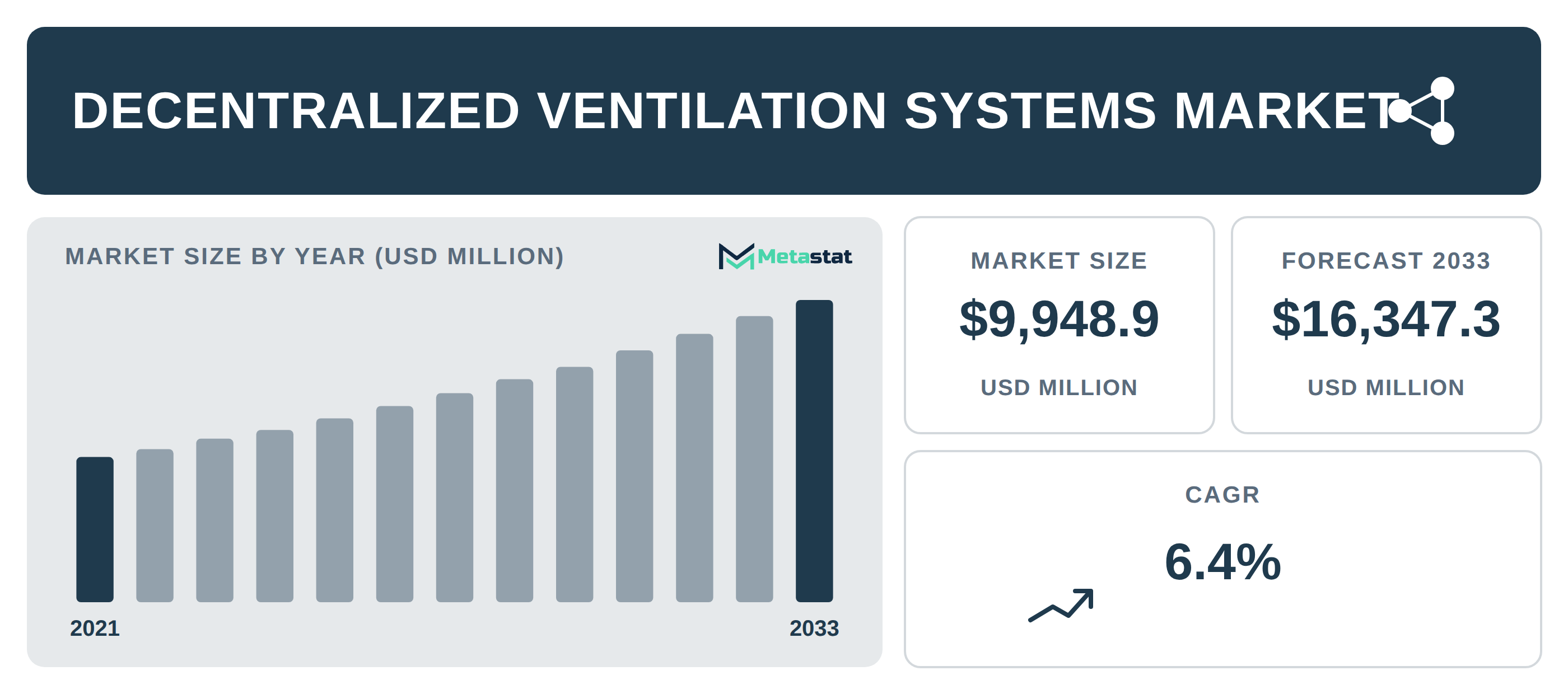
Metastat Insights has published a report detailing the growth of the Decentralized Ventilation Systems market, projected to grow from USD 9,948.9 million in 2025 to USD 16,347.3 million by 2033, at a CAGR of 6.4%. The report analyzes key trends, market drivers, and competitive dynamics.
Metastat Insights has published "Global Decentralized Ventilation Systems Market Size, Share, By Product Type (Without Heat Recovery Systems, Heat Recovery Ventilation, Energy Recovery Ventilation, Balanced Ventilation Systems, Demand-Controlled Ventilation, Exhaust Air Systems), By Installation Configuration (Wall-Mounted, Ceiling-Mounted, Window-Integrated, Roof-Mounted, Floor-Mounted, Concealed/In-Wall), By Building Type (Single-Family Residential, Multi-Family Residential, Educational Facilities, Offices, Hotels, Healthcare Facilities, Public Buildings, Industrial Buildings), By End-Users (Homeowners, Builders, HVAC Contractors, Facility Managers, Architects), Industry Analysis, Growth, Trends, and Forecast, 2026-2033", followed by the headline figures (USD 9,948.9 million in 2025, USD 16,347.3 million by 2033, 6.4% CAGR).
The Decentralized Ventilation Systems market is witnessing significant growth, driven by heightened awareness of indoor air quality alongside energy efficiency. Various sectors, including residential, commercial, and educational facilities, prioritize the adoption of these systems to improve air quality while minimizing energy consumption. The global focus on sustainability significantly influences investments in energy-efficient ventilation solutions. Consequently, research and development efforts within the sector are intensifying, stimulating innovation and broadening the market landscape.
High capital investment requirements pose a considerable challenge to growth within the Decentralized Ventilation Systems market. The costs associated with purchasing and installing these systems often deter potential buyers, particularly in regions where financing is limited. Homeowners and builders frequently cite these initial expenses because a barrier to adoption. Inflationary pressures and fluctuations in currency contribute to rising material costs, complicating market expansion.
The market is segmented based on product type, installation configuration, building type, and end-users. Key product types include heat recovery ventilation systems, projected to reach USD 5,657.8 million by 2033, alongside wall-mounted systems, which are expected to grow to USD 6,046.9 million over the same period. Regionally, Europe commands the largest market share at 37.7%, followed by Asia Pacific at 29.3% and North America at 22.9%. The North American market is anticipated to reach USD 3,650.4 million by 2033, reflecting a strong demand for innovative ventilation solutions.
The competitive environment within the Decentralized Ventilation Systems market features a myriad of players operating across diverse regions. Key companies include LUNOS Lüftungstechnik GmbH & Co. KG, inVENTer GmbH, Zehnder Group, and getAir GmbH among others. These organizations concentrate on strategic partnerships, innovation, and enhanced capabilities to strengthen their market presence while addressing evolving consumer demands.
For a comprehensive analysis, visit the full report: Global Decentralized Ventilation Systems Market.
Related Report
Global Decentralized Ventilation Systems MarketLEAD ANALYST
Utkarsh Khirodkar is a Lead Market Research Analyst at MetaStat Insight, specializing in market intelligence, technology sector assessments, and competitive strategy.

SENIOR RESEARCH ANALYST
Biotechnology · Food and Beverages · Medical Devices · Packaging
Snehal Pasalkar is a Research Analyst at MetaStat Insight, operating at the intersection of life sciences research, competitive strategy, and market intelligence.

INDUSTRY CONSULTANT - CHEMICALS & ADVANCED MATERIALS
Chemicals and Materials · Machinery & Equipment · Packaging
Amit Gadhekar Consultant for Chemicals and Materials at MetaStat Insight, directing sector-specific intelligence, research, and strategic consulting across global chemical and processing markets.