
LEAD ANALYST
Utkarsh Khirodkar is a Lead Market Research Analyst at MetaStat Insight, specializing in market intelligence, technology sector assessments, and competitive strategy.

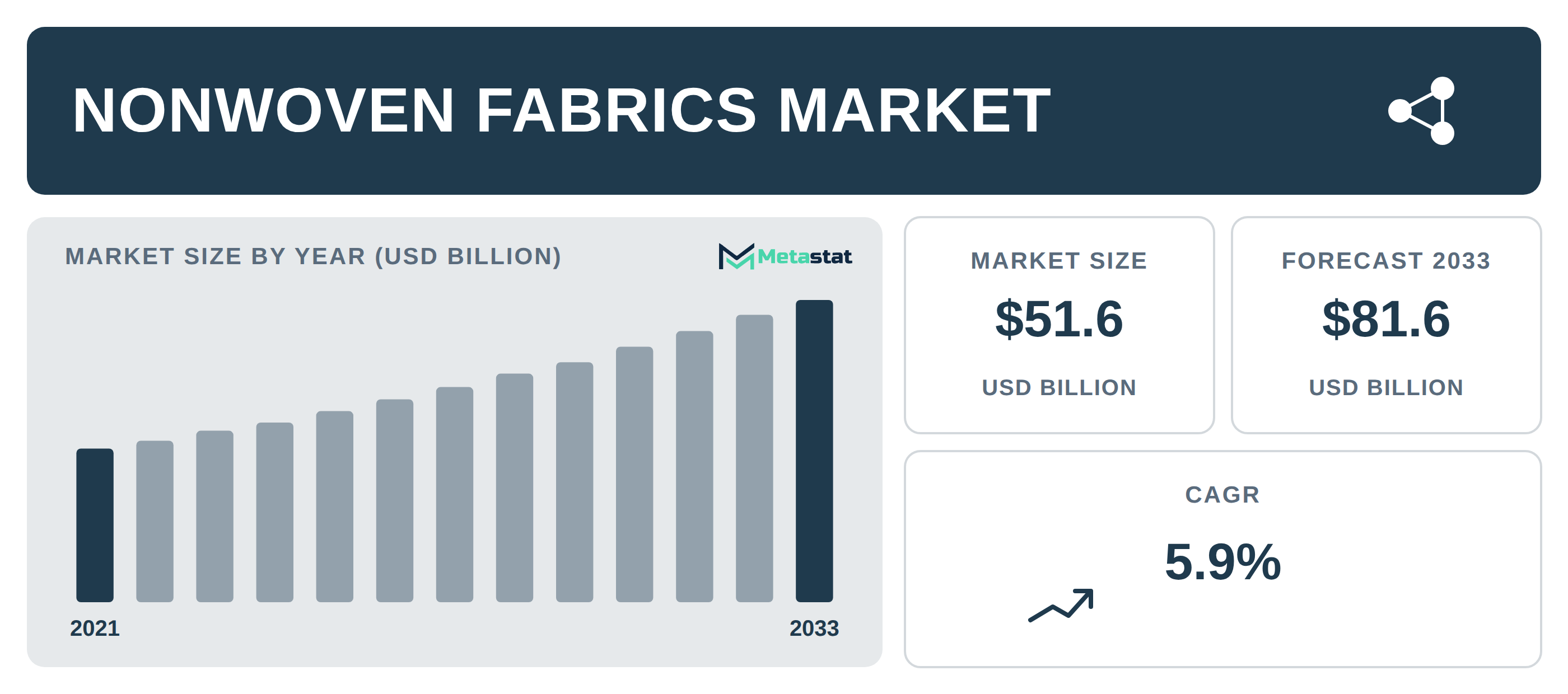
Metastat Insights announces the release of a comprehensive report on the Nonwoven Fabrics market, forecasting growth from USD 51.6 billion in 2025 to USD 81.6 billion by 2033, representing a CAGR of 5.9%. The report covers various technologies, fiber materials, applications, and regional dynamics shaping the market.
Metastat Insights has published "Global Nonwoven Fabrics Market Size, Share, By Technology (Spunbond, Spunlace / Hydroentangled, Needle-Punched, Meltblown, Airlaid, Wetlaid, Stitchbonded and Others (Flashspun, Electrospun)), By Fiber Material (Polypropylene, Polyester (PET), Polyethylene, Polyamide, Wood Pulp, Cotton and Other Natural Fibers and Others (PLA, Aramid, PPS, PTFE, Polyimide)), By Product Durability (Disposable Nonwoven and Durable Nonwoven), By Application (Filtration, Hygiene Products, Medical and Healthcare, Automotive Components, Geotextiles, Construction Materials and Others (Furniture, Bedding, Packaging and Electrical Applications)), Industry Analysis, Growth, Trends, and Forecast, 2026-2033", followed by the headline figures (USD 51.6 billion in 2025, USD 81.6 billion by 2033, 5.9% CAGR).
Demand for nonwoven materials is driven by various factors. The increasing focus on hygiene products and medical applications has created a strong market for nonwoven fabrics, particularly due to heightened global health concerns. The growth of the automotive and construction sectors has further fueled the demand for the lightweight and durable materials that nonwoven fabrics provide. Innovations in production technologies contribute to this rising demand, enhancing manufacturing efficiency.
However, the market faces challenges that could hinder growth. Regulatory constraints regarding environmental impacts and production costs limit opportunities for manufacturers. Compliance with stringent regulations typically requires investment in cleaner technologies, which are particularly challenging for smaller firms. Fluctuations in raw material availability and pricing volatility pose additional risks to production stability and overall market growth.
The Nonwoven Fabrics market is segmented by technology, fiber material, product durability, and application. On the technological side, the Spunbond segment is expected to lead the market, increasing from USD 21.9 billion in 2026 to USD 32.3 billion by 2033. The Polypropylene fiber material is projected to grow from USD 30.2 billion in 2026 to USD 45.6 billion by 2033, highlighting its versatility across various applications, including hygiene and medical products.
Regionally, Asia Pacific dominates the Nonwoven Fabrics market, commanding a notable share of 43.8%, followed by North America at 25.3% and Europe at 22.4%. In this context, the North American market is anticipated to reach USD 19.5 billion by 2033, maintaining a stable growth trajectory. This regional analysis illustrates the geographic disparities in demand and production capabilities within the global market.
Key players in the Nonwoven Fabrics market include Magnera Corporation, Freudenberg Performance Materials, Kimberly-Clark Corporation, and others. These companies emphasize technological advancements and strategic partnerships to enhance their market positions and address evolving consumer needs. By investing in research and development, these firms aim to innovate and adapt effectively to changing market dynamics.
For deeper insights into the Nonwoven Fabrics market, including detailed analysis and forecasts, readers are invited to explore the full report: Global Nonwoven Fabrics Market.
Related Report
Global Nonwoven Fabrics MarketLEAD ANALYST
Utkarsh Khirodkar is a Lead Market Research Analyst at MetaStat Insight, specializing in market intelligence, technology sector assessments, and competitive strategy.

INDUSTRY CONSULTANT - CHEMICALS & ADVANCED MATERIALS
Chemicals and Materials · Machinery & Equipment · Packaging
Amit Gadhekar Consultant for Chemicals and Materials at MetaStat Insight, directing sector-specific intelligence, research, and strategic consulting across global chemical and processing markets.