
LEAD ANALYST
Utkarsh Khirodkar is a Lead Market Research Analyst at MetaStat Insight, specializing in market intelligence, technology sector assessments, and competitive strategy.

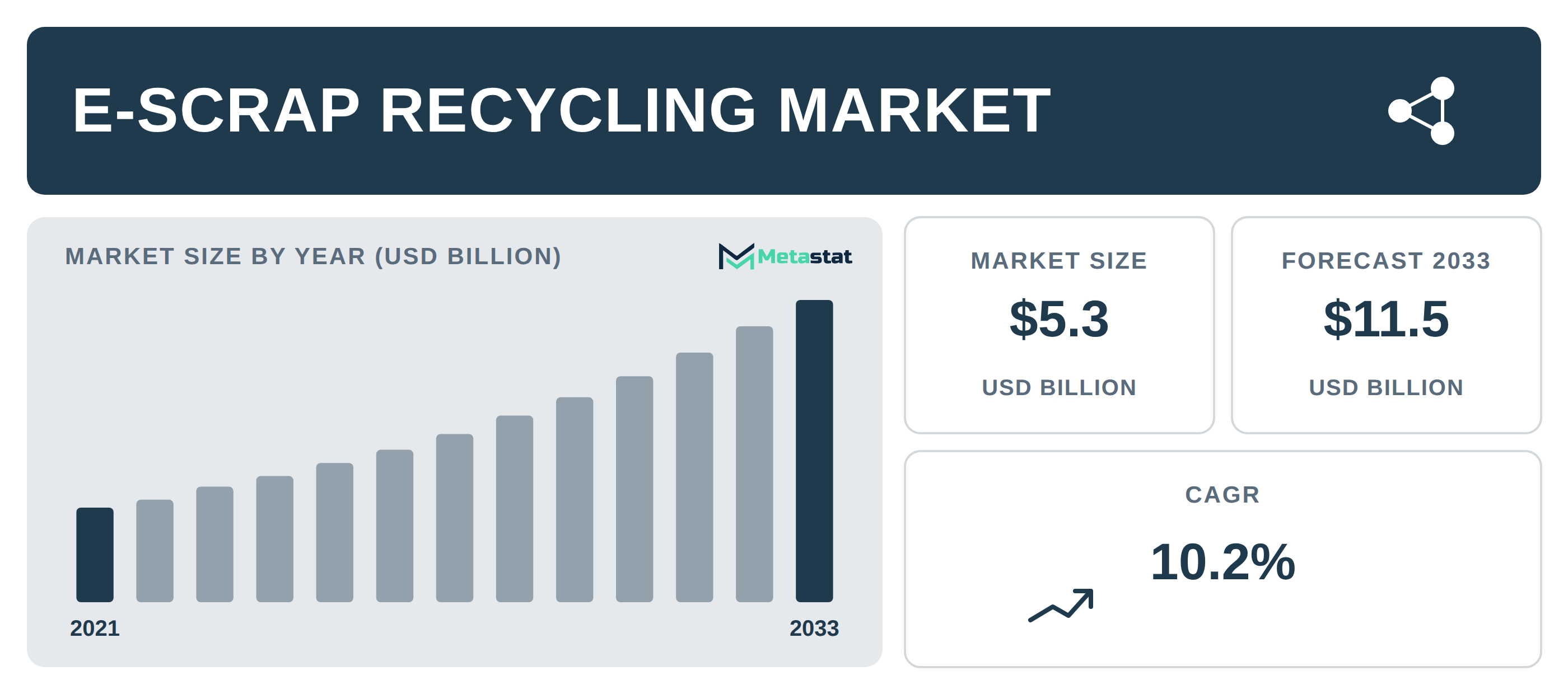
Metastat Insights has released a comprehensive report on the global E-Scrap Recycling market, forecasting growth from USD 5.3 billion in 2025 to USD 11.5 billion by 2033, with a CAGR of 10.2%. The report covers market dynamics, segmentation, key players, and regional insights.
Metastat Insights has published "Global E-Scrap Recycling Market Size, Share, By E-Scrap Type (Information Technology and Telecommunications Equipment, Consumer Electronics, Large Household Appliances, Small Household Appliances, Display Equipment, Industrial and Commercial Electronic Equipment, Electrical and Electronic Tools, Lighting Equipment, Photovoltaic Panels, and Others), By Recycling Process (Manual Dismantling and Sorting, Mechanical Shredding and Material Separation, Pyrometallurgical Processing, Hydrometallurgical Processing, and Combined Mechanical-Metallurgical Processing), By Material Recovered (Metals, Plastics, Glass, Printed Circuit Boards and Electronic Components, and Others), By End-Use Industry (Residential, Commercial, Industrial, Government and Public Sector, Retailers and Distributors, Original Equipment Manufacturers, and Data Centers and Telecommunications Operators), Industry Analysis, Growth, Trends, and Forecast, 2026-2033", followed by the headline figures (USD 5.3 billion in 2025, USD 11.5 billion by 2033, 10.2% CAGR).
Growing environmental awareness significantly influences the E-Scrap Recycling market. The increasing volume of electronic waste, driven by technological advancements and rising consumer demand, creates a pressing need for efficient recycling processes. Investment in recycling infrastructure is on the rise, alongside regulatory compliance pushing for sustainable practices. Companies are focusing on innovative recycling technologies that enhance material recovery rates, aligning with broader environmental goals.
While demand rises, several challenges hinder market growth. Stringent regulatory compliance often leads to increased operational costs and complexity for companies. Navigating varying regulations across different regions creates additional difficulties. Macroeconomic factors, including inflation and supply chain disruptions, contribute to rising costs for raw materials and labor. These challenges complicate the adoption of efficient recycling practices and may affect profit margins across the industry.
The E-Scrap Recycling market is segmented based on E-Scrap Type, Recycling Process, Material Recovered, and End-Use Industry. Key segments encompass Information Technology and Telecommunications Equipment, Consumer Electronics, Large Household Appliances, Small Household Appliances, Display Equipment, and Industrial Electronic Equipment, among others. Regional dynamics indicate that Europe and North America hold significant market shares, influenced by varying regulations that drive recycling efficiencies and resource recovery. The Asia Pacific region follows closely, reflecting its growing focus on sustainable waste management practices.
Several companies actively engage in the E-Scrap Recycling market, including Umicore, Boliden Group, and Aurubis AG. These organizations employ various recycling processes, including mechanical shredding and hydrometallurgical processing, to enhance recovery rates and improve operational efficiencies. Their commitment to innovation and compliance with environmental standards positions them favorably in the competitive landscape. Other notable players include Glencore, Stena Metall AB, and Kuusakoski Oy, all contributing to market dynamics and advancements in recycling technologies.
For detailed insights and comprehensive analysis, readers are invited to explore the full report: Global E-Scrap Recycling Market.
Related Report
Global E-Scrap Recycling MarketLEAD ANALYST
Utkarsh Khirodkar is a Lead Market Research Analyst at MetaStat Insight, specializing in market intelligence, technology sector assessments, and competitive strategy.

PRINCIPAL CONSULTANT - ENTERPRISE AI & EMERGING TECHNOLOGIES
Banking & Finance · Electronics and Semiconductor · Energy and Power · Healthcare IT · Information & Technology · Professional Services
Vijay Gunti is a Principal Consultant at MetaStat Insight, bringing over two decades of experience across enterprise digital transformation, technology strategy, and intelligent systems.

PRINCIPAL CONSULTANT - QUALITY SYSTEMS & COMPLIANCE
Electronics and Semiconductor · Machinery & Equipment · Professional Services
Omkar Phadtare is an Industry Consultant at MetaStat Insight, specializing in quality systems, regulatory compliance, and standards benchmarking to drive data-driven market intelligence and strategic industry research.

ENERGY & INFRASTRUCTURE INDUSTRY CONSULTANT
Automotive and Transportation · Electronics and Semiconductor · Energy and Power · Machinery & Equipment
Saurabh Vasant Ganvir consults for Energy & Infrastructure Industry at MetaStat Insight, specializing in renewable energy, solar EPC, and electric vehicle (EV) infrastructure markets.

LEAD CONSULTANT - COMMUNICATION, TELECOM, AND IT
Electronics and Semiconductor · Information & Technology · Machinery & Equipment · Professional Services
Ravindra Sathe Consultants for Communication, Telecom, and IT at MetaStat Insight. He leads the firm's industry research initiatives across telecommunications infrastructure, digital connectivity, enterprise networking, and emerging information technology domains.