
LEAD ANALYST
Utkarsh Khirodkar is a Lead Market Research Analyst at MetaStat Insight, specializing in market intelligence, technology sector assessments, and competitive strategy.

Metastat Insights has published a comprehensive report on the Electric Fan market, projecting growth from USD 11 billion in 2025 to USD 21.8 billion by 2033, at a CAGR of 8.9%. This report covers product types, technology advancements, regional market dynamics, and key players.
Metastat Insights has published "Global Electric Fan Market Size, Share, By Product Type (Ceiling Fans, Table Fans, Wall-Mounted Fans, Pedestal Fans, Exhaust Fans, Tower Fans, and Industrial Fans), By Technology Type (AC Electric Fans, DC Electric Fans, Smart Electric Fans (IoT Enabled), Energy-Efficient Fans, Remote-Controlled Fans, and Solar-Powered Fans), By Application (Residential, Commercial, Industrial, Healthcare Facilities, Retail Spaces, Hospitality Sector, and Educational Institutions), By Distribution Channel (Supermarkets and Hypermarkets, Specialty Stores, Online Retail Platforms, Direct Sales, Wholesale Distributors, Brand Outlets, and B2B Sales), Industry Analysis, Growth, Trends, and Forecast, 2026-2033", followed by the headline figures (USD 11 billion in 2025, USD 21.8 billion by 2033, 8.9% CAGR).
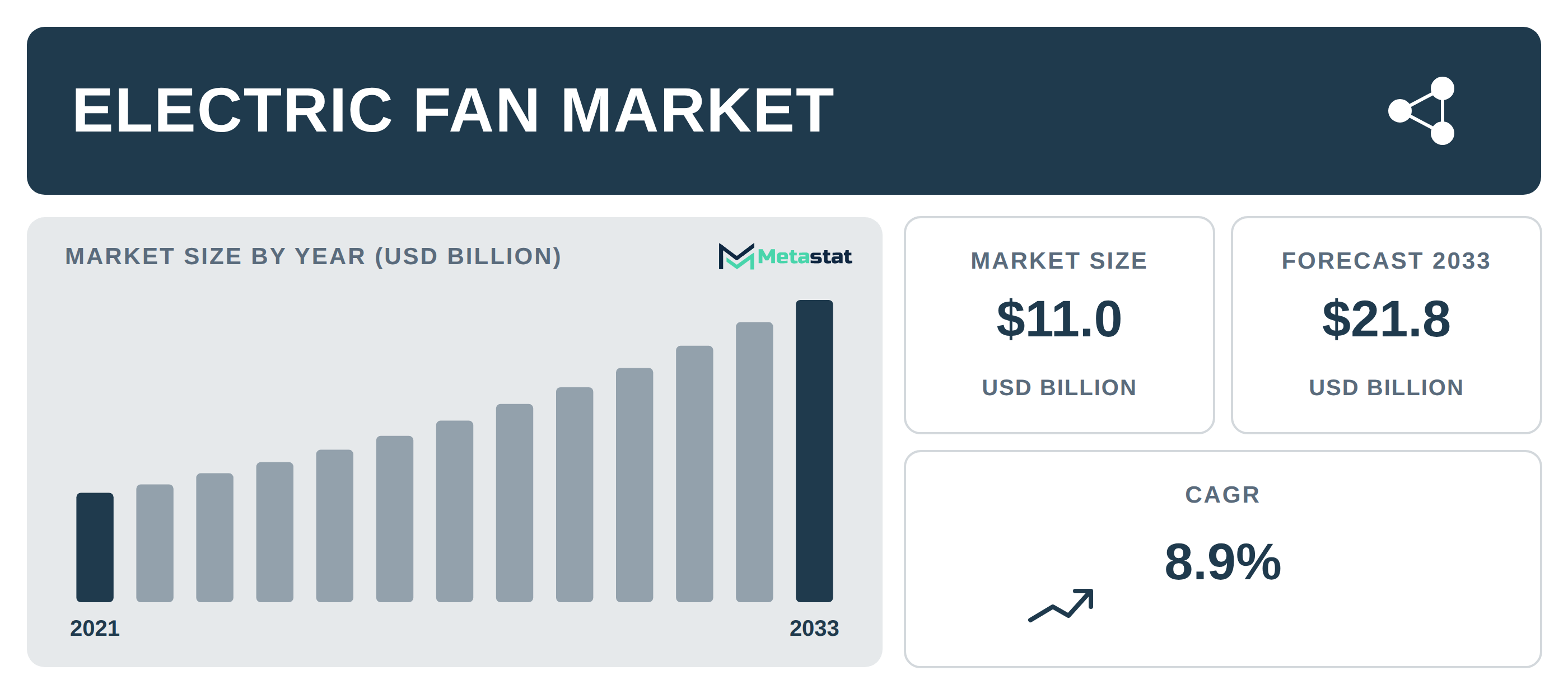
The Electric Fan market experiences significant growth driven by multiple factors, including technological advancements and evolving consumer preferences. Urbanization and an aging population contribute to an increased demand for effective cooling solutions. Consumers prioritize energy-efficient and smart electric fans, reflecting a global commitment to sustainability. This movement towards environmentally responsible products prompts manufacturers to innovate, enhancing their product lines to meet changing market expectations. The rise of online retail platforms facilitates greater access to a wider variety of electric fan options, promoting competitive dynamics among suppliers.
Challenges including supply chain disruptions have a notable impact on the Electric Fan market, causing delays in production and distribution. Geopolitical instability and resource scarcity lead to increased lead times and fluctuating costs, ultimately affecting market efficiency. Inflationary pressures elevate operational costs, straining profit margins across the industry. These economic conditions deter investments in new technologies or product development, creating an environment that hampers innovation. Technological obsolescence threatens established manufacturers, because emerging competitors introduce more energy-efficient alternatives.
The Electric Fan market divides into several key segments, including product type, technology type, application, and distribution channel. Ceiling fans hold a considerable market share, anticipated to grow from USD 5.8 billion in 2026 to USD 10.4 billion by 2033. The Asia Pacific region leads the market, accounting for 47.2% of the total share, followed closely by North America with 17.9% and Europe at 15.8%. The increasing adoption of smart and energy-efficient fans across residential, commercial, and industrial sectors underscores the diverse potential of the market.
Prominent companies participating in the Electric Fan market include Hunter Fan Company, Dyson Ltd., Panasonic Corporation, and Havells India Ltd. These companies emphasize product innovation and strategic collaborations to enhance their competitive positioning. Investments in research and development enable these firms to introduce new technologies and energy-efficient designs that cater to the escalating consumer demand for advanced cooling solutions.
For a deeper understanding of the Electric Fan market, including detailed insights and forecasts, readers are invited to explore the full report: Global Electric Fan Market.
Related Report
Global Electric Fan MarketLEAD ANALYST
Utkarsh Khirodkar is a Lead Market Research Analyst at MetaStat Insight, specializing in market intelligence, technology sector assessments, and competitive strategy.

PRINCIPAL CONSULTANT - ENTERPRISE AI & EMERGING TECHNOLOGIES
Banking & Finance · Electronics and Semiconductor · Energy and Power · Healthcare IT · Information & Technology · Professional Services
Vijay Gunti is a Principal Consultant at MetaStat Insight, bringing over two decades of experience across enterprise digital transformation, technology strategy, and intelligent systems.

PRINCIPAL CONSULTANT - QUALITY SYSTEMS & COMPLIANCE
Electronics and Semiconductor · Machinery & Equipment · Professional Services
Omkar Phadtare is an Industry Consultant at MetaStat Insight, specializing in quality systems, regulatory compliance, and standards benchmarking to drive data-driven market intelligence and strategic industry research.

ENERGY & INFRASTRUCTURE INDUSTRY CONSULTANT
Automotive and Transportation · Electronics and Semiconductor · Energy and Power · Machinery & Equipment
Saurabh Vasant Ganvir consults for Energy & Infrastructure Industry at MetaStat Insight, specializing in renewable energy, solar EPC, and electric vehicle (EV) infrastructure markets.

LEAD CONSULTANT - COMMUNICATION, TELECOM, AND IT
Electronics and Semiconductor · Information & Technology · Machinery & Equipment · Professional Services
Ravindra Sathe Consultants for Communication, Telecom, and IT at MetaStat Insight. He leads the firm's industry research initiatives across telecommunications infrastructure, digital connectivity, enterprise networking, and emerging information technology domains.