
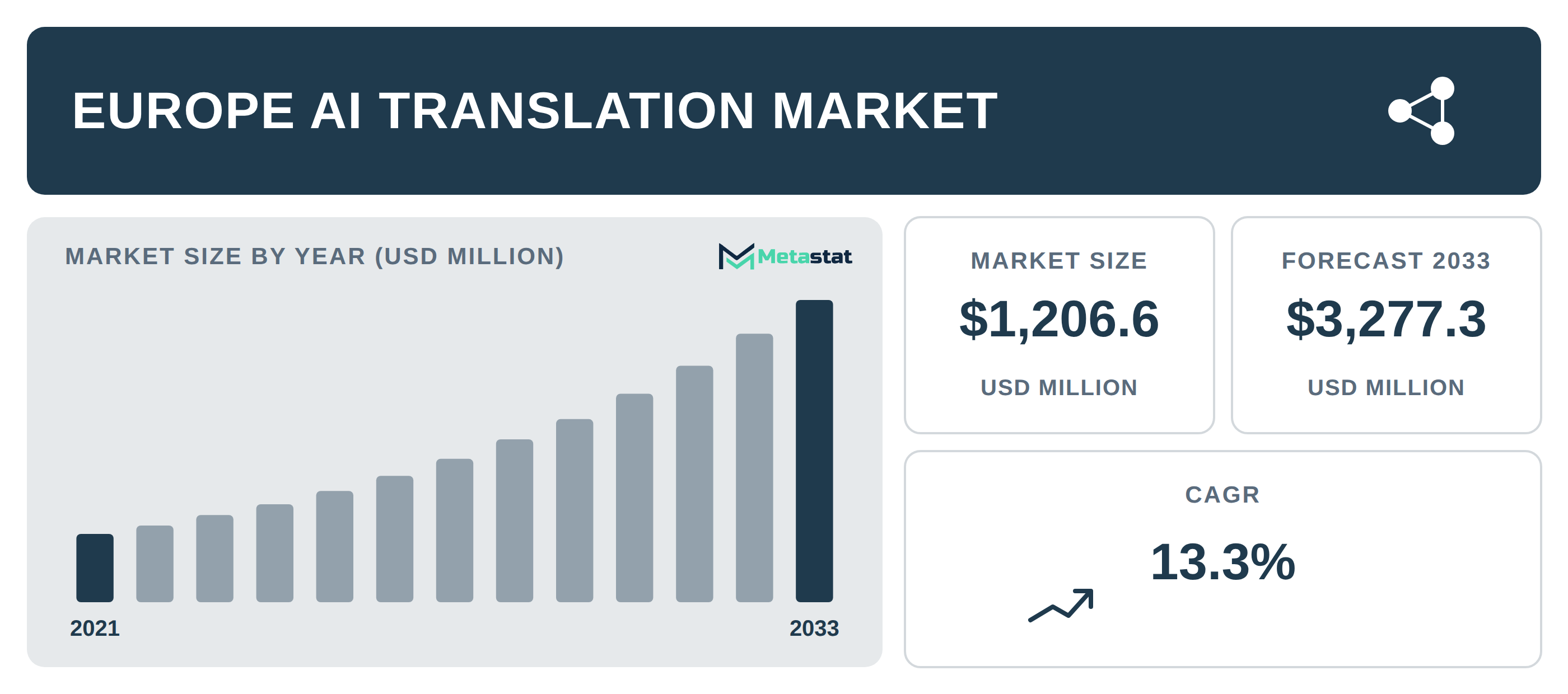
Metastat Insights has published a comprehensive report on the Europe AI Translation market, forecasting significant growth. Expected to rise from USD 1,206.6 million in 2025 to USD 3,277.3 million by 2033, the market demonstrates a robust CAGR of 13.3%. Key factors driving this expansion include digital transformation and technological advancements.
Metastat Insights has published "Europe AI Translation Market Size, Share, By Technology Type (Neural Machine Translation (NMT), Large Language Model (LLM)-Based Translation, Hybrid AI + Human Translation, and Adaptive/Custom AI Translation), By Offering Type (AI Translation Software & Platforms, AI Translation APIs & Developer Services, AI-Assisted Translation & Localization Services, AI-Powered Translation Management & Workflow Solutions, and AI-Powered Speech & Voice Translation), By Content Type (Text & Document Translation, Website & App Translation, Audio, Video & Subtitle Translation, Real-Time Conversational Translation, and Marketing & Creative Content Translation), By End-Use Industry (IT & Telecommunications, Retail & E-commerce, BFSI, Healthcare & Life Sciences, Manufacturing & Automotive, Government & Public Sector, Travel & Hospitality, Legal & Professional Services, Education, and Others), Industry Analysis, Growth, Trends, and Forecast, 2026-2033". The market was valued at USD 1,206.6 million in 2025 and is projected to reach USD 3,277.3 million by 2033, growing at a compound annual growth rate (CAGR) of 13.3%.
What is driving Europe AI Translation demand
Rising demand for digital transformation initiatives significantly influences the Europe AI Translation market. Organizations increasingly prioritize automation and the integration of advanced technologies to optimize processes and enhance operational efficiency. This shift is driven by evolving consumer behaviors and preferences, which highlight the necessity for effective multilingual communication. Companies adopting AI translation technologies experience improved productivity and cost efficiencies, positively impacting their profitability.
What is holding back the market
High capital investment requirements represent a notable restraint in the Europe AI Translation market. The costs associated with deploying advanced AI technologies deter smaller firms from entering the market, leading to market fragmentation. Escalating operating costs and geopolitical instability further complicate the landscape, hindering investment flows and creating uncertainty for existing players.
How the market splits by segment
The Europe AI Translation market is segmented into various technological categories, including Neural Machine Translation (NMT), Large Language Model (LLM)-Based Translation, Hybrid AI + Human Translation, and Adaptive/Custom AI Translation. NMT is projected to grow from USD 524 million in 2026 to USD 1,012.7 million by 2033, reflecting a CAGR of 9.9%. LLM-based translation is anticipated to experience the fastest growth, reaching USD 1,128.4 million by 2033 with a CAGR of 17.4%. The market segments by offering types, content types, and end-use industries, revealing a diverse environment.
Who competes in it
Key players in the Europe AI Translation market include DeepL, Google, Microsoft, Amazon Web Services, Inc., RWS, and TransPerfect, among others. These companies continuously invest in research and development to enhance their offerings and maintain competitive positioning. Strategic consolidation through mergers and acquisitions is likely to shape the competitive environment, allowing firms to expand their capabilities and market reach.
For more information, readers access the full report: Europe AI Translation Market.
Related Report
Europe AI Translation Market