
LEAD ANALYST
Utkarsh Khirodkar is a Lead Market Research Analyst at MetaStat Insight, specializing in market intelligence, technology sector assessments, and competitive strategy.

Europe AI Translation Market Size, Share, By Technology Type (Neural Machine Translation (NMT), Large Language Model (LLM)-Based Translation, Hybrid AI + Human Translation, and Adaptive/Custom AI Translation), By Offering Type (AI Translation Software & Platforms, AI Translation APIs & Developer Services, AI-Assisted Translation & Localization Services, AI-Powered Translation Management & Workflow Solutions, and AI-Powered Speech & Voice Translation), By Content Type (Text & Document Translation, Website & App Translation, Audio, Video & Subtitle Translation, Real-Time Conversational Translation, and Marketing & Creative Content Translation), By End-Use Industry (IT & Telecommunications, Retail & E-commerce, BFSI, Healthcare & Life Sciences, Manufacturing & Automotive, Government & Public Sector, Travel & Hospitality, Legal & Professional Services, Education, and Others), Industry Analysis, Growth, Trends, and Forecast, 2026-2033
Report ID
MSI-4949
Published
August, 2026
Pages
293 Pages
Format
Historical
Base year
Forecast
Forecast period
Report Details
Choose Your License
Europe AI Translation Market
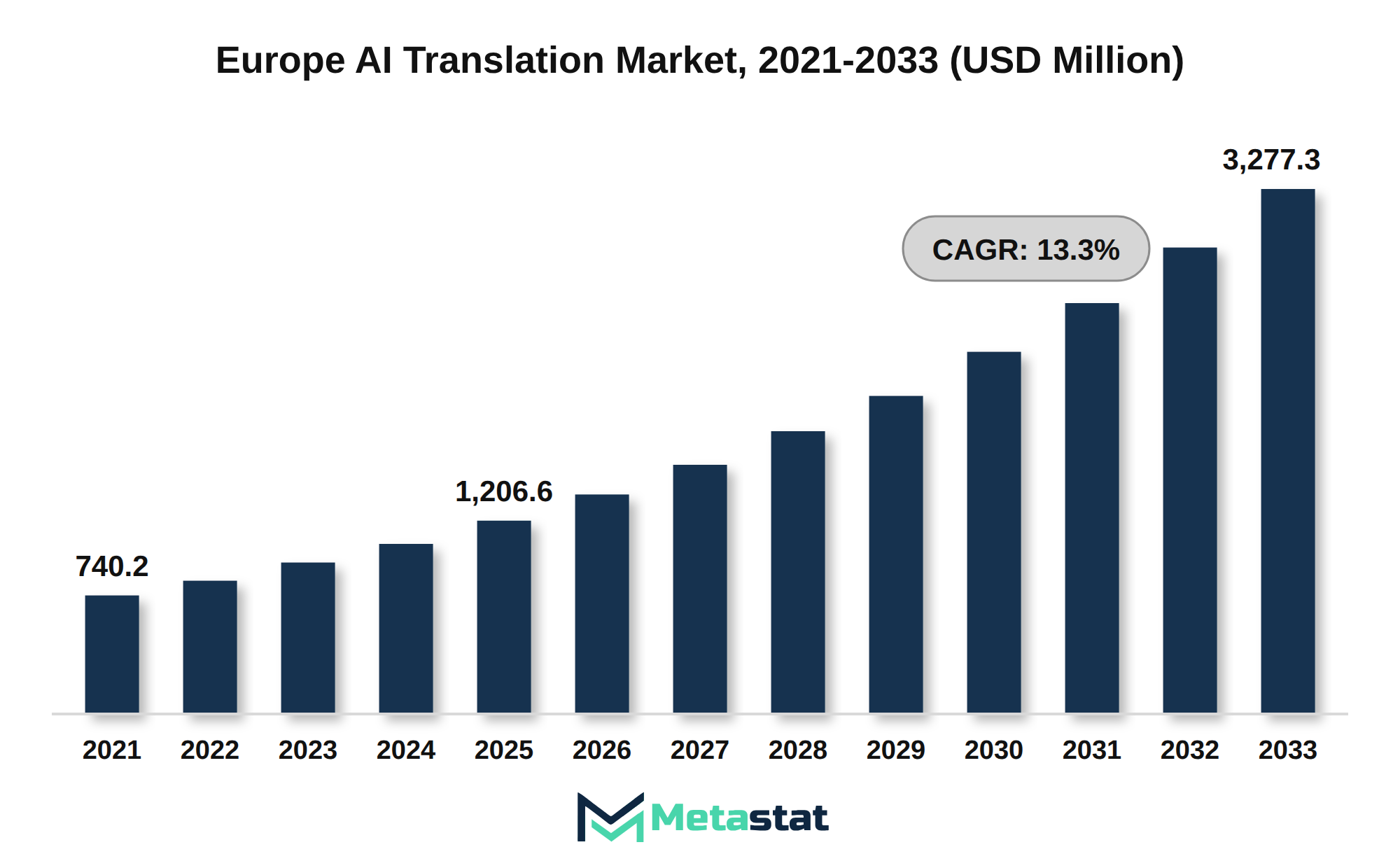
The Europe AI Translation market was valued at USD 1,206.6 million in 2025 and is projected to reach USD 3,277.3 million by 2033, growing at a CAGR of 13.3% over the forecast period.
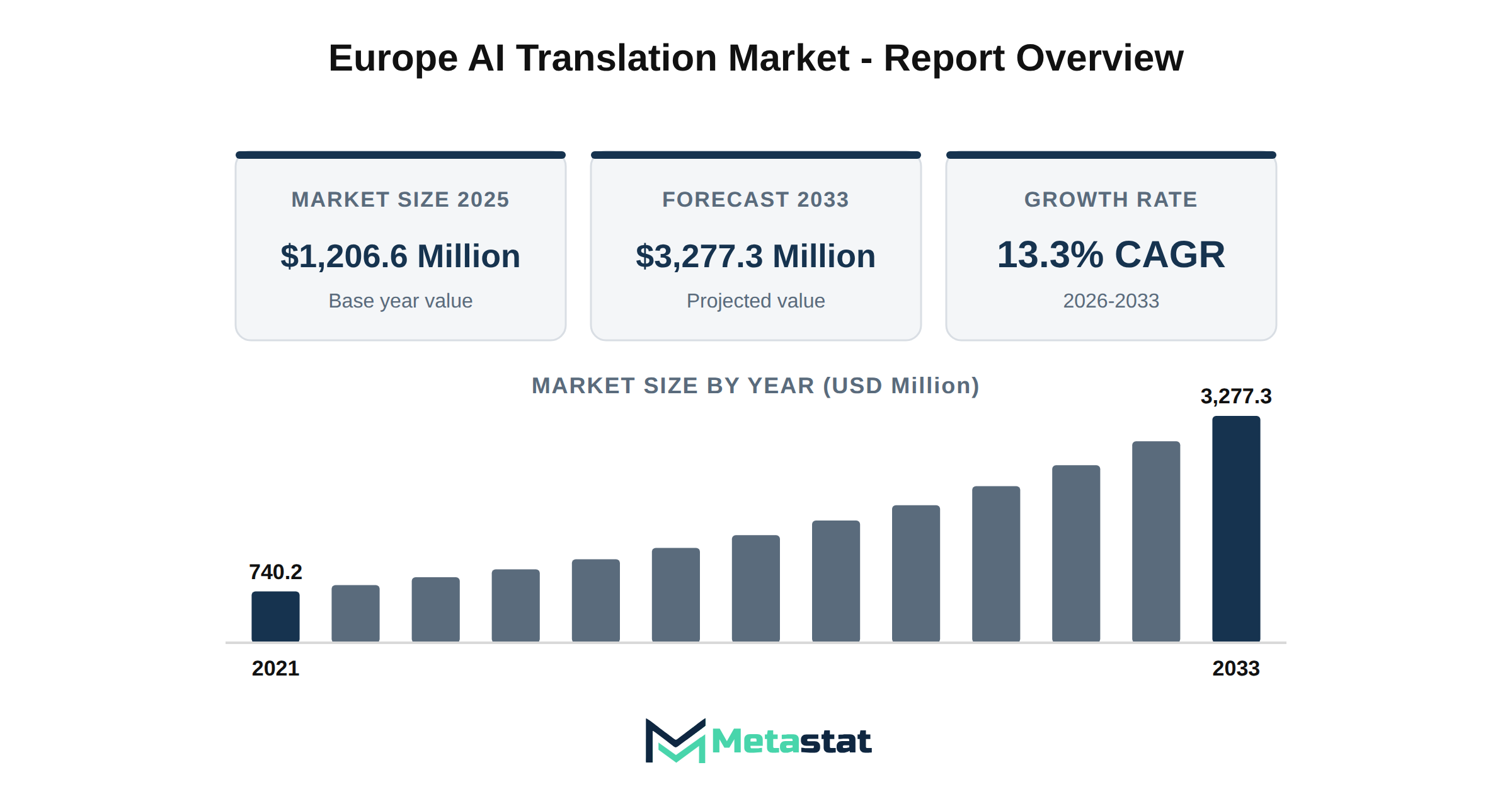
The Europe AI Translation market reached a value of USD 1,206.6 million in 2025. Forecasts indicate growth to USD 3,277.3 million by 2033, reflecting a compound annual growth rate (CAGR) of 13.3 percent. Historical data shows a steady increase from USD 740.2 million in 2021 to USD 1,061.5 million in 2024, demonstrating strong demand for AI translation solutions across various industries.
Technology types within the market include diverse applications, including Neural Machine Translation (NMT), Large Language Model (LLM)-Based Translation, Hybrid AI + Human Translation, and Adaptive/Custom AI Translation. NMT is projected to grow from USD 524 million in 2026 to USD 1,012.7 million by 2033, with a CAGR of 9.9 percent. LLM-based translation is anticipated to show the fastest growth, reaching USD 1,128.4 million by 2033 with a CAGR of 17.4 percent.
Offering types including AI Translation Software & Platforms, AI Translation APIs & Developer Services, and AI-Assisted Translation & Localization Services contribute to the market's expansion. The software and platforms segment is expected to rise from USD 461.5 million in 2026 to USD 1,049.7 million by 2033, indicating a CAGR of 12.5 percent. The APIs and developer services segment is projected to reach USD 728.9 million by 2033, reflecting a CAGR of 14.6 percent.
Content types including Text & Document Translation, Website & App Translation, and Audio, Video & Subtitle Translation represent critical areas of growth in the Europe AI Translation market. Text and document translation services are projected to grow from USD 560.3 million in 2026 to USD 1,149.7 million by 2033, with a CAGR of 10.8 percent. The website and app translation segment is projected to reach USD 743 million by 2033, demonstrating a CAGR of 13.6 percent.
The Europe AI Translation market experiences significant evolution driven by advancements in technology and increasing demand for multilingual communication. The integration of Neural Machine Translation (NMT) and Large Language Model (LLM)-Based Translation techniques enhances translation accuracy and efficiency. NMT leads the market with a share of 39.1% and is expected to grow from USD 524 million in 2026 to USD 1,012.7 million by 2033, reflecting a compound annual growth rate (CAGR) of 9.9%. LLM-Based Translation follows closely, projected to reach USD 1,128.4 million by 2033, demonstrating a robust CAGR of 17.4%.
Challenges arise from factors including regulatory compliance and geopolitical risks, which influence operational dynamics. Companies navigating these complexities invest in research and development (R&D) to innovate and adapt their offerings. Sustainable transformation initiatives gain traction, with organizations exploring decarbonization and circular economy strategies to align with global sustainability goals.
Market fragmentation presents both opportunities and challenges. A diverse range of players, including established firms and emerging startups, contributes to a competitive environment. Consolidation through mergers and acquisitions (M&A) activities is likely, enabling firms to enhance their capabilities and expand their market reach. This strategic maneuvering encourages innovation while addressing evolving customer needs.
Capital allocation remains a crucial focus, with companies prioritizing infrastructure investments to support growth. Fluctuating macroeconomic conditions, including inflationary pressures and currency volatility, impact operational costs and pricing strategies. Effectively managing these factors will influence the strategic outlook of the Europe AI Translation market, determining the competitive positioning of key players.
The Europe AI Translation market benefits from increasing demand for digital transformation initiatives across various industries. Organizations prioritize automation and the integration of advanced technologies, including artificial intelligence and machine learning, to optimize processes and enhance operational efficiency. This shift is driven by evolving consumer behaviors and preferences, alongside the necessity to streamline operations in a competitive landscape.
The push for technological integration emphasizes the importance of AI solutions in translating content accurately and efficiently, enabling businesses to expand their reach in diverse markets. Companies adopting AI translation technologies experience improved productivity and cost efficiencies, directly impacting their bottom line. The adoption of these solutions aligns with broader macro-economic trends, including GDP growth and increased capital investments in technology.
While the market evolves, organizations across sectors including IT, telecommunications, retail, and healthcare leverage AI translation tools to support their digital transformation agendas. This integration creates a collaborative environment that enhances communication and reduces barriers between global teams, ultimately contributing to revenue growth and improving market positioning in the Europe AI Translation market.
The Europe AI Translation market experiences growth influenced by macroeconomic conditions, particularly GDP growth and capital investment environments. Increased public and private spending power drives demand for advanced translation solutions, allowing organizations to expand their operational capabilities. Companies pursue competitive advantages by investing in AI translation technologies, driven by the necessity to streamline processes and enhance communication across diverse markets.
Digital transformation continues to reshape business landscapes, leading to higher adoption rates of AI translation tools. Companies prioritize technological integration to improve overall efficiency and reduce costs. This shift supports a growing emphasis on automation and software adoption to digitize legacy processes, ensuring organizations remain agile and responsive to evolving market dynamics.
Changing consumer behaviors, influenced by urbanization and demographic trends, significantly impact the demand for translation services. Businesses adapt to diverse linguistic needs, particularly within international markets. The rise in online content generation and global collaboration necessitates effective translation solutions, driving growth in the Europe AI Translation market.
Investment in innovation and R&D further supports the market's expansion. Companies focus on developing proprietary technologies and diversifying their service offerings to capture emerging opportunities. This trend creates a dynamic ecosystem where organizations utilize AI-driven solutions to enhance productivity and meet the increasing demand for localized content.
High capital investment requirements represent a significant restraint in the Europe AI Translation market. The expense associated with deploying advanced AI technologies, including neural machine translation and large language models, necessitates substantial funding that deters smaller players from entering the market. This financial barrier often leads to market fragmentation, where a limited number of established companies dominate, restricting competition and innovation.
Escalating operating costs contribute to the challenges faced by companies within the market. The ongoing need for skilled labor, coupled with rising workforce overhead, increases operational expenses. Companies allocate resources for talent acquisition and retention to maintain technological advancements, which impacts overall profitability.
Geopolitical instability disrupts investment flows and creates uncertainty in the market. Such instability leads to fluctuating demand and supply chain disruptions, complicating capital allocation decisions for businesses. This uncertainty stifles growth opportunities within the Europe AI Translation market, preventing firms from fully capitalizing on the potential of AI-driven translation solutions.
The geopolitical fragmentation across Europe creates challenges for the AI translation market, disrupting trade relationships and leading to inconsistent regulatory environments. Businesses face heightened complexities in navigating varying standards and compliance requirements across nations, affecting the speed and efficiency of market operations. These challenges increase operational costs and complicate the integration of technologies within the region, limiting overall market growth.
Trade deficits and tariff friction exacerbate market entry hurdles for AI translation providers. Suppliers experience increased costs for cross-border transactions, which limits profitability and investment capacity. This situation leads to pricing compression, intensifying margin pressures within the market and reducing the ability to invest in innovation.
Technological disruptions, alongside interoperability friction between different AI translation systems, hinder integration and collaboration among service providers. Such fragmentation slows the adoption of advanced translation solutions, reducing overall market growth and negatively impacting customer satisfaction. Evolving legal liabilities and compliance overhead contribute to an uncertain operating environment, discouraging potential investments.
Workforce skill gaps persist within the AI translation sector, affecting the availability of qualified talent needed to drive innovation and maintain competitive advantage. The challenge of attracting and retaining skilled professionals hampers operational efficiency and slows the pace of technological advancement. This issue complicates efforts to meet the changing downstream demands of clients within the market, further limiting growth potential.
Overall, the combination of geopolitical fragmentation, trade issues, and workforce challenges creates a complex situation for the Europe AI translation market. Addressing these issues will be crucial for stakeholders aiming to secure stable growth and enhance competitive positioning.
The Europe AI Translation market benefits from emerging technology advancements that enhance translation capabilities across various industries. The integration of neural machine translation and large language models enables providers to offer more accurate and context-aware translations, appealing to businesses aiming for efficiency and precision in communications. This technological evolution aligns with the ongoing digital transformation trends, encouraging companies to adopt AI-driven solutions for improving customer engagement and operational efficiency.
Infrastructure modernization efforts across Europe further fuel market growth. Investments in digital infrastructure facilitate the deployment of advanced AI translation technologies, allowing businesses to expand their global reach and serve diverse linguistic markets effectively. Enhanced connectivity supports real-time translation services, driving demand in sectors including IT & telecommunications and retail & e-commerce, where prompt and accurate communication is crucial.
Geographical expansion represents a critical opportunity within the market. Organizations increasingly recognize the value of reaching non-English speaking audiences, prompting investments in AI translation tools to streamline localization processes. This focus on expanding market presence contributes significantly to the anticipated growth rates, driven by companies seeking to adapt their content for regional markets more efficiently.
The demand for sustainability aligns with evolving buyer behaviors, emphasizing eco-friendly practices. Companies investing in green technologies increasingly prioritize AI translation solutions that support their environmental goals. This trend presents an opportunity for providers to develop specialized offerings that cater to organizations focused on sustainable operations, enhancing competitive positioning in the market.
Product integration and niche application growth represent additional avenues for market expansion. The increasing sophistication of AI translation technologies enables their incorporation into various platforms and services, enhancing user experiences. Companies adopting these integrated solutions realize improved operational yields and enhanced productivity, driving higher adoption levels across multiple sectors.
Strategic consolidation, including cross-industry mergers and acquisitions, shapes the competitive landscape of the Europe AI Translation market. Companies aiming to strengthen their market position often pursue partnerships that enhance their service offerings, contributing to a more diverse range of solutions. This consolidation trend supports innovation and accelerates technology adoption, offering a robust foundation for future growth.
The Europe AI Translation market is segmented based on Technology Type, Offering Type, Content Type, and End-Use Industry.
Neural Machine Translation (NMT) segment is valued at USD 524 million in 2026 and is projected to reach USD 1,012.7 million by 2033, at a CAGR of 9.9% during the forecast period. Demand for NMT arises from its capacity to enhance translation accuracy and efficiency, making it attractive for industries requiring precise multilingual communication. Increasing globalization and the need for businesses to cater to diverse linguistic audiences drive adoption, particularly in sectors including IT and telecommunications, retail, and healthcare.
Technological maturation contributes significantly to this segment's growth, with continuous advancements in deep learning and neural networks enabling increasingly sophisticated algorithms. Such improvements allow NMT systems to handle complex sentence structures and contextual nuances more effectively than traditional translation methods. The growing integration of NMT into various applications, including customer service, content localization, and real-time communication platforms, further supports the expansion of the Europe AI Translation market.
Investment in research and development remains crucial for capturing strategic opportunity windows, focusing on enhancing current capabilities and addressing emerging demands. Challenges including pricing volatility and margin pressures arise from the competitive landscape, prompting service providers to develop innovative pricing models and value-added services. In this dynamic environment, suppliers emphasizing quality and customization position themselves to capture market share and strengthen the long-term evolution of the NMT segment.
Growth in the Large Language Model (LLM)-Based Translation segment results from increasing accuracy and efficiency in translation tasks. Organizations across various industries prioritize effective communication, driving demand for advanced translation technologies. The integration of LLMs enhances context understanding and improves translation quality, appealing to sectors including IT, retail, and healthcare. Adoption rates rise due to businesses recognizing the value of high-quality translations in global operations, influencing overall market dynamics.
Segment expansion is influenced by continuous advancements in artificial intelligence and machine learning. LLM technology matures, and its applications evolve, allowing for more complex tasks including real-time translation and sentiment analysis. This evolution aligns with the Europe AI Translation market's trajectory, where demand for innovative solutions grows. Enhanced capabilities attract investment, further accelerating growth in this segment.
Competitive pressures within the Europe AI Translation market compel companies to adopt LLM-based solutions. Businesses seek to differentiate themselves through improved customer experiences and operational efficiencies, which LLMs facilitate. The forecast estimates that this segment is expected to reach USD 1,128.4 million by 2033, at a CAGR of 17.4% during the forecast period. This growth trajectory highlights the strategic importance of LLMs in the evolving landscape of translation services.
Hybrid AI + Human Translation represents a significant portion of the Europe AI Translation market. This segment leverages the strengths of both artificial intelligence and human expertise, resulting in superior translation accuracy and context understanding. Increasing global communication demands drive the need for efficient and accurate translation solutions, especially in sectors including IT and telecommunications, where precision is critical. In addition, the rise of remote work and global collaboration boosts adoption across various industries, enhancing the relevance of this segment.
A combination of technological maturation and next-generation upgrades drives segment expansion. Companies invest in advanced machine learning algorithms and user-friendly platforms, improving the efficiency of hybrid translation services. These developments enable organizations to cater to diverse linguistic needs while maintaining high accuracy and cultural relevance, which further stimulates demand.
Hybrid AI + Human Translation segment is expected to reach USD 628.6 million by 2033. End-use dynamics play a crucial role in shaping market strategies; businesses increasingly prioritize multilingual content to engage international audiences effectively. Regulatory compliance regulations and standards surrounding data privacy reinforce the importance of trustworthy translation services, enhancing the role of hybrid solutions in the market.
Cost structures reflect the dual nature of this offering, where investments in technology complement human resources. Pricing volatility remains a concern, urging companies to balance affordability with quality. The strategic opportunity window for investment in this segment remains robust, driven by companies seeking innovative solutions to differentiate themselves in a competitive environment. Overall, this sub-segment's growth trajectory highlights its critical role in the evolving Europe AI Translation market.
Growth in the Adaptive/Custom AI Translation segment reflects a significant trend toward personalized translation solutions tailored to specific client needs. This demand arises from industries requiring precise translations that retain contextual accuracy, particularly in sectors including IT and telecommunications, where technical jargon and specific terminologies play crucial roles. The evolving landscape of the Europe AI Translation market drives innovation in technologies that enhance customization capabilities, allowing businesses to better engage with localized audiences.
The segment is projected to grow at a CAGR of 13.7% during the forecast period. Increasing investments in artificial intelligence and machine learning technologies support the segment's development, with organizations seeking competitive advantages through improved communication strategies. Companies prioritize adaptive solutions that address unique operational requirements, facilitating better user experiences and driving further adoption.
Technological maturation drives significant enhancements in adaptive systems, expanding their integration into various applications. These advancements enable communication across diverse content types, including marketing materials and customer support resources. The appetite for customized solutions reflects a broader trend of consumption shifts towards more responsive and context-aware translation, ultimately enhancing productivity and engagement in the Europe AI Translation market.
Cost structures associated with Adaptive/Custom AI Translation require careful consideration, owing to investment in technology infrastructure and talent development being necessary for sustained growth. Companies focus on optimizing pricing models to balance affordability with quality, ensuring that clients receive tailored services that justify their costs. This careful navigation of pricing volatility strengthens market positions and encourages further investment in advanced translation technologies.
Valued at USD 461.5 million in 2026, the AI Translation Software & Platforms segment is projected to reach USD 1,049.7 million by 2033, reflecting a CAGR of 12.5% during the forecast period. This growth results from several primary demand drivers including the increasing need for efficient translation solutions in various industries. The expansion of global business operations drives organizations to adopt these technologies for effective multilingual communication.
Technological maturation influences the segment's evolution. Advances in artificial intelligence and machine learning lead to improved translation accuracy and efficiency. Adoption of next-gen upgrades further enhances user experience, enabling businesses to tailor translation solutions to their specific needs. Increased consumption shifts towards digital content drive demand for AI translation software, particularly in sectors including IT and e-commerce, where quick turnaround times are essential.
Regulatory compliance standards influence market dynamics. Organizations seek certified translation solutions to meet legal requirements, especially in industries like healthcare and finance. Pricing volatility and margin pressures from emerging competitors challenge established players, necessitating innovative pricing strategies and cost structures. Strategic opportunity windows arise for providers that deliver high-quality, customizable solutions at competitive prices.
Supply chain resilience remains a crucial consideration, driven by disruptions that impact service delivery. The segment's growth aligns with increasing demand for adaptable solutions that withstand market fluctuations. The Europe AI Translation market reflects a trend towards integrating translation software and platforms into broader digital transformation initiatives across various sectors.
Demand for AI Translation APIs & Developer Services stems from the increasing need for integration of translation capabilities into various applications, enhancing user experience and operational efficiency. The expansion of this segment is driven by rising digitalization across industries, prompting businesses to adopt advanced translation solutions to cater to diverse linguistic needs. Increased reliance on cloud-based solutions and the growing adoption of artificial intelligence in software development further support market growth. Organizations across sectors including retail, healthcare, and telecommunications seek to utilize these APIs for real-time translation, streamlining communication and content localization.
The segment is estimated to reach USD 728.9 million by 2033, at a CAGR of 14.6% during the forecast period. Technological maturation in machine learning and natural language processing facilitates the continuous evolution of APIs, providing more accurate and context-aware translation. Companies are integrating these services into their platforms to achieve competitive advantages, driving innovation in product offerings.
Adoption dynamics indicate a strong preference for customizable solutions, allowing businesses to tailor translation capabilities to specific industry requirements. Regulatory compliance standards and certifications related to data privacy and security further influence market dynamics, prompting providers to enhance their offerings. Capital investment in developing robust API solutions supports growth, driven by organizations allocating resources toward improving service quality and expanding market reach. The Europe AI Translation market reflects a strategic opportunity window for developers and service providers focused on advancing their technological capabilities.
Growing interest in AI-Assisted Translation & Localization Services stems from the increasing need for accurate and efficient translation across various industries, particularly in IT & telecommunications, retail, and healthcare. The demand for localization services aligns with the globalization of businesses, driving the need for effective communication in multiple languages. AI-powered solutions offer enhanced capabilities in streamlining the translation process, significantly improving turnaround times and reducing costs.
Technological advancements lead to the maturation of AI-assisted services, pushing providers to integrate next-gen upgrades into their offerings. These developments contribute to the segment's evolution, ensuring alignment with consumer expectations for high-quality translations. The introduction of adaptive algorithms enhances user experience and boosts overall satisfaction. Regulatory compliance and certification requirements further emphasize the importance of high standards in service delivery, influencing service providers to focus on maintaining quality.
Valued at USD 627.6 million by 2033, the segment is projected to capture an increasing share of the overall Europe AI Translation market. This growth results from a combination of strategic investment opportunities and shifting consumption patterns, where businesses prioritize efficiency and effectiveness in their translation efforts. Overall, the segment's expansion reflects the dynamic nature of the market, responding to both technological advancements and evolving user needs.
Growth in the AI-Powered Translation Management & Workflow Solutions segment reflects a commitment to enhancing operational efficiency within the Europe AI Translation market. Organizations increasingly adopt these solutions to streamline translation processes, mitigate errors, and improve time-to-market for multilingual content. This trend results from escalating demand for real-time communication and integration across platforms, driving the need for advanced management tools that handle complex workflows.
The segment is projected to grow at a CAGR of 13.5% during the forecast period. Continuous advancements in artificial intelligence and machine learning technologies contribute to this expansion, enabling more sophisticated translation management capabilities. Businesses operating in sectors including IT, telecommunications, and retail increasingly require these solutions to meet diverse customer needs and ensure compliance with evolving regulations.
Technological maturation shapes this segment. Enhanced features, including automated quality assurance and predictive analytics, build greater user confidence and wider adoption. Companies investing in AI-Powered Translation Management & Workflow Solutions position themselves to respond to the dynamic demands of the Europe AI Translation market.
Pricing volatility represents a significant consideration for businesses seeking to implement these solutions. Market participants navigate fluctuating costs associated with software licensing, support, and maintenance. The potential for improved return on investment through enhanced productivity and reduced operational costs continues to drive interest in these offerings.
Strategic opportunity windows present themselves owing to companies increasingly recognizing the importance of efficient translation processes. Investment in AI-Powered Translation Management & Workflow Solutions provides businesses with the tools necessary to enhance their competitive edge, respond to emerging market needs, and adapt to shifting consumer expectations.
Adoption of AI-Powered Speech & Voice Translation within the Europe AI Translation market responds to increasing requirements for real-time communication solutions across diverse industries. Organizations prioritize enhancements in customer interaction, collaboration efforts, and accessibility for users speaking different languages. This segment experiences demand from sectors including IT and telecommunications, retail, healthcare, and education, where effective communication is essential for operational success.
Technological maturation drives advancements in AI-Powered Speech & Voice Translation, leading to next-generation upgrades that significantly improve accuracy and contextual understanding. The integration of machine learning algorithms and natural language processing has resulted in sophisticated voice translation systems capable of handling various dialects and accents. Enhanced capabilities in this segment support greater market penetration, creating new applications and use cases.
Downstream applications of speech and voice translation solutions contribute to increased engagement levels in customer service and support environments. Companies leverage these technologies to enhance their multilingual support frameworks, ensuring effective interactions for customers worldwide. Consequently, businesses experience improved efficiency and reduced operational costs while serving diverse client bases.
Regulatory compliance standards, particularly regarding data privacy and security, influence the development of AI-Powered Speech & Voice Translation solutions. Organizations investing in these technologies adhere to regulations, ensuring customer data protection during the processing of voice inputs. This emphasis on compliance leads to additional costs, strengthening trust and brand reputation in the market.
Strategic opportunity windows emerge from the increasing demand for personalized experiences and localized content. Firms that prioritize innovation in AI-Powered Speech & Voice Translation capture greater market share by developing tailored solutions that address specific customer needs and preferences. The ongoing evolution of voice technologies presents avenues for investment and collaboration among stakeholders, improving overall market dynamics.
Valued at USD 560.3 million in 2026, the Text & Document Translation segment is projected to reach USD 1,149.7 million by 2033, at a CAGR of 10.8% during the forecast period. Demand for text and document translation services stems from the increasing globalization of businesses, requiring effective communication across multiple languages. Key industries, including IT, telecommunications, and e-commerce, significantly drive this demand, because accurate translations enhance customer engagement and operational efficiency.
Technological advancements in artificial intelligence, particularly in neural machine translation and large language models, enhance the quality and speed of translations. Enhanced capabilities facilitate integration into various applications, driving further adoption across diverse sectors. The shift towards remote work and digital communication increases the reliance on effective translation solutions, making this segment crucial for businesses seeking to expand their international reach.
Regulatory compliance standards and certifications within specific industries create a pressing need for high-quality translation services. Companies operating in regulated environments adhere to stringent language requirements, ensuring that documentation meets local legal and technical standards. This demand for compliance-driven translation services contributes to the growth of the market.
Pricing volatility impacts profit margins for service providers within the market. Fluctuations in the costs of raw materials and technology maintenance influence operational costs, with companies facing pressures to balance quality and affordability. Strategic investments in technology and infrastructure are essential for maintaining competitive advantage and meeting evolving customer expectations.
In a market characterized by rapid technological obsolescence, firms focus on continuous innovation and product evolution to remain relevant. The emergence of disruptive alternatives, including automated translation tools, presents both challenges and opportunities. Companies that adapt to these changes effectively capture significant market share, driving growth in the Europe AI Translation market.
Website and App Translation is essential in the Europe AI Translation market, reflecting the increasing demand for localized digital content. This segment is estimated to reach USD 743 million by 2033, at a CAGR of 13.6% during the forecast period. The expansion stems from businesses prioritizing user experience and engagement across diverse languages and cultures, directly influencing customer retention and market reach.
The surge in e-commerce and mobile applications drives companies to invest in translation solutions that enhance accessibility and broaden customer bases. Increasing competition in the digital landscape necessitates rapid adaptation to changing consumer preferences, propelling demand for effective translation strategies. Enterprises recognize that localized content directly correlates with improved conversion rates and customer satisfaction, emphasizing the importance of this segment.
Technological maturation within AI-powered translation systems accelerates the evolution of Website and App Translation. Next-generation upgrades in machine learning algorithms enhance translation accuracy and contextual understanding, significantly impacting user interaction. Consequently, organizations encounter fewer barriers when entering new markets, creating an environment conducive to growth.
Regulatory compliance standards further influence the demand for accurate translation services, particularly in industries including finance and healthcare. Adherence to local regulations necessitates precise communication, compelling organizations to invest in reliable translation solutions. This emphasis on compliance, coupled with evolving consumer expectations, ensures sustained interest in Website and App Translation services.
The increasing demand for high-quality content across digital platforms drives significant interest in the Audio, Video & Subtitle Translation segment within the Europe AI Translation market. Businesses recognize the necessity of effectively reaching diverse audiences, which increases the need for accurate translations in multimedia formats. This segment is projected to reach USD 608.6 million by 2033, reflecting ongoing advancements in AI technologies and an increasing focus on improving user experiences through localized content.
Technological maturation is essential in segment expansion, with improved algorithms enabling faster processing of audio and video files while maintaining high accuracy. These advancements facilitate real-time translation capabilities, which are essential for live broadcasts, conferences, and interactive media. The integration of AI tools with existing production workflows enhances operational efficiencies, significantly reducing turnaround times and costs associated with traditional translation methods.
End-use dynamics within various industries, including entertainment, education, and corporate communications, significantly influence market growth. The increasing shift towards remote collaboration and online content consumption increases the need for comprehensive translation solutions that cater to diverse linguistic audiences. While businesses focus on global outreach strategies, the demand for accurate audio, video, and subtitle translations continues to rise, reinforcing the segment's position within the broader Europe AI Translation market.
Demand for Real-Time Conversational Translation has surged due to the increasing globalization of businesses and the need for effective communication across diverse languages. Organizations prioritize effective interaction with customers and partners, leading to rising investments in advanced translation technologies. This segment is projected to grow at a CAGR of 18.8% during the forecast period. Technological advancements in natural language processing and machine learning significantly enhance the accuracy and efficiency of real-time translation services, enabling better user experiences.
The end-use dynamics reflect a shift toward remote communication solutions, further fueling demand within the Europe AI Translation market. Industries including IT, telecommunications, and customer service adopt real-time conversational translation to streamline operations and enhance customer engagement. Increasing reliance on digital platforms for communication encourages the implementation of these solutions across various sectors, driving the segment's growth trajectory.
Regulatory compliance standards and certifications contribute to the segment's evolution, ensuring that translation services meet industry-specific requirements. These standards influence the cost structures and pricing strategies of service providers, shaping the competitive environment. The demand for high-quality, efficient translation solutions aligns with evolving consumer preferences, demonstrating a clear trajectory toward growth in the real-time conversational translation segment.
Demand for Marketing & Creative Content Translation stems from the increasing necessity for businesses to engage with diverse audiences across various platforms. The significant shift towards digital marketing increases the need for accurate and culturally relevant translations that connect with local audiences. Content creators and marketing professionals recognize the importance of tailored messaging, driving investments in advanced translation technologies.
Continuous technological advancements play an important role in shaping this segment. Innovations in AI-driven translation solutions enhance the quality and speed of translations, facilitating real-time updates essential for dynamic marketing campaigns. While marketing strategies evolve, reliance on high-quality translations becomes critical for maintaining brand image and customer trust.
End-use dynamics indicate a growing focus on personalized experiences in marketing. Companies invest in translation services that ensure content aligns with regional preferences and cultural nuances. This approach builds brand loyalty and expands market reach, highlighting the strategic significance of Marketing & Creative Content Translation within the Europe AI Translation market.
Consumption shifts reflect a preference for content that engages consumers on various digital channels. The proliferation of social media and online platforms necessitates adaptation of marketing content for specific demographics. Businesses prioritizing high-quality translations are likely to see improved engagement rates and conversion metrics, reinforcing the value of this segment.
Pricing volatility and margin pressures specific to this segment impact the overall market landscape. Increased demand for high-quality translations leads to higher costs, prompting companies to explore cost-effective solutions without compromising quality. Strategic investments in translation technologies and services reflect a commitment to enhancing competitive positioning within the Europe AI Translation market.
Rapid advancements in AI technology drive significant changes within the IT and telecommunications sector, leading to enhanced communication and operational efficiency. Increased globalization encourages companies in this sector to seek robust translation solutions that support multilingual interactions and improve user experience. The rise of cloud-based services and remote work environments heightens the demand for effective AI translation technologies, enabling collaboration across diverse regions and languages. Regulatory compliance standards in various jurisdictions further drive the need for accurate and efficient translation services, ensuring that companies meet legal and operational requirements.
Growing consumer expectations for localized content compel businesses in the IT and telecommunications industry to invest in AI-powered translation solutions that deliver high-quality translations rapidly. The emergence of next-gen upgrades in AI translation technology, including improved neural machine translation and large language models, significantly influences the market, enhancing accuracy and reducing turnaround times. Strategic opportunities arise from the increasing integration of translation solutions into existing platforms, improving service offerings and competitive advantage.
In this evolving landscape, consumption shifts towards personalized and context-aware translation services, addressing the unique needs of different user segments. The market faces pressures related to cost structures and pricing volatility, highlighting the importance of efficient resource allocation and operational optimization. Ongoing technological maturation within AI translation solutions supports continuous improvements in performance metrics, positioning companies to adapt to dynamic market demands effectively.
Retail and e-commerce sectors increasingly rely on AI translation technologies to enhance their global reach and customer engagement. The expansion of these sectors drives demand for accurate and efficient translation solutions that cater to diverse languages and cultures. Businesses prioritize effective communication with their customers, leading to the adoption of advanced AI-powered translation tools that enable real-time interactions and localized content delivery.
Technological maturation within AI translation solutions significantly impacts the retail and e-commerce landscape. Innovations in neural machine translation and large language model-based systems improve the quality and efficiency of translations. These advancements enable businesses to create personalized shopping experiences, improve customer satisfaction, and build brand loyalty.
Adoption of AI translation technologies aligns with the growing trend of online shopping and digital transformation across the retail space. Businesses seek to capitalize on the increasing consumer preference for localized content and multilingual support, which enhances their competitive edge. Strategic investments in AI translation contribute to optimized marketing campaigns and product offerings tailored to local markets, strengthening long-term demand.
Regulatory compliance standards influence the deployment of AI translation solutions, particularly regarding data privacy and security in various regions. Companies operating in the retail and e-commerce sectors benefit from ensuring adherence to these regulations, which builds consumer trust and mitigates risks associated with data breaches. The need for compliance encourages firms to implement robust AI translation systems capable of handling sensitive information securely, reinforcing the segment's position.
With the competitive landscape in the Europe AI Translation market becoming increasingly dynamic, businesses in the retail and e-commerce sectors adapt to changing consumer demands and technological advancements. Strategic opportunity windows continue to emerge, allowing companies to distinguish themselves through innovative applications of AI translation technologies and enhanced customer engagement strategies, increasing investment across the value chain.
AI translation technologies in the BFSI sector experience increasing adoption due to regulatory compliance requirements and the necessity for accurate communication across different languages. Financial institutions prioritize speed and precision in translations to ensure efficient operations and enhance customer interactions. The demand for real-time translation capabilities is particularly significant in this sector, driven by globalization and the serve diverse client bases effectively.
Growing reliance on digital banking solutions further increases the requirement for efficient translation services. The BFSI sector benefits from AI-powered translation solutions that improve communication processes, reduce operational costs, and enhance service delivery. Financial institutions leverage these technologies to navigate complex regulatory landscapes and improve customer experiences across various platforms.
Investment in next-generation technologies within the Europe AI Translation market continues to shape the capabilities and offerings tailored to the BFSI industry. Financial service providers seek innovative solutions to address translation challenges, particularly in areas like risk management, compliance documentation, and client communications. This evolution reflects a strategic response to the changing demands of the financial environment, positioning AI translation because a critical enabler for growth and efficiency.
Competition within the BFSI segment of the market intensifies because technology providers innovate to capture market share. The emergence of specialized translation solutions tailored for financial applications offers significant opportunities for differentiation. Organizations increasingly recognize the importance of accurate and timely translations. The BFSI sector stands poised for substantial advancement in its use of AI translation technologies.
Investment in AI translation technologies within the healthcare and life sciences industry reflects growing recognition of the importance of accurate communication in patient care and medical research. Increased globalization in healthcare necessitates effective communication across linguistic barriers, driving demand for advanced translation solutions that ensure clarity in medical documentation, patient interactions, and research collaborations.
The complexity of medical terminology presents unique challenges, prompting healthcare organizations to seek tailored translation services that maintain accuracy and context. Regulations surrounding patient data and medical communications heighten the need for compliance and precision in translation, further emphasizing the need for specialized solutions within the Europe AI Translation market.
Technological advancements in AI translation, including neural machine translation and large language models, contribute to improved translation quality and efficiency. These innovations enhance the ability to process medical texts, research papers, and patient records, improving workflows and reducing the time required for translation tasks.
Strategic opportunities arise within the segment owing to organizations exploring partnerships with technology providers to enhance their translation capabilities. Collaborative efforts focus on integrating AI translation with existing healthcare systems, enabling smoother information exchange among various stakeholders. This integration supports better decision-making and improved patient outcomes, ultimately driving further adoption of AI translation technologies.
The rising demand for multilingual patient engagement strategies compels healthcare providers to invest in AI translation solutions that enable personalized communications with diverse patient populations. This shift in focus towards patient-centric approaches creates a more inclusive healthcare environment, aligning with broader trends in public health and service delivery.
In the manufacturing and automotive sector, the integration of AI translation technologies enhances operational efficiency and streamlines communication across multiple languages. This sector increasingly adopts these solutions to facilitate collaboration among international teams, suppliers, and customers, ensuring accurate and timely information exchange. The demand for precise documentation, technical specifications, and regulatory compliance drives the need for advanced translation capabilities.
Next-generation upgrades in AI translation tools focus on improving accuracy and contextual understanding, which align with the specific needs of manufacturing and automotive applications. Emerging technologies, including neural machine translation, deliver significant enhancements in processing speed and accuracy, addressing challenges faced in translating complex technical content.
Regulatory compliance remains a critical factor for manufacturers operating in diverse markets. Adoption of AI translation solutions aids businesses in adhering to industry standards, ensuring accurate localization of product documentation, safety instructions, and compliance reports. This focus on compliance supports market growth and encourages investment in AI translation technologies.
Strategic opportunities arise from consumption shifts within the manufacturing and automotive sectors, particularly in the transition towards sustainable practices and smart manufacturing. Companies investing in AI translation solutions leverage these advancements to tap into new markets and enhance customer engagement through localized marketing and customer service efforts. The Europe AI Translation market benefits from these dynamics, reflecting the growing importance of effective communication in global supply chains.
Manufacturers increasingly integrate digital technologies into their operations, driving demand for AI translation solutions. Organizations recognize the value of accurate, real-time translations for enhancing collaboration across multilingual teams and optimizing operational processes. This trend positions the market for growth, driven by the evolving needs of the manufacturing and automotive industries.
The adoption of AI translation solutions within government and public sector organizations reflects a strategic response to the increasing necessity for multilingual communication. Rising globalization necessitates efficient interactions across diverse linguistic groups, driving demand for effective translation tools. Regulatory compliance standards emphasize the importance of accurate translations for legal and documentation purposes. This growing focus on compliance influences organizations to invest in robust AI translation technologies capable of providing high-quality outputs.
Governments and public sector entities recognize the value of AI translation in enhancing service delivery and citizen engagement. Adoption facilitates improved accessibility to information for non-native language speakers. The ongoing digital transformation within public services further accelerates the integration of AI-driven translation solutions, enabling agencies to streamline operations and enhance communication efficiency.
Investment in AI translation technologies positions government organizations to address challenges posed by linguistic diversity while reducing operational costs associated with manual translation processes. Enhanced productivity and reduced turnaround times contribute to better service outcomes, reinforcing the strategic importance of these technologies within the Europe AI Translation market.
Technological maturation in AI translation solutions enables public sector entities to leverage next-generation upgrades. These advancements ensure that translation tools evolve in response to changing linguistic patterns and communication needs. Organizations within this segment capitalize on strategic opportunities, utilizing AI's capabilities to enhance public outreach and engagement initiatives.
Demand for AI translation solutions within the travel and hospitality industry arises from the need for effective communication across diverse languages and cultures. Globalization and a rise in international travel drive this demand, prompting hotels, airlines, and travel agencies to seek efficient translation technologies. Emphasis on customer experience heightens the necessity for accurate translations of marketing materials, websites, and real-time communications. Technological maturation enhances the industry's ability to integrate AI translation tools into existing workflows. Innovations in neural machine translation and large language models reduce the barriers to adoption, allowing businesses to leverage these technologies effectively. The ongoing evolution of AI-powered translation platforms facilitates next-generation upgrades, improving accuracy and context sensitivity. Regulatory compliance standards further influence the adoption of AI translation solutions. Businesses within the travel and hospitality sector adhere to various legal requirements when communicating with international customers. Ensuring compliance with data protection regulations while providing high-quality translations becomes essential for maintaining customer trust and satisfaction. Cost structures and pricing volatility represent critical factors impacting the industry's operational dynamics. Companies strive to balance the expense of implementing advanced translation technologies against the potential benefits of increased customer engagement and retention. The margin pressures from fluctuating costs of technology development and service delivery create a competitive environment where efficiency becomes vital. Strategic opportunity windows emerge due to businesses identifying unmet needs for tailored translation services that address the unique demands of the travel and hospitality industry. Targeting specific market segments, including luxury travel or niche tourism, allows companies to differentiate their offerings and enhance profitability. The evolving market of AI translation solutions positions the industry for continued growth and innovation.
Legal and professional services increasingly adopt AI translation technologies to enhance operational efficiency and respond to diverse client needs in multilingual environments. This segment benefits from rising global interactions, necessitating accurate and timely translation services. AI solutions reduce the time and costs associated with traditional translation methods, allowing firms to allocate resources more effectively.
Technological advancements in AI translation drive competition among service providers, spurring innovation and the development of next-generation tools tailored to legal and professional applications. Regulatory compliance presents unique challenges, requiring firms to integrate solutions that meet stringent standards and maintain client confidentiality. Increased focus on data security and compliance with privacy regulations influences technology selection within this segment.
Market dynamics highlight the importance of ongoing investments in training and development for professionals to leverage AI tools effectively. The continuous evolution of AI translation capabilities enhances accuracy and contextual understanding, which are crucial for the legal and professional services landscape. Competition among providers intensifies, prompting firms to differentiate their offerings through quality, speed, and specialization.
Education institutions increasingly adopt AI translation technologies to enhance learning experiences and broaden accessibility for non-native speakers. The demand stems from the need for high-quality, accurate translations of educational materials, which facilitate better comprehension and engagement among students from diverse linguistic backgrounds. Educational content management systems emphasize the importance of real-time translation capabilities, allowing institutions to provide multilingual support for courses, resources, and communications.
Technological advancements drive segment expansion within the education sector, with next-generation upgrades enabling institutions to integrate AI translation solutions seamlessly. These upgrades enhance user interaction and ensure that educational materials remain relevant and accessible. The market benefits from a growing emphasis on personalized learning experiences, where AI translation tools support tailored educational content for individual student needs.
Education institutions increasingly recognize the value of AI-driven translation tools in promoting global collaboration and partnerships. With the rise of online learning platforms, educational content caters to diverse audiences, reinforcing the role of AI translation in breaking down language barriers. This shift creates a more inclusive learning environment, enhancing the overall quality of education across Europe.
Compliance with regulatory standards becomes crucial due to educational institutions incorporating AI translation technologies. Adherence to language accessibility and inclusivity guidelines promotes equity in education and supports the diverse needs of students. Institutions investing in these solutions position themselves to remain competitive in an evolving educational landscape, contributing to growth in the Europe AI Translation market.
In the evolving Europe AI Translation market, sectors including media and entertainment, energy and utilities, and food and beverages experience unique dynamics that drive demand for advanced translation solutions. Growth in these industries arises from the necessity for accurate and efficient communication across diverse languages and cultures, enabling companies to reach a broader audience. Increasing globalization of content, rapid digitalization, and the need for localized customer experiences enhance adoption of AI translation technologies.
Media and entertainment stakeholders leverage AI translation to enhance user engagement and accessibility by providing content in multiple languages. This trend creates a richer experience for consumers, ensuring that films, television shows, and online platforms cater to various linguistic demographics. In the energy and utilities sector, effective communication surrounding regulations, safety protocols, and customer service plays a critical role, requiring precise translations to maintain compliance and operational efficiency. The food and beverages industry benefits from localization strategies that target specific markets, enhancing branding and consumer connection through culturally relevant messaging.
Strategic investments in technology and infrastructure within these sectors signal a shift towards comprehensive translation solutions that combine AI with human expertise. Companies prioritize innovative tools that enable real-time translations and cater to specific content types, enhancing overall communication effectiveness. This evolution underlines the significance of AI translation in promoting collaboration and connectivity within the Europe AI Translation market.
Strategic consolidation and mergers significantly influence the competitive landscape within the Europe AI Translation market. Companies engage in acquisitions to enhance their technological capabilities and expand service offerings. This trend reinforces market positions and supports innovation while enhancing customer retention through improved value propositions.
Companies implement diverse go-to-market strategies to address varying customer needs across industries including IT and telecommunications, retail, and healthcare. These strategies enable product differentiation, allowing firms to cater to specific requirements and maintain competitive advantages. Strategic alliances and joint ventures with technology partners contribute to creating robust ecosystems that enhance product capabilities.
Technological maturation shapes the competitive dynamics. Advancements in neural machine translation and large language models create new opportunities for companies to innovate and enhance translation accuracy. R&D pipelines prioritize next-generation upgrades, ensuring that firms remain leaders in technological evolution.
Cost structures and pricing architectures influence market strategies, leading to variations in service affordability and accessibility. Companies focus on optimizing operational efficiencies to mitigate pricing volatility, enhancing margins. Customer retention strategies, supported by strong brand equity, result in reduced switching costs and increased loyalty.
Intellectual property portfolios serve because a defensive mechanism against competitive threats, ensuring firms maintain unique technological advantages. Understanding future competitive outlooks aids companies in identifying strategic growth vectors, aligning investment priorities with emerging market demands.
Market size is forecast to rise from USD 1,206.6 million in 2025 to over USD 3,277.3 million by 2033. Increasing reliance on AI translation technologies within various industries drives growth in the Europe AI Translation market. Factors including globalization and the need for real-time communication spur demand for efficient and accurate translation capabilities. Businesses across different sectors adopt AI translation to enhance operational efficiency and improve customer engagement, contributing to market expansion.
The shift towards advanced translation methods, including Neural Machine Translation (NMT) and Large Language Model (LLM)-based systems, accelerates the evolution of translation solutions. Adoption of these technologies streamlines workflows, reduces time-to-market, and lowers costs associated with human translation. Enhanced accuracy and faster turnaround times strengthen competitive positioning for organizations leveraging AI translation.
Investment in research and development fuels technological maturation, resulting in next-generation upgrades that further enhance translation quality and functionality. This continuous evolution creates strategic opportunity windows for new entrants and established players in the market. Rising consumer expectations for multilingual support in services and products reinforce the need for innovative solutions.
Overall, the Europe AI Translation market demonstrates strong growth potential driven by increasing demand, technological advancements, and evolving industry dynamics. The market positions itself to cater to the expanding needs of organizations seeking to enhance their global reach and operational capabilities.
Growth in the Europe AI Translation market reflects the increasing reliance on efficient translation solutions across various industries. The IT and telecommunications sector drives primary demand, with enterprises seeking to enhance communication and operational efficiency through AI translation technologies. Retail and e-commerce companies contribute to segment expansion, focusing on localized customer experiences to drive engagement and sales.
Technological maturation enables advancements in neural machine translation, large language models, and hybrid AI systems that provide superior translation accuracy and speed. Next-gen upgrades in AI capabilities enhance user experiences, facilitating real-time translation across multiple content types. These developments encourage increased adoption among diverse end-use industries, including healthcare, BFSI, and government.
Consumption shifts towards AI-powered solutions are evident, driven by the demand for streamlined processes and improved customer interactions. Regulatory compliance standards and certifications influence market dynamics, ensuring the reliability and security of AI translation solutions. The evolution of pricing structures and margin pressures within the market reflects the competitive landscape, pushing companies to innovate and optimize their offerings continuously.
Strategic opportunity windows emerge owing to organizations identifying white-space areas within the market, targeting unmet needs for customized solutions and advanced features. Capital investment outlook remains positive, with stakeholders committed to funding innovative projects that enhance the capabilities and reach of AI translation technologies.
The shift toward advanced translation technologies drives significant changes in the Europe AI Translation market, particularly within the Technology Type segment. Neural Machine Translation (NMT) leads the segment, with organizations seeking efficient and accurate translation capabilities, resulting in increasing adoption across various industries. The rise of Large Language Model (LLM)-Based Translation reflects the demand for deeper contextual understanding and nuanced translations, aligning with the needs of businesses operating in multilingual environments.
Hybrid AI and Human Translation solutions offer a balanced approach, combining automation with human expertise. This combination appeals to industries requiring high precision, including legal and healthcare, where accuracy in translation holds substantial implications. Adaptive and Custom AI Translation technologies cater to unique business requirements, ensuring tailored solutions that enhance operational efficiency.
Technological maturation in AI translation tools leads to continuous improvements in quality, speed, and cost-effectiveness. Next-generation upgrades incorporate advancements like machine learning and natural language processing, which enhance translation accuracy. These developments create strategic opportunity windows for organizations seeking to optimize their communication strategies across diverse markets.
Downstream application trends indicate a growing reliance on AI translation for content localization, marketing materials, and customer engagement. Consumption shifts toward real-time translation services highlight the increasing demand for immediate and accurate communication, especially in the context of global business operations. Regulatory compliance standards and certifications play a critical role, ensuring that translation solutions adhere to industry-specific requirements, particularly in regulated sectors including finance and healthcare.
Cost structures and pricing volatility influence decision-making within the market. Organizations assess the trade-offs between upfront investments and long-term savings associated with efficient translation processes. Competitive pressures prompt investments in robust supply chain resilience, raw material sourcing, and logistics to mitigate vulnerabilities that could disrupt translation services. The presence of disruptive alternatives highlights the need for ongoing innovation and adaptation within the market.
Technological advancements in Neural Machine Translation (NMT) drive demand for improved accuracy and efficiency in multilingual communication. Adoption of NMT occurs across various industries, including IT and Telecommunications, where precise translations enhance customer engagement and operational efficiency. The need for real-time translation capabilities generates significant interest from businesses aiming to penetrate global markets, increasing competition among providers.
Ongoing evolution in NMT technologies highlights the importance of AI-driven solutions that adapt to specific language contexts and user preferences. Enhanced algorithms and data-driven models improve translation quality, appealing to sectors that rely heavily on accurate content localization. Businesses experience increased productivity through these solutions, allowing them to focus on core activities while outsourcing complex translation tasks.
Regulatory compliance and standardization within various industries further influence the adoption of NMT. Companies prioritize solutions that align with legal and quality standards, ensuring adherence to regional requirements while expanding their global reach. Such dynamics reinforce the growing reliance on advanced translation technologies, creating a competitive environment that emphasizes service differentiation and innovation.
The cost structures associated with NMT solutions reflect the technological investment required to maintain high-quality services. Providers face margin pressures linked to the rapid pace of technological change and evolving customer expectations. Strategic investments in R&D and partnerships with technology firms enable market participants to enhance their offerings and navigate the competitive landscape effectively, ensuring sustainability in the growing Europe AI Translation market.
Growing interest in Large Language Model (LLM)-Based Translation injects vigor into the Europe AI Translation market. Demand for highly accurate and contextually aware translations fuels adoption across various sectors, including IT and telecommunications, healthcare, and retail. Enhanced capabilities of LLMs, which leverage vast datasets for language processing, significantly improve translation quality, prompting enterprises to integrate these technologies into their workflows.
Investment in next-generation upgrades drives segment expansion. Companies focus on refining LLM algorithms, improving efficiency, and reducing operational costs. The increasing availability of cloud-based solutions broadens access to these advanced translation capabilities, encouraging organizations to experiment with LLMs for diverse applications, including real-time customer interactions and localization of marketing materials.
End-use dynamics indicate a shift towards personalized and localized content, emphasizing the importance of LLMs in meeting these needs. While businesses prioritize engaging user experiences, the ability to deliver tailored translations becomes essential. This trend increases demand for LLM-based solutions that facilitate tailored marketing strategies and enhance customer engagement.
Certain challenges persist within the segment, particularly concerning regulatory compliance standards. Organizations navigate various language-specific regulations and privacy policies, impacting the implementation of LLMs in sensitive sectors like healthcare and finance. Compliance with these standards remains crucial, ensuring that language technologies meet legal and ethical requirements.
Technological obsolescence represents a risk in the evolving landscape of AI translation. Companies continuously innovate to stay competitive, investing in R&D to keep pace with advancements in AI and machine learning. Strategic opportunity windows emerge for providers that develop adaptive solutions capable of evolving with market demands and technological progress.
Overall, the Large Language Model (LLM)-Based Translation segment significantly contributes to the broader Europe AI Translation market, driving advancements that enable organizations to engage with diverse audiences effectively. With ongoing investment and innovation, this segment is projected for significant growth in the coming years.
Hybrid AI + Human Translation benefits from the growing demand for personalized and contextually accurate translation services across multiple sectors. The integration of artificial intelligence with human expertise enhances translation quality, which appeals to industries requiring high accuracy, including legal and healthcare. This combination reduces turnaround times while ensuring nuanced understanding, making it essential for sectors where precision remains critical. Companies invest in this segment to capitalize on the increasing need for real-time translations, enabling faster communication and broader market reach.
The technological maturation observed in AI translation drives advancements in hybrid solutions, enhancing product evolution and capabilities. Continuous improvements in AI algorithms facilitate adaptive translations that align with industry-specific jargon, further strengthening market relevance. End-users experience significant benefits from using these solutions, including increased efficiency and reduced operational costs. The convergence of AI and human translators creates competitive advantages, driven by businesses seeking to navigate multilingual markets.
Regulatory compliance and evolving industry standards shape the demand for hybrid translation services. Companies adhering to strict guidelines recognize the importance of maintaining high-quality translation outputs, particularly in regulated industries. This scenario prompts investments in hybrid models, where compliance drives further adoption. Strategic opportunity windows arise from unmet needs within niche markets, allowing businesses to target specific segments experiencing rapid growth.
The Hybrid AI + Human Translation segment within the Europe AI Translation market thrives on technological advancements, evolving consumer preferences, and regulatory requirements. This dynamic environment presents continuous opportunities for growth, pushing companies to innovate and adapt to emerging trends, ultimately shaping the future of translation services.
Demand for Adaptive/Custom AI Translation solutions arises from the need for personalized and contextually relevant translation services across various industries. Businesses increasingly seek to enhance their customer experience by delivering tailored content that meets their audience's needs. This trend reflects a shift towards customization in translation services, where generic solutions often fall short of addressing specific needs. Industries including retail and e-commerce, where brand messaging is essential, benefit significantly from bespoke translation services that maintain brand integrity while reaching diverse markets.
Technological maturation significantly influences the evolution of Adaptive/Custom AI Translation. Innovations in AI algorithms and machine learning enhance the ability to customize translations based on user preferences and contextual nuances. The integration of feedback loops allows these systems to learn and adapt, improving translation accuracy and relevance over time. This evolution builds greater confidence among businesses in adopting AI-powered solutions, reinforcing their adoption within the market.
End-use dynamics dictate the demand for Adaptive/Custom AI Translation solutions. Companies in dynamic industries prioritize translation accuracy and speed to capitalize on emerging market opportunities. These businesses often require rapid deployment of translations for promotional materials, user interfaces, and customer communications. The ability to provide adaptable solutions that respond to evolving consumer preferences positions Adaptive/Custom AI Translation because an essential tool for maintaining competitive advantage.
Regulatory compliance and certification standards impact the use of Adaptive/Custom AI Translation services. Industries including healthcare and finance mandate adherence to strict guidelines, necessitating translations that align with regulatory requirements. Providers of these translation services demonstrate compliance to ensure that their solutions meet industry standards, thus influencing adoption rates. This requirement highlights the importance of quality assurance processes in the development of custom AI translation solutions.
Strategic opportunity windows for Adaptive/Custom AI Translation arise from the increasing globalization of businesses. While organizations expand into new regions, the demand for localized content grows. Companies seek to engage local audiences effectively, creating a robust market for translation services tailored to cultural and linguistic nuances. This trend illustrates a clear pivot towards adaptive solutions that cater to specific market demands, further strengthening the role of Adaptive/Custom AI Translation in the Europe AI Translation market.
Growth in the Europe AI Translation market reflects the increasing adoption of AI technologies across various industries. Demand for AI translation offerings stems from the need for efficient communication solutions in a globalized environment. Companies seek to enhance productivity and accuracy, driving interest in specialized offerings like AI Translation Software and Platforms. This segment benefits from technological advancements that enable next-gen upgrades and product evolution, allowing for more tailored solutions that meet specific client needs.
AI Translation APIs and Developer Services play a crucial role in enabling integration of translation capabilities into existing workflows. The transition towards hybrid solutions, combining AI and human expertise, addresses quality and context challenges. End-use industries leverage these offerings to streamline operations, reduce turnaround times, and enhance customer experiences. This shift in consumption patterns promotes the emergence of specialized tools designed to cater to specific requirements across various content types.
Regulatory compliance standards continue to influence the development of AI translation technologies, ensuring that offerings meet necessary guidelines in diverse sectors. Companies focused on AI-Assisted Translation and Localization Services are capitalizing on strategic opportunities to deliver comprehensive solutions that cater to market demands. This trend establishes a competitive advantage in the market, driven by organizations seeking to differentiate themselves through innovative service offerings that enhance their operational efficiency.
Investments in AI-Powered Translation Management and Workflow Solutions signal a commitment to optimizing translation processes. The focus on cost structures and pricing volatility ensures that companies balance quality with affordability, maintaining attractive margins. Strategic opportunity windows arise from technological maturation, enabling players to invest in R&D and develop next-generation products that meet evolving customer needs. Overall, the segment's expansion reflects the dynamic relationship between technological advancements and shifting industry demands.
Growing interest in AI translation solutions drives adoption of AI Translation Software & Platforms across various sectors. Organizations increasingly recognize the value of these solutions in enhancing communication and improving operational efficiency. Significant market expansion results from advancements in artificial intelligence, which enhance the capabilities of software and platforms, creating a more straightforward integration into existing workflows.
Technological maturation influences the market's evolution. Innovations in neural machine translation and large language models contribute significantly to improved accuracy and contextual understanding in translations. These enhancements support demand for AI Translation Software & Platforms, particularly among industries seeking to localize content for diverse audiences effectively.
End-user dynamics influence the growth trajectory of the market. Industries including IT & Telecommunications, retail, and healthcare increasingly adopt these solutions to maintain competitive advantage. The ability to provide accurate translations in real-time becomes essential for organizations operating in multilingual environments, leading to heightened investments in relevant technologies.
Regulatory compliance standards shape the development of AI Translation Software & Platforms. Organizations encountering strict language requirements and data protection regulations prioritize solutions that ensure compliance. This focus influences product evolution, with developers aligning offerings to meet the needs of regulated industries and expanding their market reach.
Consumption shifts towards AI-powered solutions signal a transition in how businesses approach translation tasks. Traditional methods gradually give way to automated processes that offer speed and efficiency. Adoption of AI Translation Software & Platforms directly supports this shift, enabling firms to manage larger volumes of content while maintaining quality and consistency.
Strategic opportunity windows emerge for providers who deliver tailored solutions to meet specific industry needs. Organizations increasingly seek customization in translation software, motivating developers to innovate and adapt their offerings. This trend enhances competitive positioning within the Europe AI Translation market by addressing unique customer requirements and improving market accessibility.
Growing reliance on AI Translation APIs and Developer Services emerges from the increasing demand for integration of translation capabilities into existing applications and workflows. Businesses across various sectors recognize the importance of multilingual communication in enhancing user experiences and expanding market reach. The rise of globalization and the need for localized content drive organizations to adopt these technological solutions, creating a more inclusive digital environment.
Technological advancements in artificial intelligence and machine learning contribute to the rapid evolution of AI Translation APIs. Enhanced accuracy and efficiency in translation processes allow companies to respond quickly to changing market dynamics. This agility supports businesses in adapting their content to diverse audiences, ultimately leading to improved customer engagement and retention.
End-user industries, including IT and Telecommunications, Retail and E-commerce, and Healthcare, increasingly adopt these services to streamline operations. The ability to provide real-time translations and localized content becomes crucial in maintaining competitive advantages. Organizations prioritize customer satisfaction and accessibility, and demand for AI Translation APIs and Developer Services continues to expand within the Europe AI Translation market.
Investment in research and development drives innovation within this segment, leading to the introduction of advanced features including context-aware translations and enhanced customization options. Such developments ensure that services align with specific industry needs, ultimately increasing their value proposition. The market's evolution reflects a growing recognition of AI Translation APIs because critical tools for successful digital transformation initiatives.
Overall, the environment for AI Translation APIs and Developer Services within the Europe AI Translation market presents significant growth potential. Organizations that leverage these services position themselves effectively to capitalize on the increasing demand for multilingual content and improved communication strategies.
Demand for AI-Assisted Translation and Localization Services arises from the need for precise and contextually relevant translations across diverse industries. This segment plays a critical role in enhancing user experiences, particularly in global markets where effective communication is vital. Companies face increasing pressure to deliver high-quality translations that connect with local audiences, influencing their adoption of AI-assisted solutions.
Technological advancements significantly contribute to the segment's growth. The integration of machine learning and natural language processing has led to more accurate translations, enabling organizations to streamline their localization processes. While the market evolves, companies continuously seek innovative solutions to enhance translation accuracy and efficiency, further stimulating demand in the Europe AI Translation market.
End-use dynamics indicate a strong inclination towards AI-assisted services within various sectors, particularly IT and telecommunications, retail, and healthcare. These industries recognize that effective localization improves customer engagement and retention. Consequently, organizations allocate resources to enhance their translation capabilities, ensuring alignment with local languages and cultural nuances.
Regulatory compliance standards influence the deployment of AI-assisted solutions. With increasing scrutiny on data protection and privacy, companies prioritize services that align with regulatory requirements. This focus on compliance drives investment in translation technologies that not only deliver quality translations but safeguard sensitive information.
Strategic opportunity windows emerge owing to organizations identifying gaps in their translation capabilities. By investing in AI-assisted services, companies enhance their competitive advantage in the market. This proactive approach allows businesses to address unmet localization needs, ultimately leading to greater market penetration.
Increasing integration of AI-powered translation management and workflow solutions within various industries significantly influences operational efficiency. Businesses adopt these solutions to streamline communication and enhance productivity across teams and projects. This growing adoption is driven by the necessity for effective collaboration in multilingual environments, where accurate and timely translations are crucial.
The evolution of these solutions reflects advancements in technology, including enhanced automation and improved user interfaces. Companies seek next-generation upgrades that offer better integration with existing systems, allowing for more efficient workflows. The demand for customizable solutions that cater to specific organizational needs drives further product evolution, enabling companies to tailor functionalities to their operational requirements.
End-use industries increasingly recognize the benefits of these solutions in managing large volumes of content and ensuring consistent messaging across different languages. This recognition leads to shifts in consumption patterns, wherein organizations prioritize investing in advanced translation management technologies to remain competitive. Regulatory compliance standards further necessitate the use of robust translation management systems that ensure adherence to industry-specific requirements.
Strategic opportunities arise within the market due to businesses focusing on enhancing their translation capabilities to meet growing global demands. Investments in AI-powered translation management systems support cost efficiencies and drive down operational expenses. By leveraging advanced analytics, organizations gain insights into their translation processes, optimizing costs and minimizing errors.
Overall, the expansion of AI-powered translation management and workflow solutions represents a critical component of the broader Europe AI Translation market. Organizations that capitalize on these technological advancements position themselves favorably in an increasingly globalized environment, enhancing their ability to serve diverse customer bases effectively.
Growing interest in AI-Powered Speech and Voice Translation enhances communication capabilities across diverse sectors. This segment benefits from advancements in voice recognition technologies, improving accuracy and efficiency in translation processes. Increasing globalization compels businesses to seek solutions that facilitate multilingual communication, thereby driving demand. Companies in the IT and telecommunications sector exhibit heightened adoption rates driven by their integration of voice translation into customer support and service delivery channels, enhancing user experiences.
Technological maturation supports the development of sophisticated algorithms that improve real-time translation quality. Innovations in machine learning contribute to more natural-sounding translations, enabling broader application in various industries. Significant investment in research and development drives the evolution of products, ensuring they meet user expectations effectively. While enterprises seek to remain competitive, the integration of AI-Powered Speech and Voice Translation becomes a strategic imperative.
Shifts in consumer behavior, particularly in content consumption, prompt organizations to prioritize voice translation solutions. The increasing prevalence of mobile applications and virtual assistants necessitates integration of translation technologies into everyday platforms. Regulatory compliance standards concerning data privacy and security significantly influence the adoption of AI-powered solutions, ensuring user trust and adherence to legal requirements.
In the context of the Europe AI Translation market, expanding applications of voice translation technologies highlight significant opportunities for growth. The ongoing evolution of product offerings caters to various end-use dynamics, aligning with the unique needs of industries including healthcare, education, and entertainment. The strategic focus on enhancing user engagement through improved translation accuracy positions companies favorably in a competitive environment.
Text and document translation holds a significant position in the Europe AI Translation market, driven by the expanding volume of content generated across various digital platforms. Organizations increasingly require swift and accurate translation of written materials to engage diverse audiences, fueling demand for advanced translation solutions. This segment aligns closely with the rising emphasis on globalization and the need for businesses to communicate effectively in multiple languages, strengthening long-term demand for translation services.
Website and app translation is another critical component of the market, reflecting the surge in digital business operations. Companies prioritize localized user experiences to enhance engagement and satisfaction among their international client bases. The push for effective user interfaces in various languages drives investments in translation technologies, expanding the addressable base for businesses operating on a global scale.
Audio, video, and subtitle translation services are gaining traction due to the increasing consumption of multimedia content. The demand for accessible content across languages promotes the development of solutions that accommodate various media formats. With the proliferation of streaming services and online platforms, effective multimedia translation becomes essential for user retention and audience growth, influencing investment in translation capabilities.
Real-time conversational translation shows immense potential, particularly in sectors like travel and hospitality, where immediate communication is crucial. The advancement of mobile applications and devices facilitates real-time translation capabilities, enabling users to interact across language barriers. This functionality supports the growing trend toward international travel and cross-border business interactions, enhancing operational efficiency for service providers.
Overall, shifts in consumer behavior towards digital content consumption and the need for effective multilingual communication shape the growth trajectory of the Europe AI Translation market. Adoption across varied content types demonstrates the vital role of translation technology in enhancing global connectivity and operational efficiency, reinforcing the segment's position in the market.
Increasing demand for text and document translation within various sectors stems from the growing volume of digital content generated across Europe. Organizations seek efficient solutions that improve communication and ensure accurate comprehension of materials across multiple languages. The growth trajectory in the Europe AI Translation market reflects a shift towards digitalization and globalization, where businesses prioritize effective interaction with international clients and partners.
Technological maturation plays a critical role in boosting adoption rates. The emergence of advanced neural machine translation systems and large language model-based translation solutions significantly enhances translation quality while reducing turnaround times. Companies prioritize investments in these technologies to streamline workflows and maintain a competitive edge, which drives market growth.
Next-generation upgrades within text and document translation solutions focus on integrating artificial intelligence with existing infrastructure. This integration improves operational efficiency, allowing organizations to adapt to changing market demands swiftly. Businesses recognize the value of using AI to refine translation processes, which supports their efforts to meet regulatory compliance standards and achieve higher levels of customer satisfaction.
End-use dynamics show an increasing inclination towards automation and AI-driven solutions, which aligns with changing consumption patterns. Text and document translation services encompass a wide range of content types, including marketing materials, legal documents, and technical manuals. Companies seek to diversify their offerings to cater to these evolving needs, reinforcing the importance of strong translation strategies in the competitive environment.
Strategic opportunities within the Europe AI Translation market arise from the pressing need for organizations to enhance their operational capabilities. Companies that invest in adaptive and custom AI translation solutions position themselves favorably in a marketplace characterized by rapid technological advancements. Leveraging these solutions improves translation accuracy and promotes cost savings and operational flexibility.
In the evolving environment of the Europe AI Translation market, the Website & App Translation sub-segment exhibits significant potential driven by increasing digitalization and the need for localized online experiences. The proliferation of e-commerce and mobile applications creates a demand for translations that preserve contextual integrity across multiple languages, ensuring effective communication with diverse user bases.
Technological maturation in artificial intelligence has led to more sophisticated translation algorithms, enhancing accuracy and efficiency in translating web and app content. Companies increasingly invest in advanced AI solutions to improve user engagement and retention, recognizing that localization directly impacts conversion rates and customer satisfaction. This trend highlights the importance of real-time translations that cater to user preferences and cultural nuances.
End-use dynamics reflect a shift towards personalized customer experiences, with businesses seeking to tailor their content for specific markets. Regulatory compliance standards in various regions drive the necessity for accurate translations to meet legal requirements and cultural expectations. While businesses expand their global reach, the demand for reliable and efficient translation solutions remains a critical factor in their growth strategies.
Pricing volatility in translation services presents challenges for companies, necessitating strategic investments in technology that enhance cost-effectiveness while maintaining quality. The competitive environment features a diverse range of players, each striving to differentiate their offerings through innovative features and superior service delivery. This competition creates an environment ripe for continual advancements and expansion within the segment.
Growth in the audio, video, and subtitle translation segment aligns with increasing consumption of multimedia content across various platforms. The proliferation of streaming services and online education drives demand for accurate and timely translations in audiovisual formats. This segment benefits significantly from technological maturation, particularly advancements in real-time translation capabilities and improved automation processes. The evolution of next-generation AI models enhances the ability to deliver high-quality translations, enabling broader adoption among businesses seeking to reach diverse audiences.
End-user industries including entertainment, education, and corporate training increasingly rely on high-quality translation services to engage global audiences effectively. The rising popularity of multilingual content necessitates robust translation solutions that maintain the context and nuances of the original material. Regulatory compliance regarding accessibility standards further fuels demand for subtitle translation in various industries, ensuring audiovisual content is accessible to all viewers.
Investments in AI-driven technologies within the translation space present strategic opportunities for companies looking to enhance their offerings. The need for rapid content delivery in competitive markets urges companies to adopt innovative solutions to streamline processes and improve efficiency. Maintaining competitive pricing structures becomes essential, particularly in a market characterized by fluctuating demand and evolving consumer preferences. Overall, the audio, video, and subtitle translation segment plays a critical role in the broader Europe AI Translation market, supporting ongoing integration of AI technology across industries.
Growing interest in real-time conversational translation significantly impacts the Europe AI Translation market. Businesses increasingly prioritize effective communication across diverse languages, driven by globalization and the need for efficient interactions. This segment's expansion aligns with the rise of remote work and international collaboration, creating a necessity for effective language solutions in real-time scenarios.
Technological advancements in natural language processing and machine learning fuel this segment's development. Enhanced algorithms and models enable faster and more accurate translations, satisfying user demands for immediacy and precision. The evolution of user interfaces and integration with communication platforms encourages wider adoption among enterprises seeking to improve customer experiences.
Changing consumer preferences toward instant communication reflect a broader trend toward digital transformation. Users increasingly expect immediate responses in their preferred languages, pressuring businesses to adopt solutions that streamline communication processes. This shift drives growth in real-time conversational translation, positioning it because a critical component in customer service and support sectors.
Regulatory compliance and data privacy considerations shape the market's landscape. Organizations aim to ensure secure handling of conversations while adhering to legal frameworks, which influences technology adoption. Adopting compliant solutions supports organizations in maintaining trust with users while meeting the demands of the evolving regulatory environment.
Investment in this segment remains robust, with organizations recognizing the strategic value of real-time conversational capabilities. Capital allocation focuses on enhancing technological infrastructure, driving competitive advantage, and meeting the rising demand for multilingual communication. While businesses continue to prioritize customer engagement, the segment's relevance within the Europe AI Translation market is expected to strengthen.
Interest in Marketing & Creative Content Translation within the Europe AI Translation market stems from the growing need for businesses to engage diverse audiences across various platforms. Companies increasingly recognize the importance of tailored content in driving brand loyalty and enhancing customer experiences. This segment benefits from technological maturation, with advanced AI solutions facilitating the production of localized content suited to specific cultural contexts.
Adoption of AI-driven translation tools enhances content strategies across marketing channels. The shift towards digital platforms requires integration of translation services in real time, allowing businesses to deliver campaigns that connect with local consumers. Ongoing product evolution and next-generation upgrades continually enhance the capabilities of translation technologies, resulting in increased efficiency and effectiveness.
In terms of end-use dynamics, the demand for high-quality marketing translations closely aligns with trends in e-commerce and global outreach initiatives. Companies seeking to expand their market presence prioritize accurate translations, which contribute to improved customer engagement and conversion rates. Regulatory compliance and industry standards influence the approaches businesses adopt in their translation strategies, ensuring content meets local expectations and legal requirements.
The competitive landscape includes a range of players focused on providing specialized solutions in this area. These players invest in research and development to maintain a technological edge, responding to evolving market needs. Strategic opportunity windows arise for companies that effectively utilize AI technologies, offering innovative solutions to meet the demands of the Marketing & Creative Content Translation segment.
IT & Telecommunications represents a vital end-use industry within the Europe AI Translation market. The rise in digital communication and the demand for multilingual support drive adoption in this sector. Companies continuously seek efficient solutions to enhance customer engagement across international markets, reflecting the need for robust translation services. Retail & E-commerce plays an integral role in shaping the market landscape, with businesses aiming to expand their online presence in diverse linguistic regions. Enhanced user experiences through localized content directly influence sales and customer retention.
The BFSI sector requires precise and compliant translation solutions to meet regulatory standards and cater to a diverse clientele. Financial institutions prioritize accuracy in communication to maintain trust and transparency in international dealings. Healthcare & Life Sciences face unique challenges related to patient communication and information dissemination, creating demand for specialized translation services that adhere to strict compliance requirements. Efforts to streamline processes and improve patient outcomes leverage translation technologies, contributing to market growth.
While the Europe AI Translation market evolves, shifts in consumption patterns towards automated and AI-enhanced solutions shape the competitive dynamics. Companies in various industries increasingly recognize the strategic advantages of adopting advanced translation technologies, enhancing their operational efficiency and market reach. The relationship between regulatory compliance and technological maturation continues to influence the landscape, driving investments in next-generation translation solutions across end-use industries.
Rapid advancements in AI technology drive significant changes within the IT and telecommunications sector, leading to enhanced communication and operational efficiency. Increased globalization encourages companies in this sector to seek robust translation solutions that support multilingual interactions and improve user experience. The rise of cloud-based services and remote work environments heightens the demand for effective AI translation technologies, enabling collaboration across diverse regions and languages. Regulatory compliance standards in various jurisdictions further drive the need for accurate and efficient translation services, ensuring that companies meet legal and operational requirements.
Growing consumer expectations for localized content compel businesses in the IT and telecommunications industry to invest in AI-powered translation solutions that deliver high-quality translations rapidly. The emergence of next-gen upgrades in AI translation technology, including improved neural machine translation and large language models, significantly influences the market, enhancing accuracy and reducing turnaround times. Strategic opportunities arise from the increasing integration of translation solutions into existing platforms, improving service offerings and competitive advantage.
In this evolving landscape, consumption shifts towards personalized and context-aware translation services, addressing the unique needs of different user segments. The market faces pressures related to cost structures and pricing volatility, highlighting the importance of efficient resource allocation and operational optimization. Ongoing technological maturation within AI translation solutions supports continuous improvements in performance metrics, positioning companies to adapt to dynamic market demands effectively.
Retail and e-commerce sectors increasingly rely on AI translation technologies to enhance their global reach and customer engagement. The expansion of these sectors drives demand for accurate and efficient translation solutions that cater to diverse languages and cultures. Businesses prioritize effective communication with their customers, leading to the adoption of advanced AI-powered translation tools that enable real-time interactions and localized content delivery.
Technological maturation within AI translation solutions significantly impacts the retail and e-commerce landscape. Innovations in neural machine translation and large language model-based systems improve the quality and efficiency of translations. These advancements enable businesses to create personalized shopping experiences, improve customer satisfaction, and build brand loyalty.
Adoption of AI translation technologies aligns with the growing trend of online shopping and digital transformation across the retail space. Businesses seek to capitalize on the increasing consumer preference for localized content and multilingual support, which enhances their competitive edge. Strategic investments in AI translation contribute to optimized marketing campaigns and product offerings tailored to local markets, strengthening long-term demand.
Regulatory compliance standards influence the deployment of AI translation solutions, particularly regarding data privacy and security in various regions. Companies operating in the retail and e-commerce sectors benefit from ensuring adherence to these regulations, which builds consumer trust and mitigates risks associated with data breaches. The need for compliance encourages firms to implement robust AI translation systems capable of handling sensitive information securely, reinforcing the segment's position.
With the competitive landscape in the Europe AI Translation market becoming increasingly dynamic, businesses in the retail and e-commerce sectors adapt to changing consumer demands and technological advancements. Strategic opportunity windows continue to emerge, allowing companies to distinguish themselves through innovative applications of AI translation technologies and enhanced customer engagement strategies, increasing investment across the value chain.
AI translation technologies in the BFSI sector experience increasing adoption due to regulatory compliance requirements and the necessity for accurate communication across different languages. Financial institutions prioritize speed and precision in translations to ensure efficient operations and enhance customer interactions. The demand for real-time translation capabilities is particularly significant in this sector, driven by globalization and the serve diverse client bases effectively.
Growing reliance on digital banking solutions further increases the requirement for efficient translation services. The BFSI sector benefits from AI-powered translation solutions that improve communication processes, reduce operational costs, and enhance service delivery. Financial institutions leverage these technologies to navigate complex regulatory landscapes and improve customer experiences across various platforms.
Investment in next-generation technologies within the Europe AI Translation market continues to shape the capabilities and offerings tailored to the BFSI industry. Financial service providers seek innovative solutions to address translation challenges, particularly in areas like risk management, compliance documentation, and client communications. This evolution reflects a strategic response to the changing demands of the financial environment, positioning AI translation because a critical enabler for growth and efficiency.
Competition within the BFSI segment of the market intensifies because technology providers innovate to capture market share. The emergence of specialized translation solutions tailored for financial applications offers significant opportunities for differentiation. Organizations increasingly recognize the importance of accurate and timely translations. The BFSI sector stands poised for substantial advancement in its use of AI translation technologies.
Investment in AI translation technologies within the healthcare and life sciences industry reflects growing recognition of the importance of accurate communication in patient care and medical research. Increased globalization in healthcare necessitates effective communication across linguistic barriers, driving demand for advanced translation solutions that ensure clarity in medical documentation, patient interactions, and research collaborations.
The complexity of medical terminology presents unique challenges, prompting healthcare organizations to seek tailored translation services that maintain accuracy and context. Regulations surrounding patient data and medical communications heighten the need for compliance and precision in translation, further emphasizing the need for specialized solutions within the Europe AI Translation market.
Technological advancements in AI translation, including neural machine translation and large language models, contribute to improved translation quality and efficiency. These innovations enhance the ability to process medical texts, research papers, and patient records, improving workflows and reducing the time required for translation tasks.
Strategic opportunities arise within the segment owing to organizations exploring partnerships with technology providers to enhance their translation capabilities. Collaborative efforts focus on integrating AI translation with existing healthcare systems, enabling smoother information exchange among various stakeholders. This integration supports better decision-making and improved patient outcomes, ultimately driving further adoption of AI translation technologies.
The rising demand for multilingual patient engagement strategies compels healthcare providers to invest in AI translation solutions that enable personalized communications with diverse patient populations. This shift in focus towards patient-centric approaches creates a more inclusive healthcare environment, aligning with broader trends in public health and service delivery.
In the manufacturing and automotive sector, the integration of AI translation technologies enhances operational efficiency and streamlines communication across multiple languages. This sector increasingly adopts these solutions to facilitate collaboration among international teams, suppliers, and customers, ensuring accurate and timely information exchange. The demand for precise documentation, technical specifications, and regulatory compliance drives the need for advanced translation capabilities.
Next-generation upgrades in AI translation tools focus on improving accuracy and contextual understanding, which align with the specific needs of manufacturing and automotive applications. Emerging technologies, including neural machine translation, deliver significant enhancements in processing speed and accuracy, addressing challenges faced in translating complex technical content.
Regulatory compliance remains a critical factor for manufacturers operating in diverse markets. Adoption of AI translation solutions aids businesses in adhering to industry standards, ensuring accurate localization of product documentation, safety instructions, and compliance reports. This focus on compliance supports market growth and encourages investment in AI translation technologies.
Strategic opportunities arise from consumption shifts within the manufacturing and automotive sectors, particularly in the transition towards sustainable practices and smart manufacturing. Companies investing in AI translation solutions leverage these advancements to tap into new markets and enhance customer engagement through localized marketing and customer service efforts. The Europe AI Translation market benefits from these dynamics, reflecting the growing importance of effective communication in global supply chains.
Manufacturers increasingly integrate digital technologies into their operations, driving demand for AI translation solutions. Organizations recognize the value of accurate, real-time translations for enhancing collaboration across multilingual teams and optimizing operational processes. This trend positions the market for growth, driven by the evolving needs of the manufacturing and automotive industries.
The adoption of AI translation solutions within government and public sector organizations reflects a strategic response to the increasing necessity for multilingual communication. Rising globalization necessitates efficient interactions across diverse linguistic groups, driving demand for effective translation tools. Regulatory compliance standards emphasize the importance of accurate translations for legal and documentation purposes. This growing focus on compliance influences organizations to invest in robust AI translation technologies capable of providing high-quality outputs.
Governments and public sector entities recognize the value of AI translation in enhancing service delivery and citizen engagement. Adoption facilitates improved accessibility to information for non-native language speakers. The ongoing digital transformation within public services further accelerates the integration of AI-driven translation solutions, enabling agencies to streamline operations and enhance communication efficiency.
Investment in AI translation technologies positions government organizations to address challenges posed by linguistic diversity while reducing operational costs associated with manual translation processes. Enhanced productivity and reduced turnaround times contribute to better service outcomes, reinforcing the strategic importance of these technologies within the Europe AI Translation market.
Technological maturation in AI translation solutions enables public sector entities to leverage next-generation upgrades. These advancements ensure that translation tools evolve in response to changing linguistic patterns and communication needs. Organizations within this segment capitalize on strategic opportunities, utilizing AI's capabilities to enhance public outreach and engagement initiatives.
Demand for AI translation solutions within the travel and hospitality industry arises from the need for effective communication across diverse languages and cultures. Globalization and a rise in international travel drive this demand, prompting hotels, airlines, and travel agencies to seek efficient translation technologies. Emphasis on customer experience heightens the necessity for accurate translations of marketing materials, websites, and real-time communications. Technological maturation enhances the industry's ability to integrate AI translation tools into existing workflows. Innovations in neural machine translation and large language models reduce the barriers to adoption, allowing businesses to leverage these technologies effectively. The ongoing evolution of AI-powered translation platforms facilitates next-generation upgrades, improving accuracy and context sensitivity. Regulatory compliance standards further influence the adoption of AI translation solutions. Businesses within the travel and hospitality sector adhere to various legal requirements when communicating with international customers. Ensuring compliance with data protection regulations while providing high-quality translations becomes essential for maintaining customer trust and satisfaction. Cost structures and pricing volatility represent critical factors impacting the industry's operational dynamics. Companies strive to balance the expense of implementing advanced translation technologies against the potential benefits of increased customer engagement and retention. The margin pressures from fluctuating costs of technology development and service delivery create a competitive environment where efficiency becomes vital. Strategic opportunity windows emerge due to businesses identifying unmet needs for tailored translation services that address the unique demands of the travel and hospitality industry. Targeting specific market segments, including luxury travel or niche tourism, allows companies to differentiate their offerings and enhance profitability. The evolving market of AI translation solutions positions the industry for continued growth and innovation.
Legal and professional services increasingly adopt AI translation technologies to enhance operational efficiency and respond to diverse client needs in multilingual environments. This segment benefits from rising global interactions, necessitating accurate and timely translation services. AI solutions reduce the time and costs associated with traditional translation methods, allowing firms to allocate resources more effectively.
Technological advancements in AI translation drive competition among service providers, spurring innovation and the development of next-generation tools tailored to legal and professional applications. Regulatory compliance presents unique challenges, requiring firms to integrate solutions that meet stringent standards and maintain client confidentiality. Increased focus on data security and compliance with privacy regulations influences technology selection within this segment.
Market dynamics highlight the importance of ongoing investments in training and development for professionals to leverage AI tools effectively. The continuous evolution of AI translation capabilities enhances accuracy and contextual understanding, which are crucial for the legal and professional services landscape. Competition among providers intensifies, prompting firms to differentiate their offerings through quality, speed, and specialization.
Education institutions increasingly adopt AI translation technologies to enhance learning experiences and broaden accessibility for non-native speakers. The demand stems from the need for high-quality, accurate translations of educational materials, which facilitate better comprehension and engagement among students from diverse linguistic backgrounds. Educational content management systems emphasize the importance of real-time translation capabilities, allowing institutions to provide multilingual support for courses, resources, and communications.
Technological advancements drive segment expansion within the education sector, with next-generation upgrades enabling institutions to integrate AI translation solutions seamlessly. These upgrades enhance user interaction and ensure that educational materials remain relevant and accessible. The market benefits from a growing emphasis on personalized learning experiences, where AI translation tools support tailored educational content for individual student needs.
Education institutions increasingly recognize the value of AI-driven translation tools in promoting global collaboration and partnerships. With the rise of online learning platforms, educational content caters to diverse audiences, reinforcing the role of AI translation in breaking down language barriers. This shift creates a more inclusive learning environment, enhancing the overall quality of education across Europe.
Compliance with regulatory standards becomes crucial due to educational institutions incorporating AI translation technologies. Adherence to language accessibility and inclusivity guidelines promotes equity in education and supports the diverse needs of students. Institutions investing in these solutions position themselves to remain competitive in an evolving educational landscape, contributing to growth in the Europe AI Translation market.
In the evolving Europe AI Translation market, sectors including media and entertainment, energy and utilities, and food and beverages experience unique dynamics that drive demand for advanced translation solutions. Growth in these industries arises from the necessity for accurate and efficient communication across diverse languages and cultures, enabling companies to reach a broader audience. Increasing globalization of content, rapid digitalization, and the need for localized customer experiences enhance adoption of AI translation technologies.
Media and entertainment stakeholders leverage AI translation to enhance user engagement and accessibility by providing content in multiple languages. This trend creates a richer experience for consumers, ensuring that films, television shows, and online platforms cater to various linguistic demographics. In the energy and utilities sector, effective communication surrounding regulations, safety protocols, and customer service plays a critical role, requiring precise translations to maintain compliance and operational efficiency. The food and beverages industry benefits from localization strategies that target specific markets, enhancing branding and consumer connection through culturally relevant messaging.
Strategic investments in technology and infrastructure within these sectors signal a shift towards comprehensive translation solutions that combine AI with human expertise. Companies prioritize innovative tools that enable real-time translations and cater to specific content types, enhancing overall communication effectiveness. This evolution underlines the significance of AI translation in promoting collaboration and connectivity within the Europe AI Translation market.
Key players within the Europe AI Translation market significantly influence industry dynamics through innovative technologies and strategic collaborations. Prominent companies including DeepL, Google, Microsoft, and Amazon Web Services, Inc. leverage their technological expertise to deliver advanced translation solutions, meeting the demands of diverse sectors. The competitive landscape features a mix of industry participants and emerging firms, each contributing unique capabilities and offerings.
Technological maturation shapes the capabilities of these players, driving advancements in neural machine translation and large language model-based translation. The continuous evolution of AI translation tools enhances service offerings, enabling faster and more accurate translations across languages. Companies actively invest in research and development to refine their technologies and expand their service portfolios.
End-use dynamics dictate the strategic focus of key players, with sectors including IT & Telecommunications and Healthcare & Life Sciences presenting significant growth opportunities. Strategic partnerships and alliances facilitate access to new markets, while regulatory compliance standards drive innovation in product development. Players adapt to regulatory demands and consumption shifts, reinforcing their market positions and enhancing customer loyalty.
Pricing volatility and margin pressures remain critical considerations in the competitive landscape. Companies implement cost management strategies to maintain profitability while offering competitive pricing structures. This agility enables them to respond to market fluctuations effectively, ensuring sustained growth and investment in next-generation upgrades.
Looking ahead, strategic opportunity windows arise due to the demand for AI translation solutions expanding across various industries. Key players continue to explore white-space opportunities, addressing unmet needs and enhancing their market presence. The ongoing evolution of the Europe AI Translation market highlights the importance of technological advancements and strategic positioning among industry leaders.
Strong demand for advanced AI translation solutions within the Europe AI Translation market stems from the increasing need for accurate and efficient communication across diverse languages. The proliferation of globalization and cross-border business activities drives organizations to integrate these technologies, ensuring effective interactions with clients and partners worldwide. DeepL, a prominent player, focuses on delivering high-quality translations through its innovative neural machine translation algorithms, which enhance user experience and engagement.
Technological maturation of AI translation tools optimizes workflows, reducing turnaround times for projects while ensuring high levels of accuracy. This factor attracts a broad array of industries, including IT and telecommunications, retail and e-commerce, and healthcare and life sciences, all requiring robust translation services. The market for AI translation solutions experiences a shift in consumption patterns, with organizations transitioning from traditional methods to more automated systems that deliver real-time translations.
Regulatory compliance standards significantly influence the market, with companies prioritizing adherence to data protection regulations while leveraging AI translation technologies. This commitment to compliance enhances trust among clients and stakeholders, strengthening deeper relationships and driving market adoption. Strategic capital investments in research and development further position DeepL for sustained growth in the competitive environment, allowing for continuous innovation and adaptation to emerging market demands.
AI translation technologies gain traction in various applications due to increasing demand for real-time communication and global reach. The search for efficiency in translation processes drives organizations to adopt advanced solutions capable of facilitating immediate content conversion across multiple languages. Google plays a significant role in this trend, providing robust AI translation tools that cater to diverse user needs.
Technological advancements, particularly in neural machine translation and large language models, significantly enhance the accuracy and speed of translations. Organizations within sectors including IT and telecommunications particularly benefit from these innovations, because they require effective communication across different languages to maintain competitiveness in a global market. The integration of AI translation solutions helps reduce turnaround times for multilingual content, ultimately supporting operational efficiency.
Demand for AI translation services continues to expand, fueled by globalization and the rising need for effective communication strategies. Companies in the Europe AI Translation market increasingly seek to bridge linguistic gaps, ensuring their messages connect with target audiences. Google's offerings address this need, allowing businesses to connect with clients and partners worldwide.
End-user dynamics within the market reflect a shift towards digital interactions, with organizations increasingly relying on AI-powered solutions for content localization and real-time translation. This transition highlights the importance of adaptive technologies that cater to the unique requirements of various industries. In response, Google continues to innovate, enhancing its product offerings, which include not only translation tools but platforms that integrate with user workflows.
While the market evolves, regulatory compliance standards become critical in shaping the operational landscape for AI translation providers. Companies navigate these guidelines while remaining agile in their service delivery, ensuring they meet the expectations of clients. Google's commitment to adhering to these standards reinforces its position because a trusted player in the Europe AI Translation market.
Significant demand for AI translation solutions emerges within the IT and Telecommunications sector, particularly for Microsoft's offerings. The company's established presence in cloud computing and software development enables integration of AI translation technologies into existing platforms. This integration enhances user experience, allowing enterprises to communicate effectively across diverse languages.
Ongoing advancements in AI capabilities drive the evolution of Microsoft's translation products. The incorporation of large language models continues to refine translation accuracy and contextual understanding, influencing user adoption. Organizations emphasize the necessity of precise translations in a globalized economy, driving the demand for Microsoft's solutions.
Cost-effective pricing structures play a crucial role in attracting enterprises to Microsoft's AI translation services. Competitive pricing alongside robust technology ensures that organizations of varying sizes find value, promoting broader market penetration. The strategic positioning of Microsoft enhances the accessibility of high-quality translation tools, supporting growth in the Europe AI Translation market.
Future expansions within the sector hinge on Microsoft's ability to adapt to evolving regulatory frameworks and compliance standards. Adhering to data protection regulations while delivering innovative solutions strengthens the company's market position. Ensuring compliance enhances consumer trust, further reinforcing Microsoft's role because a key player in the Europe AI Translation market.
RWS stands out in the Europe AI Translation market, driven by a surge in demand for high-quality translation services across various sectors. This demand arises from globalization and the need for businesses to communicate effectively across language barriers. The adoption of AI technology within RWS aligns with trends emphasizing efficiency and accuracy in translation processes, enhancing overall productivity.
Segment expansion is facilitated by advancements in technology, including the integration of neural machine translation and hybrid models. These innovations enhance RWS's offerings, enabling providers to deliver faster and more reliable services. Industry players focus on next-generation upgrades, ensuring that their solutions remain competitive in an evolving market. Product evolution continues to play a crucial role, with features tailored to meet specific client needs, thereby enhancing user experience and satisfaction.
End-use dynamics exhibit significant shifts, with sectors like healthcare, finance, and e-commerce increasingly relying on RWS for their translation needs. The growing trend of digital transformation promotes the consumption of AI translation solutions, making them essential for businesses aiming to thrive in competitive markets. Regulatory compliance standards influence the RWS segment, driven by businesses seeking solutions that adhere to local and international language requirements.
Cost structures and pricing volatility present challenges, impacting margins within the segment. Companies within RWS focus on strategic opportunity windows that arise from technological advancements, allowing them to mitigate these pressures. A robust approach to supply chain resilience enhances the ability to navigate potential disruptions, ensuring continuity of service and quality delivery.
Overall, RWS represents a critical component of the Europe AI Translation market, with its growth influenced by technological maturation, evolving client needs, and the strategic direction of key players. The segment's ability to adapt and innovate positions it well for future developments and expansion opportunities.
Within the Europe AI Translation market, TransPerfect plays a significant role by addressing key demand drivers including the increasing need for accurate and culturally relevant translations across diverse industries. The firm leverages advanced technologies to enhance its offerings, ensuring that clients receive high-quality translations that align with regional nuances. This focus on precision aligns with businesses in sectors like IT, healthcare, and retail, where clear communication is essential for operational success.
Adoption of TransPerfect's services reflects a broader trend among companies aiming to expand their global reach while maintaining linguistic and cultural integrity. This trend drives rapid segment expansion, influenced by globalization and the necessity for content localization. The combination of technological maturation in AI translation tools and TransPerfect’s emphasis on next-gen upgrades provides a competitive edge, positioning the company favorably within the market.
The evolution of product offerings continues to align with shifting consumption patterns. Businesses recognize the importance of effective translation in enhancing customer experience. Compliance with regulatory standards further influences adoption rates, because companies prioritize partnerships with providers that uphold certification requirements. This alignment not only mitigates risks but strengthens client trust in TransPerfect’s capabilities.
Cost structures in the market reflect pressures from pricing volatility, which influences client decisions when selecting translation services. With ongoing investments in technology and infrastructure, TransPerfect maintains a focus on supply chain resilience and raw material sourcing, ensuring that its offerings remain competitive. Disruptive alternatives are an ongoing consideration, requiring strategic foresight to navigate the competitive environment effectively.
Strategic opportunity windows become apparent because industry demands evolve, highlighting areas where TransPerfect furthers innovation. The outlook for capital investment remains strong, with an emphasis on continuous improvement in service delivery and customer satisfaction. Overall, TransPerfect continues to adapt and grow within the dynamic Europe AI Translation market, aligning its strategies with both market demands and technological advancements.
Demand for AI translation solutions within the retail and e-commerce sector continues to grow rapidly, driven by increasing globalization and the need for businesses to reach diverse customer bases. Lionbridge Technologies, LLC's focus on delivering high-quality translation services aligns well with the needs of retailers and e-commerce platforms. These companies seek to provide localized content that connects with consumers across different regions, enhancing customer engagement and satisfaction.
Technological maturation in AI translation tools significantly influences the adoption of Lionbridge's services. Advanced algorithms and machine learning technologies enable faster and more accurate translations, attracting businesses aiming to streamline their operations. Retail and e-commerce players increasingly rely on these technologies to enhance their online presence and improve user experiences.
Next-gen upgrades in AI translation capabilities facilitate integration within existing systems, supporting businesses in optimizing their workflows. Retailers benefit from enhanced efficiency and reduced costs associated with content localization. This operational streamlining contributes to improved profit margins, which is crucial in a competitive market.
Consumption shifts towards personalized and localized content further increase demand for Lionbridge's offerings. Retail and e-commerce companies prioritize tailored messaging that speaks directly to their target audiences. This trend results in increased utilization of AI-powered translation services, allowing businesses to adapt their marketing strategies to different cultural contexts.
Regulatory compliance standards within the retail sector necessitate accurate translations that convey legal and product-related information effectively. Lionbridge's expertise in this area ensures that companies meet these standards while maintaining brand integrity. Certification in multilingual content solutions enhances the trustworthiness of businesses in the eyes of consumers.
Pricing volatility in translation services poses challenges for businesses. However, Lionbridge's strategic pricing models provide flexibility, enabling companies to budget effectively while obtaining high-quality translations. This adaptability helps mitigate margin pressures faced by retailers in a competitive market.
Supply chain resilience remains a critical consideration within the retail and e-commerce sectors. Lionbridge's services support businesses in navigating the complexities of global logistics, ensuring timely and accurate translations that facilitate smooth operations. This capability strengthens the overall value proposition of their offerings.
Strategic opportunity windows arise owing to businesses increasingly recognizing the importance of effective communication in a multilingual environment. Lionbridge Technologies, LLC positions itself well to capitalize on these opportunities, leveraging its expertise to drive growth within the Europe AI Translation market.
AI translation solutions within the market gain traction through various end-use applications. Increased globalization and digital transformation drive enterprises to seek efficient ways of communicating across language barriers, particularly in sectors including IT and telecommunications, retail and e-commerce, and healthcare. Organizations prioritize solutions that enhance customer engagement and improve operations, leading to rising adoption rates of AI translation technologies.
Technological maturation supports segment expansion. Innovations in neural machine translation and large language models enable more accurate and context-aware translation, improving user experiences. Companies investing in next-generation upgrades and product evolution align their offerings with the latest advancements, allowing them to capture a larger share of the Europe AI Translation market.
Consumer preferences shift towards integration of translation tools into existing workflows. This trend influences demand for adaptive and customizable solutions tailored to specific industry needs. Regulatory compliance standards and certifications further influence the landscape, driven by businesses seeking assurances regarding data security and translation accuracy.
Cost structures and pricing volatility present challenges within the market. Organizations face pressure to balance quality and affordability, influencing their decision-making processes when selecting AI translation services. Strategic opportunity windows arise for providers that offer competitive pricing models while maintaining high-quality deliverables, ensuring customer retention and market growth.
Investments in supply chain resilience and raw material sourcing strengthen the capabilities of market players. By mitigating logistics vulnerabilities and addressing substitution risks, companies enhance service delivery and maintain operational efficiency. Navigating these dynamics positions firms to meet the evolving demands of the market effectively.
In the Europe AI Translation market, Lokalise has established a strong presence by focusing on the unique needs of various end-use industries. Demand for its solutions has escalated, driven by an increasing emphasis on localization, which enhances user experience in diverse markets. This emphasis positions companies to effectively engage with global audiences, making top-notch translation capabilities crucial. The evolution of technology, specifically advancements in localization software, supports the growth of this segment by enabling more efficient workflows and improved accuracy in translations.
Adoption of AI-powered translation services is significantly influenced by consumption shifts within industries including IT and telecommunications. Companies within these sectors recognize the necessity of efficient communication strategies across multilingual environments. While organizations expand their global outreach, compliance with regulatory standards regarding content localization becomes a priority. This compliance often leads to investment in advanced translation solutions to meet the required standards and enhance operational efficiency.
Technological maturation has brought forth next-generation upgrades in translation systems, allowing Lokalise to offer innovative features that cater to evolving customer demands. The ongoing evolution of AI capabilities, particularly in natural language processing, enhances the quality and speed of translations, reinforcing the attractiveness of these services. Customers increasingly seek solutions that address their current needs and offer the flexibility to adapt to future requirements.
Strategic opportunity windows emerge because businesses navigate the challenges of globalization. Companies within the market recognize the potential for localized content to drive engagement and conversion rates significantly. Thus, investment in AI translation solutions becomes a strategic imperative. Lokalise, by aligning its offerings with these demands, positions itself to capture growth opportunities within the expanding landscape of the Europe AI Translation market.
Growing demand for effective translation solutions emerges from various industries in the Europe AI Translation market. Companies prioritize accuracy and efficiency, prompting increased adoption of advanced technologies. The rise of globalization fuels the necessity for multilingual communication, enhancing the relevance of AI translation services in business operations.
Technological maturation influences the market. Enhanced algorithms and machine learning capabilities enable more precise translations, driving interest from sectors including IT and healthcare. These advancements contribute to the evolution of products, leading to improved user experiences and broader application ranges across different content types.
End-use dynamics reflect a shift in consumption patterns. Organizations seek to streamline their communication processes, promoting further integration of AI translation tools. Regulatory compliance and the need for certifications impact market strategies, influencing companies to invest in reliable and certified translation solutions to meet industry standards.
Strategic opportunity windows are evident, with several players focusing on innovative enhancements. Investment in research and development supports the introduction of next-generation upgrades, ensuring that offerings remain competitive. Key players leverage their technological capabilities, enhancing product differentiation and expanding their market reach.
Cost structures and pricing volatility remain critical factors shaping the market. Firms evaluate their operational efficiencies to maintain competitive pricing while ensuring quality. This dynamic environment encourages the emergence of disruptive alternatives, challenging traditional translation methods and reinforcing the need for adaptability among service providers.
The Europe AI Translation market experiences growth driven by technological advancements and evolving customer demands. Companies invest strategically in their capabilities, ensuring readiness to meet the challenges and opportunities that arise within this expanding sector.
Systran’s presence in the Europe AI Translation market reflects an increased focus on providing advanced translation solutions tailored to a diverse range of industries. The demand for high-quality, accurate translations grows owing to businesses expanding their global footprint, necessitating robust translation capabilities. Enhanced AI translation technologies facilitate this evolution, allowing Systran to adapt its offerings to meet the specific requirements of sectors including IT, healthcare, and retail.
Technological maturation drives Systran's product evolution, with continuous upgrades enhancing translation accuracy and efficiency. The integration of next-generation AI capabilities ensures that their solutions remain competitive, addressing the dynamic needs of businesses in various sectors. Industries increasingly rely on digital platforms, making the need for real-time translation solutions critical, positioning Systran to capitalize on this trend.
Regulatory compliance standards significantly influence the market. Companies across different sectors prioritize adherence to these standards, leading to an increased demand for reliable translation solutions. Systran's commitment to maintaining high compliance levels ensures that its offerings align with industry regulations, building trust and confidence among users.
Cost structures and pricing volatility present challenges within the market. Companies like Systran face the pressure of balancing competitive pricing with the need for continued investment in technology and talent. Strategic opportunity windows emerge from these dynamics, because businesses seek to optimize their translation processes while managing costs effectively.
Overall, Systran's strategic positioning within the Europe AI Translation market highlights its adaptability and commitment to providing innovative solutions. The company's focus on evolving technologies and regulatory compliance equips it to meet the growing needs of diverse industries, ensuring continued relevance and growth in a competitive environment.
Within the Europe AI Translation market, Taia focuses on delivering tailored translation solutions that address specific client needs. Companies in this sub-segment leverage advanced technologies to enhance translation efficiency and accuracy. The increasing globalization of businesses drives demand for high-quality translation services that meet diverse linguistic requirements.
Adoption of Taia by various industries stems from the rising need for effective communication across borders. In particular, sectors including IT and telecommunications, healthcare, and retail exhibit growing interest in customized translation services that enable interactions in multilingual environments. This trend leads to heightened investment in technology and infrastructure to support evolving client demands.
Technological maturation plays a critical role in the evolution of Taia's offerings. Continuous improvements in natural language processing, machine learning, and neural machine translation capabilities enhance the effectiveness of translation solutions. These advancements attract more clients seeking innovative ways to improve translation processes.
Competition within the market influences pricing strategies and service differentiation. Companies offering Taia solutions engage in strategic partnerships and collaborations to expand their reach and enhance service portfolios. Such partnerships contribute to the development of robust technology ecosystems that enable better service delivery and increase customer satisfaction.
Downstream application of Taia services occurs across various sectors, reflecting shifts in consumption patterns. Businesses increasingly prioritize localization of content to improve user experience and engagement. This shift signifies a growing recognition of the importance of culturally relevant translation in driving customer loyalty and business growth.
Regulatory compliance standards and industry certifications further shape the operational environment for Taia providers. Adherence to these standards enhances credibility and builds trust among clients. Companies in the market continuously align offerings with evolving compliance requirements to maintain competitive positioning.
LanguageWire contributes significantly to the Europe AI Translation market through its innovative translation services and technologies. The firm positions itself because a provider of comprehensive AI-driven solutions that enhance the efficiency and accuracy of translation processes across various industries. With increasing globalization, enterprises increasingly require effective communication across diverse languages, fueling demand for reliable translation services. LanguageWire's offerings align with the growing need for effective localization strategies, enabling businesses to engage more effectively with their target audiences.
Technological maturation within the translation sector drives LanguageWire's product evolution. Advancements in machine learning and natural language processing facilitate the development of more sophisticated translation tools. These tools improve translation quality, reduce turnaround times, and support a wider range of content types including multimedia, technical documents, and marketing materials. Adoption of these technologies is evident among clients seeking to enhance their operational efficiencies and maintain a competitive edge in their respective markets.
Demand dynamics within the end-use industries highlight the importance of LanguageWire's solutions. Sectors including IT and telecommunications, retail, and healthcare increasingly rely on effective translation to ensure compliance with regional regulations and to cater to diverse customer bases. The increasing reliance on AI-powered translation solutions offers cost-effective and scalable options for businesses looking to expand their operations internationally.
Market conditions are evolving, with significant capital investment directed towards enhancing translation capabilities and expanding service offerings. LanguageWire's strategic focus on R&D and partnerships enables rapid adaptation to industry changes and addresses emerging customer needs. While regulatory compliance standards tighten across various sectors, the demand for certified translation services grows, positioning LanguageWire favorably within the market.
Acolad serves a diverse clientele by providing advanced AI translation solutions that align with the growing demand across various sectors. The strong emphasis on linguistic accuracy and contextual relevance drives adoption among businesses seeking to enhance communication efficiency. Industries including IT and telecommunications particularly benefit from Acolad's offerings, leveraging its capabilities to streamline operations and improve service delivery.
Technological maturation significantly influences Acolad's market positioning. Continuous upgrades to its translation technologies ensure that the company remains competitive. Innovations in neural network architectures and large language models facilitate more nuanced translations, which appeal to organizations prioritizing quality. This evolution of products strengthens Acolad's reputation within the Europe AI Translation market.
Consumption shifts toward digital transformation heighten the demand for AI translation services. Acolad's solutions address this need by integrating seamlessly with existing workflows, thereby enhancing productivity without significant disruption. The ability to customize offerings according to client specifications builds stronger partnerships and ensures retention in a competitive landscape.
Regulatory compliance standards shape the operational framework for Acolad and its clients. Adhering to data privacy regulations, particularly in sectors like healthcare and finance, positions Acolad favorably owing to organizations seeking trusted partners in translation services. This compliance not only mitigates risk but reinforces credibility within the market.
Strategic opportunity windows emerge because Acolad explores new verticals and geographic regions. Identifying unmet needs in various industries creates pathways for expansion and increased market share. With a focus on providing tailored solutions, Acolad enhances its competitive edge, aligning with the broader growth trends observed in the Europe AI Translation market.
Within the Europe AI Translation market, memoQ provides AI-driven translation solutions tailored to various industries. The platform emphasizes integration with existing workflows, allowing organizations to enhance their translation processes. A growing focus on efficiency and accuracy drives adoption, particularly among companies aiming to streamline their localization efforts.
Technological advancements significantly influence the evolution of memoQ's offerings. Continuous upgrades ensure compatibility with the latest translation technologies, catering to the needs of diverse sectors. This adaptability positions memoQ favorably in a rapidly changing market and aligns with the increasing demand for real-time translation capabilities.
End-user dynamics reflect a shift towards more collaborative and integrated translation environments. Businesses prioritize solutions that facilitate teamwork and communication, promoting the effectiveness of translation projects. MemoQ’s features, including cloud-based collaboration tools, respond to evolving consumer preferences, enhancing user engagement and satisfaction.
Regulatory compliance and industry standards shape the operational framework within which memoQ operates. Adherence to these regulations boosts credibility and builds trust among clients, contributing to client retention. This focus on compliance positions memoQ to capture a larger share of the market, reinforcing its reputation within the translation industry.
Investment in R&D remains crucial for sustaining competitive advantage in the market. memoQ's commitment to innovation supports the continuous enhancement of its platform, ensuring it meets the demands of modern enterprises. This focus on development creates strategic opportunities, enabling memoQ to address gaps in the market and expand its user base effectively.
Wordbee operates within the Europe AI Translation market, addressing specific needs across various industries. Demand for agile and efficient translation solutions drives adoption, particularly within sectors that require rapid content localization and multilingual communication. The increasing reliance on digital platforms and content necessitates enhancements in translation efficiency, making Wordbee's offerings relevant and beneficial.
Technological maturation is significant in the expansion of this segment. Advances in machine learning and natural language processing enhance the capabilities of Wordbee's translation tools. These improvements create a streamlined process, enabling businesses to manage translation workflows effectively while ensuring high-quality outputs. Next-gen upgrades enable users to leverage automated features, which contribute to operational efficiency and cost savings.
Downstream applications highlight the versatility of Wordbee's solutions. Industries, including IT, e-commerce, and healthcare, utilize these tools to meet their diverse translation requirements. This adaptability enhances penetration into various markets, supporting segment expansion driven by businesses increasingly seeking comprehensive solutions that integrate seamlessly with existing workflows.
Consumption shifts are evident because firms prioritize real-time translation services and multilingual support. Wordbee's emphasis on user-friendly interfaces and customizable features, coupled with robust support structures, positions it favorably to meet evolving customer demands. Regulatory compliance standards and certifications further validate the quality and reliability of its offerings, reinforcing trust within the market.
Operational cost structures and pricing volatility impact the competitive landscape. By optimizing operational efficiency and offering flexible pricing models, Wordbee addresses margin pressures commonly experienced in the industry. The company's strategic focus on technology-driven solutions ensures resilience during market fluctuations, positioning it for sustainable growth.
Lingvanex TM operates within the Europe AI Translation market, focusing on delivering tailored translation solutions that cater to specific client needs. Demand for such customized solutions arises from various industries, including IT, telecommunications, and e-commerce, where precise language translation is essential for effective communication. The segment benefits from advancements in technology, enabling the development of more efficient translation tools that enhance user experience and accuracy.
Industry trends show a shift towards integrating AI technology into traditional translation processes. This evolution allows providers like Lingvanex TM to offer more competitive and adaptive services. Businesses are increasingly adopting these solutions due to their ability to streamline operations and improve overall quality, which contributes significantly to client satisfaction and retention.
The market experiences significant growth in applications beyond conventional text translation, expanding into real-time conversational translation and multimedia content. This diversification aligns with changing consumer behaviors that favor instant and efficient communication methods. Consequently, Lingvanex TM's offerings align well with current market demands and user expectations.
Regulatory compliance standards influence the strategies within the segment, driven by companies adhering to data protection regulations while ensuring translation accuracy. Lingvanex TM's commitment to maintaining compliance builds trust among clients, further strengthening its position in the competitive landscape of the Europe AI Translation market.
In the Europe AI Translation market, Crowdin demonstrates significant engagement through its focus on localized content solutions tailored to diverse business needs. The segment thrives on the increasing demand for collaborative translation platforms that enhance productivity and streamline workflows for organizations working with multilingual content. The proliferation of remote and distributed teams across industries drives adoption of cloud-based tools that enable collaboration among translators, editors, and project managers.
Technological maturation is essential in Crowdin's evolution, with continuous upgrades ensuring compatibility with emerging technologies and integration of advanced machine translation capabilities. These upgrades ensure organizations maintain high-quality translation outputs while optimizing efficiency. The shift towards agile project management methodologies in various sectors creates an environment where tools like Crowdin provide essential support, helping teams adapt quickly to changing requirements.
Downstream applications across industries, including IT, retail, and e-commerce, increasingly rely on localization strategies that enhance user experiences. The demand for versatile tools capable of accommodating varying content types, from documents to software interfaces, is rising. Regulatory compliance standards, especially in industries like healthcare and finance, necessitate precise translations, compelling companies to invest in platforms that ensure accuracy and consistency.
Crowdin's strategic positioning within the market aligns with cost structures that emphasize long-term value through subscription models. Pricing volatility associated with traditional translation services contrasts sharply with the predictable costs associated with cloud-based solutions. This financial predictability encourages organizations to incorporate Crowdin into their operational frameworks, enhancing overall translation efficiency.
Report coverage encompasses a comprehensive analysis of the Europe AI Translation market, focusing on critical parameters including primary demand drivers, adoption trends, and segment expansion catalysts. Examination of technological maturation highlights the impact of next-generation upgrades and product evolution on market dynamics. Downstream application considerations address evolving end-use dynamics and consumption shifts, while regulatory compliance standards and certifications provide insights into policy headwinds affecting the sector. Analysis includes cost structures, pricing volatility, and margins specific to the segment, alongside supply chain resilience, raw material sourcing, and potential substitution risks. The review identifies disruptive alternatives and assesses strategic opportunity windows within the market.
WHAT REPORT PROVIDES: Key company market share, revenue, and position, full in-depth analysis of the parent industry, industry statistics, important changes in market dynamics, segmentation details of the market, historical, ongoing, and projected market analysis, assessment of niche industry developments, market share analysis, key strategies of major players, company profiles of key players, unique selling propositions of leading market players, emerging segments and regional growth potential, key strategic recommendations, and competitive benchmarking.
Key inquiries surrounding the Europe AI Translation market include: What is the estimated market size by 2033? What growth rate does the market exhibit? Which technology types dominate the market? Who are the key players influencing market dynamics? What factors drive product adoption? What challenges restrain growth?
Leading players in the Europe AI Translation market include: DeepL, Google, Microsoft, Amazon Web Services, Inc., RWS, and TransPerfect. These companies influence market trends and competitive strategies through innovation and strategic partnerships.
Primary demand drivers within the Europe AI Translation market include the increasing necessity for efficient communication across multilingual environments. Companies pursue AI translation technologies to streamline operations, enhance productivity, and reduce time-to-market for global initiatives. Adoption of these technologies frequently correlates with the expansion of digital platforms, where effective translation capabilities are crucial for customer engagement and retention.
Segment expansion catalysts encompass advancements in neural machine translation and large language model-based solutions. These innovations significantly improve translation accuracy and speed, positioning AI translation because a competitive advantage for businesses operating in diverse markets. Increased reliance on digital content and online interactions further fuels the demand for efficient translation solutions.
Technological maturation reflects ongoing enhancements in AI translation systems, optimizing performance in various languages and dialects. Next-gen upgrades introduce features including context-aware translations and real-time conversational capabilities, appealing to end-users seeking high-quality communication solutions. The product evolution of AI-driven tools drives increased adoption across industries, particularly in IT, telecommunications, and retail.
End-use dynamics highlight the demand for AI translation technologies in streamlining customer service operations and supporting marketing efforts. Consumption shifts towards digital channels necessitate rapid translation of promotional materials, websites, and customer interactions. Regulatory compliance standards, including data protection and privacy regulations, influence the adoption of AI translation solutions, prompting companies to ensure secure handling of multilingual data.
Cost structures influence investment decisions, with organizations evaluating the return on investment associated with deploying AI translation systems. Pricing volatility of traditional translation services drives companies to adopt AI solutions, which offer competitive pricing models and scalability. Margin pressures encourage businesses to explore automated translation options, optimizing operational efficiencies.
Strategic opportunity windows emerge because organizations recognize the necessity for real-time translation capabilities in global markets. Supply chain resilience strengthens demand for AI translation solutions, enhancing communication between stakeholders across geographies. Raw material sourcing and logistics vulnerabilities further emphasize the need for effective translation technologies to facilitate international business operations.
Primary demand drivers within the Europe AI Translation market include the increasing need for efficient communication across diverse languages and cultural contexts. This need arises from globalization and the expansion of businesses into new markets. Industries including IT, healthcare, and e-commerce significantly influence the adoption of advanced translation technologies to enhance operational efficiency and customer engagement.
Technological maturation contributes to greater acceptance of AI translation solutions. Innovations in Neural Machine Translation (NMT) and Large Language Model (LLM)-Based Translation enhance translation accuracy and speed, aligning with the demands of high-stakes end-use environments. These advancements attract investment in next-generation upgrades and product evolution focused on tailored solutions.
Downstream applications of AI translation technologies, particularly in content localization and real-time communication, drive consumption shifts. Companies increasingly seek to provide multilingual customer experiences, which heightens demand for AI translation services. Regulatory compliance standards increase the significance of accurate translations in sectors including finance and healthcare, where precision directly impacts service delivery and legal compliance.
Pricing volatility and margin pressures affect market dynamics, compelling providers to develop competitive pricing strategies while maintaining service quality. Strategic opportunity windows emerge from unmet needs in specific language pairs and specialized industry terminologies. Capital investment outlook indicates a positive trajectory, with stakeholders aiming to enhance technological capabilities and expand service offerings.
The Metastat Insights study indicates that the AI Translation market size was valued at USD 1,206.6 million in 2025. This substantial valuation reflects growing interest in automated translation solutions across multiple industries, driven by increasing globalization of businesses and the necessity for effective communication across language barriers. Demand for AI translation services aligns closely with rising needs of sectors including IT and telecommunications, retail, and healthcare, all requiring accurate and efficient translation capabilities to enhance operational efficiency and customer engagement.
Continued advancements in technology contribute to market growth, with innovations in Neural Machine Translation and Large Language Models enhancing translation accuracy and speed. These advancements support various applications, including text document translation and real-time conversational translation, further expanding the market's reach. By 2033, the market is projected to reach USD 3,277.3 million, indicating a robust compound annual growth rate (CAGR) of 13.3%. This growth trajectory signals significant opportunities for industry participants and highlights increasing reliance on AI-driven solutions for translation needs across Europe.
The AI Translation market is projected to grow at a CAGR of 13.3% during the forecast period from 2026 to 2033. This growth is fueled by increasing demand for efficient and accurate translation solutions across various industries, particularly in IT and telecommunications, retail and e-commerce, and healthcare sectors. Enhanced accuracy and speed of translation technologies significantly contribute to market expansion, driven by businesses seeking to streamline communication and improve customer engagement through multilingual capabilities.
The adoption of advanced translation methodologies, including Neural Machine Translation (NMT) and Large Language Model (LLM)-based translation, further supports growth. These technologies enable organizations to process and translate large volumes of content swiftly, catering to the dynamic needs of global markets. The emergence of hybrid AI and human translation solutions adds flexibility, attracting diverse clientele seeking customized services. Such developments reflect the increasing maturity of AI translation technologies, leading to growing trust and investment in these systems.
Overall, the Europe AI Translation market is experiencing a robust trajectory, driven by technological advancements, evolving consumer preferences, and the continuous need for effective communication tools in an increasingly interconnected global economy.
In the Europe AI Translation market, the IT and Telecommunications sector leads in demand, driven by the increasing need for multilingual support in software, services, and communication technologies. This sector's reliance on effective translation solutions facilitates better customer engagement and enhances service delivery across diverse geographic regions.
Rapid advancements in technology contribute to the growing adoption of AI translation services within the IT and Telecommunications industry. The shift towards cloud-based solutions and the integration of AI-driven translation tools streamline operations and improve efficiency, positioning businesses for competitive advantage.
Retail and E-commerce follow closely, with demand for translation services stemming from the reach global customers and enhance online shopping experiences. Localization of product descriptions and customer support interactions is essential for maximizing market penetration and driving sales across various regions.
Industries including BFSI and Healthcare exhibit increasing interest in AI translation technologies. The necessity for accurate and timely translations in customer communications and patient interactions highlights the importance of high-quality translation services in maintaining compliance and delivering effective services.
Overall, the competitive environment within the market reflects a strong emphasis on technological integration and service evolution. End-use industries strategically invest in advanced translation solutions to optimize operations and enhance customer experiences.
Investment in technology drives the Europe AI Translation market by enhancing the capabilities of translation systems. Increasing reliance on global communication necessitates efficient and accurate translation solutions across various industries. The growing digital landscape influences demand for AI translation services, enabling businesses to reach broader audiences and improve customer engagement.
Advancements in neural machine translation (NMT) and large language models (LLM) play critical roles in shaping product offerings. Industry players prioritize continuous innovation to meet the evolving needs of customers. Companies focus on integrating AI translation with existing workflows, leading to enhanced productivity and operational efficiency.
Collaboration among technology providers, service integrators, and end-users creates a supportive ecosystem for growth in the market. Regulatory compliance standards necessitate accurate translations in sectors including healthcare and finance, further driving demand for sophisticated translation solutions. Adapting to diverse end-user requirements is essential for market participants aiming to capture significant market share.
Challenges facing the Europe AI Translation market arise from several factors, including cost structures and pricing volatility. Operational costs for AI translation technologies deter widespread adoption, particularly among smaller enterprises. High initial investments in advanced AI technologies contribute to significant upfront costs, impacting budget allocations for many organizations.
Regulatory compliance standards create obstacles for integration into existing frameworks. Stricter data protection regulations across Europe place additional burdens on companies seeking to implement AI translation solutions. Compliance with these regulations demands substantial resources, limiting the pace at which organizations adopt new translation technologies.
Technological obsolescence poses another hurdle. Rapid advancements in AI technologies necessitate ongoing investments to remain competitive. Companies investing in outdated systems face disadvantages, leading to reluctance in committing to initial investments.
Market participants face substitution risks from alternative translation methods, including traditional human translation services. While AI translation technologies improve, several industries prefer the nuanced understanding that human translators provide, creating competition that inhibits market growth.
Overall, these factors exert pressure on growth within the Europe AI Translation market, affecting both adoption rates and long-term investment strategies.
Increasing globalization drives demand for efficient communication across borders, leading to heightened adoption of AI translation solutions. Businesses in diverse industries recognize the importance of accurate translation for marketing, customer engagement, and operational efficiency, enhancing overall competitiveness. Growth in e-commerce and digital services necessitates advanced translation capabilities, fueling investment in AI technologies.
Technological advancements in neural machine translation and large language models contribute significantly to the adoption of AI translation tools. Innovations improve translation quality and speed, attracting businesses seeking to enhance user experience and streamline workflows. The availability of customizable solutions allows organizations to tailor translation processes to specific needs, increasing user satisfaction and operational effectiveness.
Regulatory compliance and standardization across regions demand precise translations to adhere to local laws and guidelines. Companies investing in AI translation technology gain a strategic advantage in navigating these complexities, ensuring that their communications meet legal requirements. The rising importance of multilingual content in marketing strategies necessitates efficient translation solutions to reach broader audiences.
Growing awareness of the advantages of AI translation tools reinforces their adoption in industries including healthcare, finance, and technology. Organizations in these sectors prioritize accurate communication to maintain trust and reliability with clients and stakeholders. User-friendly interfaces and integration capabilities with existing systems facilitate the transition to AI-powered solutions, encouraging broader implementation across the Europe AI Translation market.
The Europe AI Translation market is estimated to reach a valuation of USD 3,277.3 million by 2033. This growth is attributed to increased globalization, the rise of online content, and the need for businesses to communicate effectively with diverse audiences. Demand for advanced translation technologies, including Neural Machine Translation (NMT) and Large Language Model (LLM)-Based Translation, significantly influences the market. Companies across various sectors, including IT and telecommunications, retail, and healthcare, are increasingly adopting these technologies to enhance operational efficiency and customer engagement.
Investment in research and development drives technological maturation, leading to improved translation accuracy and efficiency. This evolution attracts businesses seeking to streamline translation processes while maintaining high-quality outputs. The growing emphasis on real-time communication drives demand for tools that facilitate immediate translation in dynamic environments. The combined effect of these market dynamics positions the Europe AI Translation market for sustained growth through 2033.
Key players within the Europe AI Translation market include industry leaders including DeepL, Google, Microsoft, and Amazon Web Services, Inc. These organizations contribute significantly to the technological advancements and service offerings in the market. For instance, DeepL's focus on neural machine translation has positioned it because a prominent entity, while Google leverages its large language models to enhance translation accuracy and speed. Microsoft provides comprehensive solutions through its Azure platform, facilitating businesses with integrated translation services. Other notable players like RWS and TransPerfect specialize in a mix of AI-assisted translation and human localization services, catering to diverse client needs.
Companies including Lionbridge Technologies, LLC, and Welocalize, Inc. emphasize scalable translation management solutions, aligning with the increasing demand for real-time and automated translation services. Smartling, Inc. and Phrase further enhance market options by providing robust translation software and APIs that cater to developers and enterprises seeking efficient translation workflows. The competitive nature of the market is driven by the necessity for innovative solutions that meet the evolving requirements of various industries, including IT, telecommunications, retail, and healthcare.
Demand for AI translation solutions within the Europe AI Translation market stems from the increasing need for real-time, accurate translations in various industries. Globalization drives enterprises to seek advanced technology that streamlines communication across linguistic barriers, enhancing efficiency and operational potential. The proliferation of digital content further stimulates the demand, driven by companies aiming to engage diverse customer bases through localized messaging. Technological maturation significantly influences adoption rates, with advancements in neural machine translation and large language models enabling more sophisticated translation capabilities.
Sector expansion catalysts include the rise of e-commerce and digital marketing, driving organizations to enhance their online presence and reach broader audiences. While firms adopt AI translation solutions, downstream applications evolve, integrating seamlessly into content management workflows and customer relationship management systems. Regulatory compliance standards concerning data privacy and accessibility influence technology selection, necessitating adherence to international regulations that govern data handling and usage.
Cost structures within this segment reflect the balance between technology investment and operational efficiencies generated by enhanced translation accuracy. Pricing volatility arises from shifts in technology costs and competition dynamics, affecting margins for providers. Strategic opportunities persist in addressing unmet needs in specific industries, including healthcare and legal services, where precise translations hold critical importance.
Continued technological obsolescence challenges established providers, necessitating ongoing investment in innovation to maintain competitive positioning. White-space analysis identifies potential for new offerings tailored to specific regional languages and dialects. Capital investment outlook remains positive, driven by anticipated growth in demand for AI translation services across various sectors, positioning the market for robust expansion through 2033.
Growing digitalization significantly influences the Europe AI Translation market, particularly within the IT and Telecommunications end-use industry. This sector increasingly adopts AI translation solutions to enhance communication and streamline operations across diverse platforms. A surge in remote work and global collaboration drives the necessity for efficient translation services, enabling companies to cater to multilingual audiences effectively.
Technological advancements, including neural machine translation and large language models, further enhance product capabilities. These innovations lead to improved accuracy and efficiency in translation processes, attracting a broader range of clients in various industries. Organizations strive to reduce time-to-market for their products and services, and the demand for reliable AI translation solutions rises, creating a robust environment for market growth.
In addition, regulatory compliance standards and data protection policies play a vital role in shaping the market landscape. Organizations operating within the IT and Telecommunications sector prioritize solutions that align with these regulations, ensuring secure and compliant data handling practices. This focus on compliance builds trust among clients and contributes to long-term market sustainability.
Investment in next-generation technologies continues to reshape the competitive dynamics of the market. Companies that embrace AI-driven translation solutions gain a strategic advantage, positioning themselves because leaders in the industry. Enhanced product offerings and flexible service models attract clients seeking tailored solutions, ultimately creating a collaborative ecosystem that promotes innovation and growth.
Growth in the Europe AI Translation market is influenced by several factors, including technological advancements and increasing demand for efficient communication solutions across diverse sectors. The emergence of next-generation technologies, including Neural Machine Translation (NMT) and Large Language Model (LLM)-Based Translation, plays a critical role in shaping future developments. These technologies enable businesses to streamline their translation processes, enhancing productivity and reducing turnaround times.
End-use industries including IT and Telecommunications, Retail and E-commerce, and Healthcare are experiencing significant shifts in consumption patterns, driven by globalization and the need for localized content. Companies are adopting AI translation solutions to meet diverse language requirements, resulting in enhanced customer experiences and market reach. This increased adoption creates opportunities for strategic expansion, further accelerating market growth.
Regulatory compliance standards and certifications continue to evolve, impacting operational processes and influencing investment decisions. Companies in the Europe AI Translation market prioritize compliance with these standards, which builds trust and credibility among clients. Increased capital investment focuses on research and development efforts, enabling companies to innovate and maintain a competitive edge.
The relationship between product evolution and market dynamics leads to the emergence of disruptive alternatives, prompting established players to adapt their strategies. Companies are investing in supply chain resilience to mitigate risks associated with sourcing and logistics, ensuring the availability of advanced translation solutions. Overall, the combination of technological maturation and strategic opportunity windows positions the Europe AI Translation market for significant growth in the coming years.
Defining the Europe AI Translation market requires understanding the various dimensions that influence its operation, including technological advancements, evolving consumer preferences, and regulatory frameworks. Primary demand drivers emerge from the increasing need for multilingual communication in a globalized economy, pushing industries to adopt translation solutions that enhance accessibility and inclusivity. Adoption of AI translation is driven by technological maturation, where sophisticated neural networks and machine learning algorithms significantly improve translation accuracy and efficiency.
Segment expansion relies on next-generation upgrades that continuously enhance product offerings. These upgrades often reflect the latest advancements in natural language processing and adaptive learning technologies, enabling solutions that cater to specific industry needs. Downstream applications across diverse sectors, including IT, retail, and healthcare, contribute to the substantial growth of the market. Consumption shifts toward real-time and context-aware translation solutions further reinforce demand, emphasizing the need for immediate and accurate communication.
Regulatory compliance standards influence the market landscape, imposing requirements that drive organizations to seek certification for their translation products and services. Cost structures and pricing volatility warrant consideration, with companies navigating the balance between competitive pricing and maintaining quality service. This dynamic environment presents margin pressures, compelling players to innovate their offerings while managing operational costs effectively. Companies face challenges in maintaining quality service while adapting to these pressures.
Strategic opportunity windows arise from the demand for localized content, particularly in regions with diverse linguistic populations. Companies that excel in supply chain resilience and raw material sourcing gain a competitive edge in the market. The threat of disruptive alternatives remains a factor, driven by emerging technologies that continue to evolve, creating competitive dynamics that challenge established players. Overall, understanding these elements is vital for positioning within the Europe AI Translation market.
Demand for AI translation solutions in various end-use industries drives expansion within the Europe AI Translation market. Increased reliance on digital communication and multilingual content creates growth opportunities in sectors including IT and Telecommunications, Retail and E-commerce, and Healthcare. Companies in these industries recognize the importance of efficient language translation for global operations, enhancing customer engagement, and maintaining compliance with international regulations.
Technological maturation in translation software and the development of advanced neural network architectures support product evolution. These innovations lead to better accuracy and faster translation speeds, appealing to enterprises seeking to enhance their operational efficiency. Next-gen upgrades, including real-time translation capabilities, further stimulate adoption across industries, particularly in customer-facing applications.
Shifts in consumption patterns impact the market. Organizations increasingly prioritize effective communication in multiple languages, driven by the engage diverse target audiences. Regulatory compliance standards in different sectors necessitate accurate translation, reinforcing the demand for reliable AI translation solutions.
Strategic opportunities arise from the growing emphasis on data-driven decision-making and analytics within enterprises. Companies that invest in AI translation technology demonstrate a commitment to enhancing their global presence. This investment outlook indicates a promising trajectory for the Europe AI Translation market, positioning it because an essential component of modern business strategies. Insights into pricing volatility and margin pressures inform stakeholders of the economic implications associated with emerging technologies.
Demand for advanced translation solutions stems from the evolving landscape of global communication. Continuous advancements in artificial intelligence drive efficiency and accuracy, enhancing the user experience. Various end-use industries, including IT and telecommunications, retail, and healthcare, increasingly rely on AI translation to meet diverse linguistic needs. The market experiences expansion driven by increasing cross-border operations, encouraging businesses to adopt robust translation solutions for effective interactions.
Technological maturation influences product evolution within the market. Innovations in neural machine translation and large language models contribute to the delivery of high-quality translation services. These advancements facilitate the integration of AI solutions in different applications, from document translation to real-time conversational support. Consequently, firms adopt these technologies to address specific communication challenges and improve operational efficiency, resulting in enhanced service delivery.
Regulatory compliance standards play a vital role in shaping the market. Adhering to data privacy regulations and industry-specific guidelines ensures that translation solutions align with compliance requirements. Businesses in sectors including healthcare and finance experience significant pressures related to these standards, demanding translation services that meet legal and ethical obligations. This heightened focus on compliance fuels the development of specialized translation capabilities that cater to industry needs, reinforcing the market's growth potential.
Price volatility and margin pressures affect market dynamics. Fluctuations in operational costs influence pricing strategies and impact profitability for translation service providers. Companies continually assess their pricing architectures to remain competitive while ensuring service quality. This financial consideration influences strategic decisions around technology investments and resource allocation, shaping the competitive landscape.
Overall, the Europe AI Translation market demonstrates resilience through adaptive strategies and innovation. The interaction of demand drivers, technological advancements, and regulatory factors positions the market for sustained growth, allowing enterprises to capitalize on emerging opportunities and expand their market presence.
Significant shifts in primary research within the Europe AI Translation market emerge from various primary demand drivers. Organizations increasingly seek to enhance communication effectiveness across multiple languages, fueling the adoption of AI translation technologies across diverse sectors. The need for swift translations in research outputs and academic publications necessitates innovative solutions that integrate advanced technology with traditional methodologies.
Technological maturation profoundly influences the expansion of segment offerings, driving the evolution of AI translation tools. Continuous improvements in machine learning algorithms enhance translation accuracy and context understanding, resulting in growing dependence on these technologies for research-based applications. The increasing volume of multilingual content presents challenges and opportunities for companies developing AI translation solutions.
End-use dynamics reflect a significant change in consumption patterns. Researchers and academic institutions leverage AI translation tools to facilitate collaboration and knowledge-sharing across borders. This trend creates higher demand for real-time conversational translation to support researchers working with global collaborators.
Regulatory compliance standards further shape the landscape of primary research. Adherence to multilingual publication requirements and data privacy regulations necessitates robust AI translation solutions that ensure compliance while maintaining translation quality. Organizations investing in these technologies find opportunities for strategic growth, driven by demand for efficient and reliable translation services.
Cost structures play a crucial role in determining the feasibility of implementing AI translation solutions. Organizations assess pricing volatility and margin pressures, weighing benefits against potential expenditures. Strategic investment in next-generation upgrades and product evolution appears essential for maintaining a competitive edge in this market.
Strategic opportunity windows arise from increased emphasis on supply chain resilience and raw material sourcing in the AI translation sector. Companies seeking to mitigate risks associated with technological obsolescence explore innovative approaches to enhance service offerings and capitalize on emerging trends. This proactive stance reinforces the competitive positioning of firms within the Europe AI Translation market.
Growing interest in advanced translation technology fuels demand in the Europe AI Translation market. Organizations recognize the importance of accurate and efficient communication to enhance global operations and customer interactions. This trend results from increasing cross-border collaboration and the need for localized content tailored to diverse markets.
Technological advancements play a critical role in shaping the market. Innovations in neural machine translation, large language models, and hybrid approaches enhance translation quality and speed, compelling various end-use industries to adopt these solutions. Financial service providers, healthcare organizations, and IT firms represent key adopters, seeking to streamline processes and improve customer experiences.
Regulatory compliance standards impact the adoption of AI translation solutions. Industries face mounting pressure to meet localization and accessibility requirements for their products and services. Compliance with these regulations drives investments in translation technologies, ensuring firms remain competitive in a changing environment.
Pricing volatility in the market remains a challenge due to fluctuating demand and the emergence of new technologies. Organizations face margin pressures, necessitating strategic investments in scalable translation solutions that balance cost and performance. This dynamic encourages continuous improvement and investment in next-generation upgrades.
Competition within the market intensifies due to the emergence of new players, bringing innovative solutions and unique value propositions. Established firms respond with strategic partnerships and technological collaborations to maintain market share. This competitive environment encourages a cycle of innovation, benefiting end users who gain access to a wider range of advanced translation services.
Overall, the Europe AI Translation market experiences significant growth potential driven by evolving consumer needs, technological maturation, and the pursuit of regulatory compliance. While organizations increasingly prioritize efficient communication and localization, the market is positioned for continued expansion and technological evolution.
Primary demand drivers within the Europe AI Translation market focus on the necessity for rapid and accurate communication across diverse languages and cultures. Adoption of AI translation technologies stems from businesses aiming to improve operational efficiency and enhance user experience. Segment expansion catalysts include technological advancements, which continually refine the capabilities of translation tools and make them more accessible to users. The maturation of technology contributes significantly to the market, allowing for next-gen upgrades that enhance performance and user interface.
Product evolution reflects a trend toward integrating AI translation with other digital tools, which facilitates efficient workflows in various industries. Downstream applications show a strong correlation between industry-specific requirements and the demand for tailored translation solutions. End-use dynamics illustrate shifts in consumption patterns, driven by the growing need for localization in global markets. Regulatory compliance standards and certifications play a vital role in ensuring quality and reliability among providers.
Pricing volatility and margin pressures remain significant concerns for stakeholders within the market. Competitive pressures necessitate strategic pricing structures that align with consumer expectations while ensuring profitability. Supply chain resilience emerges because an essential factor for companies aiming to mitigate risks associated with raw material sourcing and technology procurement. Companies face substitution risks from emerging disruptive alternatives that threaten traditional translation methods.
Technological obsolescence highlights the challenges of keeping pace with rapid advancements in AI and machine learning. Strategic opportunity windows continue to arise, particularly for businesses that leverage innovative solutions to meet the evolving needs of their clients. Areas where unmet demands exist present opportunities for new entrants and existing players to capture market share. Capital investment outlooks suggest a robust future for the market, driven by sustained interest in AI translation technologies across various sectors.
Strong growth in the Europe AI Translation market correlates with increased demand for data-driven insights across various industries. The reliance on secondary data sources becomes crucial for organizations looking to refine their market strategies and enhance their competitive edge. Comprehensive data analytics transforms operational efficiencies and decision-making processes. Adoption of advanced technologies, including machine learning and natural language processing, enhances the accuracy and relevance of insights derived from secondary data.
Growing interest in integrating various data sources supports segment expansion. Companies leverage diverse secondary data to identify trends and consumer preferences, driving innovation in product offerings. Regulatory compliance standards play a significant role in shaping strategies; organizations focus on adhering to the latest regulations while maximizing data effectiveness. The competitive landscape influences how organizations source and apply secondary data, driving investments into analytics platforms that optimize data processing capabilities.
Strategic opportunities arise from businesses capitalizing on gaps in the market. Companies seek to refine their product development processes by analyzing secondary data trends, leading to enhanced service offerings. Insights drawn from secondary data enhance responsiveness to shifting consumer behaviors, allowing organizations to adapt swiftly. Investment in technologies that facilitate data aggregation and analysis becomes imperative for sustained growth within the market.
Demand drivers within the Europe AI Translation market encompass a range of factors, including the increasing reliance on technology for multilingual communication in diverse industries. The rise of global businesses seeking effective interaction across language barriers significantly contributes to heightened demand for AI translation solutions. Organizations prioritizing efficiency and accuracy in their communication processes adopt these technologies to optimize productivity and enhance customer experiences.
Technological maturation plays an important role in the evolution of the market. Innovations in machine learning and natural language processing enhance the capabilities of AI translation systems, allowing for more nuanced translations and improved contextual understanding. This advancement drives increased adoption among various end-use industries, which value precision and speed in their operations.
End-use dynamics reflect a shift in consumption patterns within the market. Rapid digitalization across sectors, including IT and telecommunications, retail, and healthcare, creates a growing need for translation solutions that cater to specific content types. Businesses leverage AI translation tools not only for text and document translation but for website localization and real-time conversational translation, reflecting a comprehensive approach to global outreach.
Regulatory compliance standards influence the operational landscape of the market. Organizations adhere to industry-specific regulations, ensuring that translated content meets local legal requirements, particularly in sectors including healthcare and finance. Compliance pressures drive demand for reliable translation services that guarantee accuracy and adherence to regional guidelines.
Cost structures within the market reflect a balance between technological investment and operational efficiency. Companies seek to manage pricing volatility while ensuring quality in their translation outputs. Strategic capital allocation toward advanced AI systems becomes essential for maintaining competitiveness and meeting customer expectations. Companies actively pursue cost-effective solutions that enhance their operational capabilities.
Strategic opportunity windows emerge through the identification of unmet needs in various sectors. Companies explore white-space opportunities to enhance their service offerings, addressing gaps in specific content types or industry requirements. This proactive approach positions players to capture emerging segments and expand their market share effectively, ensuring responsiveness to evolving market demands.
In the Europe AI Translation market, adoption aligns closely with technological advancements and evolving user expectations. Industries including IT & Telecommunications, Retail, and Healthcare increasingly demand efficient translation solutions to accommodate diverse languages and regional dialects. Integration of Neural Machine Translation (NMT) and Large Language Model (LLM)-based technologies fuels this demand by enabling higher accuracy and faster translation processes.
Technological maturation serves because a critical factor, leading to next-generation upgrades that enhance user experience and translation quality. Firms within the market focus on product evolution to adapt to shifting user requirements, including real-time translation capabilities and AI-assisted localization services. Regulatory compliance standards influence product development, ensuring that translation solutions meet legal requirements across varying jurisdictions.
Consumption shifts reflect an increasing preference for automated translation solutions, reducing reliance on traditional methods while improving turnaround times. Strategic opportunity windows arise from unmet needs in specific industries, encouraging targeted developments and investments. The market expands, while supply chain resilience and raw material sourcing play essential roles in maintaining service availability and pricing stability.
Given the competitive environment, companies actively pursue capital investment in research and development, aiming to refine their offerings and capture market share. The assessment of these dynamics positions stakeholders to identify strategic growth vectors and align their offerings with customer demands in the Europe AI Translation market.
Technological maturation within the Europe AI Translation market drives significant changes in how translation solutions are adopted across various industries. Advances in neural machine translation (NMT) and large language model (LLM)-based translations enhance accuracy and efficiency, attracting businesses seeking high-quality translations. The increasing integration of artificial intelligence with human expertise further supports adoption, allowing for improved contextual understanding and cultural nuances in translations.
End-use dynamics highlight the crucial role of translation solutions in sectors including IT and telecommunications, where businesses require real-time communication across multiple languages. The demand for AI translation in retail and e-commerce stems from the necessity to engage consumers in their preferred language, which ultimately boosts sales and customer satisfaction. Regulatory compliance standards within industries like healthcare necessitate precise translations, thereby increasing the relevance of AI translation solutions.
Consumption shifts reflect a growing preference for efficient translation processes. Firms prioritize solutions that facilitate faster turnaround times without compromising quality. Strategic opportunity windows arise for providers that offer innovative services, including real-time conversational translation and AI-assisted localization, catering to the evolving demands of consumers and businesses alike.
Pricing volatility and margin pressures pose challenges to market participants, driven by firms striving to balance competitive pricing with the costs associated with technological advancements. Supply chain resilience becomes essential, particularly in sourcing reliable AI tools and maintaining robust service offerings. Disruptive alternatives, including emerging start-ups focusing on niche translation services, introduce new competition, compelling established players to innovate continuously to retain market share.
Increased globalization drives demand for AI translation solutions across various sectors, particularly in IT and telecommunications, where efficient communication across multiple languages is critical. Businesses in these industries prioritize rapid and accurate translation to enhance customer engagement and expand market reach. The growing emphasis on digital transformation accelerates the adoption of advanced translation technology, enabling organizations to streamline operations and improve service delivery.
Technological advancements, particularly in neural machine translation and large language models, fuel the evolution of the Europe AI Translation market. Companies increasingly seek next-generation translation tools that deliver higher accuracy and contextual relevance, which enhances user experience and satisfaction. The integration of AI with human oversight creates an effective hybrid translation approach, ensuring quality while optimizing turnaround times.
Demand for real-time translation applications continues to grow, especially in sectors including healthcare, where timely communication significantly impacts patient outcomes. The healthcare industry increasingly relies on AI translation solutions to bridge language barriers, enabling better patient interactions and improved access to services. This trend reflects a broader move towards inclusive service delivery across diverse populations.
Regulatory compliance regarding multilingual communication and documentation has emerged because a significant driver for AI translation adoption. Organizations adhere to local regulations that mandate the provision of information in multiple languages, particularly in sectors like finance and public services. This compliance requirement drives investment in reliable translation technology to meet legal obligations while maintaining operational efficiency.
While organizations recognize the strategic advantages of AI translation, the market experiences a shift towards higher capital investment in innovative solutions. Companies actively explore opportunities to enhance their translation capabilities, leading to increased competition among major players. Key market participants focus on developing robust AI translation platforms that address various end-user needs, positioning themselves favorably in a growing market.
Market participants face several challenges that hinder growth within the Europe AI Translation market. Fragmented regulatory environments across countries complicate compliance, affecting deployment timelines and increasing operational costs. Different nations enforce varying standards, creating a complex situation that requires companies to adapt their solutions to meet local demands. This regulatory burden limits operational efficiency, particularly for firms entering new markets.
Cost structures represent another significant constraint. The high investment required for advanced AI translation technologies deters smaller organizations from adopting these solutions. Many companies grapple with balancing the expenses associated with acquiring sophisticated technologies against the anticipated return on investment. This financial pressure slows adoption rates, particularly in sectors with prevalent budget constraints.
Strategic supply chain vulnerabilities pose risks to the market. Dependence on specific technology providers limits flexibility, resulting in potential disruptions. Companies focusing on a narrow range of suppliers expose themselves to the risk of price volatility and service interruptions. This situation hinders the ability to deliver timely and cost-effective solutions, impacting overall competitiveness.
Technological obsolescence represents an ongoing challenge in the Europe AI Translation market. Rapid advancements in AI technologies necessitate continuous investment in upgrades and training. Firms unable to keep pace with evolving technologies risk losing market share to more agile competitors. This constant pressure to innovate strains resources, particularly for smaller players with limited technical capabilities.
Opportunities within the Europe AI Translation market arise from several critical factors influencing demand and adoption. Increasing globalization prompts organizations to reach broader audiences by offering multilingual content, enhancing the need for effective translation solutions. The technological maturation of AI-driven tools, including advancements in neural machine translation and large language models, boosts translation accuracy and efficiency, allowing businesses to streamline processes and reduce operational costs.
Industry players observe rising interest in hybrid AI and human translation services, capitalizing on the strengths of both approaches. This trend reflects a shift in end-user dynamics, where businesses prioritize quality and contextual accuracy in translated content. The demand for real-time conversational translation in sectors including IT and telecommunications signifies a growing need for immediate, context-aware communication across borders.
Regulatory compliance standards further enhance the market landscape, driving organizations to adopt translation solutions that meet specific legal and industry requirements. The emergence of next-generation upgrades and product evolution introduces innovative features, increasing competition among providers and expanding the overall market. Strategic investments in AI translation technologies are expected to position companies to capture lucrative opportunities, enhancing both market share and revenue potential.
Competition within the Europe AI Translation market presents a multi-faceted landscape influenced by various factors, including the threat of new entrants and existing players' competitive strategies. The presence of established firms, including DeepL and Google, exerts significant pressure on new entrants seeking market share. High capital requirements for technology development and brand recognition further inhibit the entry of new competitors. Existing players maintain a stronghold, contributing to heightened competition.
Supplier power remains moderate, with dependencies forming around proprietary technologies and intellectual property. Firms that rely on unique algorithms or advanced machine learning models exert influence over pricing structures. Buyers increasingly demand quality and efficiency, thus impacting supplier negotiations and lowering margins for translation service providers. While organizations seek tailored solutions, the push for customization has led to competition among suppliers to offer innovative technology and services.
The bargaining power of buyers is on the rise, driven by increasing options available in the market. Organizations, especially in sectors like IT and telecommunications, leverage their purchasing power to negotiate favorable terms. With more options, buyers easily shift preferences, further intensifying price pressures. In this context, service differentiation becomes crucial, because companies strive to offer unique value propositions that align with client needs.
Substitutes pose a moderate threat, with traditional translation methods still prevalent in certain scenarios. Innovations in machine translation technologies have introduced disruptive alternatives that challenge traditional approaches. The continuing evolution of AI-driven solutions enhances the market's competitiveness and influences buyer behavior, leading to a gradual shift away from conventional translation methods.
The dynamics within the Europe AI Translation market continue to evolve, shaped by competitive pressures, technological advancements, and shifting buyer preferences. Companies investing in next-generation upgrades and demonstrating agility in adapting to market trends will likely secure a competitive advantage, ensuring their place in this growing landscape.
Expansion within the Europe AI Translation market reflects significant shifts in end-use industries, with increasing reliance on translation technology across diverse sectors. The integration of advanced AI solutions within IT and telecommunications, retail and e-commerce, and healthcare and life sciences highlights a response to the growing need for efficient, accurate translation services. Factors driving this demand include globalization, the rise of digital content, and an emphasis on effective communication across languages. Companies in these sectors increasingly adopt AI-driven solutions to enhance productivity and reach broader audiences.
Investment in next-generation translation technologies creates competitive advantages among players in the market. Organizations seek to leverage AI capabilities to streamline processes and reduce turnaround times. The transition from traditional methods to AI-powered solutions represents a significant evolution in translation practices, driven by technological maturation and the need for real-time communication. This evolution creates strategic opportunities for companies to enhance their service offerings and establish themselves because leaders in the market.
Regulatory compliance standards play a crucial role in shaping market dynamics. Companies operating in highly regulated industries, including healthcare and finance, require precise translations to meet legal and operational requirements. This need encourages the development of specialized translation solutions that adhere to industry-specific guidelines. The focus on compliance engenders trust and reliability, which are essential for maintaining customer relationships and ensuring continuous market growth.
Shifts in consumer behavior towards digital content consumption further influence the landscape of the Europe AI Translation market. Businesses increasingly invest in translation solutions to cater to multicultural audiences and localize their offerings effectively. This demand for localized content drives the need for advanced AI translation technologies that support multiple languages and formats, facilitating engagement with diverse user bases.
While the market continues to evolve, emerging players and innovative technologies challenge established paradigms. The introduction of hybrid models that combine AI capabilities with human expertise exemplifies a response to the need for high-quality translations. This dynamic encourages continuous innovation and adaptation among market participants, ensuring that the Europe AI Translation market remains competitive and responsive.
Technological advancements significantly impact the Europe AI Translation market, influencing the adoption of various technologies including Neural Machine Translation (NMT) and Large Language Model (LLM)-Based Translation. NMT, which holds a growing share, benefits from increased demand for efficient and accurate translation capabilities across industries. The continual evolution of deep learning techniques enhances the effectiveness of these technologies, driving broader adoption in sectors like IT and telecommunications.
Transitioning to LLM-based solutions reflects preferences for more nuanced and context-aware translation processes. This trend aligns with expanding content creation needs in marketing, e-commerce, and information dissemination, enhancing the overall user experience. The increasing reliance on AI-powered translation solutions facilitates streamlined operations and supports real-time communication in diverse settings.
Hybrid AI and human translation approaches demonstrate resilience within the market, addressing the need for accuracy while maintaining cost-effectiveness. This segment caters to specialized industries including healthcare and legal services, where precision is critical. Consumer preferences shift towards solutions that combine technological efficiency with human oversight, ensuring high-quality translations in critical communications.
Adaptive and custom AI translation technologies represent another evolution within the Europe AI Translation market, allowing for tailored solutions that meet specific business requirements. Companies increasingly prioritize personalized translation services to cater to localized markets, enhancing their competitive edge. This focus on customization drives innovation and investment, resulting in new opportunities for growth and market expansion.
Investments in AI translation technologies across various end-use industries fuel the Europe AI Translation market. Organizations increasingly seek efficient solutions to handle multilingual communications, leading to heightened demand for innovative translation methods. Continuous advancements in neural machine translation and large language models are shaping adoption patterns.
Sector-specific applications drive the evolution of translation services. For instance, the IT and telecommunications industries leverage AI translation for enhanced customer engagement and support. The retail and e-commerce sectors focus on creating localized content, improving customer experiences and expanding market reach.
Regulatory compliance standards influence the integration of AI translation technologies. Adhering to language requirements while ensuring data privacy and security is essential for organizations operating in regulated environments. This dynamic encourages investment in robust translation solutions to meet industry-specific criteria.
Consumption shifts toward real-time and adaptive translation solutions reflect user preferences for effective communication. The desire for instant translation capabilities pushes organizations to explore next-gen upgrades and tailor offerings to meet evolving consumer expectations. This trend indicates a significant opportunity for service providers within the market.
Rapid advancements in technology and increasing globalization drive demand for AI translation solutions across various end-use industries. The need for efficient communication across borders contributes to the growth of the Europe AI Translation market. Companies in sectors including IT and telecommunications, retail and e-commerce, and healthcare require precise and rapid translation capabilities to engage with diverse customer bases. These sectors experience heightened competition, prompting investments in AI translation technologies to streamline processes, reduce time-to-market, and improve customer experiences.
Regulatory compliance standards in different industries necessitate accurate translations to maintain legal integrity and meet local requirements. The evolution of consumer preferences towards localized content influences the market dynamics, leading organizations to invest in AI translation solutions that cater to specific regional dialects and cultural nuances. The shift towards digital platforms across sectors drives the demand for translation services, pushing companies to adopt AI-driven solutions that offer scalability and flexibility.
Strategic partnerships and collaborations among technology providers, content creators, and industry stakeholders emerge because catalysts for segment expansion. These collaborations enhance product offerings and provide comprehensive solutions, ensuring end-users access high-quality AI translation services. The market anticipates continued growth driven by the ongoing digital transformation and the increasing emphasis on personalized customer experiences.
Technological advancements in Neural Machine Translation (NMT) drive demand for improved accuracy and efficiency in multilingual communication. Adoption of NMT occurs across various industries, including IT and Telecommunications, where precise translations enhance customer engagement and operational efficiency. The need for real-time translation capabilities generates significant interest from businesses aiming to penetrate global markets, increasing competition among providers.
Ongoing evolution in NMT technologies highlights the importance of AI-driven solutions that adapt to specific language contexts and user preferences. Enhanced algorithms and data-driven models improve translation quality, appealing to sectors that rely heavily on accurate content localization. Businesses experience increased productivity through these solutions, allowing them to focus on core activities while outsourcing complex translation tasks.
Regulatory compliance and standardization within various industries further influence the adoption of NMT. Companies prioritize solutions that align with legal and quality standards, ensuring adherence to regional requirements while expanding their global reach. Such dynamics reinforce the growing reliance on advanced translation technologies, creating a competitive environment that emphasizes service differentiation and innovation.
The cost structures associated with NMT solutions reflect the technological investment required to maintain high-quality services. Providers face margin pressures linked to the rapid pace of technological change and evolving customer expectations. Strategic investments in R&D and partnerships with technology firms enable market participants to enhance their offerings and navigate the competitive landscape effectively, ensuring sustainability in the growing Europe AI Translation market.
Rapid advancements in technology and increasing globalization drive demand for AI translation solutions across various end-use industries. The need for efficient communication across borders contributes to the growth of the Europe AI Translation market. Companies in sectors including IT and telecommunications, retail and e-commerce, and healthcare require precise and rapid translation capabilities to engage with diverse customer bases. These sectors experience heightened competition, prompting investments in AI translation technologies to streamline processes, reduce time-to-market, and improve customer experiences.
Regulatory compliance standards in different industries necessitate accurate translations to maintain legal integrity and meet local requirements. The evolution of consumer preferences towards localized content influences the market dynamics, leading organizations to invest in AI translation solutions that cater to specific regional dialects and cultural nuances. The shift towards digital platforms across sectors drives the demand for translation services, pushing companies to adopt AI-driven solutions that offer scalability and flexibility.
Strategic partnerships and collaborations among technology providers, content creators, and industry stakeholders emerge because catalysts for segment expansion. These collaborations enhance product offerings and provide comprehensive solutions, ensuring end-users access high-quality AI translation services. The market anticipates continued growth driven by the ongoing digital transformation and the increasing emphasis on personalized customer experiences.
Growing interest in Large Language Model (LLM)-Based Translation injects vigor into the Europe AI Translation market. Demand for highly accurate and contextually aware translations fuels adoption across various sectors, including IT and telecommunications, healthcare, and retail. Enhanced capabilities of LLMs, which leverage vast datasets for language processing, significantly improve translation quality, prompting enterprises to integrate these technologies into their workflows.
Investment in next-generation upgrades drives segment expansion. Companies focus on refining LLM algorithms, improving efficiency, and reducing operational costs. The increasing availability of cloud-based solutions broadens access to these advanced translation capabilities, encouraging organizations to experiment with LLMs for diverse applications, including real-time customer interactions and localization of marketing materials.
End-use dynamics indicate a shift towards personalized and localized content, emphasizing the importance of LLMs in meeting these needs. While businesses prioritize engaging user experiences, the ability to deliver tailored translations becomes essential. This trend increases demand for LLM-based solutions that facilitate tailored marketing strategies and enhance customer engagement.
Certain challenges persist within the segment, particularly concerning regulatory compliance standards. Organizations navigate various language-specific regulations and privacy policies, impacting the implementation of LLMs in sensitive sectors like healthcare and finance. Compliance with these standards remains crucial, ensuring that language technologies meet legal and ethical requirements.
Technological obsolescence represents a risk in the evolving landscape of AI translation. Companies continuously innovate to stay competitive, investing in R&D to keep pace with advancements in AI and machine learning. Strategic opportunity windows emerge for providers that develop adaptive solutions capable of evolving with market demands and technological progress.
Overall, the Large Language Model (LLM)-Based Translation segment significantly contributes to the broader Europe AI Translation market, driving advancements that enable organizations to engage with diverse audiences effectively. With ongoing investment and innovation, this segment is projected for significant growth in the coming years.
Rapid advancements in technology and increasing globalization drive demand for AI translation solutions across various end-use industries. The need for efficient communication across borders contributes to the growth of the Europe AI Translation market. Companies in sectors including IT and telecommunications, retail and e-commerce, and healthcare require precise and rapid translation capabilities to engage with diverse customer bases. These sectors experience heightened competition, prompting investments in AI translation technologies to streamline processes, reduce time-to-market, and improve customer experiences.
Regulatory compliance standards in different industries necessitate accurate translations to maintain legal integrity and meet local requirements. The evolution of consumer preferences towards localized content influences the market dynamics, leading organizations to invest in AI translation solutions that cater to specific regional dialects and cultural nuances. The shift towards digital platforms across sectors drives the demand for translation services, pushing companies to adopt AI-driven solutions that offer scalability and flexibility.
Strategic partnerships and collaborations among technology providers, content creators, and industry stakeholders emerge because catalysts for segment expansion. These collaborations enhance product offerings and provide comprehensive solutions, ensuring end-users access high-quality AI translation services. The market anticipates continued growth driven by the ongoing digital transformation and the increasing emphasis on personalized customer experiences.
Hybrid AI + Human Translation benefits from the growing demand for personalized and contextually accurate translation services across multiple sectors. The integration of artificial intelligence with human expertise enhances translation quality, which appeals to industries requiring high accuracy, including legal and healthcare. This combination reduces turnaround times while ensuring nuanced understanding, making it essential for sectors where precision remains critical. Companies invest in this segment to capitalize on the increasing need for real-time translations, enabling faster communication and broader market reach.
The technological maturation observed in AI translation drives advancements in hybrid solutions, enhancing product evolution and capabilities. Continuous improvements in AI algorithms facilitate adaptive translations that align with industry-specific jargon, further strengthening market relevance. End-users experience significant benefits from using these solutions, including increased efficiency and reduced operational costs. The convergence of AI and human translators creates competitive advantages, driven by businesses seeking to navigate multilingual markets.
Regulatory compliance and evolving industry standards shape the demand for hybrid translation services. Companies adhering to strict guidelines recognize the importance of maintaining high-quality translation outputs, particularly in regulated industries. This scenario prompts investments in hybrid models, where compliance drives further adoption. Strategic opportunity windows arise from unmet needs within niche markets, allowing businesses to target specific segments experiencing rapid growth.
The Hybrid AI + Human Translation segment within the Europe AI Translation market thrives on technological advancements, evolving consumer preferences, and regulatory requirements. This dynamic environment presents continuous opportunities for growth, pushing companies to innovate and adapt to emerging trends, ultimately shaping the future of translation services.
Rapid advancements in technology and increasing globalization drive demand for AI translation solutions across various end-use industries. The need for efficient communication across borders contributes to the growth of the Europe AI Translation market. Companies in sectors including IT and telecommunications, retail and e-commerce, and healthcare require precise and rapid translation capabilities to engage with diverse customer bases. These sectors experience heightened competition, prompting investments in AI translation technologies to streamline processes, reduce time-to-market, and improve customer experiences.
Regulatory compliance standards in different industries necessitate accurate translations to maintain legal integrity and meet local requirements. The evolution of consumer preferences towards localized content influences the market dynamics, leading organizations to invest in AI translation solutions that cater to specific regional dialects and cultural nuances. The shift towards digital platforms across sectors drives the demand for translation services, pushing companies to adopt AI-driven solutions that offer scalability and flexibility.
Strategic partnerships and collaborations among technology providers, content creators, and industry stakeholders emerge because catalysts for segment expansion. These collaborations enhance product offerings and provide comprehensive solutions, ensuring end-users access high-quality AI translation services. The market anticipates continued growth driven by the ongoing digital transformation and the increasing emphasis on personalized customer experiences.
Demand for Adaptive/Custom AI Translation solutions arises from the need for personalized and contextually relevant translation services across various industries. Businesses increasingly seek to enhance their customer experience by delivering tailored content that meets their audience's needs. This trend reflects a shift towards customization in translation services, where generic solutions often fall short of addressing specific needs. Industries including retail and e-commerce, where brand messaging is essential, benefit significantly from bespoke translation services that maintain brand integrity while reaching diverse markets.
Technological maturation significantly influences the evolution of Adaptive/Custom AI Translation. Innovations in AI algorithms and machine learning enhance the ability to customize translations based on user preferences and contextual nuances. The integration of feedback loops allows these systems to learn and adapt, improving translation accuracy and relevance over time. This evolution builds greater confidence among businesses in adopting AI-powered solutions, reinforcing their adoption within the market.
End-use dynamics dictate the demand for Adaptive/Custom AI Translation solutions. Companies in dynamic industries prioritize translation accuracy and speed to capitalize on emerging market opportunities. These businesses often require rapid deployment of translations for promotional materials, user interfaces, and customer communications. The ability to provide adaptable solutions that respond to evolving consumer preferences positions Adaptive/Custom AI Translation because an essential tool for maintaining competitive advantage.
Regulatory compliance and certification standards impact the use of Adaptive/Custom AI Translation services. Industries including healthcare and finance mandate adherence to strict guidelines, necessitating translations that align with regulatory requirements. Providers of these translation services demonstrate compliance to ensure that their solutions meet industry standards, thus influencing adoption rates. This requirement highlights the importance of quality assurance processes in the development of custom AI translation solutions.
Strategic opportunity windows for Adaptive/Custom AI Translation arise from the increasing globalization of businesses. While organizations expand into new regions, the demand for localized content grows. Companies seek to engage local audiences effectively, creating a robust market for translation services tailored to cultural and linguistic nuances. This trend illustrates a clear pivot towards adaptive solutions that cater to specific market demands, further strengthening the role of Adaptive/Custom AI Translation in the Europe AI Translation market.
Rapid advancements in technology and increasing globalization drive demand for AI translation solutions across various end-use industries. The need for efficient communication across borders contributes to the growth of the Europe AI Translation market. Companies in sectors including IT and telecommunications, retail and e-commerce, and healthcare require precise and rapid translation capabilities to engage with diverse customer bases. These sectors experience heightened competition, prompting investments in AI translation technologies to streamline processes, reduce time-to-market, and improve customer experiences.
Regulatory compliance standards in different industries necessitate accurate translations to maintain legal integrity and meet local requirements. The evolution of consumer preferences towards localized content influences the market dynamics, leading organizations to invest in AI translation solutions that cater to specific regional dialects and cultural nuances. The shift towards digital platforms across sectors drives the demand for translation services, pushing companies to adopt AI-driven solutions that offer scalability and flexibility.
Strategic partnerships and collaborations among technology providers, content creators, and industry stakeholders emerge because catalysts for segment expansion. These collaborations enhance product offerings and provide comprehensive solutions, ensuring end-users access high-quality AI translation services. The market anticipates continued growth driven by the ongoing digital transformation and the increasing emphasis on personalized customer experiences.
Rapid advancements in technology and increasing globalization drive demand for AI translation solutions across various end-use industries. The need for efficient communication across borders contributes to the growth of the Europe AI Translation market. Companies in sectors including IT and telecommunications, retail and e-commerce, and healthcare require precise and rapid translation capabilities to engage with diverse customer bases. These sectors experience heightened competition, prompting investments in AI translation technologies to streamline processes, reduce time-to-market, and improve customer experiences.
Regulatory compliance standards in different industries necessitate accurate translations to maintain legal integrity and meet local requirements. The evolution of consumer preferences towards localized content influences the market dynamics, leading organizations to invest in AI translation solutions that cater to specific regional dialects and cultural nuances. The shift towards digital platforms across sectors drives the demand for translation services, pushing companies to adopt AI-driven solutions that offer scalability and flexibility.
Strategic partnerships and collaborations among technology providers, content creators, and industry stakeholders emerge because catalysts for segment expansion. These collaborations enhance product offerings and provide comprehensive solutions, ensuring end-users access high-quality AI translation services. The market anticipates continued growth driven by the ongoing digital transformation and the increasing emphasis on personalized customer experiences.
Rapid advancements in technology and increasing globalization drive demand for AI translation solutions across various end-use industries. The need for efficient communication across borders contributes to the growth of the Europe AI Translation market. Companies in sectors including IT and telecommunications, retail and e-commerce, and healthcare require precise and rapid translation capabilities to engage with diverse customer bases. These sectors experience heightened competition, prompting investments in AI translation technologies to streamline processes, reduce time-to-market, and improve customer experiences.
Regulatory compliance standards in different industries necessitate accurate translations to maintain legal integrity and meet local requirements. The evolution of consumer preferences towards localized content influences the market dynamics, leading organizations to invest in AI translation solutions that cater to specific regional dialects and cultural nuances. The shift towards digital platforms across sectors drives the demand for translation services, pushing companies to adopt AI-driven solutions that offer scalability and flexibility.
Strategic partnerships and collaborations among technology providers, content creators, and industry stakeholders emerge because catalysts for segment expansion. These collaborations enhance product offerings and provide comprehensive solutions, ensuring end-users access high-quality AI translation services. The market anticipates continued growth driven by the ongoing digital transformation and the increasing emphasis on personalized customer experiences.
Rapid advancements in technology and increasing globalization drive demand for AI translation solutions across various end-use industries. The need for efficient communication across borders contributes to the growth of the Europe AI Translation market. Companies in sectors including IT and telecommunications, retail and e-commerce, and healthcare require precise and rapid translation capabilities to engage with diverse customer bases. These sectors experience heightened competition, prompting investments in AI translation technologies to streamline processes, reduce time-to-market, and improve customer experiences.
Regulatory compliance standards in different industries necessitate accurate translations to maintain legal integrity and meet local requirements. The evolution of consumer preferences towards localized content influences the market dynamics, leading organizations to invest in AI translation solutions that cater to specific regional dialects and cultural nuances. The shift towards digital platforms across sectors drives the demand for translation services, pushing companies to adopt AI-driven solutions that offer scalability and flexibility.
Strategic partnerships and collaborations among technology providers, content creators, and industry stakeholders emerge because catalysts for segment expansion. These collaborations enhance product offerings and provide comprehensive solutions, ensuring end-users access high-quality AI translation services. The market anticipates continued growth driven by the ongoing digital transformation and the increasing emphasis on personalized customer experiences.
Rapid advancements in technology and increasing globalization drive demand for AI translation solutions across various end-use industries. The need for efficient communication across borders contributes to the growth of the Europe AI Translation market. Companies in sectors including IT and telecommunications, retail and e-commerce, and healthcare require precise and rapid translation capabilities to engage with diverse customer bases. These sectors experience heightened competition, prompting investments in AI translation technologies to streamline processes, reduce time-to-market, and improve customer experiences.
Regulatory compliance standards in different industries necessitate accurate translations to maintain legal integrity and meet local requirements. The evolution of consumer preferences towards localized content influences the market dynamics, leading organizations to invest in AI translation solutions that cater to specific regional dialects and cultural nuances. The shift towards digital platforms across sectors drives the demand for translation services, pushing companies to adopt AI-driven solutions that offer scalability and flexibility.
Strategic partnerships and collaborations among technology providers, content creators, and industry stakeholders emerge because catalysts for segment expansion. These collaborations enhance product offerings and provide comprehensive solutions, ensuring end-users access high-quality AI translation services. The market anticipates continued growth driven by the ongoing digital transformation and the increasing emphasis on personalized customer experiences.
Rapid advancements in technology and increasing globalization drive demand for AI translation solutions across various end-use industries. The need for efficient communication across borders contributes to the growth of the Europe AI Translation market. Companies in sectors including IT and telecommunications, retail and e-commerce, and healthcare require precise and rapid translation capabilities to engage with diverse customer bases. These sectors experience heightened competition, prompting investments in AI translation technologies to streamline processes, reduce time-to-market, and improve customer experiences.
Regulatory compliance standards in different industries necessitate accurate translations to maintain legal integrity and meet local requirements. The evolution of consumer preferences towards localized content influences the market dynamics, leading organizations to invest in AI translation solutions that cater to specific regional dialects and cultural nuances. The shift towards digital platforms across sectors drives the demand for translation services, pushing companies to adopt AI-driven solutions that offer scalability and flexibility.
Strategic partnerships and collaborations among technology providers, content creators, and industry stakeholders emerge because catalysts for segment expansion. These collaborations enhance product offerings and provide comprehensive solutions, ensuring end-users access high-quality AI translation services. The market anticipates continued growth driven by the ongoing digital transformation and the increasing emphasis on personalized customer experiences.
Rapid advancements in technology and increasing globalization drive demand for AI translation solutions across various end-use industries. The need for efficient communication across borders contributes to the growth of the Europe AI Translation market. Companies in sectors including IT and telecommunications, retail and e-commerce, and healthcare require precise and rapid translation capabilities to engage with diverse customer bases. These sectors experience heightened competition, prompting investments in AI translation technologies to streamline processes, reduce time-to-market, and improve customer experiences.
Regulatory compliance standards in different industries necessitate accurate translations to maintain legal integrity and meet local requirements. The evolution of consumer preferences towards localized content influences the market dynamics, leading organizations to invest in AI translation solutions that cater to specific regional dialects and cultural nuances. The shift towards digital platforms across sectors drives the demand for translation services, pushing companies to adopt AI-driven solutions that offer scalability and flexibility.
Strategic partnerships and collaborations among technology providers, content creators, and industry stakeholders emerge because catalysts for segment expansion. These collaborations enhance product offerings and provide comprehensive solutions, ensuring end-users access high-quality AI translation services. The market anticipates continued growth driven by the ongoing digital transformation and the increasing emphasis on personalized customer experiences.
Innovations in AI translation technologies contribute to the evolution of service offerings within the Europe AI Translation market. Diverse needs across industries fuel demand for distinct solutions that enhance efficiency and accuracy in translation processes. Increased reliance on automated translation tools transforms the market, prompting businesses to invest in advanced software and platforms to remain competitive.
AI Translation Software and Platforms play a critical role in enabling organizations to streamline their translation workflows, leading to improved operational efficiency. Developers continually enhance product features, integrating machine learning capabilities to deliver more accurate and context-aware translations. Growing demand for AI Translation APIs and Developer Services encourages businesses to leverage these tools to automate translation tasks and integrate them into existing systems, further driving market expansion.
Emerging segments including AI-Assisted Translation and Localization Services complement traditional offerings, addressing the unique challenges organizations face in adapting content for diverse audiences. The evolution of these services reflects a broader trend towards customization and personalization in translation, ensuring that communicated messages are effective across different cultures and languages.
Technological maturation within the market drives organizations to seek next-generation upgrades and solutions that enhance translation speed and accuracy. This evolution leads to increased competition among key players who strive to differentiate their offerings through innovative features and superior performance. Continuous investment in R&D remains critical for companies aiming to capture market share and meet the evolving demands of their clients.
Cost structures and pricing volatility present challenges for several providers, impacting profitability. However, strategic opportunity windows arise owing to businesses seeking to optimize translation expenses while maintaining quality. The ongoing shift towards automation and AI-driven solutions positions the market for significant growth, allowing providers to address new client needs and expand their service portfolios.
Investments in AI translation technologies across various end-use industries fuel the Europe AI Translation market. Organizations increasingly seek efficient solutions to handle multilingual communications, leading to heightened demand for innovative translation methods. Continuous advancements in neural machine translation and large language models are shaping adoption patterns.
Sector-specific applications drive the evolution of translation services. For instance, the IT and telecommunications industries leverage AI translation for enhanced customer engagement and support. The retail and e-commerce sectors focus on creating localized content, improving customer experiences and expanding market reach.
Regulatory compliance standards influence the integration of AI translation technologies. Adhering to language requirements while ensuring data privacy and security is essential for organizations operating in regulated environments. This dynamic encourages investment in robust translation solutions to meet industry-specific criteria.
Consumption shifts toward real-time and adaptive translation solutions reflect user preferences for effective communication. The desire for instant translation capabilities pushes organizations to explore next-gen upgrades and tailor offerings to meet evolving consumer expectations. This trend indicates a significant opportunity for service providers within the market.
Rapid advancements in technology and increasing globalization drive demand for AI translation solutions across various end-use industries. The need for efficient communication across borders contributes to the growth of the Europe AI Translation market. Companies in sectors including IT and telecommunications, retail and e-commerce, and healthcare require precise and rapid translation capabilities to engage with diverse customer bases. These sectors experience heightened competition, prompting investments in AI translation technologies to streamline processes, reduce time-to-market, and improve customer experiences.
Regulatory compliance standards in different industries necessitate accurate translations to maintain legal integrity and meet local requirements. The evolution of consumer preferences towards localized content influences the market dynamics, leading organizations to invest in AI translation solutions that cater to specific regional dialects and cultural nuances. The shift towards digital platforms across sectors drives the demand for translation services, pushing companies to adopt AI-driven solutions that offer scalability and flexibility.
Strategic partnerships and collaborations among technology providers, content creators, and industry stakeholders emerge because catalysts for segment expansion. These collaborations enhance product offerings and provide comprehensive solutions, ensuring end-users access high-quality AI translation services. The market anticipates continued growth driven by the ongoing digital transformation and the increasing emphasis on personalized customer experiences.
Growing interest in AI translation solutions drives adoption of AI Translation Software & Platforms across various sectors. Organizations increasingly recognize the value of these solutions in enhancing communication and improving operational efficiency. Significant market expansion results from advancements in artificial intelligence, which enhance the capabilities of software and platforms, creating a more straightforward integration into existing workflows.
Technological maturation influences the market's evolution. Innovations in neural machine translation and large language models contribute significantly to improved accuracy and contextual understanding in translations. These enhancements support demand for AI Translation Software & Platforms, particularly among industries seeking to localize content for diverse audiences effectively.
End-user dynamics influence the growth trajectory of the market. Industries including IT & Telecommunications, retail, and healthcare increasingly adopt these solutions to maintain competitive advantage. The ability to provide accurate translations in real-time becomes essential for organizations operating in multilingual environments, leading to heightened investments in relevant technologies.
Regulatory compliance standards shape the development of AI Translation Software & Platforms. Organizations encountering strict language requirements and data protection regulations prioritize solutions that ensure compliance. This focus influences product evolution, with developers aligning offerings to meet the needs of regulated industries and expanding their market reach.
Consumption shifts towards AI-powered solutions signal a transition in how businesses approach translation tasks. Traditional methods gradually give way to automated processes that offer speed and efficiency. Adoption of AI Translation Software & Platforms directly supports this shift, enabling firms to manage larger volumes of content while maintaining quality and consistency.
Strategic opportunity windows emerge for providers who deliver tailored solutions to meet specific industry needs. Organizations increasingly seek customization in translation software, motivating developers to innovate and adapt their offerings. This trend enhances competitive positioning within the Europe AI Translation market by addressing unique customer requirements and improving market accessibility.
Rapid advancements in technology and increasing globalization drive demand for AI translation solutions across various end-use industries. The need for efficient communication across borders contributes to the growth of the Europe AI Translation market. Companies in sectors including IT and telecommunications, retail and e-commerce, and healthcare require precise and rapid translation capabilities to engage with diverse customer bases. These sectors experience heightened competition, prompting investments in AI translation technologies to streamline processes, reduce time-to-market, and improve customer experiences.
Regulatory compliance standards in different industries necessitate accurate translations to maintain legal integrity and meet local requirements. The evolution of consumer preferences towards localized content influences the market dynamics, leading organizations to invest in AI translation solutions that cater to specific regional dialects and cultural nuances. The shift towards digital platforms across sectors drives the demand for translation services, pushing companies to adopt AI-driven solutions that offer scalability and flexibility.
Strategic partnerships and collaborations among technology providers, content creators, and industry stakeholders emerge because catalysts for segment expansion. These collaborations enhance product offerings and provide comprehensive solutions, ensuring end-users access high-quality AI translation services. The market anticipates continued growth driven by the ongoing digital transformation and the increasing emphasis on personalized customer experiences.
Growing reliance on AI Translation APIs and Developer Services emerges from the increasing demand for integration of translation capabilities into existing applications and workflows. Businesses across various sectors recognize the importance of multilingual communication in enhancing user experiences and expanding market reach. The rise of globalization and the need for localized content drive organizations to adopt these technological solutions, creating a more inclusive digital environment.
Technological advancements in artificial intelligence and machine learning contribute to the rapid evolution of AI Translation APIs. Enhanced accuracy and efficiency in translation processes allow companies to respond quickly to changing market dynamics. This agility supports businesses in adapting their content to diverse audiences, ultimately leading to improved customer engagement and retention.
End-user industries, including IT and Telecommunications, Retail and E-commerce, and Healthcare, increasingly adopt these services to streamline operations. The ability to provide real-time translations and localized content becomes crucial in maintaining competitive advantages. Organizations prioritize customer satisfaction and accessibility, and demand for AI Translation APIs and Developer Services continues to expand within the Europe AI Translation market.
Investment in research and development drives innovation within this segment, leading to the introduction of advanced features including context-aware translations and enhanced customization options. Such developments ensure that services align with specific industry needs, ultimately increasing their value proposition. The market's evolution reflects a growing recognition of AI Translation APIs because critical tools for successful digital transformation initiatives.
Overall, the environment for AI Translation APIs and Developer Services within the Europe AI Translation market presents significant growth potential. Organizations that leverage these services position themselves effectively to capitalize on the increasing demand for multilingual content and improved communication strategies.
Rapid advancements in technology and increasing globalization drive demand for AI translation solutions across various end-use industries. The need for efficient communication across borders contributes to the growth of the Europe AI Translation market. Companies in sectors including IT and telecommunications, retail and e-commerce, and healthcare require precise and rapid translation capabilities to engage with diverse customer bases. These sectors experience heightened competition, prompting investments in AI translation technologies to streamline processes, reduce time-to-market, and improve customer experiences.
Regulatory compliance standards in different industries necessitate accurate translations to maintain legal integrity and meet local requirements. The evolution of consumer preferences towards localized content influences the market dynamics, leading organizations to invest in AI translation solutions that cater to specific regional dialects and cultural nuances. The shift towards digital platforms across sectors drives the demand for translation services, pushing companies to adopt AI-driven solutions that offer scalability and flexibility.
Strategic partnerships and collaborations among technology providers, content creators, and industry stakeholders emerge because catalysts for segment expansion. These collaborations enhance product offerings and provide comprehensive solutions, ensuring end-users access high-quality AI translation services. The market anticipates continued growth driven by the ongoing digital transformation and the increasing emphasis on personalized customer experiences.
Demand for AI-Assisted Translation and Localization Services arises from the need for precise and contextually relevant translations across diverse industries. This segment plays a critical role in enhancing user experiences, particularly in global markets where effective communication is vital. Companies face increasing pressure to deliver high-quality translations that connect with local audiences, influencing their adoption of AI-assisted solutions.
Technological advancements significantly contribute to the segment's growth. The integration of machine learning and natural language processing has led to more accurate translations, enabling organizations to streamline their localization processes. While the market evolves, companies continuously seek innovative solutions to enhance translation accuracy and efficiency, further stimulating demand in the Europe AI Translation market.
End-use dynamics indicate a strong inclination towards AI-assisted services within various sectors, particularly IT and telecommunications, retail, and healthcare. These industries recognize that effective localization improves customer engagement and retention. Consequently, organizations allocate resources to enhance their translation capabilities, ensuring alignment with local languages and cultural nuances.
Regulatory compliance standards influence the deployment of AI-assisted solutions. With increasing scrutiny on data protection and privacy, companies prioritize services that align with regulatory requirements. This focus on compliance drives investment in translation technologies that not only deliver quality translations but safeguard sensitive information.
Strategic opportunity windows emerge owing to organizations identifying gaps in their translation capabilities. By investing in AI-assisted services, companies enhance their competitive advantage in the market. This proactive approach allows businesses to address unmet localization needs, ultimately leading to greater market penetration.
Rapid advancements in technology and increasing globalization drive demand for AI translation solutions across various end-use industries. The need for efficient communication across borders contributes to the growth of the Europe AI Translation market. Companies in sectors including IT and telecommunications, retail and e-commerce, and healthcare require precise and rapid translation capabilities to engage with diverse customer bases. These sectors experience heightened competition, prompting investments in AI translation technologies to streamline processes, reduce time-to-market, and improve customer experiences.
Regulatory compliance standards in different industries necessitate accurate translations to maintain legal integrity and meet local requirements. The evolution of consumer preferences towards localized content influences the market dynamics, leading organizations to invest in AI translation solutions that cater to specific regional dialects and cultural nuances. The shift towards digital platforms across sectors drives the demand for translation services, pushing companies to adopt AI-driven solutions that offer scalability and flexibility.
Strategic partnerships and collaborations among technology providers, content creators, and industry stakeholders emerge because catalysts for segment expansion. These collaborations enhance product offerings and provide comprehensive solutions, ensuring end-users access high-quality AI translation services. The market anticipates continued growth driven by the ongoing digital transformation and the increasing emphasis on personalized customer experiences.
Increasing integration of AI-powered translation management and workflow solutions within various industries significantly influences operational efficiency. Businesses adopt these solutions to streamline communication and enhance productivity across teams and projects. This growing adoption is driven by the necessity for effective collaboration in multilingual environments, where accurate and timely translations are crucial.
The evolution of these solutions reflects advancements in technology, including enhanced automation and improved user interfaces. Companies seek next-generation upgrades that offer better integration with existing systems, allowing for more efficient workflows. The demand for customizable solutions that cater to specific organizational needs drives further product evolution, enabling companies to tailor functionalities to their operational requirements.
End-use industries increasingly recognize the benefits of these solutions in managing large volumes of content and ensuring consistent messaging across different languages. This recognition leads to shifts in consumption patterns, wherein organizations prioritize investing in advanced translation management technologies to remain competitive. Regulatory compliance standards further necessitate the use of robust translation management systems that ensure adherence to industry-specific requirements.
Strategic opportunities arise within the market due to businesses focusing on enhancing their translation capabilities to meet growing global demands. Investments in AI-powered translation management systems support cost efficiencies and drive down operational expenses. By leveraging advanced analytics, organizations gain insights into their translation processes, optimizing costs and minimizing errors.
Overall, the expansion of AI-powered translation management and workflow solutions represents a critical component of the broader Europe AI Translation market. Organizations that capitalize on these technological advancements position themselves favorably in an increasingly globalized environment, enhancing their ability to serve diverse customer bases effectively.
Rapid advancements in technology and increasing globalization drive demand for AI translation solutions across various end-use industries. The need for efficient communication across borders contributes to the growth of the Europe AI Translation market. Companies in sectors including IT and telecommunications, retail and e-commerce, and healthcare require precise and rapid translation capabilities to engage with diverse customer bases. These sectors experience heightened competition, prompting investments in AI translation technologies to streamline processes, reduce time-to-market, and improve customer experiences.
Regulatory compliance standards in different industries necessitate accurate translations to maintain legal integrity and meet local requirements. The evolution of consumer preferences towards localized content influences the market dynamics, leading organizations to invest in AI translation solutions that cater to specific regional dialects and cultural nuances. The shift towards digital platforms across sectors drives the demand for translation services, pushing companies to adopt AI-driven solutions that offer scalability and flexibility.
Strategic partnerships and collaborations among technology providers, content creators, and industry stakeholders emerge because catalysts for segment expansion. These collaborations enhance product offerings and provide comprehensive solutions, ensuring end-users access high-quality AI translation services. The market anticipates continued growth driven by the ongoing digital transformation and the increasing emphasis on personalized customer experiences.
Growing interest in AI-Powered Speech and Voice Translation enhances communication capabilities across diverse sectors. This segment benefits from advancements in voice recognition technologies, improving accuracy and efficiency in translation processes. Increasing globalization compels businesses to seek solutions that facilitate multilingual communication, thereby driving demand. Companies in the IT and telecommunications sector exhibit heightened adoption rates driven by their integration of voice translation into customer support and service delivery channels, enhancing user experiences.
Technological maturation supports the development of sophisticated algorithms that improve real-time translation quality. Innovations in machine learning contribute to more natural-sounding translations, enabling broader application in various industries. Significant investment in research and development drives the evolution of products, ensuring they meet user expectations effectively. While enterprises seek to remain competitive, the integration of AI-Powered Speech and Voice Translation becomes a strategic imperative.
Shifts in consumer behavior, particularly in content consumption, prompt organizations to prioritize voice translation solutions. The increasing prevalence of mobile applications and virtual assistants necessitates integration of translation technologies into everyday platforms. Regulatory compliance standards concerning data privacy and security significantly influence the adoption of AI-powered solutions, ensuring user trust and adherence to legal requirements.
In the context of the Europe AI Translation market, expanding applications of voice translation technologies highlight significant opportunities for growth. The ongoing evolution of product offerings caters to various end-use dynamics, aligning with the unique needs of industries including healthcare, education, and entertainment. The strategic focus on enhancing user engagement through improved translation accuracy positions companies favorably in a competitive environment.
Rapid advancements in technology and increasing globalization drive demand for AI translation solutions across various end-use industries. The need for efficient communication across borders contributes to the growth of the Europe AI Translation market. Companies in sectors including IT and telecommunications, retail and e-commerce, and healthcare require precise and rapid translation capabilities to engage with diverse customer bases. These sectors experience heightened competition, prompting investments in AI translation technologies to streamline processes, reduce time-to-market, and improve customer experiences.
Regulatory compliance standards in different industries necessitate accurate translations to maintain legal integrity and meet local requirements. The evolution of consumer preferences towards localized content influences the market dynamics, leading organizations to invest in AI translation solutions that cater to specific regional dialects and cultural nuances. The shift towards digital platforms across sectors drives the demand for translation services, pushing companies to adopt AI-driven solutions that offer scalability and flexibility.
Strategic partnerships and collaborations among technology providers, content creators, and industry stakeholders emerge because catalysts for segment expansion. These collaborations enhance product offerings and provide comprehensive solutions, ensuring end-users access high-quality AI translation services. The market anticipates continued growth driven by the ongoing digital transformation and the increasing emphasis on personalized customer experiences.
Rapid advancements in technology and increasing globalization drive demand for AI translation solutions across various end-use industries. The need for efficient communication across borders contributes to the growth of the Europe AI Translation market. Companies in sectors including IT and telecommunications, retail and e-commerce, and healthcare require precise and rapid translation capabilities to engage with diverse customer bases. These sectors experience heightened competition, prompting investments in AI translation technologies to streamline processes, reduce time-to-market, and improve customer experiences.
Regulatory compliance standards in different industries necessitate accurate translations to maintain legal integrity and meet local requirements. The evolution of consumer preferences towards localized content influences the market dynamics, leading organizations to invest in AI translation solutions that cater to specific regional dialects and cultural nuances. The shift towards digital platforms across sectors drives the demand for translation services, pushing companies to adopt AI-driven solutions that offer scalability and flexibility.
Strategic partnerships and collaborations among technology providers, content creators, and industry stakeholders emerge because catalysts for segment expansion. These collaborations enhance product offerings and provide comprehensive solutions, ensuring end-users access high-quality AI translation services. The market anticipates continued growth driven by the ongoing digital transformation and the increasing emphasis on personalized customer experiences.
Rapid advancements in technology and increasing globalization drive demand for AI translation solutions across various end-use industries. The need for efficient communication across borders contributes to the growth of the Europe AI Translation market. Companies in sectors including IT and telecommunications, retail and e-commerce, and healthcare require precise and rapid translation capabilities to engage with diverse customer bases. These sectors experience heightened competition, prompting investments in AI translation technologies to streamline processes, reduce time-to-market, and improve customer experiences.
Regulatory compliance standards in different industries necessitate accurate translations to maintain legal integrity and meet local requirements. The evolution of consumer preferences towards localized content influences the market dynamics, leading organizations to invest in AI translation solutions that cater to specific regional dialects and cultural nuances. The shift towards digital platforms across sectors drives the demand for translation services, pushing companies to adopt AI-driven solutions that offer scalability and flexibility.
Strategic partnerships and collaborations among technology providers, content creators, and industry stakeholders emerge because catalysts for segment expansion. These collaborations enhance product offerings and provide comprehensive solutions, ensuring end-users access high-quality AI translation services. The market anticipates continued growth driven by the ongoing digital transformation and the increasing emphasis on personalized customer experiences.
Rapid advancements in technology and increasing globalization drive demand for AI translation solutions across various end-use industries. The need for efficient communication across borders contributes to the growth of the Europe AI Translation market. Companies in sectors including IT and telecommunications, retail and e-commerce, and healthcare require precise and rapid translation capabilities to engage with diverse customer bases. These sectors experience heightened competition, prompting investments in AI translation technologies to streamline processes, reduce time-to-market, and improve customer experiences.
Regulatory compliance standards in different industries necessitate accurate translations to maintain legal integrity and meet local requirements. The evolution of consumer preferences towards localized content influences the market dynamics, leading organizations to invest in AI translation solutions that cater to specific regional dialects and cultural nuances. The shift towards digital platforms across sectors drives the demand for translation services, pushing companies to adopt AI-driven solutions that offer scalability and flexibility.
Strategic partnerships and collaborations among technology providers, content creators, and industry stakeholders emerge because catalysts for segment expansion. These collaborations enhance product offerings and provide comprehensive solutions, ensuring end-users access high-quality AI translation services. The market anticipates continued growth driven by the ongoing digital transformation and the increasing emphasis on personalized customer experiences.
Rapid advancements in technology and increasing globalization drive demand for AI translation solutions across various end-use industries. The need for efficient communication across borders contributes to the growth of the Europe AI Translation market. Companies in sectors including IT and telecommunications, retail and e-commerce, and healthcare require precise and rapid translation capabilities to engage with diverse customer bases. These sectors experience heightened competition, prompting investments in AI translation technologies to streamline processes, reduce time-to-market, and improve customer experiences.
Regulatory compliance standards in different industries necessitate accurate translations to maintain legal integrity and meet local requirements. The evolution of consumer preferences towards localized content influences the market dynamics, leading organizations to invest in AI translation solutions that cater to specific regional dialects and cultural nuances. The shift towards digital platforms across sectors drives the demand for translation services, pushing companies to adopt AI-driven solutions that offer scalability and flexibility.
Strategic partnerships and collaborations among technology providers, content creators, and industry stakeholders emerge because catalysts for segment expansion. These collaborations enhance product offerings and provide comprehensive solutions, ensuring end-users access high-quality AI translation services. The market anticipates continued growth driven by the ongoing digital transformation and the increasing emphasis on personalized customer experiences.
Rapid advancements in technology and increasing globalization drive demand for AI translation solutions across various end-use industries. The need for efficient communication across borders contributes to the growth of the Europe AI Translation market. Companies in sectors including IT and telecommunications, retail and e-commerce, and healthcare require precise and rapid translation capabilities to engage with diverse customer bases. These sectors experience heightened competition, prompting investments in AI translation technologies to streamline processes, reduce time-to-market, and improve customer experiences.
Regulatory compliance standards in different industries necessitate accurate translations to maintain legal integrity and meet local requirements. The evolution of consumer preferences towards localized content influences the market dynamics, leading organizations to invest in AI translation solutions that cater to specific regional dialects and cultural nuances. The shift towards digital platforms across sectors drives the demand for translation services, pushing companies to adopt AI-driven solutions that offer scalability and flexibility.
Strategic partnerships and collaborations among technology providers, content creators, and industry stakeholders emerge because catalysts for segment expansion. These collaborations enhance product offerings and provide comprehensive solutions, ensuring end-users access high-quality AI translation services. The market anticipates continued growth driven by the ongoing digital transformation and the increasing emphasis on personalized customer experiences.
Strong interest in text and document translation within the Europe AI Translation market reflects the ongoing shift towards digital communication and globalization. Companies increasingly prioritize effective multilingual document management to streamline operations and enhance customer engagement. This trend aligns with the rising need for accurate and timely translations across various sectors, including IT and telecommunications, retail, and healthcare.
Website and app translation continues to gain traction due to businesses expanding their online presence. The demand for localized digital content drives companies to invest in automated translation solutions that ensure consistent messaging across different languages. This focus on user experience significantly impacts customer retention and brand loyalty, reinforcing the market's growth.
Audio, video, and subtitle translation have emerged because critical components in adapting content for diverse audiences. While multimedia consumption rises, the need for accurate translation and localization of audiovisual materials becomes essential. This segment supports industries including entertainment, education, and e-learning, where effective communication enhances engagement and accessibility.
Real-time conversational translation represents a technological leap within the market, enabling communication across language barriers. Advancements in artificial intelligence and machine learning allow businesses to provide instant translation services during live interactions, catering to international clients and audiences. This innovation promotes collaboration and expands market reach for companies operating in global environments.
Investments in AI translation technologies across various end-use industries fuel the Europe AI Translation market. Organizations increasingly seek efficient solutions to handle multilingual communications, leading to heightened demand for innovative translation methods. Continuous advancements in neural machine translation and large language models are shaping adoption patterns.
Sector-specific applications drive the evolution of translation services. For instance, the IT and telecommunications industries leverage AI translation for enhanced customer engagement and support. The retail and e-commerce sectors focus on creating localized content, improving customer experiences and expanding market reach.
Regulatory compliance standards influence the integration of AI translation technologies. Adhering to language requirements while ensuring data privacy and security is essential for organizations operating in regulated environments. This dynamic encourages investment in robust translation solutions to meet industry-specific criteria.
Consumption shifts toward real-time and adaptive translation solutions reflect user preferences for effective communication. The desire for instant translation capabilities pushes organizations to explore next-gen upgrades and tailor offerings to meet evolving consumer expectations. This trend indicates a significant opportunity for service providers within the market.
Rapid advancements in technology and increasing globalization drive demand for AI translation solutions across various end-use industries. The need for efficient communication across borders contributes to the growth of the Europe AI Translation market. Companies in sectors including IT and telecommunications, retail and e-commerce, and healthcare require precise and rapid translation capabilities to engage with diverse customer bases. These sectors experience heightened competition, prompting investments in AI translation technologies to streamline processes, reduce time-to-market, and improve customer experiences.
Regulatory compliance standards in different industries necessitate accurate translations to maintain legal integrity and meet local requirements. The evolution of consumer preferences towards localized content influences the market dynamics, leading organizations to invest in AI translation solutions that cater to specific regional dialects and cultural nuances. The shift towards digital platforms across sectors drives the demand for translation services, pushing companies to adopt AI-driven solutions that offer scalability and flexibility.
Strategic partnerships and collaborations among technology providers, content creators, and industry stakeholders emerge because catalysts for segment expansion. These collaborations enhance product offerings and provide comprehensive solutions, ensuring end-users access high-quality AI translation services. The market anticipates continued growth driven by the ongoing digital transformation and the increasing emphasis on personalized customer experiences.
Increasing demand for text and document translation within various sectors stems from the growing volume of digital content generated across Europe. Organizations seek efficient solutions that improve communication and ensure accurate comprehension of materials across multiple languages. The growth trajectory in the Europe AI Translation market reflects a shift towards digitalization and globalization, where businesses prioritize effective interaction with international clients and partners.
Technological maturation plays a critical role in boosting adoption rates. The emergence of advanced neural machine translation systems and large language model-based translation solutions significantly enhances translation quality while reducing turnaround times. Companies prioritize investments in these technologies to streamline workflows and maintain a competitive edge, which drives market growth.
Next-generation upgrades within text and document translation solutions focus on integrating artificial intelligence with existing infrastructure. This integration improves operational efficiency, allowing organizations to adapt to changing market demands swiftly. Businesses recognize the value of using AI to refine translation processes, which supports their efforts to meet regulatory compliance standards and achieve higher levels of customer satisfaction.
End-use dynamics show an increasing inclination towards automation and AI-driven solutions, which aligns with changing consumption patterns. Text and document translation services encompass a wide range of content types, including marketing materials, legal documents, and technical manuals. Companies seek to diversify their offerings to cater to these evolving needs, reinforcing the importance of strong translation strategies in the competitive environment.
Strategic opportunities within the Europe AI Translation market arise from the pressing need for organizations to enhance their operational capabilities. Companies that invest in adaptive and custom AI translation solutions position themselves favorably in a marketplace characterized by rapid technological advancements. Leveraging these solutions improves translation accuracy and promotes cost savings and operational flexibility.
Rapid advancements in technology and increasing globalization drive demand for AI translation solutions across various end-use industries. The need for efficient communication across borders contributes to the growth of the Europe AI Translation market. Companies in sectors including IT and telecommunications, retail and e-commerce, and healthcare require precise and rapid translation capabilities to engage with diverse customer bases. These sectors experience heightened competition, prompting investments in AI translation technologies to streamline processes, reduce time-to-market, and improve customer experiences.
Regulatory compliance standards in different industries necessitate accurate translations to maintain legal integrity and meet local requirements. The evolution of consumer preferences towards localized content influences the market dynamics, leading organizations to invest in AI translation solutions that cater to specific regional dialects and cultural nuances. The shift towards digital platforms across sectors drives the demand for translation services, pushing companies to adopt AI-driven solutions that offer scalability and flexibility.
Strategic partnerships and collaborations among technology providers, content creators, and industry stakeholders emerge because catalysts for segment expansion. These collaborations enhance product offerings and provide comprehensive solutions, ensuring end-users access high-quality AI translation services. The market anticipates continued growth driven by the ongoing digital transformation and the increasing emphasis on personalized customer experiences.
In the evolving environment of the Europe AI Translation market, the Website & App Translation sub-segment exhibits significant potential driven by increasing digitalization and the need for localized online experiences. The proliferation of e-commerce and mobile applications creates a demand for translations that preserve contextual integrity across multiple languages, ensuring effective communication with diverse user bases.
Technological maturation in artificial intelligence has led to more sophisticated translation algorithms, enhancing accuracy and efficiency in translating web and app content. Companies increasingly invest in advanced AI solutions to improve user engagement and retention, recognizing that localization directly impacts conversion rates and customer satisfaction. This trend highlights the importance of real-time translations that cater to user preferences and cultural nuances.
End-use dynamics reflect a shift towards personalized customer experiences, with businesses seeking to tailor their content for specific markets. Regulatory compliance standards in various regions drive the necessity for accurate translations to meet legal requirements and cultural expectations. While businesses expand their global reach, the demand for reliable and efficient translation solutions remains a critical factor in their growth strategies.
Pricing volatility in translation services presents challenges for companies, necessitating strategic investments in technology that enhance cost-effectiveness while maintaining quality. The competitive environment features a diverse range of players, each striving to differentiate their offerings through innovative features and superior service delivery. This competition creates an environment ripe for continual advancements and expansion within the segment.
Rapid advancements in technology and increasing globalization drive demand for AI translation solutions across various end-use industries. The need for efficient communication across borders contributes to the growth of the Europe AI Translation market. Companies in sectors including IT and telecommunications, retail and e-commerce, and healthcare require precise and rapid translation capabilities to engage with diverse customer bases. These sectors experience heightened competition, prompting investments in AI translation technologies to streamline processes, reduce time-to-market, and improve customer experiences.
Regulatory compliance standards in different industries necessitate accurate translations to maintain legal integrity and meet local requirements. The evolution of consumer preferences towards localized content influences the market dynamics, leading organizations to invest in AI translation solutions that cater to specific regional dialects and cultural nuances. The shift towards digital platforms across sectors drives the demand for translation services, pushing companies to adopt AI-driven solutions that offer scalability and flexibility.
Strategic partnerships and collaborations among technology providers, content creators, and industry stakeholders emerge because catalysts for segment expansion. These collaborations enhance product offerings and provide comprehensive solutions, ensuring end-users access high-quality AI translation services. The market anticipates continued growth driven by the ongoing digital transformation and the increasing emphasis on personalized customer experiences.
Growth in the audio, video, and subtitle translation segment aligns with increasing consumption of multimedia content across various platforms. The proliferation of streaming services and online education drives demand for accurate and timely translations in audiovisual formats. This segment benefits significantly from technological maturation, particularly advancements in real-time translation capabilities and improved automation processes. The evolution of next-generation AI models enhances the ability to deliver high-quality translations, enabling broader adoption among businesses seeking to reach diverse audiences.
End-user industries including entertainment, education, and corporate training increasingly rely on high-quality translation services to engage global audiences effectively. The rising popularity of multilingual content necessitates robust translation solutions that maintain the context and nuances of the original material. Regulatory compliance regarding accessibility standards further fuels demand for subtitle translation in various industries, ensuring audiovisual content is accessible to all viewers.
Investments in AI-driven technologies within the translation space present strategic opportunities for companies looking to enhance their offerings. The need for rapid content delivery in competitive markets urges companies to adopt innovative solutions to streamline processes and improve efficiency. Maintaining competitive pricing structures becomes essential, particularly in a market characterized by fluctuating demand and evolving consumer preferences. Overall, the audio, video, and subtitle translation segment plays a critical role in the broader Europe AI Translation market, supporting ongoing integration of AI technology across industries.
Rapid advancements in technology and increasing globalization drive demand for AI translation solutions across various end-use industries. The need for efficient communication across borders contributes to the growth of the Europe AI Translation market. Companies in sectors including IT and telecommunications, retail and e-commerce, and healthcare require precise and rapid translation capabilities to engage with diverse customer bases. These sectors experience heightened competition, prompting investments in AI translation technologies to streamline processes, reduce time-to-market, and improve customer experiences.
Regulatory compliance standards in different industries necessitate accurate translations to maintain legal integrity and meet local requirements. The evolution of consumer preferences towards localized content influences the market dynamics, leading organizations to invest in AI translation solutions that cater to specific regional dialects and cultural nuances. The shift towards digital platforms across sectors drives the demand for translation services, pushing companies to adopt AI-driven solutions that offer scalability and flexibility.
Strategic partnerships and collaborations among technology providers, content creators, and industry stakeholders emerge because catalysts for segment expansion. These collaborations enhance product offerings and provide comprehensive solutions, ensuring end-users access high-quality AI translation services. The market anticipates continued growth driven by the ongoing digital transformation and the increasing emphasis on personalized customer experiences.
Growing interest in real-time conversational translation significantly impacts the Europe AI Translation market. Businesses increasingly prioritize effective communication across diverse languages, driven by globalization and the need for efficient interactions. This segment's expansion aligns with the rise of remote work and international collaboration, creating a necessity for effective language solutions in real-time scenarios.
Technological advancements in natural language processing and machine learning fuel this segment's development. Enhanced algorithms and models enable faster and more accurate translations, satisfying user demands for immediacy and precision. The evolution of user interfaces and integration with communication platforms encourages wider adoption among enterprises seeking to improve customer experiences.
Changing consumer preferences toward instant communication reflect a broader trend toward digital transformation. Users increasingly expect immediate responses in their preferred languages, pressuring businesses to adopt solutions that streamline communication processes. This shift drives growth in real-time conversational translation, positioning it because a critical component in customer service and support sectors.
Regulatory compliance and data privacy considerations shape the market's landscape. Organizations aim to ensure secure handling of conversations while adhering to legal frameworks, which influences technology adoption. Adopting compliant solutions supports organizations in maintaining trust with users while meeting the demands of the evolving regulatory environment.
Investment in this segment remains robust, with organizations recognizing the strategic value of real-time conversational capabilities. Capital allocation focuses on enhancing technological infrastructure, driving competitive advantage, and meeting the rising demand for multilingual communication. While businesses continue to prioritize customer engagement, the segment's relevance within the Europe AI Translation market is expected to strengthen.
Rapid advancements in technology and increasing globalization drive demand for AI translation solutions across various end-use industries. The need for efficient communication across borders contributes to the growth of the Europe AI Translation market. Companies in sectors including IT and telecommunications, retail and e-commerce, and healthcare require precise and rapid translation capabilities to engage with diverse customer bases. These sectors experience heightened competition, prompting investments in AI translation technologies to streamline processes, reduce time-to-market, and improve customer experiences.
Regulatory compliance standards in different industries necessitate accurate translations to maintain legal integrity and meet local requirements. The evolution of consumer preferences towards localized content influences the market dynamics, leading organizations to invest in AI translation solutions that cater to specific regional dialects and cultural nuances. The shift towards digital platforms across sectors drives the demand for translation services, pushing companies to adopt AI-driven solutions that offer scalability and flexibility.
Strategic partnerships and collaborations among technology providers, content creators, and industry stakeholders emerge because catalysts for segment expansion. These collaborations enhance product offerings and provide comprehensive solutions, ensuring end-users access high-quality AI translation services. The market anticipates continued growth driven by the ongoing digital transformation and the increasing emphasis on personalized customer experiences.
Interest in Marketing & Creative Content Translation within the Europe AI Translation market stems from the growing need for businesses to engage diverse audiences across various platforms. Companies increasingly recognize the importance of tailored content in driving brand loyalty and enhancing customer experiences. This segment benefits from technological maturation, with advanced AI solutions facilitating the production of localized content suited to specific cultural contexts.
Adoption of AI-driven translation tools enhances content strategies across marketing channels. The shift towards digital platforms requires integration of translation services in real time, allowing businesses to deliver campaigns that connect with local consumers. Ongoing product evolution and next-generation upgrades continually enhance the capabilities of translation technologies, resulting in increased efficiency and effectiveness.
In terms of end-use dynamics, the demand for high-quality marketing translations closely aligns with trends in e-commerce and global outreach initiatives. Companies seeking to expand their market presence prioritize accurate translations, which contribute to improved customer engagement and conversion rates. Regulatory compliance and industry standards influence the approaches businesses adopt in their translation strategies, ensuring content meets local expectations and legal requirements.
The competitive landscape includes a range of players focused on providing specialized solutions in this area. These players invest in research and development to maintain a technological edge, responding to evolving market needs. Strategic opportunity windows arise for companies that effectively utilize AI technologies, offering innovative solutions to meet the demands of the Marketing & Creative Content Translation segment.
Rapid advancements in technology and increasing globalization drive demand for AI translation solutions across various end-use industries. The need for efficient communication across borders contributes to the growth of the Europe AI Translation market. Companies in sectors including IT and telecommunications, retail and e-commerce, and healthcare require precise and rapid translation capabilities to engage with diverse customer bases. These sectors experience heightened competition, prompting investments in AI translation technologies to streamline processes, reduce time-to-market, and improve customer experiences.
Regulatory compliance standards in different industries necessitate accurate translations to maintain legal integrity and meet local requirements. The evolution of consumer preferences towards localized content influences the market dynamics, leading organizations to invest in AI translation solutions that cater to specific regional dialects and cultural nuances. The shift towards digital platforms across sectors drives the demand for translation services, pushing companies to adopt AI-driven solutions that offer scalability and flexibility.
Strategic partnerships and collaborations among technology providers, content creators, and industry stakeholders emerge because catalysts for segment expansion. These collaborations enhance product offerings and provide comprehensive solutions, ensuring end-users access high-quality AI translation services. The market anticipates continued growth driven by the ongoing digital transformation and the increasing emphasis on personalized customer experiences.
Rapid advancements in technology and increasing globalization drive demand for AI translation solutions across various end-use industries. The need for efficient communication across borders contributes to the growth of the Europe AI Translation market. Companies in sectors including IT and telecommunications, retail and e-commerce, and healthcare require precise and rapid translation capabilities to engage with diverse customer bases. These sectors experience heightened competition, prompting investments in AI translation technologies to streamline processes, reduce time-to-market, and improve customer experiences.
Regulatory compliance standards in different industries necessitate accurate translations to maintain legal integrity and meet local requirements. The evolution of consumer preferences towards localized content influences the market dynamics, leading organizations to invest in AI translation solutions that cater to specific regional dialects and cultural nuances. The shift towards digital platforms across sectors drives the demand for translation services, pushing companies to adopt AI-driven solutions that offer scalability and flexibility.
Strategic partnerships and collaborations among technology providers, content creators, and industry stakeholders emerge because catalysts for segment expansion. These collaborations enhance product offerings and provide comprehensive solutions, ensuring end-users access high-quality AI translation services. The market anticipates continued growth driven by the ongoing digital transformation and the increasing emphasis on personalized customer experiences.
Rapid advancements in technology and increasing globalization drive demand for AI translation solutions across various end-use industries. The need for efficient communication across borders contributes to the growth of the Europe AI Translation market. Companies in sectors including IT and telecommunications, retail and e-commerce, and healthcare require precise and rapid translation capabilities to engage with diverse customer bases. These sectors experience heightened competition, prompting investments in AI translation technologies to streamline processes, reduce time-to-market, and improve customer experiences.
Regulatory compliance standards in different industries necessitate accurate translations to maintain legal integrity and meet local requirements. The evolution of consumer preferences towards localized content influences the market dynamics, leading organizations to invest in AI translation solutions that cater to specific regional dialects and cultural nuances. The shift towards digital platforms across sectors drives the demand for translation services, pushing companies to adopt AI-driven solutions that offer scalability and flexibility.
Strategic partnerships and collaborations among technology providers, content creators, and industry stakeholders emerge because catalysts for segment expansion. These collaborations enhance product offerings and provide comprehensive solutions, ensuring end-users access high-quality AI translation services. The market anticipates continued growth driven by the ongoing digital transformation and the increasing emphasis on personalized customer experiences.
Rapid advancements in technology and increasing globalization drive demand for AI translation solutions across various end-use industries. The need for efficient communication across borders contributes to the growth of the Europe AI Translation market. Companies in sectors including IT and telecommunications, retail and e-commerce, and healthcare require precise and rapid translation capabilities to engage with diverse customer bases. These sectors experience heightened competition, prompting investments in AI translation technologies to streamline processes, reduce time-to-market, and improve customer experiences.
Regulatory compliance standards in different industries necessitate accurate translations to maintain legal integrity and meet local requirements. The evolution of consumer preferences towards localized content influences the market dynamics, leading organizations to invest in AI translation solutions that cater to specific regional dialects and cultural nuances. The shift towards digital platforms across sectors drives the demand for translation services, pushing companies to adopt AI-driven solutions that offer scalability and flexibility.
Strategic partnerships and collaborations among technology providers, content creators, and industry stakeholders emerge because catalysts for segment expansion. These collaborations enhance product offerings and provide comprehensive solutions, ensuring end-users access high-quality AI translation services. The market anticipates continued growth driven by the ongoing digital transformation and the increasing emphasis on personalized customer experiences.
Rapid advancements in technology and increasing globalization drive demand for AI translation solutions across various end-use industries. The need for efficient communication across borders contributes to the growth of the Europe AI Translation market. Companies in sectors including IT and telecommunications, retail and e-commerce, and healthcare require precise and rapid translation capabilities to engage with diverse customer bases. These sectors experience heightened competition, prompting investments in AI translation technologies to streamline processes, reduce time-to-market, and improve customer experiences.
Regulatory compliance standards in different industries necessitate accurate translations to maintain legal integrity and meet local requirements. The evolution of consumer preferences towards localized content influences the market dynamics, leading organizations to invest in AI translation solutions that cater to specific regional dialects and cultural nuances. The shift towards digital platforms across sectors drives the demand for translation services, pushing companies to adopt AI-driven solutions that offer scalability and flexibility.
Strategic partnerships and collaborations among technology providers, content creators, and industry stakeholders emerge because catalysts for segment expansion. These collaborations enhance product offerings and provide comprehensive solutions, ensuring end-users access high-quality AI translation services. The market anticipates continued growth driven by the ongoing digital transformation and the increasing emphasis on personalized customer experiences.
Rapid advancements in technology and increasing globalization drive demand for AI translation solutions across various end-use industries. The need for efficient communication across borders contributes to the growth of the Europe AI Translation market. Companies in sectors including IT and telecommunications, retail and e-commerce, and healthcare require precise and rapid translation capabilities to engage with diverse customer bases. These sectors experience heightened competition, prompting investments in AI translation technologies to streamline processes, reduce time-to-market, and improve customer experiences.
Regulatory compliance standards in different industries necessitate accurate translations to maintain legal integrity and meet local requirements. The evolution of consumer preferences towards localized content influences the market dynamics, leading organizations to invest in AI translation solutions that cater to specific regional dialects and cultural nuances. The shift towards digital platforms across sectors drives the demand for translation services, pushing companies to adopt AI-driven solutions that offer scalability and flexibility.
Strategic partnerships and collaborations among technology providers, content creators, and industry stakeholders emerge because catalysts for segment expansion. These collaborations enhance product offerings and provide comprehensive solutions, ensuring end-users access high-quality AI translation services. The market anticipates continued growth driven by the ongoing digital transformation and the increasing emphasis on personalized customer experiences.
Technological advancements drive significant transformation within various end-use industries, enhancing the capabilities of the Europe AI Translation market. Adoption of AI translation solutions across sectors including IT and telecommunications, retail, healthcare, and finance creates competitive advantages and improves operational efficiencies. The ongoing development of Neural Machine Translation (NMT) and Large Language Model (LLM)-Based Translation contributes to the evolution of translation quality and speed, attracting more businesses to integrate these technologies into their workflows.
Strong demand for personalized and localized content fuels segment expansion, particularly in retail and e-commerce. Companies increasingly recognize the necessity of addressing diverse language needs to reach broader audiences effectively. Regulatory compliance and the push for multilingual support in customer engagement enhance the market appeal within these sectors.
Investment in AI translation technologies highlights the importance of rapid adaptation to changing consumer preferences and regulatory landscapes. Industries focusing on global reach emphasize the need for efficient translation solutions to streamline operations and reduce costs. Shifts in consumption patterns emphasize the ongoing maturation of the market. Businesses evolve their strategies to incorporate advanced translation technologies.
The reliance on AI translation capabilities within the healthcare sector responds to the need for accurate and timely communication across languages. Enhanced patient experiences and improved outcomes drive healthcare providers to adopt these technologies, reinforcing their commitment to quality service delivery. Overall, end-use dynamics shape the future of the Europe AI Translation market, presenting opportunities for innovation and investment across various sectors.
Investments in AI translation technologies across various end-use industries fuel the Europe AI Translation market. Organizations increasingly seek efficient solutions to handle multilingual communications, leading to heightened demand for innovative translation methods. Continuous advancements in neural machine translation and large language models are shaping adoption patterns.
Sector-specific applications drive the evolution of translation services. For instance, the IT and telecommunications industries leverage AI translation for enhanced customer engagement and support. The retail and e-commerce sectors focus on creating localized content, improving customer experiences and expanding market reach.
Regulatory compliance standards influence the integration of AI translation technologies. Adhering to language requirements while ensuring data privacy and security is essential for organizations operating in regulated environments. This dynamic encourages investment in robust translation solutions to meet industry-specific criteria.
Consumption shifts toward real-time and adaptive translation solutions reflect user preferences for effective communication. The desire for instant translation capabilities pushes organizations to explore next-gen upgrades and tailor offerings to meet evolving consumer expectations. This trend indicates a significant opportunity for service providers within the market.
Rapid advancements in technology and increasing globalization drive demand for AI translation solutions across various end-use industries. The need for efficient communication across borders contributes to the growth of the Europe AI Translation market. Companies in sectors including IT and telecommunications, retail and e-commerce, and healthcare require precise and rapid translation capabilities to engage with diverse customer bases. These sectors experience heightened competition, prompting investments in AI translation technologies to streamline processes, reduce time-to-market, and improve customer experiences.
Regulatory compliance standards in different industries necessitate accurate translations to maintain legal integrity and meet local requirements. The evolution of consumer preferences towards localized content influences the market dynamics, leading organizations to invest in AI translation solutions that cater to specific regional dialects and cultural nuances. The shift towards digital platforms across sectors drives the demand for translation services, pushing companies to adopt AI-driven solutions that offer scalability and flexibility.
Strategic partnerships and collaborations among technology providers, content creators, and industry stakeholders emerge because catalysts for segment expansion. These collaborations enhance product offerings and provide comprehensive solutions, ensuring end-users access high-quality AI translation services. The market anticipates continued growth driven by the ongoing digital transformation and the increasing emphasis on personalized customer experiences.
Rapid advancements in AI technology drive significant changes within the IT and telecommunications sector, leading to enhanced communication and operational efficiency. Increased globalization encourages companies in this sector to seek robust translation solutions that support multilingual interactions and improve user experience. The rise of cloud-based services and remote work environments heightens the demand for effective AI translation technologies, enabling collaboration across diverse regions and languages. Regulatory compliance standards in various jurisdictions further drive the need for accurate and efficient translation services, ensuring that companies meet legal and operational requirements.
Growing consumer expectations for localized content compel businesses in the IT and telecommunications industry to invest in AI-powered translation solutions that deliver high-quality translations rapidly. The emergence of next-gen upgrades in AI translation technology, including improved neural machine translation and large language models, significantly influences the market, enhancing accuracy and reducing turnaround times. Strategic opportunities arise from the increasing integration of translation solutions into existing platforms, improving service offerings and competitive advantage.
In this evolving landscape, consumption shifts towards personalized and context-aware translation services, addressing the unique needs of different user segments. The market faces pressures related to cost structures and pricing volatility, highlighting the importance of efficient resource allocation and operational optimization. Ongoing technological maturation within AI translation solutions supports continuous improvements in performance metrics, positioning companies to adapt to dynamic market demands effectively.
Rapid advancements in technology and increasing globalization drive demand for AI translation solutions across various end-use industries. The need for efficient communication across borders contributes to the growth of the Europe AI Translation market. Companies in sectors including IT and telecommunications, retail and e-commerce, and healthcare require precise and rapid translation capabilities to engage with diverse customer bases. These sectors experience heightened competition, prompting investments in AI translation technologies to streamline processes, reduce time-to-market, and improve customer experiences.
Regulatory compliance standards in different industries necessitate accurate translations to maintain legal integrity and meet local requirements. The evolution of consumer preferences towards localized content influences the market dynamics, leading organizations to invest in AI translation solutions that cater to specific regional dialects and cultural nuances. The shift towards digital platforms across sectors drives the demand for translation services, pushing companies to adopt AI-driven solutions that offer scalability and flexibility.
Strategic partnerships and collaborations among technology providers, content creators, and industry stakeholders emerge because catalysts for segment expansion. These collaborations enhance product offerings and provide comprehensive solutions, ensuring end-users access high-quality AI translation services. The market anticipates continued growth driven by the ongoing digital transformation and the increasing emphasis on personalized customer experiences.
Retail and e-commerce sectors increasingly rely on AI translation technologies to enhance their global reach and customer engagement. The expansion of these sectors drives demand for accurate and efficient translation solutions that cater to diverse languages and cultures. Businesses prioritize effective communication with their customers, leading to the adoption of advanced AI-powered translation tools that enable real-time interactions and localized content delivery.
Technological maturation within AI translation solutions significantly impacts the retail and e-commerce landscape. Innovations in neural machine translation and large language model-based systems improve the quality and efficiency of translations. These advancements enable businesses to create personalized shopping experiences, improve customer satisfaction, and build brand loyalty.
Adoption of AI translation technologies aligns with the growing trend of online shopping and digital transformation across the retail space. Businesses seek to capitalize on the increasing consumer preference for localized content and multilingual support, which enhances their competitive edge. Strategic investments in AI translation contribute to optimized marketing campaigns and product offerings tailored to local markets, strengthening long-term demand.
Regulatory compliance standards influence the deployment of AI translation solutions, particularly regarding data privacy and security in various regions. Companies operating in the retail and e-commerce sectors benefit from ensuring adherence to these regulations, which builds consumer trust and mitigates risks associated with data breaches. The need for compliance encourages firms to implement robust AI translation systems capable of handling sensitive information securely, reinforcing the segment's position.
With the competitive landscape in the Europe AI Translation market becoming increasingly dynamic, businesses in the retail and e-commerce sectors adapt to changing consumer demands and technological advancements. Strategic opportunity windows continue to emerge, allowing companies to distinguish themselves through innovative applications of AI translation technologies and enhanced customer engagement strategies, increasing investment across the value chain.
Rapid advancements in technology and increasing globalization drive demand for AI translation solutions across various end-use industries. The need for efficient communication across borders contributes to the growth of the Europe AI Translation market. Companies in sectors including IT and telecommunications, retail and e-commerce, and healthcare require precise and rapid translation capabilities to engage with diverse customer bases. These sectors experience heightened competition, prompting investments in AI translation technologies to streamline processes, reduce time-to-market, and improve customer experiences.
Regulatory compliance standards in different industries necessitate accurate translations to maintain legal integrity and meet local requirements. The evolution of consumer preferences towards localized content influences the market dynamics, leading organizations to invest in AI translation solutions that cater to specific regional dialects and cultural nuances. The shift towards digital platforms across sectors drives the demand for translation services, pushing companies to adopt AI-driven solutions that offer scalability and flexibility.
Strategic partnerships and collaborations among technology providers, content creators, and industry stakeholders emerge because catalysts for segment expansion. These collaborations enhance product offerings and provide comprehensive solutions, ensuring end-users access high-quality AI translation services. The market anticipates continued growth driven by the ongoing digital transformation and the increasing emphasis on personalized customer experiences.
AI translation technologies in the BFSI sector experience increasing adoption due to regulatory compliance requirements and the necessity for accurate communication across different languages. Financial institutions prioritize speed and precision in translations to ensure efficient operations and enhance customer interactions. The demand for real-time translation capabilities is particularly significant in this sector, driven by globalization and the serve diverse client bases effectively.
Growing reliance on digital banking solutions further increases the requirement for efficient translation services. The BFSI sector benefits from AI-powered translation solutions that improve communication processes, reduce operational costs, and enhance service delivery. Financial institutions leverage these technologies to navigate complex regulatory landscapes and improve customer experiences across various platforms.
Investment in next-generation technologies within the Europe AI Translation market continues to shape the capabilities and offerings tailored to the BFSI industry. Financial service providers seek innovative solutions to address translation challenges, particularly in areas like risk management, compliance documentation, and client communications. This evolution reflects a strategic response to the changing demands of the financial environment, positioning AI translation because a critical enabler for growth and efficiency.
Competition within the BFSI segment of the market intensifies because technology providers innovate to capture market share. The emergence of specialized translation solutions tailored for financial applications offers significant opportunities for differentiation. Organizations increasingly recognize the importance of accurate and timely translations. The BFSI sector stands poised for substantial advancement in its use of AI translation technologies.
Rapid advancements in technology and increasing globalization drive demand for AI translation solutions across various end-use industries. The need for efficient communication across borders contributes to the growth of the Europe AI Translation market. Companies in sectors including IT and telecommunications, retail and e-commerce, and healthcare require precise and rapid translation capabilities to engage with diverse customer bases. These sectors experience heightened competition, prompting investments in AI translation technologies to streamline processes, reduce time-to-market, and improve customer experiences.
Regulatory compliance standards in different industries necessitate accurate translations to maintain legal integrity and meet local requirements. The evolution of consumer preferences towards localized content influences the market dynamics, leading organizations to invest in AI translation solutions that cater to specific regional dialects and cultural nuances. The shift towards digital platforms across sectors drives the demand for translation services, pushing companies to adopt AI-driven solutions that offer scalability and flexibility.
Strategic partnerships and collaborations among technology providers, content creators, and industry stakeholders emerge because catalysts for segment expansion. These collaborations enhance product offerings and provide comprehensive solutions, ensuring end-users access high-quality AI translation services. The market anticipates continued growth driven by the ongoing digital transformation and the increasing emphasis on personalized customer experiences.
Investment in AI translation technologies within the healthcare and life sciences industry reflects growing recognition of the importance of accurate communication in patient care and medical research. Increased globalization in healthcare necessitates effective communication across linguistic barriers, driving demand for advanced translation solutions that ensure clarity in medical documentation, patient interactions, and research collaborations.
The complexity of medical terminology presents unique challenges, prompting healthcare organizations to seek tailored translation services that maintain accuracy and context. Regulations surrounding patient data and medical communications heighten the need for compliance and precision in translation, further emphasizing the need for specialized solutions within the Europe AI Translation market.
Technological advancements in AI translation, including neural machine translation and large language models, contribute to improved translation quality and efficiency. These innovations enhance the ability to process medical texts, research papers, and patient records, improving workflows and reducing the time required for translation tasks.
Strategic opportunities arise within the segment owing to organizations exploring partnerships with technology providers to enhance their translation capabilities. Collaborative efforts focus on integrating AI translation with existing healthcare systems, enabling smoother information exchange among various stakeholders. This integration supports better decision-making and improved patient outcomes, ultimately driving further adoption of AI translation technologies.
The rising demand for multilingual patient engagement strategies compels healthcare providers to invest in AI translation solutions that enable personalized communications with diverse patient populations. This shift in focus towards patient-centric approaches creates a more inclusive healthcare environment, aligning with broader trends in public health and service delivery.
Rapid advancements in technology and increasing globalization drive demand for AI translation solutions across various end-use industries. The need for efficient communication across borders contributes to the growth of the Europe AI Translation market. Companies in sectors including IT and telecommunications, retail and e-commerce, and healthcare require precise and rapid translation capabilities to engage with diverse customer bases. These sectors experience heightened competition, prompting investments in AI translation technologies to streamline processes, reduce time-to-market, and improve customer experiences.
Regulatory compliance standards in different industries necessitate accurate translations to maintain legal integrity and meet local requirements. The evolution of consumer preferences towards localized content influences the market dynamics, leading organizations to invest in AI translation solutions that cater to specific regional dialects and cultural nuances. The shift towards digital platforms across sectors drives the demand for translation services, pushing companies to adopt AI-driven solutions that offer scalability and flexibility.
Strategic partnerships and collaborations among technology providers, content creators, and industry stakeholders emerge because catalysts for segment expansion. These collaborations enhance product offerings and provide comprehensive solutions, ensuring end-users access high-quality AI translation services. The market anticipates continued growth driven by the ongoing digital transformation and the increasing emphasis on personalized customer experiences.
In the manufacturing and automotive sector, the integration of AI translation technologies enhances operational efficiency and streamlines communication across multiple languages. This sector increasingly adopts these solutions to facilitate collaboration among international teams, suppliers, and customers, ensuring accurate and timely information exchange. The demand for precise documentation, technical specifications, and regulatory compliance drives the need for advanced translation capabilities.
Next-generation upgrades in AI translation tools focus on improving accuracy and contextual understanding, which align with the specific needs of manufacturing and automotive applications. Emerging technologies, including neural machine translation, deliver significant enhancements in processing speed and accuracy, addressing challenges faced in translating complex technical content.
Regulatory compliance remains a critical factor for manufacturers operating in diverse markets. Adoption of AI translation solutions aids businesses in adhering to industry standards, ensuring accurate localization of product documentation, safety instructions, and compliance reports. This focus on compliance supports market growth and encourages investment in AI translation technologies.
Strategic opportunities arise from consumption shifts within the manufacturing and automotive sectors, particularly in the transition towards sustainable practices and smart manufacturing. Companies investing in AI translation solutions leverage these advancements to tap into new markets and enhance customer engagement through localized marketing and customer service efforts. The Europe AI Translation market benefits from these dynamics, reflecting the growing importance of effective communication in global supply chains.
Manufacturers increasingly integrate digital technologies into their operations, driving demand for AI translation solutions. Organizations recognize the value of accurate, real-time translations for enhancing collaboration across multilingual teams and optimizing operational processes. This trend positions the market for growth, driven by the evolving needs of the manufacturing and automotive industries.
Rapid advancements in technology and increasing globalization drive demand for AI translation solutions across various end-use industries. The need for efficient communication across borders contributes to the growth of the Europe AI Translation market. Companies in sectors including IT and telecommunications, retail and e-commerce, and healthcare require precise and rapid translation capabilities to engage with diverse customer bases. These sectors experience heightened competition, prompting investments in AI translation technologies to streamline processes, reduce time-to-market, and improve customer experiences.
Regulatory compliance standards in different industries necessitate accurate translations to maintain legal integrity and meet local requirements. The evolution of consumer preferences towards localized content influences the market dynamics, leading organizations to invest in AI translation solutions that cater to specific regional dialects and cultural nuances. The shift towards digital platforms across sectors drives the demand for translation services, pushing companies to adopt AI-driven solutions that offer scalability and flexibility.
Strategic partnerships and collaborations among technology providers, content creators, and industry stakeholders emerge because catalysts for segment expansion. These collaborations enhance product offerings and provide comprehensive solutions, ensuring end-users access high-quality AI translation services. The market anticipates continued growth driven by the ongoing digital transformation and the increasing emphasis on personalized customer experiences.
The adoption of AI translation solutions within government and public sector organizations reflects a strategic response to the increasing necessity for multilingual communication. Rising globalization necessitates efficient interactions across diverse linguistic groups, driving demand for effective translation tools. Regulatory compliance standards emphasize the importance of accurate translations for legal and documentation purposes. This growing focus on compliance influences organizations to invest in robust AI translation technologies capable of providing high-quality outputs.
Governments and public sector entities recognize the value of AI translation in enhancing service delivery and citizen engagement. Adoption facilitates improved accessibility to information for non-native language speakers. The ongoing digital transformation within public services further accelerates the integration of AI-driven translation solutions, enabling agencies to streamline operations and enhance communication efficiency.
Investment in AI translation technologies positions government organizations to address challenges posed by linguistic diversity while reducing operational costs associated with manual translation processes. Enhanced productivity and reduced turnaround times contribute to better service outcomes, reinforcing the strategic importance of these technologies within the Europe AI Translation market.
Technological maturation in AI translation solutions enables public sector entities to leverage next-generation upgrades. These advancements ensure that translation tools evolve in response to changing linguistic patterns and communication needs. Organizations within this segment capitalize on strategic opportunities, utilizing AI's capabilities to enhance public outreach and engagement initiatives.
Rapid advancements in technology and increasing globalization drive demand for AI translation solutions across various end-use industries. The need for efficient communication across borders contributes to the growth of the Europe AI Translation market. Companies in sectors including IT and telecommunications, retail and e-commerce, and healthcare require precise and rapid translation capabilities to engage with diverse customer bases. These sectors experience heightened competition, prompting investments in AI translation technologies to streamline processes, reduce time-to-market, and improve customer experiences.
Regulatory compliance standards in different industries necessitate accurate translations to maintain legal integrity and meet local requirements. The evolution of consumer preferences towards localized content influences the market dynamics, leading organizations to invest in AI translation solutions that cater to specific regional dialects and cultural nuances. The shift towards digital platforms across sectors drives the demand for translation services, pushing companies to adopt AI-driven solutions that offer scalability and flexibility.
Strategic partnerships and collaborations among technology providers, content creators, and industry stakeholders emerge because catalysts for segment expansion. These collaborations enhance product offerings and provide comprehensive solutions, ensuring end-users access high-quality AI translation services. The market anticipates continued growth driven by the ongoing digital transformation and the increasing emphasis on personalized customer experiences.
Demand for AI translation solutions within the travel and hospitality industry arises from the need for effective communication across diverse languages and cultures. Globalization and a rise in international travel drive this demand, prompting hotels, airlines, and travel agencies to seek efficient translation technologies. Emphasis on customer experience heightens the necessity for accurate translations of marketing materials, websites, and real-time communications. Technological maturation enhances the industry's ability to integrate AI translation tools into existing workflows. Innovations in neural machine translation and large language models reduce the barriers to adoption, allowing businesses to leverage these technologies effectively. The ongoing evolution of AI-powered translation platforms facilitates next-generation upgrades, improving accuracy and context sensitivity. Regulatory compliance standards further influence the adoption of AI translation solutions. Businesses within the travel and hospitality sector adhere to various legal requirements when communicating with international customers. Ensuring compliance with data protection regulations while providing high-quality translations becomes essential for maintaining customer trust and satisfaction. Cost structures and pricing volatility represent critical factors impacting the industry's operational dynamics. Companies strive to balance the expense of implementing advanced translation technologies against the potential benefits of increased customer engagement and retention. The margin pressures from fluctuating costs of technology development and service delivery create a competitive environment where efficiency becomes vital. Strategic opportunity windows emerge due to businesses identifying unmet needs for tailored translation services that address the unique demands of the travel and hospitality industry. Targeting specific market segments, including luxury travel or niche tourism, allows companies to differentiate their offerings and enhance profitability. The evolving market of AI translation solutions positions the industry for continued growth and innovation.
Rapid advancements in technology and increasing globalization drive demand for AI translation solutions across various end-use industries. The need for efficient communication across borders contributes to the growth of the Europe AI Translation market. Companies in sectors including IT and telecommunications, retail and e-commerce, and healthcare require precise and rapid translation capabilities to engage with diverse customer bases. These sectors experience heightened competition, prompting investments in AI translation technologies to streamline processes, reduce time-to-market, and improve customer experiences.
Regulatory compliance standards in different industries necessitate accurate translations to maintain legal integrity and meet local requirements. The evolution of consumer preferences towards localized content influences the market dynamics, leading organizations to invest in AI translation solutions that cater to specific regional dialects and cultural nuances. The shift towards digital platforms across sectors drives the demand for translation services, pushing companies to adopt AI-driven solutions that offer scalability and flexibility.
Strategic partnerships and collaborations among technology providers, content creators, and industry stakeholders emerge because catalysts for segment expansion. These collaborations enhance product offerings and provide comprehensive solutions, ensuring end-users access high-quality AI translation services. The market anticipates continued growth driven by the ongoing digital transformation and the increasing emphasis on personalized customer experiences.
Legal and professional services increasingly adopt AI translation technologies to enhance operational efficiency and respond to diverse client needs in multilingual environments. This segment benefits from rising global interactions, necessitating accurate and timely translation services. AI solutions reduce the time and costs associated with traditional translation methods, allowing firms to allocate resources more effectively.
Technological advancements in AI translation drive competition among service providers, spurring innovation and the development of next-generation tools tailored to legal and professional applications. Regulatory compliance presents unique challenges, requiring firms to integrate solutions that meet stringent standards and maintain client confidentiality. Increased focus on data security and compliance with privacy regulations influences technology selection within this segment.
Market dynamics highlight the importance of ongoing investments in training and development for professionals to leverage AI tools effectively. The continuous evolution of AI translation capabilities enhances accuracy and contextual understanding, which are crucial for the legal and professional services landscape. Competition among providers intensifies, prompting firms to differentiate their offerings through quality, speed, and specialization.
Rapid advancements in technology and increasing globalization drive demand for AI translation solutions across various end-use industries. The need for efficient communication across borders contributes to the growth of the Europe AI Translation market. Companies in sectors including IT and telecommunications, retail and e-commerce, and healthcare require precise and rapid translation capabilities to engage with diverse customer bases. These sectors experience heightened competition, prompting investments in AI translation technologies to streamline processes, reduce time-to-market, and improve customer experiences.
Regulatory compliance standards in different industries necessitate accurate translations to maintain legal integrity and meet local requirements. The evolution of consumer preferences towards localized content influences the market dynamics, leading organizations to invest in AI translation solutions that cater to specific regional dialects and cultural nuances. The shift towards digital platforms across sectors drives the demand for translation services, pushing companies to adopt AI-driven solutions that offer scalability and flexibility.
Strategic partnerships and collaborations among technology providers, content creators, and industry stakeholders emerge because catalysts for segment expansion. These collaborations enhance product offerings and provide comprehensive solutions, ensuring end-users access high-quality AI translation services. The market anticipates continued growth driven by the ongoing digital transformation and the increasing emphasis on personalized customer experiences.
Education institutions increasingly adopt AI translation technologies to enhance learning experiences and broaden accessibility for non-native speakers. The demand stems from the need for high-quality, accurate translations of educational materials, which facilitate better comprehension and engagement among students from diverse linguistic backgrounds. Educational content management systems emphasize the importance of real-time translation capabilities, allowing institutions to provide multilingual support for courses, resources, and communications.
Technological advancements drive segment expansion within the education sector, with next-generation upgrades enabling institutions to integrate AI translation solutions seamlessly. These upgrades enhance user interaction and ensure that educational materials remain relevant and accessible. The market benefits from a growing emphasis on personalized learning experiences, where AI translation tools support tailored educational content for individual student needs.
Education institutions increasingly recognize the value of AI-driven translation tools in promoting global collaboration and partnerships. With the rise of online learning platforms, educational content caters to diverse audiences, reinforcing the role of AI translation in breaking down language barriers. This shift creates a more inclusive learning environment, enhancing the overall quality of education across Europe.
Compliance with regulatory standards becomes crucial due to educational institutions incorporating AI translation technologies. Adherence to language accessibility and inclusivity guidelines promotes equity in education and supports the diverse needs of students. Institutions investing in these solutions position themselves to remain competitive in an evolving educational landscape, contributing to growth in the Europe AI Translation market.
Rapid advancements in technology and increasing globalization drive demand for AI translation solutions across various end-use industries. The need for efficient communication across borders contributes to the growth of the Europe AI Translation market. Companies in sectors including IT and telecommunications, retail and e-commerce, and healthcare require precise and rapid translation capabilities to engage with diverse customer bases. These sectors experience heightened competition, prompting investments in AI translation technologies to streamline processes, reduce time-to-market, and improve customer experiences.
Regulatory compliance standards in different industries necessitate accurate translations to maintain legal integrity and meet local requirements. The evolution of consumer preferences towards localized content influences the market dynamics, leading organizations to invest in AI translation solutions that cater to specific regional dialects and cultural nuances. The shift towards digital platforms across sectors drives the demand for translation services, pushing companies to adopt AI-driven solutions that offer scalability and flexibility.
Strategic partnerships and collaborations among technology providers, content creators, and industry stakeholders emerge because catalysts for segment expansion. These collaborations enhance product offerings and provide comprehensive solutions, ensuring end-users access high-quality AI translation services. The market anticipates continued growth driven by the ongoing digital transformation and the increasing emphasis on personalized customer experiences.
In the evolving Europe AI Translation market, sectors including media and entertainment, energy and utilities, and food and beverages experience unique dynamics that drive demand for advanced translation solutions. Growth in these industries arises from the necessity for accurate and efficient communication across diverse languages and cultures, enabling companies to reach a broader audience. Increasing globalization of content, rapid digitalization, and the need for localized customer experiences enhance adoption of AI translation technologies.
Media and entertainment stakeholders leverage AI translation to enhance user engagement and accessibility by providing content in multiple languages. This trend creates a richer experience for consumers, ensuring that films, television shows, and online platforms cater to various linguistic demographics. In the energy and utilities sector, effective communication surrounding regulations, safety protocols, and customer service plays a critical role, requiring precise translations to maintain compliance and operational efficiency. The food and beverages industry benefits from localization strategies that target specific markets, enhancing branding and consumer connection through culturally relevant messaging.
Strategic investments in technology and infrastructure within these sectors signal a shift towards comprehensive translation solutions that combine AI with human expertise. Companies prioritize innovative tools that enable real-time translations and cater to specific content types, enhancing overall communication effectiveness. This evolution underlines the significance of AI translation in promoting collaboration and connectivity within the Europe AI Translation market.
Rapid advancements in technology and increasing globalization drive demand for AI translation solutions across various end-use industries. The need for efficient communication across borders contributes to the growth of the Europe AI Translation market. Companies in sectors including IT and telecommunications, retail and e-commerce, and healthcare require precise and rapid translation capabilities to engage with diverse customer bases. These sectors experience heightened competition, prompting investments in AI translation technologies to streamline processes, reduce time-to-market, and improve customer experiences.
Regulatory compliance standards in different industries necessitate accurate translations to maintain legal integrity and meet local requirements. The evolution of consumer preferences towards localized content influences the market dynamics, leading organizations to invest in AI translation solutions that cater to specific regional dialects and cultural nuances. The shift towards digital platforms across sectors drives the demand for translation services, pushing companies to adopt AI-driven solutions that offer scalability and flexibility.
Strategic partnerships and collaborations among technology providers, content creators, and industry stakeholders emerge because catalysts for segment expansion. These collaborations enhance product offerings and provide comprehensive solutions, ensuring end-users access high-quality AI translation services. The market anticipates continued growth driven by the ongoing digital transformation and the increasing emphasis on personalized customer experiences.
Key players within the Europe AI Translation market engage in various strategies to enhance their market position and address evolving customer needs. Companies including DeepL, Google, Microsoft, and Amazon Web Services, Inc. focus on technological innovation to deliver advanced solutions that cater to diverse end-use industries. Investments in research and development allow these firms to refine their product offerings, ensuring they meet the demands of sectors including IT, healthcare, and retail.
Competitive dynamics drive firms to establish strategic partnerships and alliances, facilitating the sharing of expertise and resources. This collaboration enhances the capacity for innovation, leading to improved service delivery and customer satisfaction. Regulatory compliance is crucial, prompting companies to adopt standards that align with industry requirements while remaining adaptable to changing challenges.
Cost structures and pricing strategies play a significant role in shaping market dynamics. Companies work to optimize their operations, balancing cost efficiency with high-quality service provision. This approach supports price competitiveness and enhances margins, which is crucial amid increasing demand for AI translation solutions.
Downstream applications of AI translation technologies continue to evolve, influencing consumption patterns across various industries. The growing reliance on digital platforms for communication and content dissemination highlights the importance of real-time translation capabilities. Firms actively respond to this trend by expanding their service portfolios to include advanced offerings including real-time conversational translation, which caters to the needs of global businesses.
Overall, the Europe AI Translation market is marked by continuous advancements in technology, strategic collaborations, and a strong focus on regulatory compliance, positioning companies to capture emerging opportunities and address shifting consumer demands.
Strong demand for advanced AI translation solutions within the Europe AI Translation market stems from the increasing need for accurate and efficient communication across diverse languages. The proliferation of globalization and cross-border business activities drives organizations to integrate these technologies, ensuring effective interactions with clients and partners worldwide. DeepL, a prominent player, focuses on delivering high-quality translations through its innovative neural machine translation algorithms, which enhance user experience and engagement.
Technological maturation of AI translation tools optimizes workflows, reducing turnaround times for projects while ensuring high levels of accuracy. This factor attracts a broad array of industries, including IT and telecommunications, retail and e-commerce, and healthcare and life sciences, all requiring robust translation services. The market for AI translation solutions experiences a shift in consumption patterns, with organizations transitioning from traditional methods to more automated systems that deliver real-time translations.
Regulatory compliance standards significantly influence the market, with companies prioritizing adherence to data protection regulations while leveraging AI translation technologies. This commitment to compliance enhances trust among clients and stakeholders, strengthening deeper relationships and driving market adoption. Strategic capital investments in research and development further position DeepL for sustained growth in the competitive environment, allowing for continuous innovation and adaptation to emerging market demands.
Companies in the Europe AI Translation market exhibit a strong focus on developing innovative solutions that address unique customer needs. Key players leverage advanced technology, including Neural Machine Translation (NMT) and Large Language Models (LLM), to enhance translation accuracy and efficiency. The competitive environment encourages continuous improvement in algorithms and user experience, creating an ecosystem that supports rapid advancement and market growth.
Operating footprints extend across multiple regions, facilitating a global service area that includes diverse industries including IT, telecommunications, healthcare, and e-commerce. This broad reach allows companies to tailor their offerings to various market demands, ensuring adaptability and responsiveness to changing consumer preferences and industry requirements.
Strategic partnerships and collaborations among key players enhance product capabilities and market reach. These alliances promote knowledge sharing, enabling firms to integrate complementary technologies that improve overall service delivery. The presence of established companies alongside emerging startups creates a dynamic competitive environment, driving innovation and providing consumers with a variety of choices.
Market dynamics reflect ongoing shifts, with increasing demand for AI translation solutions driven by globalization and the need for efficient cross-linguistic communication. Companies within the market continuously monitor changes in regulatory compliance and technological advancements, allowing them to align their strategies with industry trends. This proactive approach positions them to seize opportunities for growth and expansion.
DeepL's product offerings within the Europe AI Translation market focus on providing advanced translation solutions leveraging advanced technology. The primary demand drivers include the increasing need for accurate and efficient translation services across various sectors. Businesses and organizations seek reliable solutions to communicate effectively in multiple languages, highlighting the importance of overcoming language barriers in a globalized economy. Adoption of DeepL's technology has expanded owing to its robust performance and user-friendly interfaces, catering to diverse client requirements.
Technological maturation significantly shapes DeepL's offerings, driven by ongoing enhancements and next-generation upgrades that ensure competitive advantages. Continuous product evolution emphasizes the integration of machine learning algorithms, which contribute to improved translation accuracy and context understanding. This evolution aligns with evolving consumer preferences, driving demand for more sophisticated translation solutions in industries including IT, retail, and healthcare.
End-use dynamics demonstrate a shift toward digitalization, with organizations increasingly relying on AI translation tools to support operational efficiency. The surge in online content creation necessitates effective translation services, further increasing the relevance of DeepL’s products. Regulatory compliance standards and certifications influence market participation, prompting companies to adopt solutions that meet specific legal and industry requirements.
Cost structures and pricing volatility in the market impact the competitive landscape. DeepL's pricing strategies focus on providing value while accommodating varying customer budgets. Strategic opportunity windows arise from unmet needs in niche markets, where DeepL's innovative solutions position the company favorably against traditional translation services. Overall, the growth trajectory of DeepL within the Europe AI Translation market remains promising, supported by its commitment to excellence and adaptation to market demands.
DeepL's financial performance within the Europe AI Translation market reflects strong growth driven by primary demand drivers including increasing global communication needs and the rise of digital content. The demand for efficient and accurate translation services encourages widespread adoption of DeepL's solutions across various sectors, including IT, healthcare, and retail, where high-quality communication is essential. Segment expansion is influenced by technological maturation, with advancements in machine learning and neural networks enhancing the capabilities of DeepL's offerings.
Next-generation upgrades in DeepL's technology provide enhanced features, making translation services more efficient and user-friendly. Continuous product evolution, alongside strategic investments in research and development, positions DeepL to capitalize on emerging trends in AI translation. End-use dynamics show a shift towards real-time and context-aware translation solutions. DeepL meets evolving consumer expectations effectively.
Regulatory compliance standards increasingly shape market dynamics. Companies seek translation services that align with international guidelines. Cost structures and pricing volatility in the translation sector impact margins. DeepL's innovative practices help maintain competitive pricing while sustaining profitability. The company’s focus on supply chain resilience and raw material sourcing strengthens its operational capabilities, reducing vulnerabilities associated with logistics.
Strategic opportunity windows arise from the growing need for AI-driven solutions. DeepL is positioned favorably through its robust technological offerings. The market presents white-space analysis opportunities where unmet enterprise needs exist, enabling DeepL to target high-growth pockets effectively. Capital investment outlook remains positive, supporting DeepL's potential for continued success in the evolving Europe AI Translation market.
Demand for AI translation solutions in the healthcare and life sciences sector arises from the increasing need for accurate and timely communication across various languages. Regulations and compliance standards require precise translations to ensure patient safety and compliance with industry guidelines. Consequently, adoption rates within this end-use industry reflect a growing recognition of the value of AI-enhanced translation technologies.
Investments in AI translation technologies have accelerated due to advancements in machine learning and natural language processing. These technologies drive increased efficiency and effectiveness when translating medical documents, patient records, and research publications. The resulting operational improvements enhance productivity and mitigate errors, reinforcing the importance of AI translation in the healthcare sector.
Companies within the healthcare and life sciences domain leverage AI translation tools to support clinical trials, regulatory submissions, and patient communications. This integration of translation technologies enables global collaboration and expedites the research process, ensuring that vital information reaches stakeholders promptly. The market's significance for healthcare organizations continues to grow driven by their efforts to enhance their global footprint.
Regulatory compliance influences the demand for accurate translations, particularly in documentation that requires adherence to strict standards. Companies face pressures related to pricing volatility and margin management, compelling them to adopt more efficient translation solutions. Thus, organizations prioritize investments in AI translation to navigate these challenges effectively.
The evolution of AI translation technologies allows healthcare organizations to stay ahead in innovation. Continuous enhancements in AI capabilities lead to improved translation quality and increased customization options. This evolution positions the market favorably for sustained growth, with healthcare and life sciences embracing advanced solutions.
AI translation technologies gain traction in various applications due to increasing demand for real-time communication and global reach. The search for efficiency in translation processes drives organizations to adopt advanced solutions capable of facilitating immediate content conversion across multiple languages. Google plays a significant role in this trend, providing robust AI translation tools that cater to diverse user needs.
Technological advancements, particularly in neural machine translation and large language models, significantly enhance the accuracy and speed of translations. Organizations within sectors including IT and telecommunications particularly benefit from these innovations, because they require effective communication across different languages to maintain competitiveness in a global market. The integration of AI translation solutions helps reduce turnaround times for multilingual content, ultimately supporting operational efficiency.
Demand for AI translation services continues to expand, fueled by globalization and the rising need for effective communication strategies. Companies in the Europe AI Translation market increasingly seek to bridge linguistic gaps, ensuring their messages connect with target audiences. Google's offerings address this need, allowing businesses to connect with clients and partners worldwide.
End-user dynamics within the market reflect a shift towards digital interactions, with organizations increasingly relying on AI-powered solutions for content localization and real-time translation. This transition highlights the importance of adaptive technologies that cater to the unique requirements of various industries. In response, Google continues to innovate, enhancing its product offerings, which include not only translation tools but platforms that integrate with user workflows.
While the market evolves, regulatory compliance standards become critical in shaping the operational landscape for AI translation providers. Companies navigate these guidelines while remaining agile in their service delivery, ensuring they meet the expectations of clients. Google's commitment to adhering to these standards reinforces its position because a trusted player in the Europe AI Translation market.
Significant demand for AI translation solutions emerges within the IT and Telecommunications sector, particularly for Microsoft's offerings. The company's established presence in cloud computing and software development enables integration of AI translation technologies into existing platforms. This integration enhances user experience, allowing enterprises to communicate effectively across diverse languages.
Ongoing advancements in AI capabilities drive the evolution of Microsoft's translation products. The incorporation of large language models continues to refine translation accuracy and contextual understanding, influencing user adoption. Organizations emphasize the necessity of precise translations in a globalized economy, driving the demand for Microsoft's solutions.
Cost-effective pricing structures play a crucial role in attracting enterprises to Microsoft's AI translation services. Competitive pricing alongside robust technology ensures that organizations of varying sizes find value, promoting broader market penetration. The strategic positioning of Microsoft enhances the accessibility of high-quality translation tools, supporting growth in the Europe AI Translation market.
Future expansions within the sector hinge on Microsoft's ability to adapt to evolving regulatory frameworks and compliance standards. Adhering to data protection regulations while delivering innovative solutions strengthens the company's market position. Ensuring compliance enhances consumer trust, further reinforcing Microsoft's role because a key player in the Europe AI Translation market.
RWS stands out in the Europe AI Translation market, driven by a surge in demand for high-quality translation services across various sectors. This demand arises from globalization and the need for businesses to communicate effectively across language barriers. The adoption of AI technology within RWS aligns with trends emphasizing efficiency and accuracy in translation processes, enhancing overall productivity.
Segment expansion is facilitated by advancements in technology, including the integration of neural machine translation and hybrid models. These innovations enhance RWS's offerings, enabling providers to deliver faster and more reliable services. Industry players focus on next-generation upgrades, ensuring that their solutions remain competitive in an evolving market. Product evolution continues to play a crucial role, with features tailored to meet specific client needs, thereby enhancing user experience and satisfaction.
End-use dynamics exhibit significant shifts, with sectors like healthcare, finance, and e-commerce increasingly relying on RWS for their translation needs. The growing trend of digital transformation promotes the consumption of AI translation solutions, making them essential for businesses aiming to thrive in competitive markets. Regulatory compliance standards influence the RWS segment, driven by businesses seeking solutions that adhere to local and international language requirements.
Cost structures and pricing volatility present challenges, impacting margins within the segment. Companies within RWS focus on strategic opportunity windows that arise from technological advancements, allowing them to mitigate these pressures. A robust approach to supply chain resilience enhances the ability to navigate potential disruptions, ensuring continuity of service and quality delivery.
Overall, RWS represents a critical component of the Europe AI Translation market, with its growth influenced by technological maturation, evolving client needs, and the strategic direction of key players. The segment's ability to adapt and innovate positions it well for future developments and expansion opportunities.
Within the Europe AI Translation market, TransPerfect plays a significant role by addressing key demand drivers including the increasing need for accurate and culturally relevant translations across diverse industries. The firm leverages advanced technologies to enhance its offerings, ensuring that clients receive high-quality translations that align with regional nuances. This focus on precision aligns with businesses in sectors like IT, healthcare, and retail, where clear communication is essential for operational success.
Adoption of TransPerfect's services reflects a broader trend among companies aiming to expand their global reach while maintaining linguistic and cultural integrity. This trend drives rapid segment expansion, influenced by globalization and the necessity for content localization. The combination of technological maturation in AI translation tools and TransPerfect’s emphasis on next-gen upgrades provides a competitive edge, positioning the company favorably within the market.
The evolution of product offerings continues to align with shifting consumption patterns. Businesses recognize the importance of effective translation in enhancing customer experience. Compliance with regulatory standards further influences adoption rates, because companies prioritize partnerships with providers that uphold certification requirements. This alignment not only mitigates risks but strengthens client trust in TransPerfect’s capabilities.
Cost structures in the market reflect pressures from pricing volatility, which influences client decisions when selecting translation services. With ongoing investments in technology and infrastructure, TransPerfect maintains a focus on supply chain resilience and raw material sourcing, ensuring that its offerings remain competitive. Disruptive alternatives are an ongoing consideration, requiring strategic foresight to navigate the competitive environment effectively.
Strategic opportunity windows become apparent because industry demands evolve, highlighting areas where TransPerfect furthers innovation. The outlook for capital investment remains strong, with an emphasis on continuous improvement in service delivery and customer satisfaction. Overall, TransPerfect continues to adapt and grow within the dynamic Europe AI Translation market, aligning its strategies with both market demands and technological advancements.
Demand for AI translation solutions within the retail and e-commerce sector continues to grow rapidly, driven by increasing globalization and the need for businesses to reach diverse customer bases. Lionbridge Technologies, LLC's focus on delivering high-quality translation services aligns well with the needs of retailers and e-commerce platforms. These companies seek to provide localized content that connects with consumers across different regions, enhancing customer engagement and satisfaction.
Technological maturation in AI translation tools significantly influences the adoption of Lionbridge's services. Advanced algorithms and machine learning technologies enable faster and more accurate translations, attracting businesses aiming to streamline their operations. Retail and e-commerce players increasingly rely on these technologies to enhance their online presence and improve user experiences.
Next-gen upgrades in AI translation capabilities facilitate integration within existing systems, supporting businesses in optimizing their workflows. Retailers benefit from enhanced efficiency and reduced costs associated with content localization. This operational streamlining contributes to improved profit margins, which is crucial in a competitive market.
Consumption shifts towards personalized and localized content further increase demand for Lionbridge's offerings. Retail and e-commerce companies prioritize tailored messaging that speaks directly to their target audiences. This trend results in increased utilization of AI-powered translation services, allowing businesses to adapt their marketing strategies to different cultural contexts.
Regulatory compliance standards within the retail sector necessitate accurate translations that convey legal and product-related information effectively. Lionbridge's expertise in this area ensures that companies meet these standards while maintaining brand integrity. Certification in multilingual content solutions enhances the trustworthiness of businesses in the eyes of consumers.
Pricing volatility in translation services poses challenges for businesses. However, Lionbridge's strategic pricing models provide flexibility, enabling companies to budget effectively while obtaining high-quality translations. This adaptability helps mitigate margin pressures faced by retailers in a competitive market.
Supply chain resilience remains a critical consideration within the retail and e-commerce sectors. Lionbridge's services support businesses in navigating the complexities of global logistics, ensuring timely and accurate translations that facilitate smooth operations. This capability strengthens the overall value proposition of their offerings.
Strategic opportunity windows arise owing to businesses increasingly recognizing the importance of effective communication in a multilingual environment. Lionbridge Technologies, LLC positions itself well to capitalize on these opportunities, leveraging its expertise to drive growth within the Europe AI Translation market.
AI translation solutions within the market gain traction through various end-use applications. Increased globalization and digital transformation drive enterprises to seek efficient ways of communicating across language barriers, particularly in sectors including IT and telecommunications, retail and e-commerce, and healthcare. Organizations prioritize solutions that enhance customer engagement and improve operations, leading to rising adoption rates of AI translation technologies.
Technological maturation supports segment expansion. Innovations in neural machine translation and large language models enable more accurate and context-aware translation, improving user experiences. Companies investing in next-generation upgrades and product evolution align their offerings with the latest advancements, allowing them to capture a larger share of the Europe AI Translation market.
Consumer preferences shift towards integration of translation tools into existing workflows. This trend influences demand for adaptive and customizable solutions tailored to specific industry needs. Regulatory compliance standards and certifications further influence the landscape, driven by businesses seeking assurances regarding data security and translation accuracy.
Cost structures and pricing volatility present challenges within the market. Organizations face pressure to balance quality and affordability, influencing their decision-making processes when selecting AI translation services. Strategic opportunity windows arise for providers that offer competitive pricing models while maintaining high-quality deliverables, ensuring customer retention and market growth.
Investments in supply chain resilience and raw material sourcing strengthen the capabilities of market players. By mitigating logistics vulnerabilities and addressing substitution risks, companies enhance service delivery and maintain operational efficiency. Navigating these dynamics positions firms to meet the evolving demands of the market effectively.
In the Europe AI Translation market, Lokalise has established a strong presence by focusing on the unique needs of various end-use industries. Demand for its solutions has escalated, driven by an increasing emphasis on localization, which enhances user experience in diverse markets. This emphasis positions companies to effectively engage with global audiences, making top-notch translation capabilities crucial. The evolution of technology, specifically advancements in localization software, supports the growth of this segment by enabling more efficient workflows and improved accuracy in translations.
Adoption of AI-powered translation services is significantly influenced by consumption shifts within industries including IT and telecommunications. Companies within these sectors recognize the necessity of efficient communication strategies across multilingual environments. While organizations expand their global outreach, compliance with regulatory standards regarding content localization becomes a priority. This compliance often leads to investment in advanced translation solutions to meet the required standards and enhance operational efficiency.
Technological maturation has brought forth next-generation upgrades in translation systems, allowing Lokalise to offer innovative features that cater to evolving customer demands. The ongoing evolution of AI capabilities, particularly in natural language processing, enhances the quality and speed of translations, reinforcing the attractiveness of these services. Customers increasingly seek solutions that address their current needs and offer the flexibility to adapt to future requirements.
Strategic opportunity windows emerge because businesses navigate the challenges of globalization. Companies within the market recognize the potential for localized content to drive engagement and conversion rates significantly. Thus, investment in AI translation solutions becomes a strategic imperative. Lokalise, by aligning its offerings with these demands, positions itself to capture growth opportunities within the expanding landscape of the Europe AI Translation market.
Growing demand for effective translation solutions emerges from various industries in the Europe AI Translation market. Companies prioritize accuracy and efficiency, prompting increased adoption of advanced technologies. The rise of globalization fuels the necessity for multilingual communication, enhancing the relevance of AI translation services in business operations.
Technological maturation influences the market. Enhanced algorithms and machine learning capabilities enable more precise translations, driving interest from sectors including IT and healthcare. These advancements contribute to the evolution of products, leading to improved user experiences and broader application ranges across different content types.
End-use dynamics reflect a shift in consumption patterns. Organizations seek to streamline their communication processes, promoting further integration of AI translation tools. Regulatory compliance and the need for certifications impact market strategies, influencing companies to invest in reliable and certified translation solutions to meet industry standards.
Strategic opportunity windows are evident, with several players focusing on innovative enhancements. Investment in research and development supports the introduction of next-generation upgrades, ensuring that offerings remain competitive. Key players leverage their technological capabilities, enhancing product differentiation and expanding their market reach.
Cost structures and pricing volatility remain critical factors shaping the market. Firms evaluate their operational efficiencies to maintain competitive pricing while ensuring quality. This dynamic environment encourages the emergence of disruptive alternatives, challenging traditional translation methods and reinforcing the need for adaptability among service providers.
The Europe AI Translation market experiences growth driven by technological advancements and evolving customer demands. Companies invest strategically in their capabilities, ensuring readiness to meet the challenges and opportunities that arise within this expanding sector.
Systran’s presence in the Europe AI Translation market reflects an increased focus on providing advanced translation solutions tailored to a diverse range of industries. The demand for high-quality, accurate translations grows owing to businesses expanding their global footprint, necessitating robust translation capabilities. Enhanced AI translation technologies facilitate this evolution, allowing Systran to adapt its offerings to meet the specific requirements of sectors including IT, healthcare, and retail.
Technological maturation drives Systran's product evolution, with continuous upgrades enhancing translation accuracy and efficiency. The integration of next-generation AI capabilities ensures that their solutions remain competitive, addressing the dynamic needs of businesses in various sectors. Industries increasingly rely on digital platforms, making the need for real-time translation solutions critical, positioning Systran to capitalize on this trend.
Regulatory compliance standards significantly influence the market. Companies across different sectors prioritize adherence to these standards, leading to an increased demand for reliable translation solutions. Systran's commitment to maintaining high compliance levels ensures that its offerings align with industry regulations, building trust and confidence among users.
Cost structures and pricing volatility present challenges within the market. Companies like Systran face the pressure of balancing competitive pricing with the need for continued investment in technology and talent. Strategic opportunity windows emerge from these dynamics, because businesses seek to optimize their translation processes while managing costs effectively.
Overall, Systran's strategic positioning within the Europe AI Translation market highlights its adaptability and commitment to providing innovative solutions. The company's focus on evolving technologies and regulatory compliance equips it to meet the growing needs of diverse industries, ensuring continued relevance and growth in a competitive environment.
Within the Europe AI Translation market, Taia focuses on delivering tailored translation solutions that address specific client needs. Companies in this sub-segment leverage advanced technologies to enhance translation efficiency and accuracy. The increasing globalization of businesses drives demand for high-quality translation services that meet diverse linguistic requirements.
Adoption of Taia by various industries stems from the rising need for effective communication across borders. In particular, sectors including IT and telecommunications, healthcare, and retail exhibit growing interest in customized translation services that enable interactions in multilingual environments. This trend leads to heightened investment in technology and infrastructure to support evolving client demands.
Technological maturation plays a critical role in the evolution of Taia's offerings. Continuous improvements in natural language processing, machine learning, and neural machine translation capabilities enhance the effectiveness of translation solutions. These advancements attract more clients seeking innovative ways to improve translation processes.
Competition within the market influences pricing strategies and service differentiation. Companies offering Taia solutions engage in strategic partnerships and collaborations to expand their reach and enhance service portfolios. Such partnerships contribute to the development of robust technology ecosystems that enable better service delivery and increase customer satisfaction.
Downstream application of Taia services occurs across various sectors, reflecting shifts in consumption patterns. Businesses increasingly prioritize localization of content to improve user experience and engagement. This shift signifies a growing recognition of the importance of culturally relevant translation in driving customer loyalty and business growth.
Regulatory compliance standards and industry certifications further shape the operational environment for Taia providers. Adherence to these standards enhances credibility and builds trust among clients. Companies in the market continuously align offerings with evolving compliance requirements to maintain competitive positioning.
LanguageWire contributes significantly to the Europe AI Translation market through its innovative translation services and technologies. The firm positions itself because a provider of comprehensive AI-driven solutions that enhance the efficiency and accuracy of translation processes across various industries. With increasing globalization, enterprises increasingly require effective communication across diverse languages, fueling demand for reliable translation services. LanguageWire's offerings align with the growing need for effective localization strategies, enabling businesses to engage more effectively with their target audiences.
Technological maturation within the translation sector drives LanguageWire's product evolution. Advancements in machine learning and natural language processing facilitate the development of more sophisticated translation tools. These tools improve translation quality, reduce turnaround times, and support a wider range of content types including multimedia, technical documents, and marketing materials. Adoption of these technologies is evident among clients seeking to enhance their operational efficiencies and maintain a competitive edge in their respective markets.
Demand dynamics within the end-use industries highlight the importance of LanguageWire's solutions. Sectors including IT and telecommunications, retail, and healthcare increasingly rely on effective translation to ensure compliance with regional regulations and to cater to diverse customer bases. The increasing reliance on AI-powered translation solutions offers cost-effective and scalable options for businesses looking to expand their operations internationally.
Market conditions are evolving, with significant capital investment directed towards enhancing translation capabilities and expanding service offerings. LanguageWire's strategic focus on R&D and partnerships enables rapid adaptation to industry changes and addresses emerging customer needs. While regulatory compliance standards tighten across various sectors, the demand for certified translation services grows, positioning LanguageWire favorably within the market.
Acolad serves a diverse clientele by providing advanced AI translation solutions that align with the growing demand across various sectors. The strong emphasis on linguistic accuracy and contextual relevance drives adoption among businesses seeking to enhance communication efficiency. Industries including IT and telecommunications particularly benefit from Acolad's offerings, leveraging its capabilities to streamline operations and improve service delivery.
Technological maturation significantly influences Acolad's market positioning. Continuous upgrades to its translation technologies ensure that the company remains competitive. Innovations in neural network architectures and large language models facilitate more nuanced translations, which appeal to organizations prioritizing quality. This evolution of products strengthens Acolad's reputation within the Europe AI Translation market.
Consumption shifts toward digital transformation heighten the demand for AI translation services. Acolad's solutions address this need by integrating seamlessly with existing workflows, thereby enhancing productivity without significant disruption. The ability to customize offerings according to client specifications builds stronger partnerships and ensures retention in a competitive landscape.
Regulatory compliance standards shape the operational framework for Acolad and its clients. Adhering to data privacy regulations, particularly in sectors like healthcare and finance, positions Acolad favorably owing to organizations seeking trusted partners in translation services. This compliance not only mitigates risk but reinforces credibility within the market.
Strategic opportunity windows emerge because Acolad explores new verticals and geographic regions. Identifying unmet needs in various industries creates pathways for expansion and increased market share. With a focus on providing tailored solutions, Acolad enhances its competitive edge, aligning with the broader growth trends observed in the Europe AI Translation market.
Within the Europe AI Translation market, memoQ provides AI-driven translation solutions tailored to various industries. The platform emphasizes integration with existing workflows, allowing organizations to enhance their translation processes. A growing focus on efficiency and accuracy drives adoption, particularly among companies aiming to streamline their localization efforts.
Technological advancements significantly influence the evolution of memoQ's offerings. Continuous upgrades ensure compatibility with the latest translation technologies, catering to the needs of diverse sectors. This adaptability positions memoQ favorably in a rapidly changing market and aligns with the increasing demand for real-time translation capabilities.
End-user dynamics reflect a shift towards more collaborative and integrated translation environments. Businesses prioritize solutions that facilitate teamwork and communication, promoting the effectiveness of translation projects. MemoQ’s features, including cloud-based collaboration tools, respond to evolving consumer preferences, enhancing user engagement and satisfaction.
Regulatory compliance and industry standards shape the operational framework within which memoQ operates. Adherence to these regulations boosts credibility and builds trust among clients, contributing to client retention. This focus on compliance positions memoQ to capture a larger share of the market, reinforcing its reputation within the translation industry.
Investment in R&D remains crucial for sustaining competitive advantage in the market. memoQ's commitment to innovation supports the continuous enhancement of its platform, ensuring it meets the demands of modern enterprises. This focus on development creates strategic opportunities, enabling memoQ to address gaps in the market and expand its user base effectively.
Wordbee operates within the Europe AI Translation market, addressing specific needs across various industries. Demand for agile and efficient translation solutions drives adoption, particularly within sectors that require rapid content localization and multilingual communication. The increasing reliance on digital platforms and content necessitates enhancements in translation efficiency, making Wordbee's offerings relevant and beneficial.
Technological maturation is significant in the expansion of this segment. Advances in machine learning and natural language processing enhance the capabilities of Wordbee's translation tools. These improvements create a streamlined process, enabling businesses to manage translation workflows effectively while ensuring high-quality outputs. Next-gen upgrades enable users to leverage automated features, which contribute to operational efficiency and cost savings.
Downstream applications highlight the versatility of Wordbee's solutions. Industries, including IT, e-commerce, and healthcare, utilize these tools to meet their diverse translation requirements. This adaptability enhances penetration into various markets, supporting segment expansion driven by businesses increasingly seeking comprehensive solutions that integrate seamlessly with existing workflows.
Consumption shifts are evident because firms prioritize real-time translation services and multilingual support. Wordbee's emphasis on user-friendly interfaces and customizable features, coupled with robust support structures, positions it favorably to meet evolving customer demands. Regulatory compliance standards and certifications further validate the quality and reliability of its offerings, reinforcing trust within the market.
Operational cost structures and pricing volatility impact the competitive landscape. By optimizing operational efficiency and offering flexible pricing models, Wordbee addresses margin pressures commonly experienced in the industry. The company's strategic focus on technology-driven solutions ensures resilience during market fluctuations, positioning it for sustainable growth.
Lingvanex TM operates within the Europe AI Translation market, focusing on delivering tailored translation solutions that cater to specific client needs. Demand for such customized solutions arises from various industries, including IT, telecommunications, and e-commerce, where precise language translation is essential for effective communication. The segment benefits from advancements in technology, enabling the development of more efficient translation tools that enhance user experience and accuracy.
Industry trends show a shift towards integrating AI technology into traditional translation processes. This evolution allows providers like Lingvanex TM to offer more competitive and adaptive services. Businesses are increasingly adopting these solutions due to their ability to streamline operations and improve overall quality, which contributes significantly to client satisfaction and retention.
The market experiences significant growth in applications beyond conventional text translation, expanding into real-time conversational translation and multimedia content. This diversification aligns with changing consumer behaviors that favor instant and efficient communication methods. Consequently, Lingvanex TM's offerings align well with current market demands and user expectations.
Regulatory compliance standards influence the strategies within the segment, driven by companies adhering to data protection regulations while ensuring translation accuracy. Lingvanex TM's commitment to maintaining compliance builds trust among clients, further strengthening its position in the competitive landscape of the Europe AI Translation market.
In the Europe AI Translation market, Crowdin demonstrates significant engagement through its focus on localized content solutions tailored to diverse business needs. The segment thrives on the increasing demand for collaborative translation platforms that enhance productivity and streamline workflows for organizations working with multilingual content. The proliferation of remote and distributed teams across industries drives adoption of cloud-based tools that enable collaboration among translators, editors, and project managers.
Technological maturation is essential in Crowdin's evolution, with continuous upgrades ensuring compatibility with emerging technologies and integration of advanced machine translation capabilities. These upgrades ensure organizations maintain high-quality translation outputs while optimizing efficiency. The shift towards agile project management methodologies in various sectors creates an environment where tools like Crowdin provide essential support, helping teams adapt quickly to changing requirements.
Downstream applications across industries, including IT, retail, and e-commerce, increasingly rely on localization strategies that enhance user experiences. The demand for versatile tools capable of accommodating varying content types, from documents to software interfaces, is rising. Regulatory compliance standards, especially in industries like healthcare and finance, necessitate precise translations, compelling companies to invest in platforms that ensure accuracy and consistency.
Crowdin's strategic positioning within the market aligns with cost structures that emphasize long-term value through subscription models. Pricing volatility associated with traditional translation services contrasts sharply with the predictable costs associated with cloud-based solutions. This financial predictability encourages organizations to incorporate Crowdin into their operational frameworks, enhancing overall translation efficiency.
The Europe AI Translation market features diverse players, each employing various strategies to enhance competitive positioning. Companies including DeepL, Google, and Microsoft leverage advanced technologies, including Neural Machine Translation and Large Language Model-Based Translation, to capture significant market share. These companies focus on developing high-quality AI translation solutions that address the increasing demands of global customers.
Partnerships and collaborations have become vital in the competitive landscape. Firms including Amazon Web Services, Inc. and RWS engage in strategic alliances to expand service offerings and improve technological capabilities. This approach enables companies to enhance market presence while catering to the growing needs of industries including IT, retail, and healthcare.
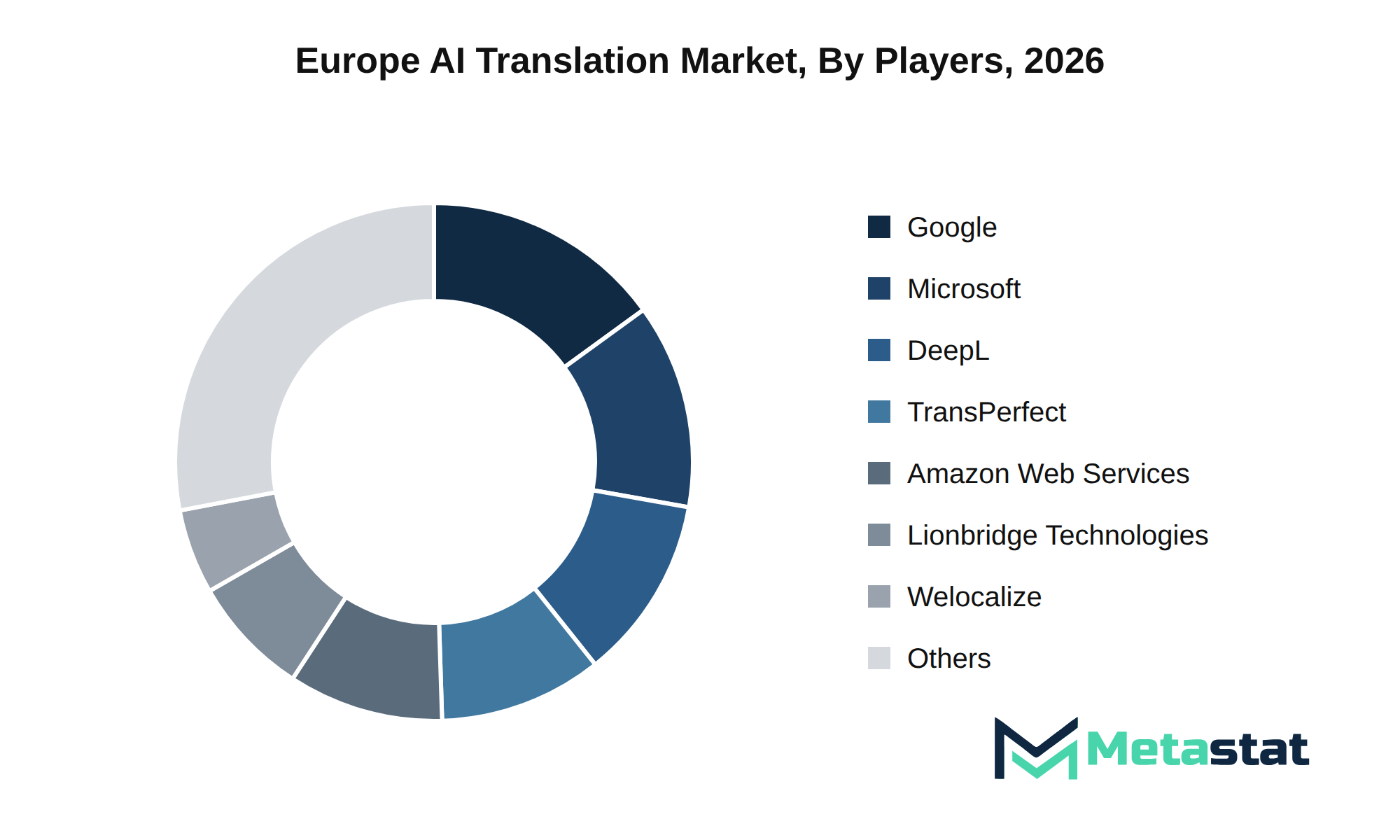
Market size is forecast to rise from USD 1,206.6 million in 2025 to over USD 3,277.3 million by 2033. The base case anticipates growth at a compound annual growth rate (CAGR) of 13.3%. This trajectory results from several macroeconomic factors influencing investment in AI technologies, including shifts in downstream demand across various industries.
In a favorable scenario, the integration of next-generation technologies and advancements in research and development (R&D) could accelerate the adoption of AI translation solutions. Industries emphasizing global outreach and enhanced customer experience prioritize investments in AI translation, driving demand significantly. Conversely, a less favorable scenario could emerge from regulatory changes or geopolitical realignments that disrupt supply chains and hinder growth potential. These challenges result in slower adoption rates and reduced capital allocation in the market.
Emerging white-space opportunities, particularly in sectors including healthcare and e-commerce, highlight unmet enterprise needs. Companies seeking to enhance operational efficiency capitalize on advancements in AI-powered translation services, further boosting market growth. Strategic capital allocation and infrastructure commitments play a crucial role in enabling firms to navigate evolving market dynamics effectively.
Future growth recommendations for stakeholders involve focusing on R&D commercialization timelines and aligning product offerings with regulatory evolution timelines. By anticipating compliance milestones and adapting to policy enforcement horizons, companies strengthen their market positions and enhance long-term sustainability in the Europe AI Translation market.
The report strategically identifies and profiles the key market players and analyses their core competencies in each sub-segment of the AI Translation market.
Report Attributes | Details |
Study Period | 2021-2033 |
Base Year | 2025 |
Estimated Year | 2026 |
Forecast Period | 2026-2033 |
Historical Period | 2021-2025 |
Growth Rate | CAGR 13.3% from 2026 to 2033 |
Revenue Unit | USD million |
Segmentation | By Technology Type, Offering Type, Content Type, and End-Use Industry |
Find answers to common questions about this report
The AI Translation market size in Europe was valued at USD 1,206.6 million in 2025.
The AI Translation market is projected to grow at a CAGR of 13.3% during the forecast period from 2026 to 2033.
The leading segment in the Europe AI Translation market is Neural Machine Translation (NMT), with a projected value of USD 1,012.7 million by 2033. This segment holds the largest share based on technology type.
Increasing demand for digital transformation initiatives across various industries drives the Europe AI Translation market. Organizations prioritize automation and advanced technologies to optimize processes and enhance operational efficiency, addressing evolving consumer behaviors and preferences. This shift supports the integration of AI translation tools, leading to improved communication and revenue growth.
High capital investment requirements and rising operating costs represent significant restraints in the Europe AI Translation market. The financial burden of deploying advanced AI technologies deters smaller players, while the ongoing requirement for skilled labor increases operational expenses, limiting profitability and market competition.
Increasing demand for digital transformation initiatives across various industries favors product adoption in the Europe AI Translation market. Organizations prioritize automation and advanced technologies to optimize processes, enhance operational efficiency, and meet evolving consumer behaviors, driving the need for effective translation solutions. This trend supports revenue growth and improved market positioning for businesses leveraging AI translation tools.
The AI Translation market is estimated to reach a valuation of USD 3,277.3 million by 2033.
Key players operating in the Europe AI Translation market include DeepL, Google, Microsoft, Amazon Web Services, Inc., RWS, and TransPerfect.
Neural Machine Translation (NMT) is projected to reach USD 1,012.7 million by 2033, growing at a CAGR of 9.9%.
The AI Translation Software & Platforms segment is expected to reach USD 1,049.7 million by 2033.
The analysts below cover Information & Technology research at Metastat Insights.
LEAD ANALYST
Utkarsh Khirodkar is a Lead Market Research Analyst at MetaStat Insight, specializing in market intelligence, technology sector assessments, and competitive strategy.

PRINCIPAL CONSULTANT - ENTERPRISE AI & EMERGING TECHNOLOGIES
Banking & Finance · Electronics and Semiconductor · Energy and Power · Healthcare IT · Information & Technology · Professional Services
Vijay Gunti is a Principal Consultant at MetaStat Insight, bringing over two decades of experience across enterprise digital transformation, technology strategy, and intelligent systems.

LEAD CONSULTANT - COMMUNICATION, TELECOM, AND IT
Electronics and Semiconductor · Information & Technology · Machinery & Equipment · Professional Services
Ravindra Sathe Consultants for Communication, Telecom, and IT at MetaStat Insight. He leads the firm's industry research initiatives across telecommunications infrastructure, digital connectivity, enterprise networking, and emerging information technology domains.
Most industry reports on warehouse automation bundle autonomous mobile robots and fixed conveyor installations into the same top-level numbers, which complicates advisory work. This study split the market cleanly by payload tiers, navigation technology, and fleet management software layers. The regional forecast for Western Europe gave our team defensible adoption benchmarks when evaluating capital allocation for logistics clients, saving us days of secondary data scrubbing.
Analyzing the transition from natural gas to green hydrogen in iron ore reduction requires realistic infrastructure timelines. Meta stat insight supplied a detailed regional assessment of DRI plant conversion costs and scrap metal availability in North America and Western Europe. Their report carefully examined pellet quality specs and electrical grid access constraints without making oversimplified market assumptions. The research material served as a practical reference during internal technology roadmap discussions.
Integrating zero-trust access controls across legacy electronic health record systems involves complex compliance overhead. Team produced an analysis that clearly separated identity governance and administration tools from privileged access management platforms. Their evaluation of HIPAA and GDPR compliance features across cloud native solutions gave our architecture group clear baseline criteria. The custom data request regarding biometric authentication adoption in hospital networks was returned promptly with clear documentation.
Explore related market intelligence reports worth reading alongside this one.
Starting from
$2950