
LEAD ANALYST
Utkarsh Khirodkar is a Lead Market Research Analyst at MetaStat Insight, specializing in market intelligence, technology sector assessments, and competitive strategy.

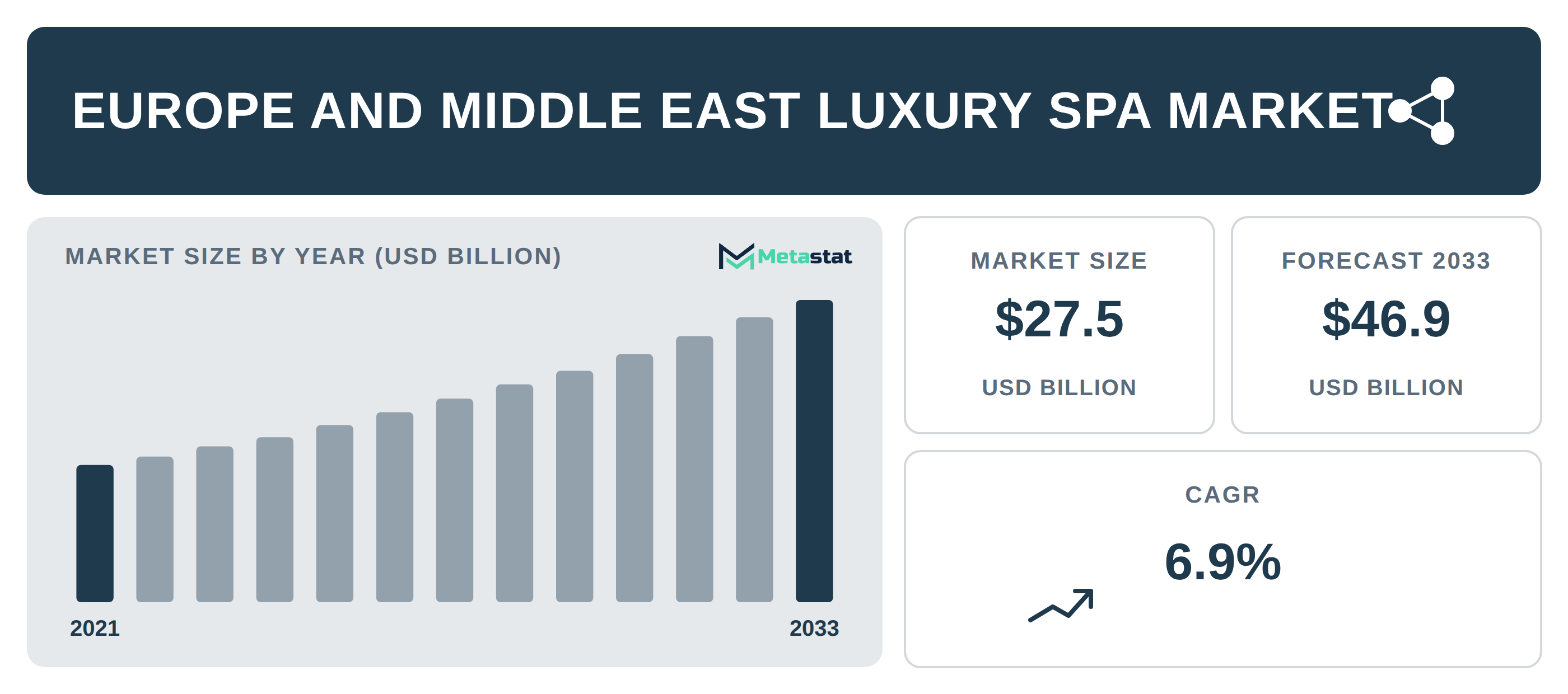
Metastat Insights has published a new report on the Europe and Middle East Luxury Spa market, forecasting growth from USD 27.5 billion in 2025 to USD 46.9 billion by 2033, with a CAGR of 6.9%. The report details market drivers, restraints, segment analysis, and competitive landscape.
Metastat Insights has published "Europe and Middle East Luxury Spa Market Size, Share, By Spa Type (Luxury Hotel and Resort Spas, Destination Spas and Wellness Resorts, Luxury Day and Urban Spas, Medical Spas and Longevity Clinics, Thermal and Mineral Spring Spas, Cruise and Yacht Spas), By Service Type (Massage and Body Treatments, Facial and Skincare Treatments, Beauty and Aesthetic Treatments, Hydrotherapy and Thermal Treatments, Fitness and Mind-Body Wellness, Medical Wellness and Longevity Programs), By Gender (Men, Women), By Region (UAE, Saudi Arabia, France, Germany, Italy, and Other Regions of Europe and the Middle East), Industry Analysis, Growth, Trends, and Forecast, 2026-2033", followed by the headline figures (USD 27.5 billion in 2025, USD 46.9 billion by 2033, 6.9% CAGR).
Increasing consumer awareness regarding health and wellness significantly influences the growth of the Europe and Middle East Luxury Spa market. The trend towards prioritizing self-care leads individuals to seek premium spa services, enhancing demand across various segments, including Luxury Hotel & Resort Spas and Destination Spas & Wellness Resorts. The rising disposable incomes in the region further support this trend, driven by affluent consumers investing more in luxury experiences. Operators respond by expanding service offerings that cater to evolving customer preferences, enhancing their appeal and market share.
Regulatory compliance presents notable challenges within the Europe and Middle East Luxury Spa market. Operators face significant costs associated with adhering to health, safety, and environmental standards, which divert resources from growth initiatives. Economic pressures, including inflation and rising operating costs, complicate the financial landscape for spa operators, impacting profitability and pricing strategies. Supply chain disruptions and geopolitical factors further constrain operational efficiencies, making it necessary for businesses to navigate these complexities to sustain growth.
The Europe and Middle East Luxury Spa market features a diverse range of segments, with Luxury Hotel & Resort Spas representing 38.2% of the total market share. Other noteworthy segments include Destination Spas & Wellness Resorts at 16.1%, Luxury Day & Urban Spas at 15.3%, Medical Spas & Longevity Clinics at 11.4%, and Thermal & Mineral Spring Spas at 11.9%. Geographically, the key regions include the UAE, Saudi Arabia, France, Germany, Italy, and other parts of Europe, each contributing uniquely to market dynamics and growth trends.
The competitive environment within the Europe and Middle East Luxury Spa market features several key players, including Four Seasons Hotels and Resorts, Mandarin Oriental Hotel Group, Marriott International, Inc., and Hilton Worldwide Holdings Inc. These organizations prioritize investment in customer experiences and innovative service offerings, striving to enhance their market positioning. Companies including InterContinental Hotels Group PLC and Accor S.A. play vital roles in shaping the competitive landscape through strategic expansions and high-quality service delivery.
For further insights, readers are invited to explore the full report: Europe and Middle East Luxury Spa Market.
Related Report
Europe and Middle East Luxury Spa MarketLEAD ANALYST
Utkarsh Khirodkar is a Lead Market Research Analyst at MetaStat Insight, specializing in market intelligence, technology sector assessments, and competitive strategy.