
LEAD ANALYST
Utkarsh Khirodkar is a Lead Market Research Analyst at MetaStat Insight, specializing in market intelligence, technology sector assessments, and competitive strategy.

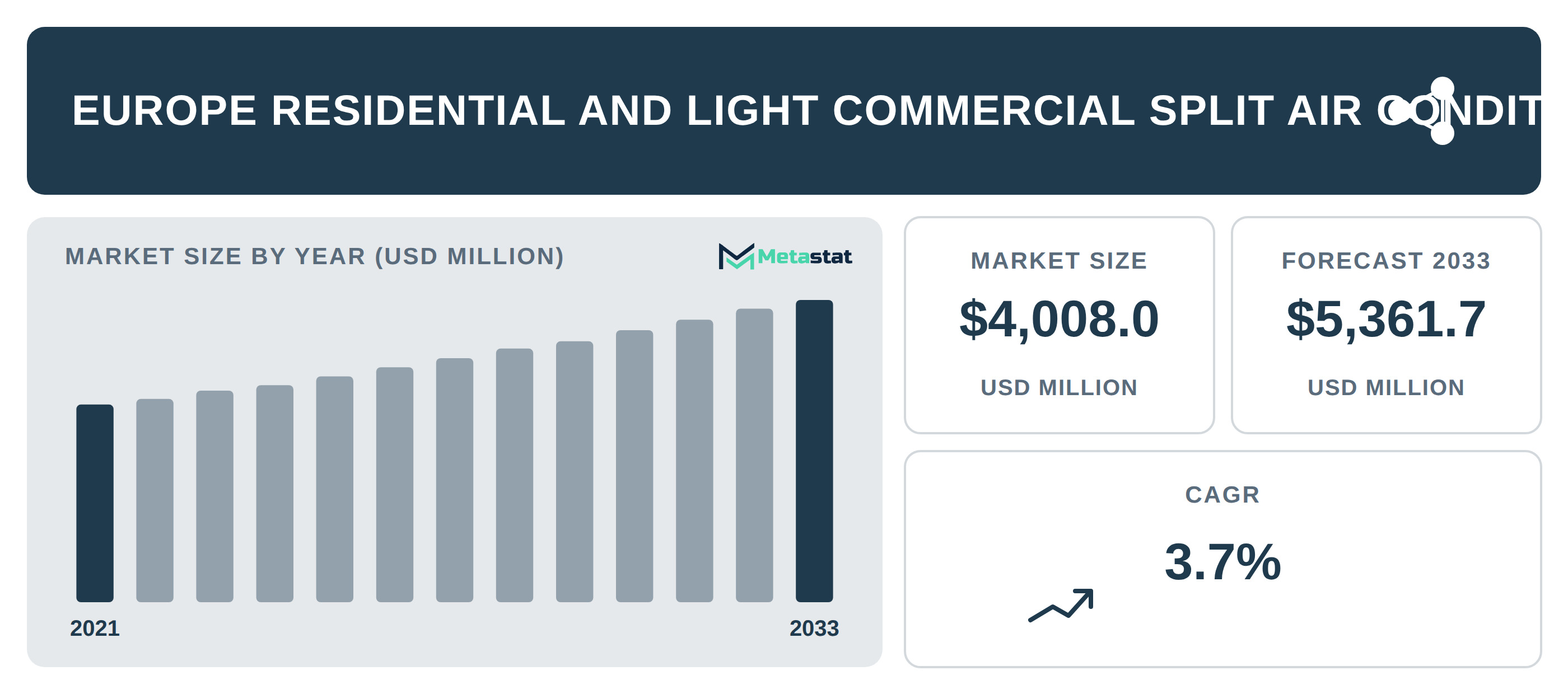
Metastat Insights announces a new report on the Europe Residential and Light Commercial Split Air Conditioning Systems market, projecting growth from USD 4,008 million in 2025 to USD 5,361.7 million by 2033 at a CAGR of 3.7%.
Metastat Insights has published "Europe Residential and Light Commercial Split Air Conditioning Systems Market Size, Share, By Configuration (Mono-Split Systems and Multi-Split Systems), By Indoor Unit Type (Wall-Mounted Units, Ceiling Cassette Units, Concealed Ducted Units, Floor-Standing / Console Units, Ceiling-Suspended / Floor-Ceiling Units), By End Use (Residential, Offices, Retail Stores, Hospitality & Foodservice, Small Healthcare Facilities & Clinics, Education & Small Institutional Buildings), By Region (Turkey, Spain, Italy, France, Germany, United Kingdom & Ireland, Benelux, Nordic Countries, Rest of Europe), Industry Analysis, Growth, Trends, and Forecast, 2026-2033", with key figures indicating a market value of USD 4,008 million in 2025 and a projected increase to USD 5,361.7 million by 2033, reflecting a compound annual growth rate (CAGR) of 3.7%.
Rising temperatures and increased frequency of heat waves significantly influence the Europe Residential and Light Commercial Split Air Conditioning Systems market. Consumers and businesses invest in effective cooling solutions to enhance comfort, leading to a surge in demand. The growing focus on building insulation and retrofitting existing structures further supports market growth, driven by improved energy efficiency. The demand for air conditioning systems aligns with trends in various sectors, including residential, hospitality, and small healthcare facilities, where efficient cooling solutions are crucial.
Regulatory constraints pose challenges for market expansion, with compliance to stringent environmental standards increasing production costs. These higher costs lead to elevated prices for consumers, potentially reducing overall demand. Macroeconomic factors, including inflation and currency fluctuations, impact operational strategies for market players, complicating pricing decisions and affecting purchasing power. Supply chain disruptions further hinder the ability of manufacturers to meet customer expectations efficiently.
The Europe Residential and Light Commercial Split Air Conditioning Systems market segments into configurations like mono-split and multi-split systems, with each appealing to different consumer preferences. The mono-split systems segment holds a significant market share, valued at USD 2,957.7 million in 2026 and projected to reach USD 3,592.3 million by 2033. Conversely, the multi-split systems segment is anticipated to grow at a CAGR of 5.6% during the forecast period, driven by increasing consumer interest in energy-efficient solutions. Regionally, markets in Northern Europe emphasize energy efficiency, while Southern European countries exhibit a preference for cost-effective options.
Several companies operate within the Europe Residential and Light Commercial Split Air Conditioning Systems market, including Daikin Industries, Ltd., Mitsubishi Electric Corporation, Panasonic Corporation, LG Electronics Inc., Samsung Electronics Co., Ltd., GENERAL Inc., Carrier Global Corporation, and Midea Group Co., Ltd. These players engage in strategic investments and innovations to enhance product offerings and competitive positioning, responding to the evolving landscape shaped by technological advancements and regulatory compliance.
For more insights and a detailed analysis, readers are invited to explore the full report: Europe Residential and Light Commercial Split Air Conditioning Systems Market.
LEAD ANALYST
Utkarsh Khirodkar is a Lead Market Research Analyst at MetaStat Insight, specializing in market intelligence, technology sector assessments, and competitive strategy.

INDUSTRY CONSULTANT - CHEMICALS & ADVANCED MATERIALS
Chemicals and Materials · Machinery & Equipment · Packaging
Amit Gadhekar Consultant for Chemicals and Materials at MetaStat Insight, directing sector-specific intelligence, research, and strategic consulting across global chemical and processing markets.

PRINCIPAL CONSULTANT - QUALITY SYSTEMS & COMPLIANCE
Electronics and Semiconductor · Machinery & Equipment · Professional Services
Omkar Phadtare is an Industry Consultant at MetaStat Insight, specializing in quality systems, regulatory compliance, and standards benchmarking to drive data-driven market intelligence and strategic industry research.

ENERGY & INFRASTRUCTURE INDUSTRY CONSULTANT
Automotive and Transportation · Electronics and Semiconductor · Energy and Power · Machinery & Equipment
Saurabh Vasant Ganvir consults for Energy & Infrastructure Industry at MetaStat Insight, specializing in renewable energy, solar EPC, and electric vehicle (EV) infrastructure markets.

LEAD CONSULTANT - COMMUNICATION, TELECOM, AND IT
Electronics and Semiconductor · Information & Technology · Machinery & Equipment · Professional Services
Ravindra Sathe Consultants for Communication, Telecom, and IT at MetaStat Insight. He leads the firm's industry research initiatives across telecommunications infrastructure, digital connectivity, enterprise networking, and emerging information technology domains.