
LEAD ANALYST
Utkarsh Khirodkar is a Lead Market Research Analyst at MetaStat Insight, specializing in market intelligence, technology sector assessments, and competitive strategy.

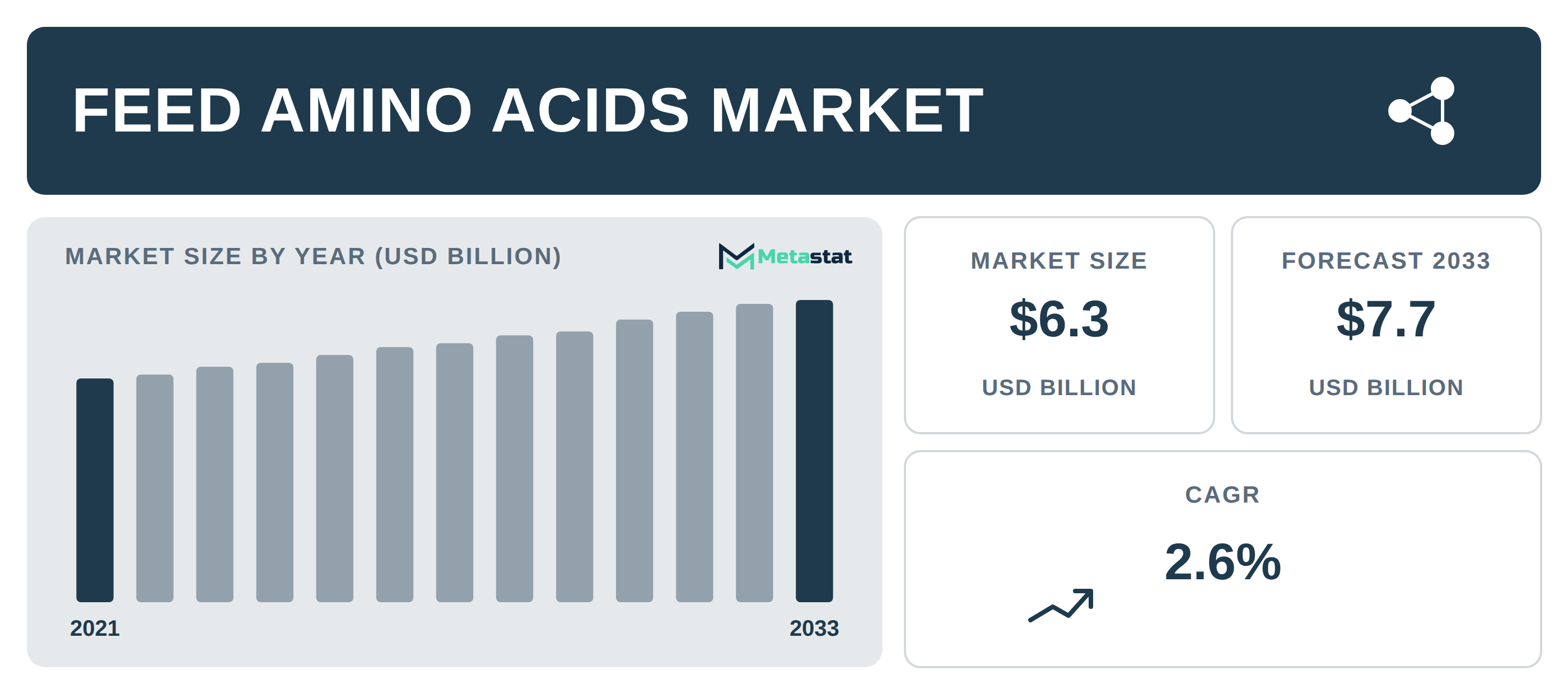
Metastat Insights reveals the Feed Amino Acids market, valued at USD 6.3 billion in 2025, will reach USD 7.7 billion by 2033, growing at a CAGR of 2.6%. Demand is driven by livestock feed efficiency and technological advancements.
Metastat Insights has published "Global Feed Amino Acids Market Size, Share, By Type (Lysine, Methionine, Threonine, Tryptophan, Valine, Isoleucine, Arginine, Histidine, and Others), By Livestock (Poultry, Swine, Ruminants, Aquaculture, and Others), By Physical Form (Dry and Liquid), By Production Method (Fermentation-Based, Chemical Synthesis-Based, and Protein Hydrolysis-Based), Industry Analysis, Growth, Trends, and Forecast, 2026-2033." This market was valued at USD 6.3 billion in 2025 and is set to reach USD 7.7 billion by 2033, achieving a compound annual growth rate (CAGR) of 2.6% during the forecast period.
A significant driver of demand in the Feed Amino Acids market is the increasing emphasis on improving livestock feed efficiency. The global demand for protein-rich food drives livestock producers to enhance feed formulations, ensuring that animals receive the necessary nutrients for optimal growth and productivity. This focus leads to improved feed conversion ratios, which help lower overall feed costs. Markets experiencing population growth and rising disposable incomes show a notable increase in the need for animal protein, prompting further investments in livestock production and the incorporation of feed additives including amino acids.
Increased regulatory compliance challenges pose considerable obstacles in the Feed Amino Acids market. Strict regulations concerning food safety and quality control complicate the approval processes for new products, leading to delays in market entry and heightened costs for producers. Such compliance hurdles particularly impact smaller manufacturers, often resulting in market fragmentation. Macroeconomic factors, including inflation, contribute to rising operational expenses, squeezing profit margins and restricting capacity for innovation and growth.
The Feed Amino Acids market is segmented by various criteria, including product types, livestock categories, physical forms, and production methods. In terms of product types, lysine is a prominent segment, with expectations to grow from USD 2.6 billion in 2026 to USD 2.9 billion by 2033. The poultry sector acts because a primary demand driver, with projections indicating growth from USD 2.7 billion in 2026 to USD 3 billion by 2033. Regionally, the Asia Pacific commands the largest market share at 34.4%, followed by North America at 26.6%. North America alone anticipates a market value of USD 1.8 billion by 2033.
Prominent players within the Feed Amino Acids market include ADM, Sumitomo Chemical Co., Ltd., Evonik, and CJ CheilJedang Corp. These companies emphasize enhancing their production capabilities and broadening distribution networks to satisfy the growing demand. Their strategies often involve investments in research and development aimed at creating innovative products that align with changing consumer preferences for high-quality livestock feeds.
For more detailed insights and a comprehensive analysis of the market dynamics, trends, and forecasts, readers access the full report: Global Feed Amino Acids Market.
Related Report
Global Feed Amino Acids MarketLEAD ANALYST
Utkarsh Khirodkar is a Lead Market Research Analyst at MetaStat Insight, specializing in market intelligence, technology sector assessments, and competitive strategy.

LEAD PRINCIPAL ANALYST, PHARMA AND HEALTHCARE
Food and Beverages · Healthcare · Healthcare IT · Medical Devices
Ajay Devgire is the Lead Healthcare Analyst at MetaStat Insight, leading strategic research and market intelligence initiatives across the global healthcare domain.

SENIOR RESEARCH ANALYST
Biotechnology · Food and Beverages · Medical Devices · Packaging
Snehal Pasalkar is a Research Analyst at MetaStat Insight, operating at the intersection of life sciences research, competitive strategy, and market intelligence.