
LEAD ANALYST
Utkarsh Khirodkar is a Lead Market Research Analyst at MetaStat Insight, specializing in market intelligence, technology sector assessments, and competitive strategy.

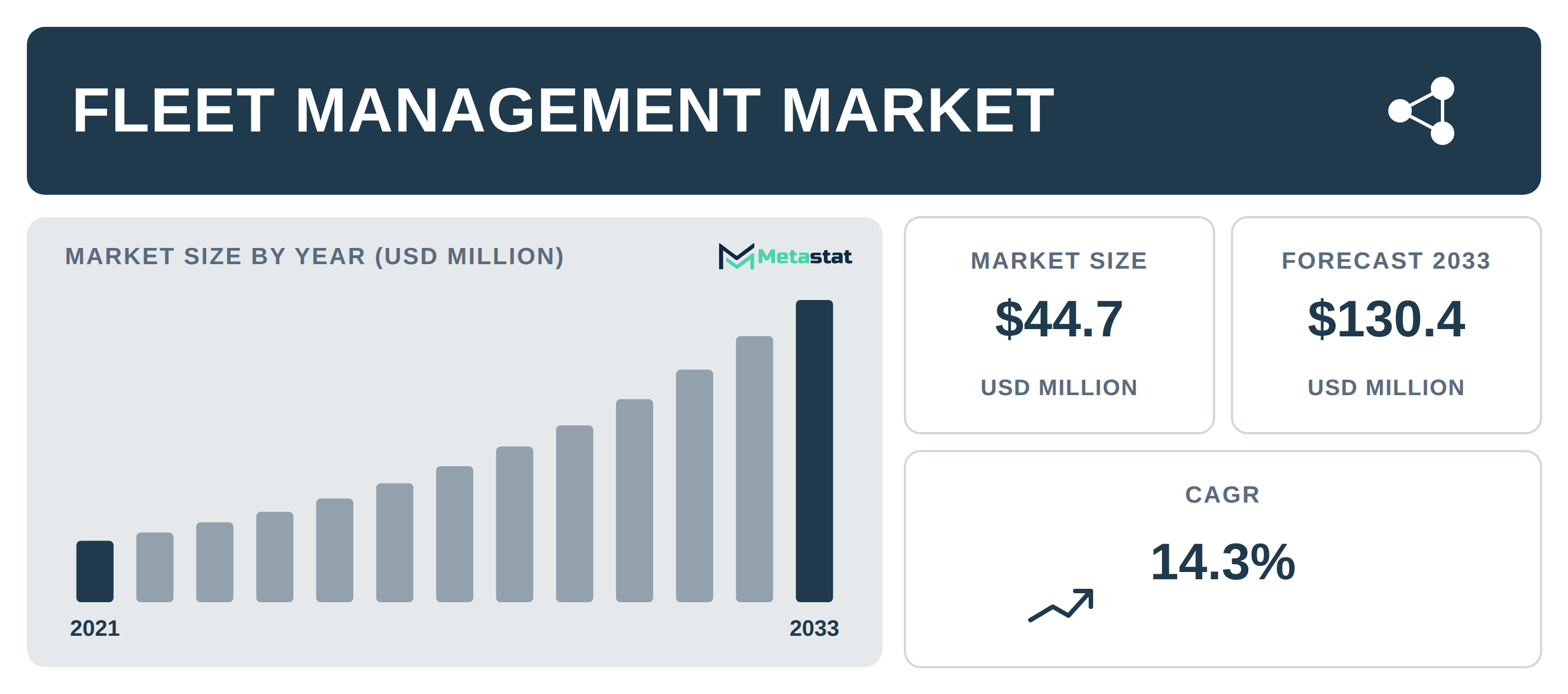
Metastat Insights has released a report highlighting the rapid growth of the Fleet Management market, projected to rise from USD 44.7 million in 2025 to USD 130.4 million by 2033, driven by advances in technology and increasing demand for efficiency.
Metastat Insights has published "Global Fleet Management Market Size, Share, By Offering Type (Fleet Management Software Platforms, Telematics Hardware and Connected Devices, Professional and Integration Services, Managed Fleet Administration and Lifecycle Services), By Function (Vehicle Tracking and Telematics, Route Planning, Dispatch and Workflow Management, Vehicle Maintenance and Diagnostics, Fuel and Energy Management, Driver Safety and Performance Management, Compliance and Risk Management, Vehicle Lifecycle and Asset Management, Fleet Analytics and Reporting, EV Fleet and Charging Management, Others (Toll, Parking and Expense Administration)), By Vehicle Type (Passenger Cars, Light Commercial Vehicles, Medium and Heavy Commercial Vehicles, Buses and Coaches, Special-Purpose Commercial Vehicles, Others (Two-Wheelers and Off-Highway Fleet Vehicles)), By End-Use Industry (Transportation and Logistics, Retail and E-commerce, Construction and Infrastructure, Utilities and Telecommunications, Manufacturing and Industrial, Government and Public Sector, Passenger Transportation, Vehicle Rental and Leasing, Oil, Gas and Mining, Others (Healthcare, Agriculture and Waste Management)), Industry Analysis, Growth, Trends, and Forecast, 2026-2033", with key figures showing a market value of USD 44.7 million in 2025 and a projected increase to USD 130.4 million by 2033, representing a CAGR of 14.3%.
Investment in digital transformation significantly boosts the Fleet Management market. Organizations increasingly adopt advanced technologies to enhance operational efficiency and meet rising consumer expectations for immediate data access. Favorable capital investment conditions support businesses seeking to upgrade their fleet management systems. Automation, artificial intelligence, and the integration of sophisticated software enhance productivity, attracting new participants focused on technology-driven solutions.
Regulatory compliance represents a substantial challenge for the Fleet Management market. Evolving legal requirements demand significant resources for adherence, which inhibits competition, especially for smaller firms. Macroeconomic factors, including inflation and supply chain disruptions, impact operational costs and profit margins. Inadequate infrastructure complicates implementation efforts, restricting the deployment of essential advanced telematics and connected devices for effective fleet management.
The Fleet Management market segments by offering type, function, vehicle type, and end-use industry. Fleet Management Software Platforms are projected to grow from USD 22 million in 2026 to USD 60 million by 2033. Telematics Hardware and Connected Devices are forecasted to reach USD 28.7 million by 2033, driven by the increasing demand for vehicle tracking. North America stands because the largest regional market, holding a 33.8% share, followed by Europe at 28.8% and Asia Pacific at 25.4%.
Significant players in the Fleet Management market include Alphabet International GmbH, Arval Service Lease, AT&T Inc., Cisco Systems, Geotab Inc., and Verizon Connect. These companies operate across various segments, contributing to the growth and evolution of fleet management solutions across different industries.
For a comprehensive view of the market, the full report is available at Global Fleet Management Market.
Related Report
Global Fleet Management MarketLEAD ANALYST
Utkarsh Khirodkar is a Lead Market Research Analyst at MetaStat Insight, specializing in market intelligence, technology sector assessments, and competitive strategy.

ENERGY & INFRASTRUCTURE INDUSTRY CONSULTANT
Automotive and Transportation · Electronics and Semiconductor · Energy and Power · Machinery & Equipment
Saurabh Vasant Ganvir consults for Energy & Infrastructure Industry at MetaStat Insight, specializing in renewable energy, solar EPC, and electric vehicle (EV) infrastructure markets.