
LEAD ANALYST
Utkarsh Khirodkar is a Lead Market Research Analyst at MetaStat Insight, specializing in market intelligence, technology sector assessments, and competitive strategy.

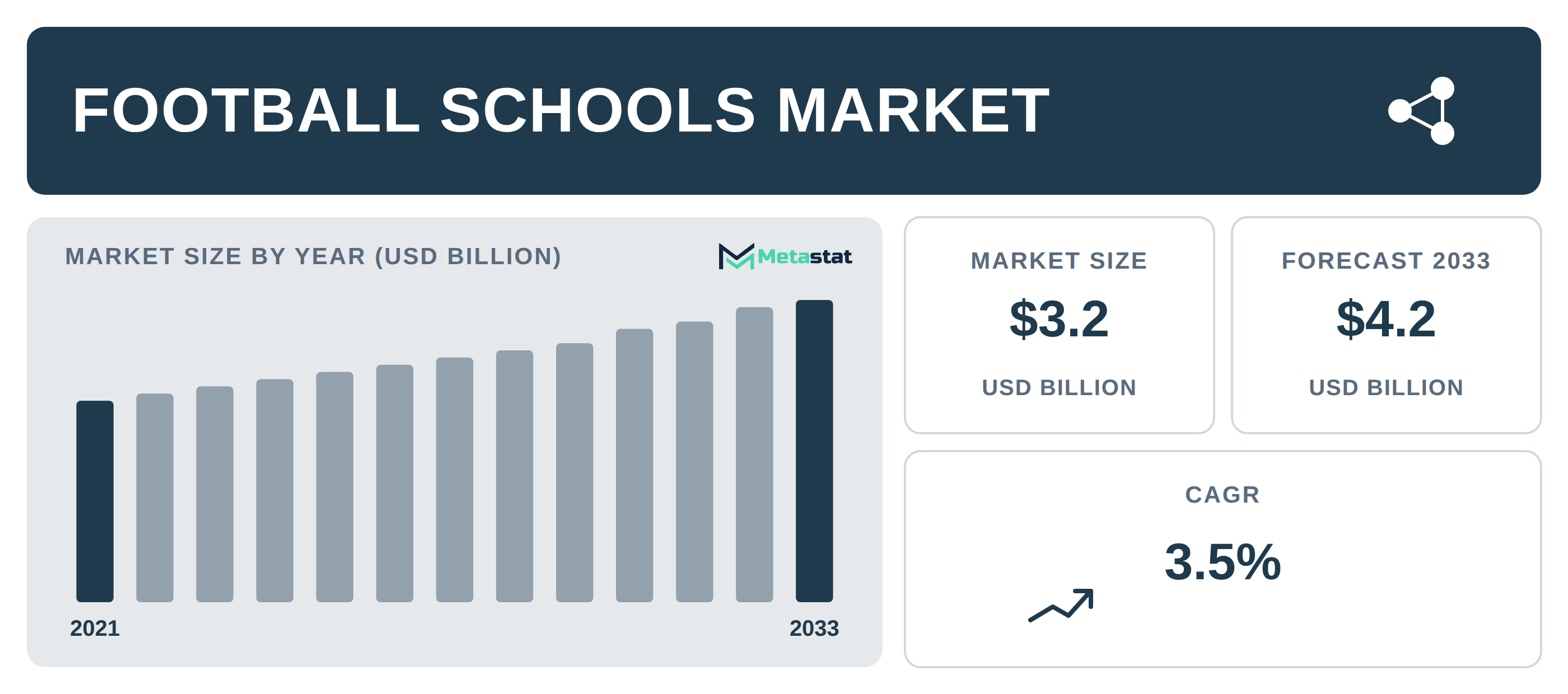
The global Football Schools market is projected to grow from USD 3.2 billion in 2025 to USD 4.2 billion by 2033, driven by increasing youth participation and professional coaching methods.
Metastat Insights has published "Global Football Schools Market Size, Share, By Operating Model (Club-Affiliated Football Schools, Federation / Association-Run Programs, Private Football Academies, Community-Based Programs and School / Education-Based Programs), By Age Group (Under-15 Programs, Under-10 Programs, Under-18 Programs and Adult Training), By Program Format (Year-Round Football Schools, Football Camps, Short-Term Clinics / Development Courses and Residential Football Academies), Industry Analysis, Growth, Trends, and Forecast, 2026-2033", detailing the market's growth from USD 3.2 billion in 2025 to USD 4.2 billion by 2033, representing a compound annual growth rate (CAGR) of 3.5%.
Rising interest in football among youth significantly boosts enrollment in football schools. Increasing awareness of the sport's benefits, alongside economic growth, creates a favorable environment for investment in training programs. Parents recognize the importance of extracurricular activities for their children's development, leading to increased participation in football education. Investments in infrastructure and facilities enhance the quality of training, making programs more appealing to prospective students. The digital transformation within sports education drives innovation in methodologies, making training more accessible and effective.
Regulatory compliance presents a challenge, with various legal mandates increasing operational costs, particularly for smaller institutions. Macroeconomic factors, including inflation, exert pressure on budgets, forcing schools to adjust pricing structures that lead to reduced enrollment. Supply chain disruptions hinder the delivery of essential equipment and materials, impacting program quality. Skilled labor shortages affect the ability to provide effective training, limiting market growth potential. Geopolitical fragmentation introduces challenges for international collaborations and partnerships, affecting market dynamics.
The Football Schools market segments include operational models including Club-Affiliated Football Schools, Federation / Association-Run Programs, Private Academies, Community Programs, and School-Based Programs. Specifically, Club-Affiliated Football Schools are projected to grow from USD 1.3 billion in 2026 to USD 1.5 billion by 2033, while Federation/Association-Run Programs are expected to reach USD 0.4 billion. The market is geographically divided, with Europe holding the largest share at 29.7%, followed by North America at 23.9% and Asia Pacific at 20.4%. Growth in these regions reflects a cultural affinity for football and increasing investment in youth development.
Several key players influence the Football Schools market, including FC Barcelona, Manchester United FC Ltd, and Juventus Football Club S.p.A. These organizations develop training programs that attract young athletes and enhance their skills. Their collaborations with local schools and community organizations broaden their reach, while investment in advanced training facilities strengthens their appeal. Clubs like Paris Saint-Germain and FC Bayern München AG contribute to the professionalization of coaching methods, shaping the future of football education. The emphasis on quality coaching and structured training environments drives parents to seek these programs for their children.
For further insights, readers are invited to explore the full report: Global Football Schools Market.
Related Report
Global Football Schools MarketLEAD ANALYST
Utkarsh Khirodkar is a Lead Market Research Analyst at MetaStat Insight, specializing in market intelligence, technology sector assessments, and competitive strategy.