
LEAD ANALYST
Utkarsh Khirodkar is a Lead Market Research Analyst at MetaStat Insight, specializing in market intelligence, technology sector assessments, and competitive strategy.

Metastat Insights reveals the Fuel Management Systems market is projected to grow from USD 2,113.3 million in 2025 to USD 5,086.3 million by 2033, driven by advancements in technology and increasing demand for efficient fuel management solutions.
Metastat Insights has published "Global Fuel Management Systems Market Size, Share, By Component (Software, Hardware, and Professional and Managed Services), By Application (Fuel Procurement and Strategic Sourcing, Supplier and Contract Management, Order and Delivery Management, Fuel Inventory and Tank Monitoring, Fuel Dispensing and Access Control, Fuel Card and Transaction Management, Invoice Audit and Reconciliation, Fuel Consumption and Efficiency Optimization, Compliance and Fuel Tax Reporting), By Deployment Model (Cloud-Based, On-Premises, and Hybrid), By End-Use Industry (Transportation and Logistics, Construction, Mining and Quarrying, Energy and Utilities, Manufacturing and Industrial Facilities, Government and Municipal Fleets, Data Centers, Aviation and Marine, and Agriculture), Industry Analysis, Growth, Trends, and Forecast, 2026-2033", indicating that the global Fuel Management Systems market was valued at USD 2,113.3 million in 2025 and is projected to reach USD 5,086.3 million by 2033, growing at a CAGR of 11.6%.
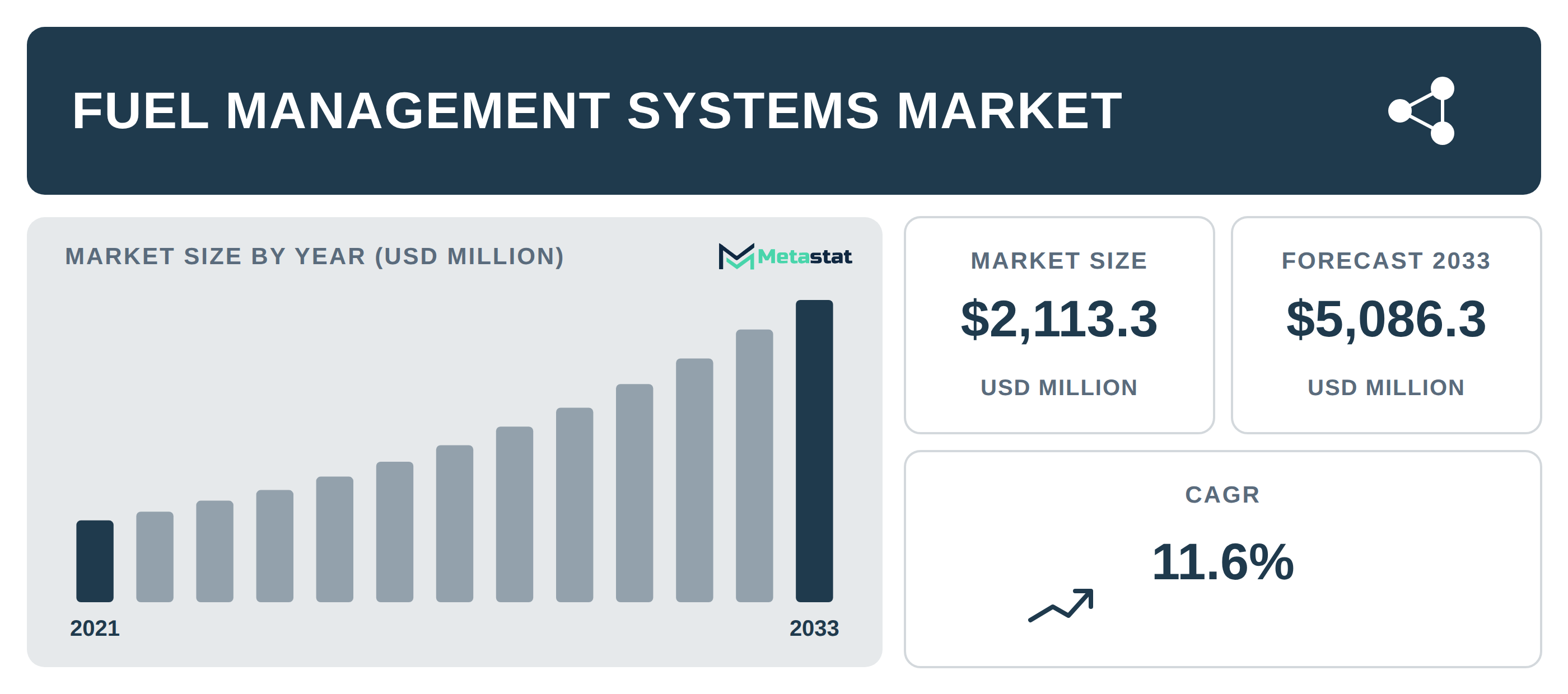
Growing demand for efficient fuel management solutions significantly influences the market's expansion. Industries including transportation, logistics, and energy increasingly adopt advanced technologies, including AI-driven fuel optimization and automated auditing, to improve operational efficiency. These innovations streamline processes and reinforce compliance with regulatory standards, enabling organizations to manage fuel consumption effectively. North America holds the largest market share at 34.7%, propelled by continuous technological advancements and strategic investments in fuel procurement.
High capital investment requirements pose a notable challenge for various organizations, especially small to medium-sized enterprises. The significant upfront costs associated with deploying fuel management systems deter investment, compounded by inflationary pressures that elevate raw material and labor expenses. Supply chain disruptions complicate these challenges, resulting in procurement delays and limiting operational efficiency for businesses dependent on these systems.
The Fuel Management Systems market is segmented by component into software, hardware, and professional and managed services. The software segment is anticipated to grow from USD 1,111.4 million in 2026 to USD 2,543.2 million by 2033, achieving a CAGR of 12.6%. Hardware solutions are experiencing growth, expected to reach USD 1,627.6 million by 2033. Applications of these systems encompass fuel procurement, inventory oversight, and compliance reporting, which are essential for maximizing operational efficiencies across diverse sectors.
Numerous companies are actively involved in the Fuel Management Systems market, including PDI Technologies, Inc., Titan Cloud Software, DTN, LLC, and OPW Fuel Management Systems. These organizations prioritize innovation and sustainable practices, addressing challenges related to decarbonization and shifting market demands. Their dedication to research and development fosters next-generation solutions that enhance operational performance and ensure compliance with regulatory frameworks.
For more detailed insights, readers access the full report on the Global Fuel Management Systems Market.
Related Report
Global Fuel Management Systems MarketLEAD ANALYST
Utkarsh Khirodkar is a Lead Market Research Analyst at MetaStat Insight, specializing in market intelligence, technology sector assessments, and competitive strategy.

PRINCIPAL CONSULTANT - ENTERPRISE AI & EMERGING TECHNOLOGIES
Banking & Finance · Electronics and Semiconductor · Energy and Power · Healthcare IT · Information & Technology · Professional Services
Vijay Gunti is a Principal Consultant at MetaStat Insight, bringing over two decades of experience across enterprise digital transformation, technology strategy, and intelligent systems.

ENERGY & INFRASTRUCTURE INDUSTRY CONSULTANT
Automotive and Transportation · Electronics and Semiconductor · Energy and Power · Machinery & Equipment
Saurabh Vasant Ganvir consults for Energy & Infrastructure Industry at MetaStat Insight, specializing in renewable energy, solar EPC, and electric vehicle (EV) infrastructure markets.