
LEAD ANALYST
Utkarsh Khirodkar is a Lead Market Research Analyst at MetaStat Insight, specializing in market intelligence, technology sector assessments, and competitive strategy.

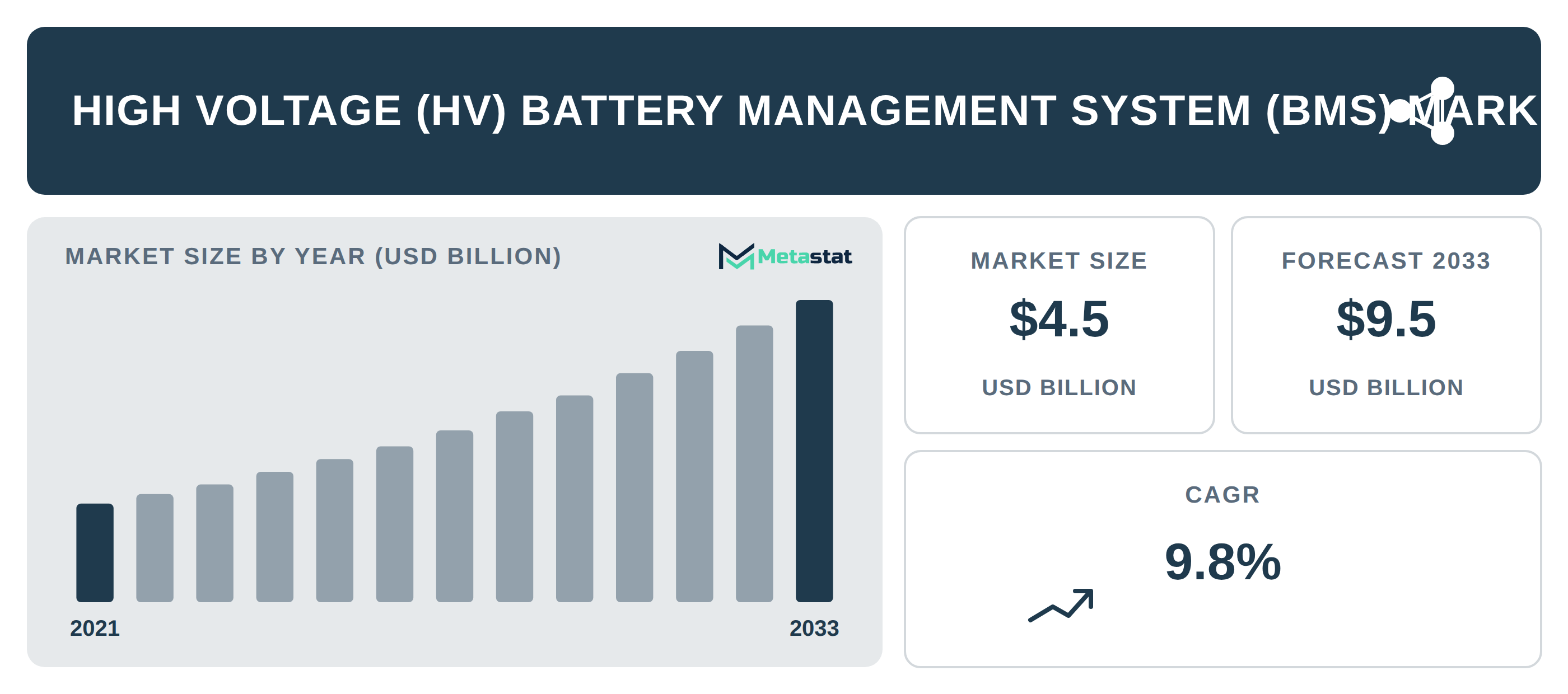
Metastat Insights reveals the High Voltage (HV) Battery Management System (BMS) market will grow from USD 4,479.7 million in 2025 to USD 9,466.8 million by 2033, driven by electric vehicle adoption and energy storage demands.
Metastat Insights has published "Global High Voltage (HV) Battery Management System (BMS) Market Size, Share, By Battery Capacity (75 kWh-150 kWh, 151 kWh-225 kWh, 226 kWh-300 kWh and >300 kWh), By Battery Type (Lithium Iron Phosphate (LFP), Lithium Nickel Manganese Cobalt Oxide (NMC), Lithium Nickel Cobalt Aluminium Oxide (NCA), Lithium Titanate Oxide (LTO) and Others (Lithium Manganese Oxide, Sodium-Ion, Solid-State and Other Emerging Chemistries)), By Voltage (400-600V and >600V), By Application (Passenger Cars, Buses, Trucks and Stationary Energy Storage Systems), Industry Analysis, Growth, Trends, and Forecast, 2026-2033". The market valuation reached USD 4,479.7 million in 2025 and is set to grow to USD 9,466.8 million by 2033, reflecting a compound annual growth rate (CAGR) of 9.8% during the forecast period.
Increasing electric vehicle (EV) adoption and heightened demands for efficient energy storage solutions are significant factors propelling market demand. The transition to advanced voltage architectures, notably 800V and 1000V, significantly enhances the effectiveness and efficiency of BMS technologies. Supportive government incentives aimed at promoting EV uptake and a growing emphasis on sustainable energy practices reinforce these trends, creating a robust growth environment for the market.
The High Voltage (HV) Battery Management System (BMS) market encounters challenges stemming from the high capital investment requirements necessary for development and implementation. Supply chain issues, particularly semiconductor shortages, compound these difficulties, creating hurdles for smaller companies and new entrants. Infrastructure limitations, especially in emerging markets, further restrict the effective rollout of battery management systems, delaying potential growth.
The market is segmented by battery capacity, including categories of 75 kWh-150 kWh, 151 kWh-225 kWh, 226 kWh-300 kWh, and over 300 kWh. Additional segments include battery types including Lithium Iron Phosphate (LFP), Nickel Manganese Cobalt Oxide (NMC), Nickel Cobalt Aluminium Oxide (NCA), Lithium Titanate Oxide (LTO), among others. Voltage classifications include 400-600V and above 600V, while applications span passenger cars, buses, trucks, and stationary energy storage systems. Each segment showcases unique growth opportunities driven by technological advancements and evolving consumer preferences.
Key participants in the High Voltage (HV) Battery Management System (BMS) market include Infineon Technologies AG, NXP Semiconductors, Texas Instruments, STMicroelectronics, and others. These companies engage in strategic partnerships and leverage technological innovations to enhance their capabilities and expand their market presence.
For a comprehensive analysis and insights into the High Voltage (HV) Battery Management System (BMS) market, please visit the full report: Global High Voltage (HV) Battery Management System (BMS) Market.
LEAD ANALYST
Utkarsh Khirodkar is a Lead Market Research Analyst at MetaStat Insight, specializing in market intelligence, technology sector assessments, and competitive strategy.

ENERGY & INFRASTRUCTURE INDUSTRY CONSULTANT
Automotive and Transportation · Electronics and Semiconductor · Energy and Power · Machinery & Equipment
Saurabh Vasant Ganvir consults for Energy & Infrastructure Industry at MetaStat Insight, specializing in renewable energy, solar EPC, and electric vehicle (EV) infrastructure markets.