
LEAD ANALYST
Utkarsh Khirodkar is a Lead Market Research Analyst at MetaStat Insight, specializing in market intelligence, technology sector assessments, and competitive strategy.

Metastat Insights has published a comprehensive report forecasting significant growth in the Hybrid Vehicle market, expected to reach USD 518.9 billion by 2033. The report analyzes demand drivers, regulatory challenges, market segmentation, and key players influencing this dynamic sector.
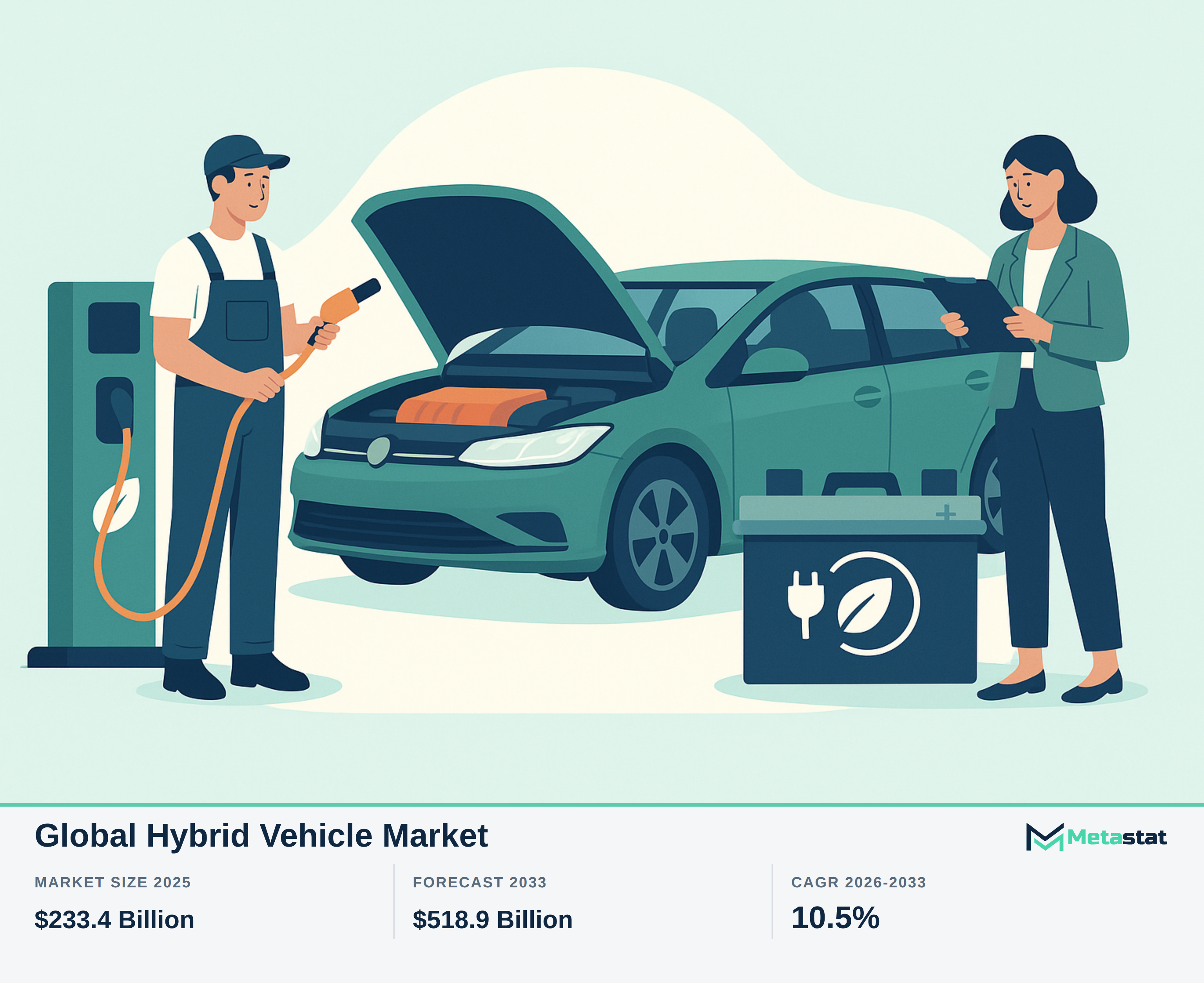
Metastat Insights has published "Global Hybrid Vehicle Market Size, Share, By Hybrid Vehicle Type (Mild-Hybrid, Hybrid Electric Vehicle (HEV), and Plug-in Hybrid (PHEV)), By Vehicle Type (Passenger Cars, Light Commercial Vehicles, and Medium and Heavy Commercial Vehicles), By Motor Type (Permanent Magnet Synchronous AC Motor (PMSM), Induction (Asynchronous) AC Motor, Switched Reluctance Motor (SRM), and Others), By Battery Type (Nickel-Metal Hydride, Lithium-iron Phosphate Battery, and Others), Industry Analysis, Growth, Trends, and Forecast, 2026-2033", which indicates that the Hybrid Vehicle market was valued at USD 233.4 billion in 2025 and is projected to reach USD 518.9 billion by 2033, growing at a CAGR of 10.5%.
Several factors are propelling the growth of the Hybrid Vehicle market. Increasing urbanization intensifies the demand for efficient transportation solutions, particularly in densely populated areas. Consumers prioritize fuel efficiency and lower emissions, prompting a shift toward cleaner transportation options. Heightened awareness of environmental sustainability is influencing consumer preferences, leading to a significant rise in hybrid vehicle adoption. Economic growth in urban regions supports higher disposable incomes, enabling consumers to invest in advanced automotive technologies. Investments in electric vehicle infrastructure further enhance the operational landscape for hybrid vehicle adoption, making them an attractive option for urban dwellers.
Despite the promising outlook, the Hybrid Vehicle market faces regulatory challenges that impede growth. Stringent compliance requirements from various legal mandates create barriers for manufacturers and suppliers. These compliance pressures necessitate substantial investments in technology, driving up operational costs. Infrastructure gaps in regions lacking adequate charging stations and support systems pose critical challenges, complicating the adoption of hybrid vehicles. The industry faces skilled labor deficiencies, making it difficult to attract and retain talent required for hybrid vehicle development and production. Macroeconomic headwinds, including inflation and resource scarcity, further complicate the market environment.
The Hybrid Vehicle market exhibits diverse segmentation based on vehicle type, motor type, and battery type. Demand is segmented into passenger cars, light commercial vehicles, and medium and heavy commercial vehicles. The Mild-Hybrid segment is projected to grow from USD 96.1 billion in 2026 to USD 175 billion by 2033. The market's regional dynamics reveal that North America holds a 25.8% market share, while the Asia Pacific region dominates with 44.3%. Europe follows with a 23.9% share. By 2033, North America's market value is expected to reach USD 124.3 billion, supported by favorable policies and infrastructure investments.
The competitive environment features several major players, including Toyota Motor Corporation, Honda Motor Co., Ltd., Hyundai Motor Company, Kia Corporation, Ford Motor Company, Nissan Motor Co., Ltd., Mitsubishi Motors Corporation, and Mazda Motor Corporation. These companies are actively investing in research and development to innovate and enhance hybrid technologies, addressing evolving consumer preferences and regulatory requirements.
For a comprehensive analysis, readers are invited to access the full report: Global Hybrid Vehicle Market.
Related Report
Global Hybrid Vehicle MarketLEAD ANALYST
Utkarsh Khirodkar is a Lead Market Research Analyst at MetaStat Insight, specializing in market intelligence, technology sector assessments, and competitive strategy.

ENERGY & INFRASTRUCTURE INDUSTRY CONSULTANT
Automotive and Transportation · Electronics and Semiconductor · Energy and Power · Machinery & Equipment
Saurabh Vasant Ganvir consults for Energy & Infrastructure Industry at MetaStat Insight, specializing in renewable energy, solar EPC, and electric vehicle (EV) infrastructure markets.