
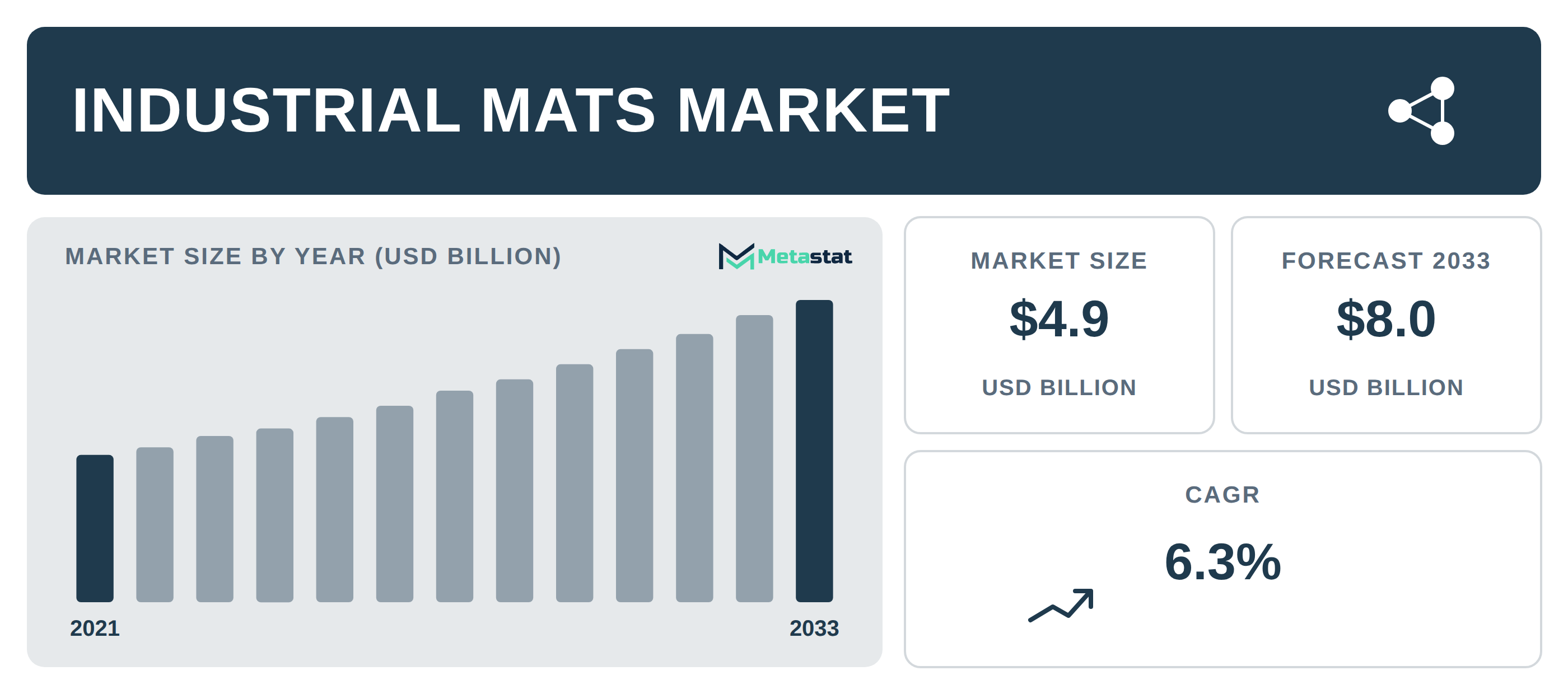
Metastat Insights has published a report on the Industrial Mats market, detailing its expected growth from USD 4.9 billion in 2025 to USD 8 billion by 2033, driven by workplace safety and ergonomic needs.
Metastat Insights has published "Global Industrial Mats Market Size, Share, By Material Type (Rubber and Nitrile Rubber, PVC and Vinyl, Polyurethane, Foam-Based Materials, Polypropylene, Polyethylene, Nylon and Polyamide, Polyester, Aluminium, and Others), By Product Type (Anti-Fatigue Mats, Entrance Mats, Logo Mats, Anti-Slip Mats, Kitchen Mats, Welding Mats, Sticky Mats, Chemical Resistant Mats, and Others), By Distribution Channel (Direct and Indirect), By End-Use Industry (Manufacturing, Oil and Gas, Construction, Healthcare and Pharmaceuticals, Food Processing and Agriculture, Warehousing and Logistics, Automotive, Mining, Hospitality, and Others), Industry Analysis, Growth, Trends, and Forecast, 2026-2033", stating that the global Industrial Mats market achieved a valuation of USD 4.9 billion in 2025 and is projected to increase to USD 8 billion by 2033, representing a compound annual growth rate (CAGR) of 6.3%.
Demand for industrial mats is primarily driven by heightened awareness regarding workplace safety and the need for ergonomic solutions across various sectors. Manufacturing and healthcare industries prioritize mats that enhance employee comfort and productivity. The market's growth trajectory reflects a shift in organizational focus towards employee well-being, prompting investments in high-quality mat products. This trend is expected to further stimulate demand, particularly for categories including anti-fatigue mats, projected to grow from USD 1.6 billion in 2026 to USD 2.3 billion by 2033.
Despite positive growth indicators, challenges persist related to regulatory compliance and supply chain disruptions. Manufacturers face increasing environmental regulations, necessitating investments in technology and processes to meet compliance standards. Geopolitical tensions contribute to supply chain instability, hindering access to essential raw materials and impacting production costs. These factors create an environment where efficiency and adaptability are critical for manufacturers striving to maintain competitive positions within the market.
The market exhibits notable segmentation based on material type, product type, distribution channel, and end-use industry. Key materials encompass rubber and nitrile rubber, PVC and vinyl, polyurethane, and foam-based materials. The rubber and nitrile rubber segment is expected to expand from USD 2.2 billion in 2026 to USD 3.2 billion by 2033, driven by demand for durable flooring solutions across various sectors. The PVC and vinyl segment is projected to reach USD 1.2 billion by 2033, reflecting versatile applications across multiple industries.
North America leads the market with a share of 26%, followed closely by Europe at 25% and Asia Pacific at 30%. These regional dynamics significantly influence product demand, with specific material types and product categories gaining traction based on local industrial needs. The focus on employee safety in North America has particularly driven the demand for anti-fatigue mats, while Asia Pacific's rapid industrialization has increased the requirement for effective workplace safety solutions.
Key players in the Industrial Mats market include Kleen-Tex Europe, 3M, Cintas Corporation, M+A Matting, Wearwell LLC, NoTrax, Bergo Flooring AB, Eagle Mat and Floor Products, among others. These companies actively engage in strategic partnerships and research and development initiatives aimed at enhancing product offerings and expanding geographical reach.
For more insights and detailed analysis, readers are invited to explore the full report: Global Industrial Mats Market.
Related Report
View full market research reportAbout the Authors

LEAD ANALYST
Utkarsh Khirodkar is a Lead Market Research Analyst at MetaStat Insight, specializing in market intelligence, technology sector assessments, and competitive strategy.

INDUSTRY CONSULTANT - CHEMICALS & ADVANCED MATERIALS
Chemicals and Materials · Machinery & Equipment · Packaging
Amit Gadhekar Consultant for Chemicals and Materials at MetaStat Insight, directing sector-specific intelligence, research, and strategic consulting across global chemical and processing markets.