
LEAD ANALYST
Utkarsh Khirodkar is a Lead Market Research Analyst at MetaStat Insight, specializing in market intelligence, technology sector assessments, and competitive strategy.

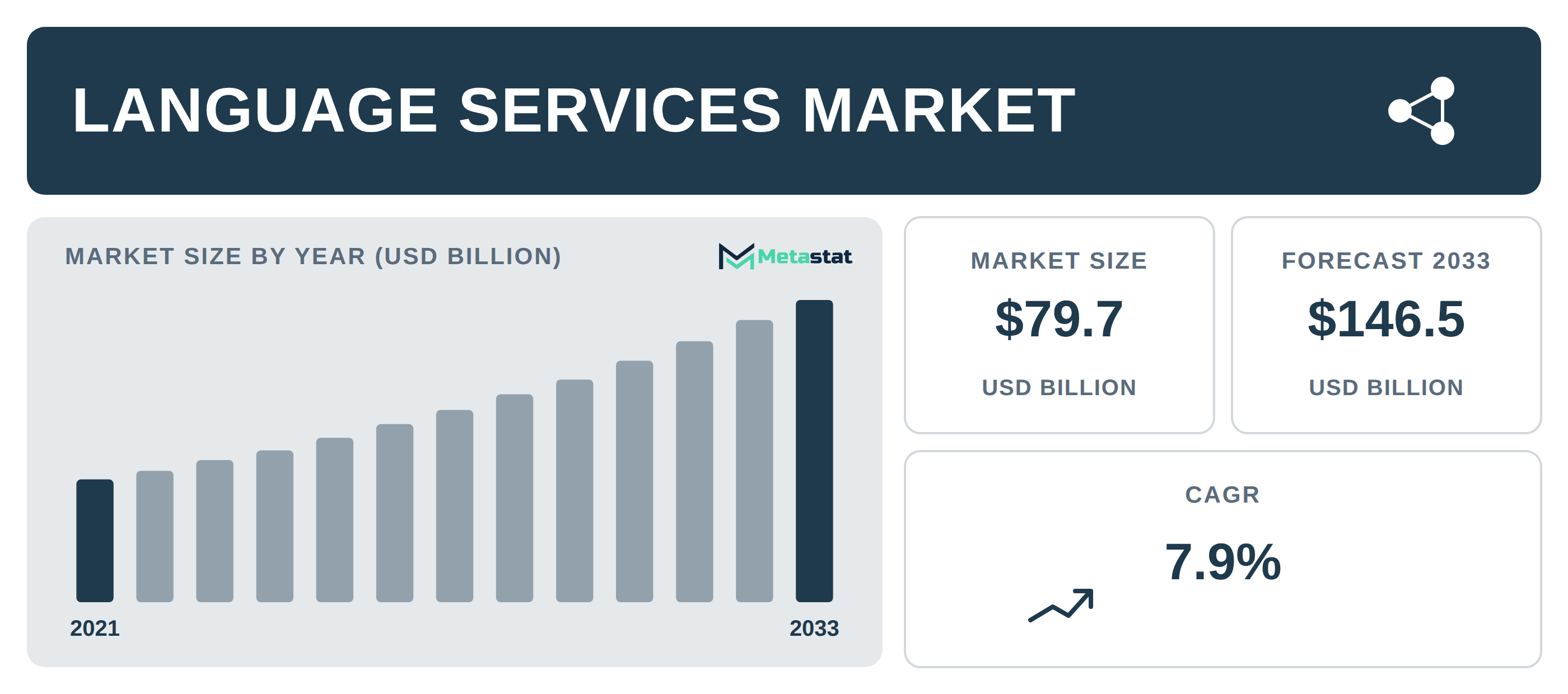
Metastat Insights announces the release of its comprehensive report on the Language Services market, projected to grow from USD 79.7 billion in 2025 to USD 146.5 billion by 2033, with a CAGR of 7.9%.
Metastat Insights has published "Global Language Services Market Size, Share, By Service Type (Translation Services, Localization Services, Interpretation Services, Multilingual Content Management Services, and Others (Transcreation Services and Language Data & AI Training Services)), By Technology (Human Translation, Machine Translation, Neural Machine Translation, Generative AI Translation and Content Adaptation, and Others (AI-Powered Translation Quality Assurance, Translation Management Systems, and Computer-Assisted Translation Tools)), By Deployment Model (Cloud-based, On-premises, and Hybrid), By End-user Industry (Information Technology and Software, Media and Entertainment, Healthcare and Life Sciences, BFSI, Retail and E-commerce, Manufacturing and Industrial, Government and Public Sector, Legal Services, Travel and Hospitality, and Others (Education, Telecommunications, and Energy and Utilities)), Industry Analysis, Growth, Trends, and Forecast, 2026-2033", stating that the Language Services market was valued at USD 79.7 billion in 2025 and is projected to grow to USD 146.5 billion by 2033, achieving a compound annual growth rate (CAGR) of 7.9%.
Demand for Language Services is significantly fueled by digital transformation initiatives across numerous sectors. Organizations increasingly focus on integrating technology to enhance communication and streamline operations, which leads to a heightened need for language services. Globalization has intensified the requirement for effective translation, localization, and multilingual content management. Industries including information technology, healthcare, and media are making substantial investments in language services to engage diverse audiences and meet their communication needs.
While promising growth lies ahead, the Language Services market faces obstacles from regulatory compliance and macroeconomic challenges. Increasingly strict regulations related to data privacy and intellectual property create additional costs and complexities for service providers. Inflationary pressures and economic downturns restrict investment in language services, resulting in tighter budgets for localization and translation projects. Geopolitical uncertainties and supply chain disruptions present additional hurdles that affect service delivery and overall operational efficiency.
The Language Services market is divided into segments based on service type, technology, deployment model, and end-user industry. Major segments encompass translation services, localization services, interpretation services, and multilingual content management services. Geographically, North America leads the market with a share of 36.8%, followed by Europe at 29.8% and Asia Pacific at 23%. The increasing demand for multilingual content management services highlights a larger trend toward global communication and accessibility in various industries.
Competitive dynamics within the Language Services market showcase several key players including LanguageCheck.ai, RWS Holdings plc, TransPerfect, Lionbridge Technologies, and Welocalize. These organizations are broadening their service offerings through strategic partnerships and technological advancements, contributing to overall market development. The competitive landscape encourages firms to distinguish their services, increasing operational capabilities while addressing the evolving requirements of clients.
For further insights and a comprehensive analysis, readers are invited to access the full report on the Global Language Services Market.
Related Report
Global Language Services MarketLEAD ANALYST
Utkarsh Khirodkar is a Lead Market Research Analyst at MetaStat Insight, specializing in market intelligence, technology sector assessments, and competitive strategy.

PRINCIPAL CONSULTANT - ENTERPRISE AI & EMERGING TECHNOLOGIES
Banking & Finance · Electronics and Semiconductor · Energy and Power · Healthcare IT · Information & Technology · Professional Services
Vijay Gunti is a Principal Consultant at MetaStat Insight, bringing over two decades of experience across enterprise digital transformation, technology strategy, and intelligent systems.

PRINCIPAL CONSULTANT - QUALITY SYSTEMS & COMPLIANCE
Electronics and Semiconductor · Machinery & Equipment · Professional Services
Omkar Phadtare is an Industry Consultant at MetaStat Insight, specializing in quality systems, regulatory compliance, and standards benchmarking to drive data-driven market intelligence and strategic industry research.

LEAD CONSULTANT - COMMUNICATION, TELECOM, AND IT
Electronics and Semiconductor · Information & Technology · Machinery & Equipment · Professional Services
Ravindra Sathe Consultants for Communication, Telecom, and IT at MetaStat Insight. He leads the firm's industry research initiatives across telecommunications infrastructure, digital connectivity, enterprise networking, and emerging information technology domains.