
LEAD ANALYST
Utkarsh Khirodkar is a Lead Market Research Analyst at MetaStat Insight, specializing in market intelligence, technology sector assessments, and competitive strategy.

Metastat Insights announces the release of its report on the Latin America Carbon Credit market, detailing significant growth projections and key market dynamics through 2033.
Metastat Insights has published "Latin America Carbon Credit Market Size, Share, By Market Type (Voluntary Carbon Market and Compliance Carbon Market), By Project Type (Forestry & Land Use, Renewable Energy, Waste Management, Agriculture & Livestock, Industrial & Energy Efficiency, Transport, Household & Community Energy, Carbon Capture & Removal), By End Use (Power Generation, Transportation, Aviation, Industrial, Buildings), By Region (Brazil, Peru, Colombia, Chile, Argentina, Rest of Latin America), Industry Analysis, Growth, Trends, and Forecast, 2026-2033", detailing the market's valuation at USD 4,498.9 million in 2025 and projecting it to reach USD 47,059.5 million by 2033, with a compound annual growth rate (CAGR) of 34.1%.
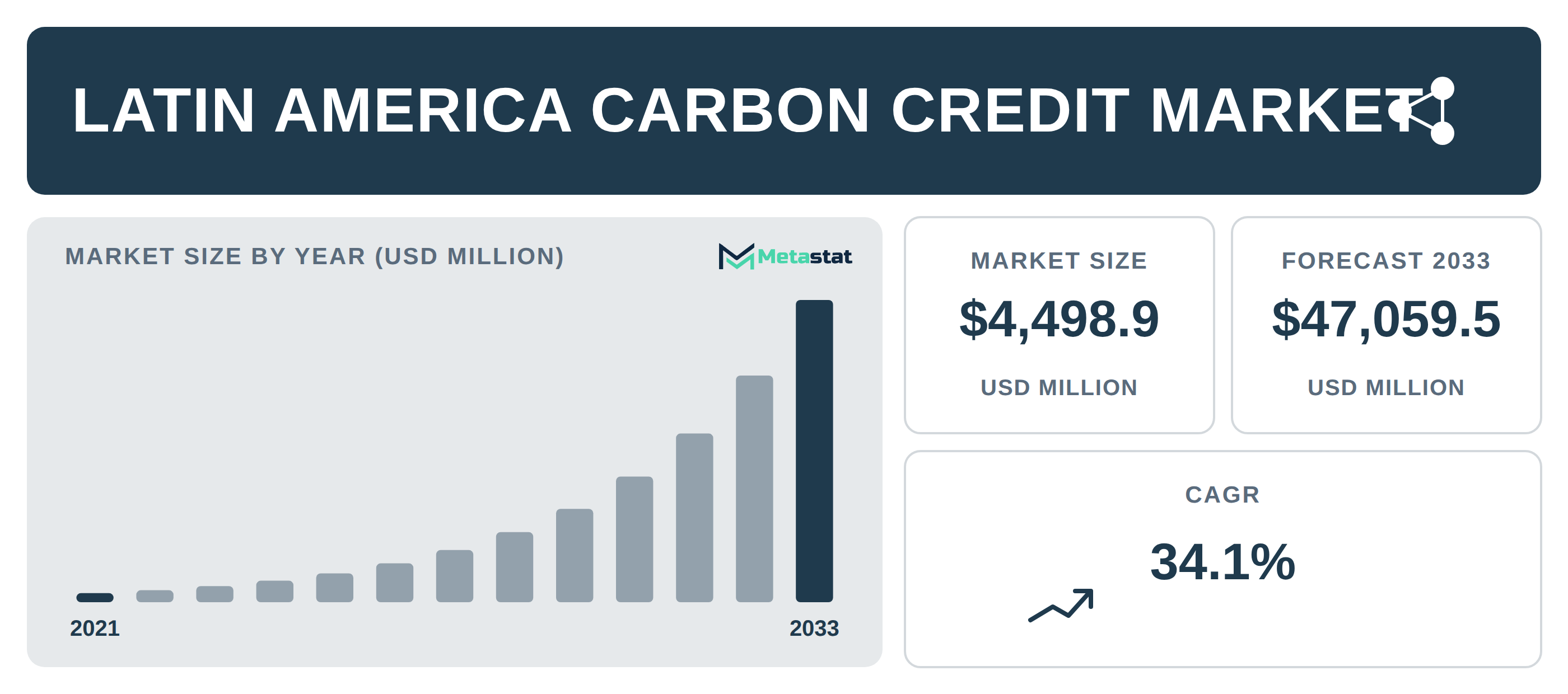
The Latin America Carbon Credit market experiences substantial growth driven by heightened awareness surrounding sustainability and increasing corporate commitments to achieve carbon neutrality. Regulatory pressures compel various sectors to adopt carbon credit initiatives, significantly enhancing demand. The voluntary carbon market, accounting for 61.6% of the overall market, indicates a robust interest from companies seeking to voluntarily offset their emissions. In contrast, the compliance carbon market, representing 38.4%, reflects the enforcement of mandated emissions reductions, showcasing the regulatory framework's importance.
Compliance hurdles present significant challenges in the Latin America Carbon Credit market. Complex regulatory requirements often overwhelm small and medium-sized enterprises, leading to delays and increased project initiation costs. Macroeconomic factors, including inflation and rising operational costs, hinder investments in carbon credit projects. Infrastructure gaps and a shortage of skilled labor exacerbate these challenges, further limiting market growth and participation.
The Latin America Carbon Credit market is divided into voluntary and compliance markets, with notable growth projected in both areas. The voluntary carbon market is expected to rise from USD 3,676.7 million in 2026 to USD 25,798 million by 2033. Simultaneously, the compliance market is projected to reach USD 21,261.5 million by 2033. Regionally, Brazil stands out, with its market anticipated to expand significantly, reaching USD 19,849.7 million by 2033, supported by initiatives like the Sistema Brasileiro de Comercio de Emissões. Other countries, including Colombia and Mexico, contribute to market dynamics through regulatory developments and carbon tax implementations.
Several companies operate within the Latin America Carbon Credit market, focusing on various carbon credit projects. Key players include EcoRegistry, Cercarbono, BioCarbon Cert, and South Pole, among others. These organizations engage in diverse initiatives, ranging from forestry and land use to renewable energy projects, enhancing their contributions to the region's sustainability goals.
For more insights and detailed analysis, access the full report: Latin America Carbon Credit Market.
Related Report
Latin America Carbon Credit MarketLEAD ANALYST
Utkarsh Khirodkar is a Lead Market Research Analyst at MetaStat Insight, specializing in market intelligence, technology sector assessments, and competitive strategy.

PRINCIPAL CONSULTANT - ENTERPRISE AI & EMERGING TECHNOLOGIES
Banking & Finance · Electronics and Semiconductor · Energy and Power · Healthcare IT · Information & Technology · Professional Services
Vijay Gunti is a Principal Consultant at MetaStat Insight, bringing over two decades of experience across enterprise digital transformation, technology strategy, and intelligent systems.