
LEAD ANALYST
Utkarsh Khirodkar is a Lead Market Research Analyst at MetaStat Insight, specializing in market intelligence, technology sector assessments, and competitive strategy.

Metastat Insights reveals significant growth in the Maritime Decarbonization market, expected to grow from USD 12.3 billion in 2025 to USD 31.4 billion by 2033, driven by regulatory pressures and the shift towards sustainable practices.
Metastat Insights has published "Global Maritime Decarbonization Market Size, Share, By Fuel Type (Green Ammonia, Hydrogen, Bio-methanol and Others (LNG & Biomethane, Biofuels)), By Vessel Type (Container Ships, Bulk Carriers, Oil & Chemical Tankers, Gas Carriers, Vehicle Carriers and Ro-Ro Cargo Vessels, Passenger Ships (Cruise, Ferries and Ro-Pax), General Cargo and Multipurpose Vessels, Offshore Support and Service Vessels and Others (Fishing Vessels, Government and Research Vessels)), By Technology Addressable (Alternative Fuel and Fuel Conversion Technologies, Energy Efficiency and Propulsion Optimization, Electrification and Hybrid Power, Shore Power and Charging, Wind-Assisted Propulsion, Exhaust Emission Abatement, Onboard Carbon Capture, Digital Decarbonization and Carbon Management and Others (Emerging and Specialized Technologies)), By Application (Commercial Shipping, Offshore Support Vessels (OSVs), Passenger and Cruise Ships, Naval and Defense Applications and Others (Fishing Vessels, Ferries and Ro-Pax Vessels)), Industry Analysis, Growth, Trends, and Forecast, 2026-2033", followed by the headline figures (USD 12.3 billion in 2025, USD 31.4 billion by 2033, 12.4% CAGR).
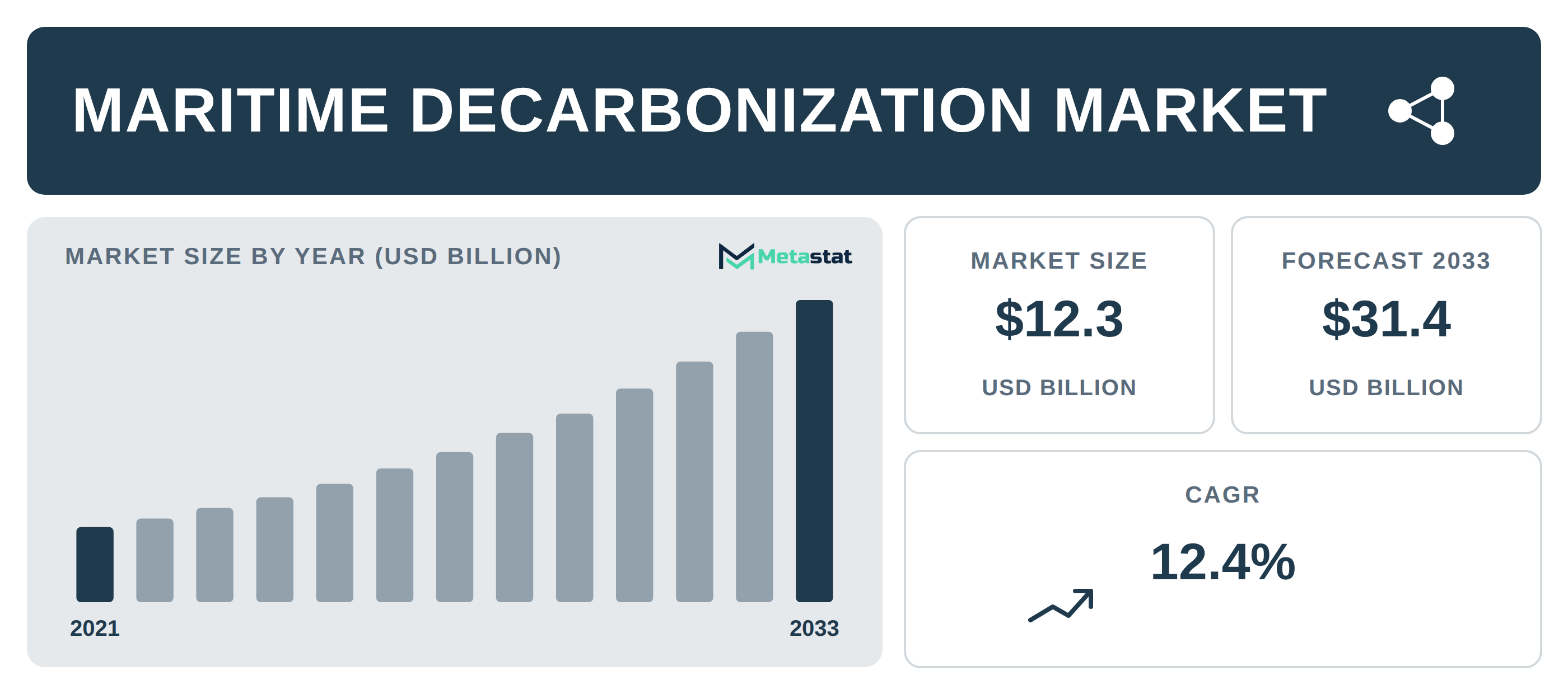
The Maritime Decarbonization market is experiencing significant expansion, primarily driven by heightened regulatory pressures and a strong global commitment to sustainability. The market is anticipated to grow substantially, propelled by strict environmental standards that require maritime operators to adopt cleaner technologies. This shift is evident because companies prioritize investments in advanced technologies that reduce emissions, aligning with international agreements aimed at mitigating climate change.
High capital investment requirements present substantial constraints on the Maritime Decarbonization market. The transition to cleaner fuels necessitates considerable upfront expenditures, particularly for emerging players. This financial barrier slows the adoption of essential technologies among smaller firms, limiting overall market growth potential. Geopolitical fragmentation introduces uncertainties in international trade, complicating access to necessary resources and technologies for decarbonization.
The Maritime Decarbonization market is categorized by fuel type, vessel type, technology addressable, and application. Key fuel types include alternative options including green ammonia, hydrogen, and bio-methanol. Notable vessel types encompass container ships and bulk carriers, which are significant categories within the market. Technological advancements in alternative fuels and energy efficiency are critical for meeting regulatory standards while enhancing operational productivity. This segmentation highlights diverse opportunities available to stakeholders seeking to capitalize on evolving market dynamics.
Several companies actively contribute to the Maritime Decarbonization market, including Wärtsilä Corporation, Everllence SE, WinGD Ltd., and Rolls-Royce Holdings plc. These organizations prioritize innovation and sustainability, investing in technologies that align with industry goals for reduced emissions. Collaboration among these key players facilitates the development of advanced solutions tailored to meet the needs of various vessel types and applications.
For more detailed insights, readers are invited to access the full report: Global Maritime Decarbonization Market.
Related Report
Global Maritime Decarbonization MarketLEAD ANALYST
Utkarsh Khirodkar is a Lead Market Research Analyst at MetaStat Insight, specializing in market intelligence, technology sector assessments, and competitive strategy.

ENERGY & INFRASTRUCTURE INDUSTRY CONSULTANT
Automotive and Transportation · Electronics and Semiconductor · Energy and Power · Machinery & Equipment
Saurabh Vasant Ganvir consults for Energy & Infrastructure Industry at MetaStat Insight, specializing in renewable energy, solar EPC, and electric vehicle (EV) infrastructure markets.