
LEAD ANALYST
Utkarsh Khirodkar is a Lead Market Research Analyst at MetaStat Insight, specializing in market intelligence, technology sector assessments, and competitive strategy.

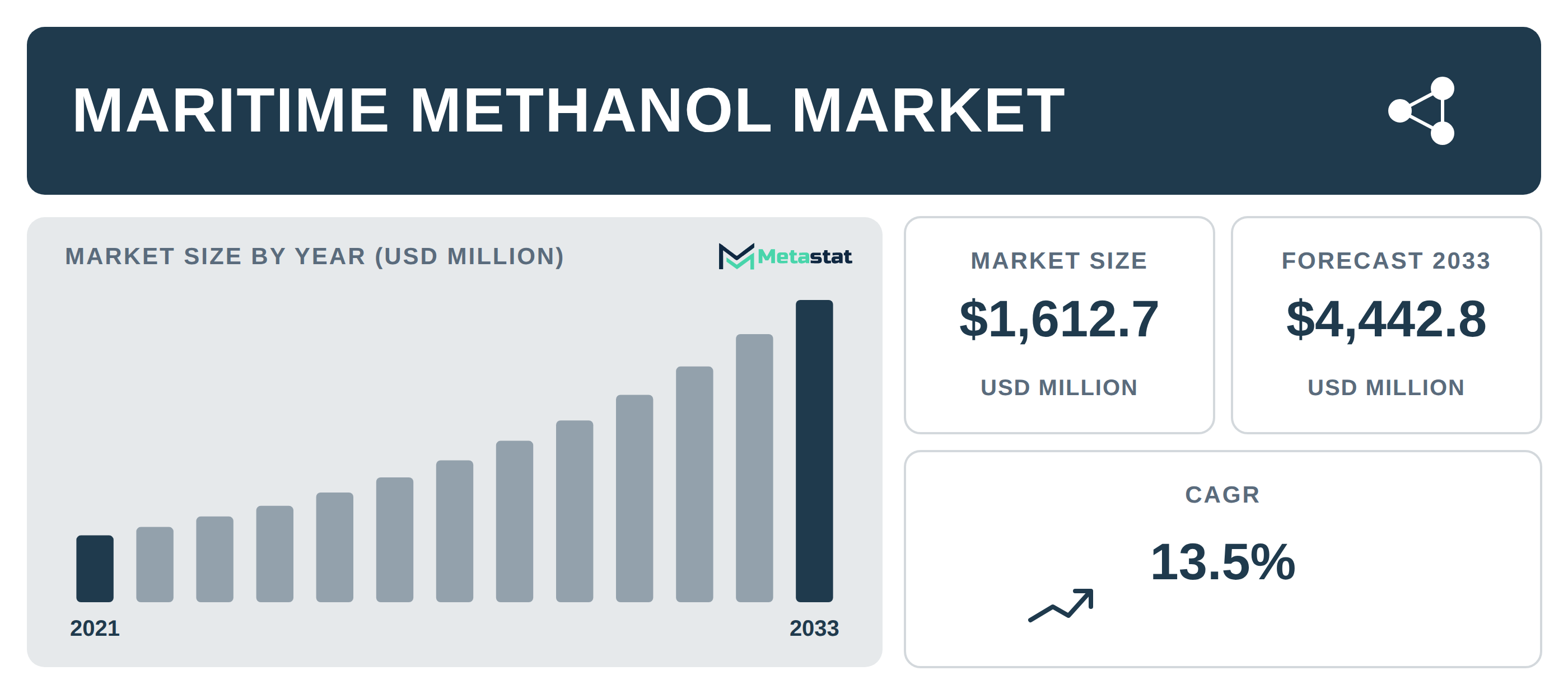
Metastat Insights reveals the Maritime Methanol market's growth trajectory, expected to increase from USD 1,612.7 million in 2025 to USD 4,442.8 million by 2033, with a CAGR of 13.5%. The report details key drivers, challenges, market segmentation, and competitive landscape.
Metastat Insights has published "Global Maritime Methanol Market Size, Share, By Type (Conventional Fossil-Based Methanol, Blue / Low-Carbon Methanol, Bio-Methanol, E-Methanol), By Vessel Type (Container Ships, Tankers, Bulk Carriers, Ro-Ro & Ro-Pax / Ferries, Cruise & Passenger Ships, General Cargo & Multipurpose Vessels, Offshore & Service Vessels, Others (Tugs, Inland Waterway Vessels, Fishing Vessels)), Industry Analysis, Growth, Trends, and Forecast, 2026-2033", followed by the headline figures (USD 1,612.7 million in 2025, USD 4,442.8 million by 2033, 13.5% CAGR).
Demand for sustainable fuel alternatives significantly impacts the Maritime Methanol market. Stricter emission regulations and environmental standards compel shipping operators to transition towards alternative fuels, including methanol, recognized for its reduced carbon emissions compared to conventional fuels. Investments directed toward low-carbon technologies and infrastructure enhancements further facilitate this shift, enabling improved production and distribution capabilities for methanol. Regional stakeholders increasingly prioritize sustainability, aligning operations with global environmental objectives, which promotes market growth and investment in this sector.
High capital investment requirements present a notable obstacle for smaller companies entering the Maritime Methanol market. Initial expenses related to establishing methanol production facilities and associated infrastructure often exceed projections, limiting participation from these smaller entities. Fluctuating raw material prices and rising operational costs amplify pressure on profit margins, particularly affecting smaller players. Technological obsolescence constitutes another challenge, because companies invest in ongoing innovation to maintain competitive viability.
The Maritime Methanol market is categorized by type into Conventional Fossil-Based Methanol, Blue / Low-Carbon Methanol, Bio-Methanol, and E-Methanol. It is segmented by vessel types, including Container Ships, Tankers, Bulk Carriers, and other categories. The Asia-Pacific region leads the market, capturing a substantial share owing to robust industrial activity and a commitment to cleaner energy sources. Europe closely follows, driven by stringent regulatory frameworks and a dedication to sustainability, while North America anticipates growth spurred by infrastructure investments aimed at supporting these transitions.
Several companies actively influence the Maritime Methanol market. Key players include Methanex Corporation, Proman AG, Equinor ASA, and European Energy A/S, among others. These firms concentrate on enhancing production capabilities and integrating low-carbon solutions into their operations. Strategic collaborations and partnerships among these significant players further bolster their market positions and facilitate advancements in methanol technologies.
For more in-depth analysis and insights, read the full report on the Global Maritime Methanol Market.
Related Report
Global Maritime Methanol MarketLEAD ANALYST
Utkarsh Khirodkar is a Lead Market Research Analyst at MetaStat Insight, specializing in market intelligence, technology sector assessments, and competitive strategy.

ENERGY & INFRASTRUCTURE INDUSTRY CONSULTANT
Automotive and Transportation · Electronics and Semiconductor · Energy and Power · Machinery & Equipment
Saurabh Vasant Ganvir consults for Energy & Infrastructure Industry at MetaStat Insight, specializing in renewable energy, solar EPC, and electric vehicle (EV) infrastructure markets.