
According to the latest comprehensive market analysis released by MetaStat Insight, the Global Medical Enclosures Market is poised for substantial expansion over the next decade. Valued at USD 4.7 billion in 2025, the industry is anticipated to compound at a CAGR of 7.8% during the forecast period (2026–2033), eventually expanding to USD 8.6 billion by 2033.
Medical enclosures play a vital role across healthcare settings by providing secure, protective housing for sensitive medical instrumentation and bio-materials. These specialized housings safeguard critical devices ranging from diagnostic tools like surgical instruments, blood/sugar meters, and operating room equipment to specialized units used for organic tissue transport.
Key Market Drivers & Innovation Trends
Technological advancements remain the primary engine powering growth across the medical enclosure sector. Modern healthcare demands have accelerated the creation of specialized protective housings tailored to complex medical applications.
Innovations such as TransMedics' Organ Care System (OCS) utilize pressure-formed, clear polycarbonate enclosures to enable continuous visual observation while protecting living organs during multi-thousand-mile transports. Similarly, manufacturers like OKW Gehäusesysteme have pioneered space-saving options like the EVOTEC 100, built to withstand demanding clinical and laboratory environments. Further expanding versatility, plastic electronic enclosures such as the SMART-CONTROL series enable wall, ceiling, or desktop installation across IoT, sensor, and laboratory technology systems. Modern developments also focus on hygiene, exemplified by UV-Concepts’ automated UV-C Enclosure (UVE), which integrates cloud-based process management and digital tracking to enhance sanitization for portable medical equipment.
Market Challenges vs. Emerging Opportunities
While technological gains spur momentum, regulatory adjustments introduce occasional industry hurdles. For example, regulatory actions such as the U.S. FDA’s revocation of emergency use authorizations for specific protective barrier enclosures highlight the necessity for strict, long-term compliance. Nonetheless, supportive government policies and funding initiatives targeting specialized medical housing development continue to unlock lucrative avenues for industry stakeholders.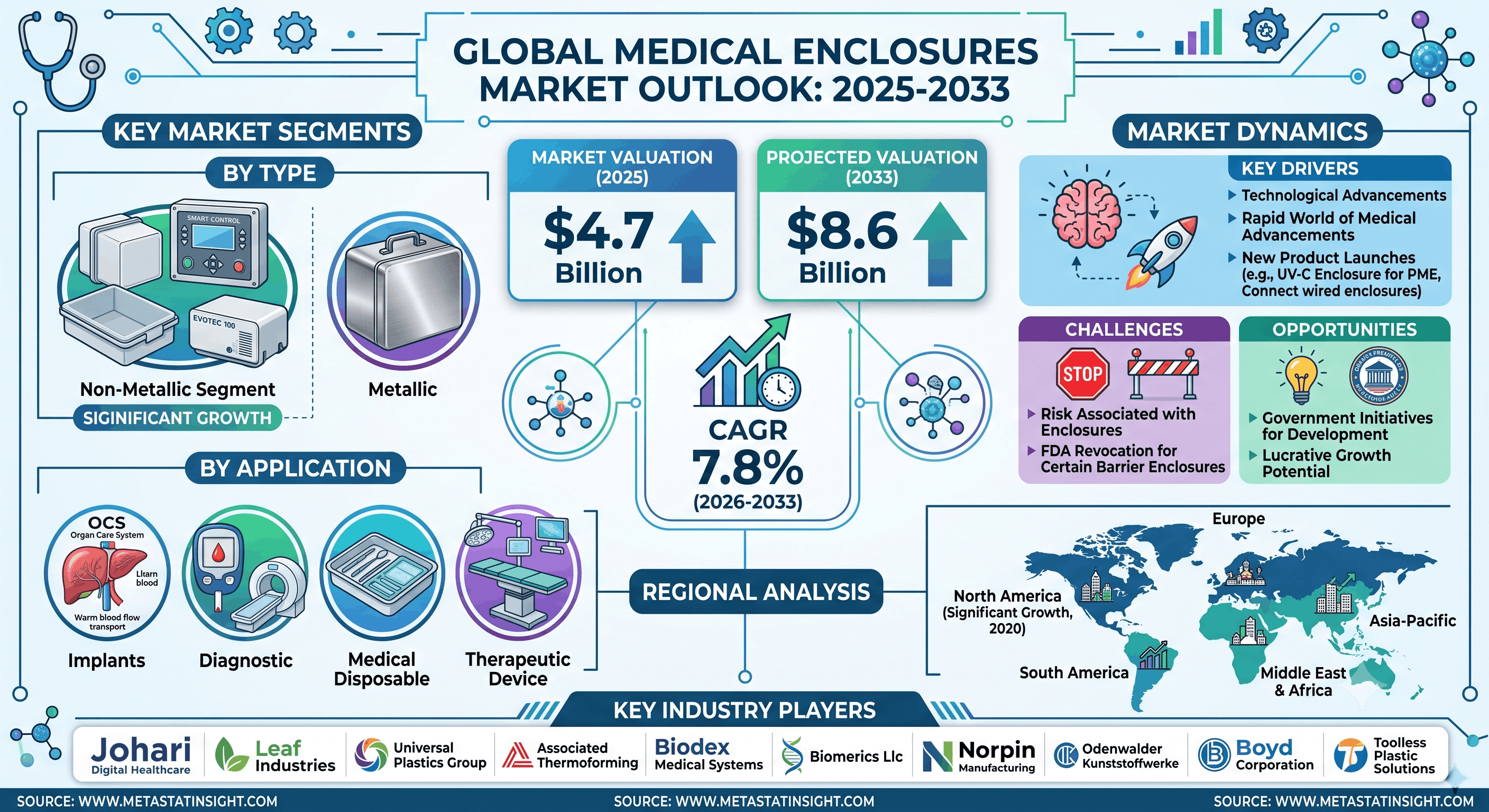
Market Segmentation Summary
The report categorizes the global medical enclosures industry across two main structures:
-
By Type: The market is divided into Metallic Enclosures and Non-Metallic Enclosures. The non-metallic segment showed notable traction driven by material innovations, regulatory approvals, and multi-industry collaborations spanning medical, laboratory, and environmental controls.
-
By Application: Segmented into Implants, Diagnostic Equipment, Medical Disposable Equipment, and Therapeutic Device Units.
Regional Insights & Competitive Landscape
North America continues to demonstrate robust growth momentum, supported by swift regulatory approvals, significant investment in content-protection technologies, and frequent new product rollouts. Beyond North America, the market report encompasses exhaustive regional analyses across Europe, Asia-Pacific, South America, and the Middle East & Africa.
Industry participants are actively leveraging strategic partnerships, non-screw ergonomic designs (such as OKW's dual-shell Connect wired series), and continuous product innovation to consolidate their positions. Key enterprises highlighted in the industry evaluation include Johari Digital Healthcare Ltd., Leaf Industries Inc., Universal Plastics Group, Inc., Associated Thermoforming Inc., Biodex Medical Systems, Biomerics LLC, Norpin Manufacturing Co. Inc., Odenwälder Kunststoffwerke Gehäusesysteme GmbH, Boyd Corporation, and Toolless Plastic Solutions, Inc.
About MetaStat Insight
MetaStat Insight is a market research and consulting firm delivering market intelligence reports across global industries. Our research offerings provide decision-makers with quantitative and qualitative analyses, competitor benchmarking, and growth forecasting.
Related Report
View full market research reportAbout the Authors

LEAD ANALYST
Utkarsh Khirodkar is a Lead Market Research Analyst at MetaStat Insight, specializing in market intelligence, technology sector assessments, and competitive strategy.

LEAD PRINCIPAL ANALYST, PHARMA AND HEALTHCARE
Food and Beverages · Healthcare · Healthcare IT · Medical Devices
Ajay Devgire is the Lead Healthcare Analyst at MetaStat Insight, leading strategic research and market intelligence initiatives across the global healthcare domain.

SENIOR RESEARCH ANALYST
Biotechnology · Food and Beverages · Medical Devices · Packaging
Snehal Pasalkar is a Research Analyst at MetaStat Insight, operating at the intersection of life sciences research, competitive strategy, and market intelligence.