
LEAD ANALYST
Utkarsh Khirodkar is a Lead Market Research Analyst at MetaStat Insight, specializing in market intelligence, technology sector assessments, and competitive strategy.

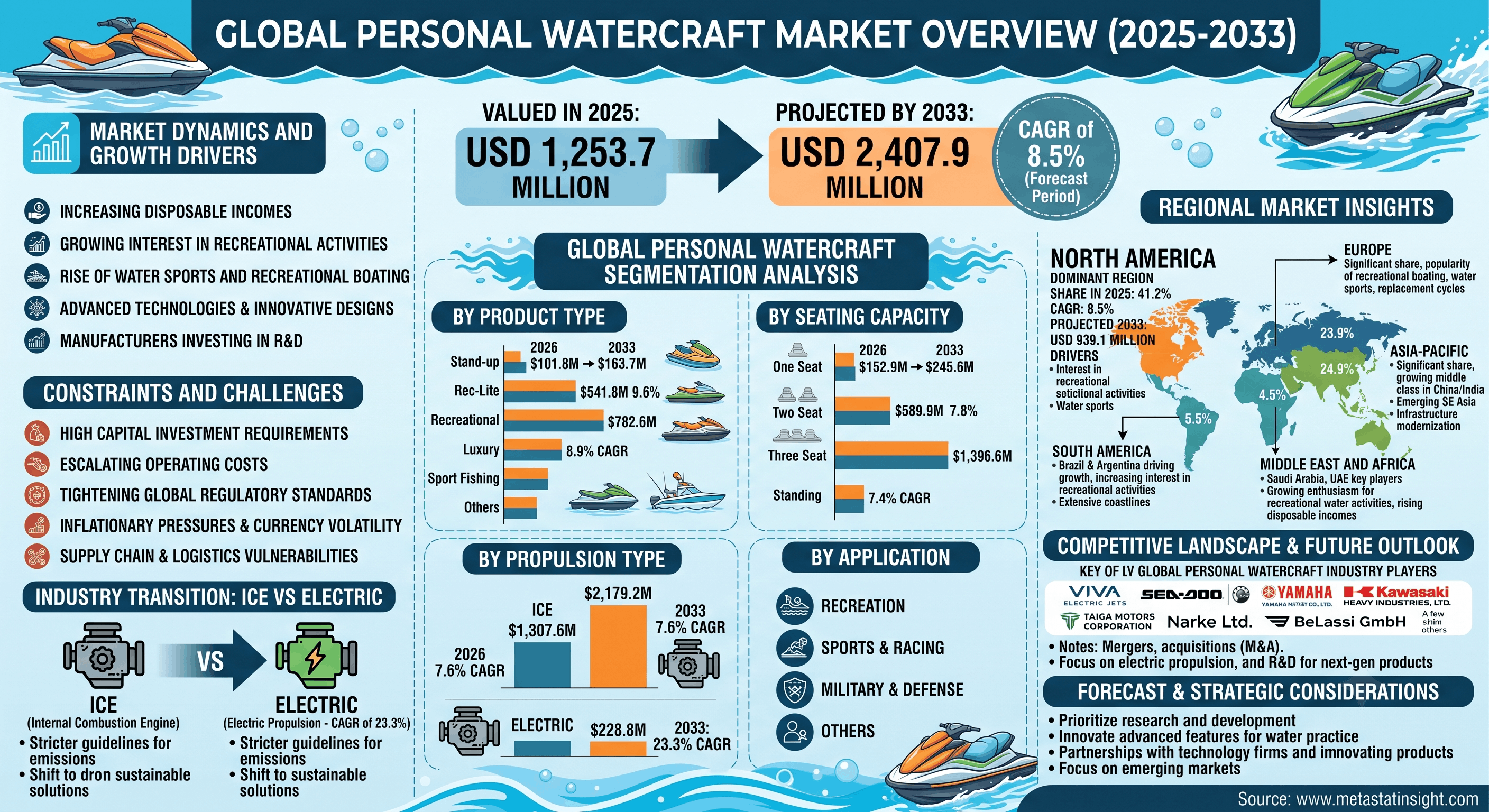
Metastat Insights' latest report reveals the Personal Watercraft market's anticipated growth from USD 1.25 billion in 2025 to USD 2.4 billion by 2033, driven by rising consumer demand and innovative technologies.
Metastat Insights has published "Global Personal Watercraft Market Size, Share, By Product Type (Stand-up Personal Watercraft, Rec-Lite, Recreational, Luxury, Sport Fishing and Others), By Seating Capacity (One Seat and Two Seat), By Propulsion Type (ICE and Electric), By Application (Recreation and Sports & Racing), Industry Analysis, Growth, Trends, and Forecast, 2026-2033". The report indicates that the market was valued at USD 1,253.7 million in 2025 and is projected to achieve USD 2,407.9 million by 2033, reflecting a compound annual growth rate (CAGR) of 8.5%.
Several factors contribute to the strong growth of the Personal Watercraft market. An increase in disposable incomes has prompted more consumers to invest in recreational activities, driving demand for personal watercraft. A rising interest in water sports and recreational boating also enhances market dynamics. Manufacturers are focusing on developing innovative designs and advanced technologies to attract consumers seeking better performance and features. In North America, where the market share is substantial, a culture of water sports supports strong growth. The United States leads this trend, exhibiting a notable preference for personal watercraft for both recreational use and competitive sports.
Despite the promising growth, the Personal Watercraft market faces challenges related to regulatory compliance. Manufacturers must adhere to stringent safety and environmental regulations, which can influence product development strategies and operational costs. In North America, for instance, strict emissions standards compel manufacturers to invest significantly in compliance measures. Additionally, the high capital investment required for advanced manufacturing technologies presents a barrier that can limit the expansion of existing players and deter new entrants.
The market is divided into categories based on product type, seating capacity, propulsion type, and application. By product type, key categories include stand-up personal watercraft, Rec-Lite, recreational, luxury, and sport fishing. The one-seat and two-seat segments cater to different consumer preferences, with the one-seat segment projected to reach USD 245.6 million by 2033. The internal combustion engine (ICE) segment, valued at USD 1,307.6 million in 2026, will grow at a CAGR of 7.6%. Meanwhile, electric personal watercraft, projected to expand at a remarkable CAGR of 23.3%, reflects a significant shift toward sustainable options.
 Who competes in the market
The competitive environment of the Personal Watercraft market features established brands and emerging players. Prominent companies include BRP Inc., Yamaha Motor Co., Ltd., and Kawasaki Heavy Industries, Ltd., which maintain considerable market share with their extensive product ranges. Emerging players like Taiga Motors Corporation and Viva Electric Jets focus on innovative electric models to meet the growing demand for eco-friendly alternatives. This sector is characterized by ongoing product innovation, as companies adapt to changing consumer preferences and regulatory challenges.
Readers can explore the full findings and insights in the complete report: Global Personal Watercraft Market.
Related Report
Global Personal Watercraft MarketLEAD ANALYST
Utkarsh Khirodkar is a Lead Market Research Analyst at MetaStat Insight, specializing in market intelligence, technology sector assessments, and competitive strategy.

ENERGY & INFRASTRUCTURE INDUSTRY CONSULTANT
Automotive and Transportation · Electronics and Semiconductor · Energy and Power · Machinery & Equipment
Saurabh Vasant Ganvir consults for Energy & Infrastructure Industry at MetaStat Insight, specializing in renewable energy, solar EPC, and electric vehicle (EV) infrastructure markets.