
LEAD ANALYST
Utkarsh Khirodkar is a Lead Market Research Analyst at MetaStat Insight, specializing in market intelligence, technology sector assessments, and competitive strategy.

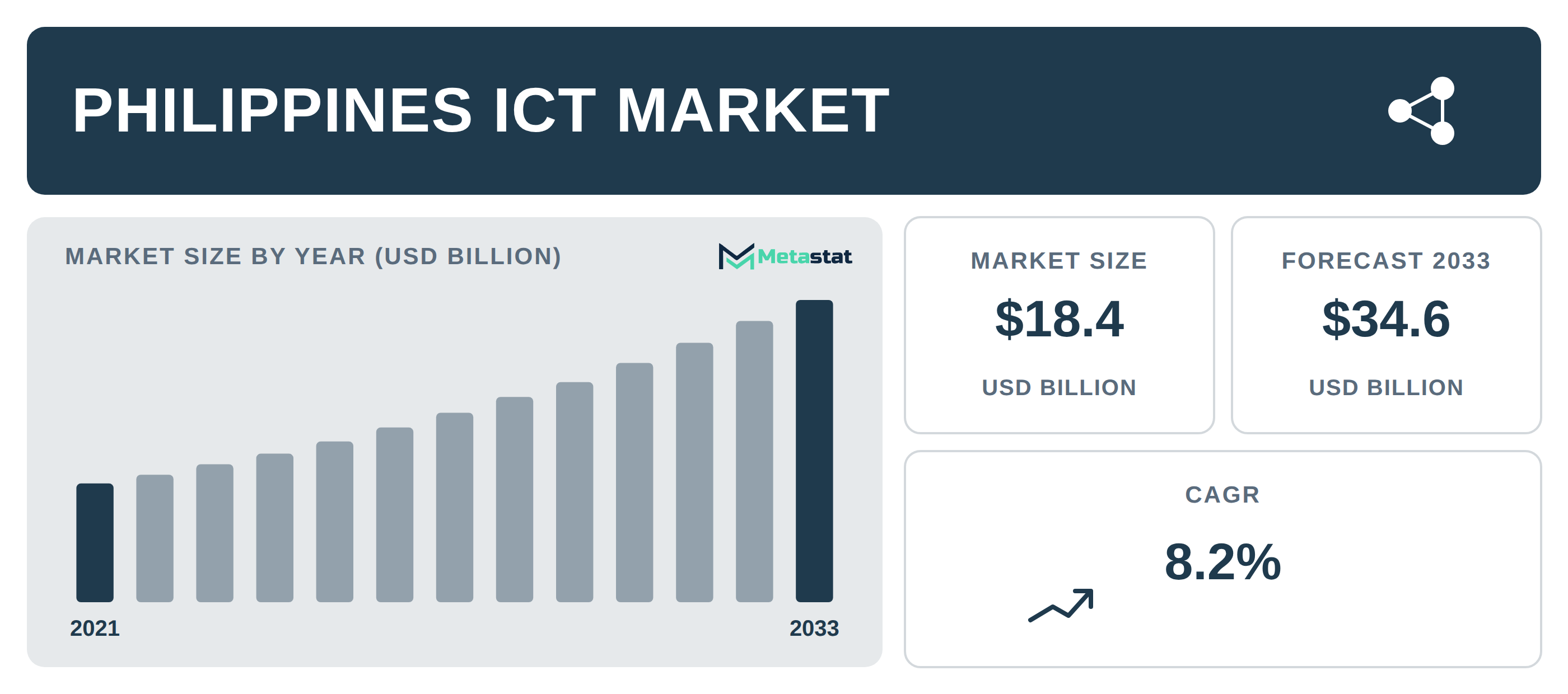
Metastat Insights has released a report detailing the Philippines ICT market, forecasting growth from USD 18.4 billion in 2025 to USD 34.6 billion by 2033, with a CAGR of 8.2%. It examines market dynamics, segmentation, and key players.
Metastat Insights has published "Philippines ICT Market Size, Share, By Offering (IT Hardware, IT Software, IT Consulting and Implementation, IT Outsourcing (ITO), Business Process Outsourcing (BPO), Managed Security Services, Cloud and Platform Services, IT Infrastructure, IT Security/Cybersecurity, Communication Services), By End-User Sector (Households & Individual Consumers, BFSI, IT-BPM & Professional Services, Retail & E-commerce, Manufacturing, Government & Public Administration, Healthcare, Education, Energy & Utilities, Others (Transportation & Logistics, Hospitality, Media & Entertainment, Agriculture)), By Organization Size (Large Enterprises, Mid-Sized Companies, Small Businesses), Industry Analysis, Growth, Trends, and Forecast, 2026-2033", followed by the headline figures (USD 18.4 billion in 2025, USD 34.6 billion by 2033, 8.2% CAGR).
The expansion of the Philippines ICT market is largely fueled by the ongoing digital transformation across numerous sectors. Organizations increasingly focus on integrating sophisticated technologies to enhance operational efficiencies and satisfy changing consumer expectations. Investment in digital solutions is vital for businesses striving to remain competitive in a swiftly evolving landscape. For instance, the banking, financial services, and insurance (BFSI) sector exhibits a significant commitment to adopting advanced technologies that improve customer service and streamline transactions, with a projected compound annual growth rate (CAGR) of 9.1% through 2033.
Regulatory compliance emerges because a significant challenge affecting the growth of the Philippines ICT market. Stringent regulations and compliance obstacles impose additional costs on businesses, frequently hindering essential technology upgrades and innovations. Companies contend with intricate regulatory frameworks, particularly in the realms of data protection and cybersecurity, complicating compliance efforts. Economic factors, including inflationary pressures and rising operational expenses, further restrict investment in ICT solutions, compelling organizations to prioritize short-term financial survival over long-term technological advancements.
The Philippines ICT market is categorized by offering, end-user sector, and organization size. Major segments include Business Process Outsourcing (BPO), which holds a dominant position with a 31.7% market share, followed by Communication Services at 26.3%. The IT Software segment is anticipated to exhibit the highest growth potential, with a projected CAGR of 9.9% through 2033. Key end-user sectors encompass households and individual consumers, which are expected to grow from USD 5.5 billion in 2026 to USD 8.3 billion by 2033, translating to a CAGR of 6.2%.
Significant companies operating in the Philippines ICT market include Accenture, Teleperformance SE, TELUS International, PLDT Inc, Globe Telecom, Inc, Converge Information and Communications Technology Solutions, Inc, and Huawei Technologies Co, Ltd. These firms contribute to a competitive environment characterized by innovation and differentiation, enabling niche players to flourish alongside established companies.
For a comprehensive analysis and detailed insights, readers are invited to explore the full report: Philippines ICT Market.
Related Report
Philippines ICT MarketLEAD ANALYST
Utkarsh Khirodkar is a Lead Market Research Analyst at MetaStat Insight, specializing in market intelligence, technology sector assessments, and competitive strategy.

PRINCIPAL CONSULTANT - ENTERPRISE AI & EMERGING TECHNOLOGIES
Banking & Finance · Electronics and Semiconductor · Energy and Power · Healthcare IT · Information & Technology · Professional Services
Vijay Gunti is a Principal Consultant at MetaStat Insight, bringing over two decades of experience across enterprise digital transformation, technology strategy, and intelligent systems.

LEAD CONSULTANT - COMMUNICATION, TELECOM, AND IT
Electronics and Semiconductor · Information & Technology · Machinery & Equipment · Professional Services
Ravindra Sathe Consultants for Communication, Telecom, and IT at MetaStat Insight. He leads the firm's industry research initiatives across telecommunications infrastructure, digital connectivity, enterprise networking, and emerging information technology domains.